Everywhere you look these days, people seem to be talking about the youth. The youth have it pretty bad. They have sky high rents and miniscule wages because young people don’t vote for neoliberal capitalists, but neoliberal capitalists have all the power. They have to work harder than any previous generation because all the older generations left them so much stuff to do. They have a dying planet they have to work out how to save, because all the older generations loved fossil fuels too much and didn’t like the thought of doing anything differently. So, they’ve got a lot on their plate.
But of course we also know that young people – “Generation Y” or “Millennials” – are self-entitled, arrogant, lazy and prone to whining about the fact that they have no jobs, no prospects, nowhere to live, etc. etc.
And we also know that the youth “are the future” (to quote every school head teacher). And millennials are being more than a little disruptive to the way businesses and government try to deal with everything.
All of which is good advice probably/possibly/maybe not/definitely not/what are you talking about that’s not good advice? (delete as appropriate to your world view and current living circumstances).
Yet when there is such a plethora of advice out there, it can be hard to work out exactly what to do, especially for aspiring creatives. Which articles should writers, artists, photographers, illustrators, comedians and just normal members of Gen Y pay attention to? Which should they ignore?
Our advice? Ignore all of them. None of them say anything that hasn’t been said before (even this hasn’t been said before; Thucydides beat us to that almost 2.5 thousand years ago).
More importantly, none of them say anything better than a recently unearthed 350 year old book in North Staffordshire.
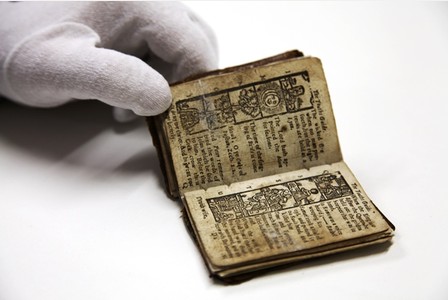
The leather-bound book, currently held at Keele University Library, was first published in 1667 – one year after the Great Fire of London. Titled A Guide for the Childe and Youth, it’s target demographic is perhaps a little younger than the twenty-somethings currently stepping out blinking into a world spiralling toward economic, humanitarian and environmental disaster. Yet the book still teaches valuable life skills that the cash-strapped, asset-poor Millennial could do with knowing.
Indeed, the book’s several chapters on “How to work out a sum of money and count up the pence” are probably of far more practical use to the youth of today than Guardian advice columns telling them to “fall in love 10 times a day, or at least have sex”.
Fortunately, Millennials won’t have to travel to Keele University Library to check out the sole existing copy of this marvellous little book. The university is planning to make A Guide for the Childe and Youth digitally accessible, so Millennials can read advice on how to prepare for “a life of trade-based work” on their smartphones as they commute to their unpaid internships.
Disappear Here is a project that aims to bring together nine writers and nine film-makers to make a series of films about the Coventry ringroad. We are currently crowdfunding start-up support to get the project off the ground and, to-date, we are almost half-way to our target figure of £1000.
The challenge of Disappear Here is to bring together artists of different stripes, some more experienced practitioners, others up and coming and hungry; native Coventrians and people who might be coming to the city for the first time and seeing it with fresh eyes; expressing the human aspect of what is so commonly seen as an inhuman structure, another one of HRH Charles’ “concrete monstrosities” – by way of contrast, witness the faux-Kensington banality of his ideal housing estate, Poundbury – but it is also fair to say that few near-monolithic concrete structures inspire such intense feelings of love and loathing.
But there is a positivity to the project. As much as it is anything, Coventry Ringroad is an archetype of reinvention. Each time the same A4053 road, but every journey around it different. It is the eye through which Coventry is (notoriously) seen, and can be seen, from above and below; a looping horizon where tarmac sea and brilliant blue sky meet and form a sinew of shuffling perspective. Here is one of the first videos we created a test-run for the Disappear Here concept – Antony Owen – The Dreamer of Samuel Vale House:
Having spent many hours, day and night, circumnavigating (traipsing about) Coventry ringroad, I became fascinated with its welcoming overhang of proud underbelly. The swell of concrete, the gross lump of potential energy as mass is a perpetual question – round and round, enacting flux, but arriving at no answer, generating only questions.
Photography by Adam Steiner.
Coventry is an ex-working-class city, chock-full with post-industrial grit from crumbling fire of red brick, after many of its 70s, 80s and 90s industries successively closed down. As such, the city has become an affordable and welcoming haven for artists with a burgeoning community of creative and socially-conscious practitioners – there is a story to be told there. I think the people and the city’s physical attitudes speak to this, guarded but protective. As both defensive wall and encircling stranglehold – the ringroad echoes this taut insularity, but also provides us with a blank canvas for reimagining public space. I think this push/pull reflex makes for an interesting tension as to how we define a city and its search for its centre.
It’s an irony that the creation of the ringroad brought about a series of displacements (the least of which being the destruction of the childhood home of errant Coventrian poet, Philip Larkin, more rightly, of Hull) that sought to unite and focus the city as shopping precinct, promenading arcades and preservation of ruins and sites of heritage, including the Coventry Baths Elephant, a modernist beast of epic girth that was sadly not granted listed status and is due for demolition.
Photography by Adam Steiner
But in place of fear, new generations of artists, eager to look beyond the apparent greyness of concrete, swept-up in the internationaliste fervour of post-Situationist post-Ballardian psychogeographic dogma that has voraciously absorbed hipsters/Brutalism/Iain Sinclair/The Guardian/Shoreditch wankers/Will Self with gruff uniformity of common interest – thus what’s brute is automatically beautiful (Milton Keynes?) – but each will have their own stories to tell – whether they are born-and-bred citizens, London ex-pats, outsiders or newly-arrived to the city (unlike other UK centres, Coventry has a strong reputation for inclusively welcoming and embracing immigrants and refugees a la Two-Tone). There is an argument that the self-loving lust of interstices and abandoned spaces (ruin porn) has become insular and in its own way alienating, which is where Disappear Here has a fresh perspective around urban space, to aggravate as much as analyse the good, the bad and the less deceived of Coventry ringroad.
As Larkin identifies in his poem, Here, so many modern cities share a history and formation of modernist town centres as well architectural and town-planning follies, such that they could be mistaken for one another. For me, this makes many themes of Coventry ringroad universal to citizens across the UK (and the rest of the world), both as physical space and in the social make-up and attitudes of its population. In spite of its relatively small size, Coventry is one of the most diverse cities in the UK which is something to embrace in the relatively niche world of poetry films; an emerging medium that is highly adaptable in creating impressionistic, conceptual films, or more straightforward narrative performances, often clocking-in at under 5 minutes. The mercurial nature of a written poem then read or performed alongside visuals is actually a highly-accessible medium as it breaks down barriers of language and can be enjoyed on many levels.
So, if you want to see alternative histories, new beginnings and the creation of unique poetry/film collaborations about Coventry ringroad (and future cities) please support the fundraising campaign, submit your pitches once the project is launched and SHARE and disseminate our propaganda:
Disappear Here is a project created by Adam Steiner, an artist who co-founded the Coventry-based not-for-profit publisher, Silhouette Press and Here Comes Everyone magazine back in 2012, as well as holding various literary events across Coventry, including the Fire & Dust poetry open-mics at The Big Comfy Bookshop (Fargo).
Giving up five chapters into a book? You’re not alone. Newly published data by Jellybooks shows that 90% of people reading e-books gave up after only five chapters.
Jellybooks, a reader analytics company based in London, mined troves of data collected from e-books to discover more about the reading habits of “e-readers”.
The company is hoping to sell its analytics work to publishers, helping them produce books their readers read from cover to cover (and not abandon 50 pages in).
While readers of traditional print books can read how they want, when they want, as much as they want and where they want without being tracked by a profiteering corporation, readers of e-books are not so fortunate, as Jellybooks can track your reading behaviour in the same way Netflix knows what you binge-watch and Spotify knows what you listen to (and what you don’t).
But it’s not all bad news for fans of e-books. Jellybooks offers readers a group of free e-books, often before publication. Rather than asking readers to review these books, it tells them to click on a link embedded in the e-book that will upload all the information the device has recorded.
It is this information that shows analysts what books people are reading, when they are reading, and how long they spend reading. It tells them how far readers make it through a book and how quickly they read, among other details.
The process resembles how e-book retailers, like Amazon, Apple, and Barnes & Noble, are able to track reader trends by looking at data stored in e-reading devices and apps. Therein lies the less good news for fans of e-books; as Amazon et al are getting all their valuable data and information automatically, with no need to offer readers a free e-book in exchange for their data.
The service offered by Jellybooks could prove invaluable to major publishing houses whose focus lies in traditional print publishing. Yet initial published research may prove hard reading for publishers.
The majority of readers, it turns out, finish fewer than half the books they are given to read. Women are the most persevering of readers; typically lasting between 50 – 100 pages before they give up on a text, while men are much quicker to judge; quitting after just 30 or so pages.
What does this mean for the book industry?
As this New York Times article noted, publishers can use the findings of Jellybook’s data to shape their marketing plans; withdrawing funding from books that readers don’t like, and putting it into books that readers love.
Yet for writers, there may be concern that publisher’s editorial decisions will increasingly be informed by metrics and data, which may somewhat miss the point of what literature is actually for. What is more, the readers who participate in data studies like those conducted by Jellybooks may be unrepresentative of the real, “average reader”. And writers may also fear the relatively small sample sizes of Jellybook’s studies – of groups between 200 and 600 readers – may distort the picture and misrepresent the reactions of a more general, larger audience.
Readers may not feel comfortable with the Big Brother image of some unknown figure essentially reading over their shoulders. While those that sign up for Jellybooks actively consent to having their data tracked in exchange for free e-books, the worry surely comes from the knowledge that e-book retailers like tax-dodging Amazon are doing this – and have been doing this – relatively under the radar, and without getting any direct consent from the readers they are monitoring.
The NYT article points out that “regular e-book readers might not realise that digital retailers are recording and storing their data.” Yet is this necessarily surprising? In our increasingly heavy digital world, analytics and data are transforming the way companies operate. We might not like the thought, as human beings, of being reduced to a set of numbers and percentages, yet we don’t seem inclined to do very much about it.
Of course, while fans of TV series and music may have to accept that their every action is being watched as they stream shows and songs, book fans don’t have to worry: as there is a very real and simple alternative to the e-book.
The humble print book has been with us for generations. And it still does a pretty good job. As the author Jonathan Franzen said: “The technology I like is the American paperback edition of Freedom. I can spill water on it and it would still work! So it’s pretty good technology. And what’s more, it will work great 10 years from now. So no wonder the capitalists hate it. It’s a bad business model.”
“Maybe nobody will care about printed books 50 years from now, but I do. When I read a book, I’m handling a specific object in a specific time and place. The fact that when I take the book off the shelf it still says the same thing – that’s reassuring.”
“Someone worked really hard to make the language just right, just the way they wanted it. They were so sure of it that they printed it in ink, on paper. A screen always feels like we could delete that, change that, move it around. So for a literature-crazed person like me, it’s just not permanent enough.”
Many of us will have been party to debates that attempt to define the purpose of the artist and the creative works they produce. How useful is literature? What is it for? What is the purpose of writing? What is the point of art?
Few of us will have participated in such thorough debates as the one held between two giants of literature a century ago.
Wells vs James: fight (with words)!
Indeed, in 1915, Henry James and H.G. Wells, both men champions of free speech, both known for their social commentaries and strong political views (James is often described as a reactionary and social conservative; Wells described himself as a socialist), and both were absolutely committed to contrasting opinions on the purpose of art and literature.
These differences in opinion are, fortunately for us, preserved to this day thanks to the written word the two men argued so much about. Indeed, it is fascinating to see captured in written form a division within creative culture and between creative practitioners that continues to this day.
James first wrote to Wells in friendship – declaring his admiration for the emerging writer and telling him he was “the most interesting ‘literary man’ of your generation; in fact the only interesting one”. Yet James, who had previously described the act of creativity as being “an intimate restlessness of projection and perception”, soon changed his tune as he realised that Wells – a trained biologist known best for his science fiction – considered himself more than anything a journalist, and measured writing by its usefulness and practicality.
In 1915, these core differences were laid bare a year before James’s death, when Wells published a satirical novel – Boon – in which he parodied James’s writing and caricatured his writing style as a hippopotamus trying to pick up a pea in a corner. Wells argued that James “never discovered that a novel isn’t a picture … that life isn’t a studio.”
Had one artist attacked another with such a sideswipe in today’s digital culture, we might expect an instant, albeit brief and perhaps less-than-dignified rebuttal, from the accused via Twitter. However, in 1915, James took the time that so often seems absent in today’s Instaworld to compose a much more considered defense using the timeless, humble medium of the postal letter. Within this letter, James argues that the artist is ultimately beholden only to one measure of success and purpose: the “fullness of life and the projection of it, which seems to you [Wells] an emptiness of both.”
Wells responded thoroughly. The pragmatist to James’s creative idealism:
“To you literature, like painting, is an end, to me literature like architecture is a means, it has a use. Your view was, I felt, altogether too prominent in the world of criticism and I assailed it in lines of harsh antagonism. And writing that stuff about you was the first escape I had from the obsession of this war. Boon is just a waste-paper basket. Some of it was written before I left my home at Sandgate (1911), and it was while I was turning over some old papers that I came upon it, found it expressive, and went on with it last December. I had rather be called a journalist than an artist, that is the essence of it, and there was no other antagonist possible than yourself. But since it was printed I have regretted a hundred times that I did not express our profound and incurable contrast with a better grace.”
Despite Wells’s wish that the two authors might express their differences with “better grace”, James took affront and responded in outrage. He forthrightly condemns Wells’s view that writing and literature must be, above all else, created for a specific purpose:
“My Dear Wells
[…]
Your comparison of the book to a waste-basket strikes me as the reverse of felicitous, for what one throws into that receptacle is exactly what one doesn’t commit to publicity and make the affirmation of one’s estimate of one’s contemporaries by. I should liken it much rather to the preservative portfolio or drawer in which what is withheld from the basket is savingly laid away.
[…]
I have no view of life and literature, I maintain, other than that our form of the latter in especial is admirable exactly by its range and variety, its plasticity and liberality, its fairly living on the sincere and shifting experience of the individual practitioner. That is why I have always so admired your so free and strong application of it, the particular rich receptacle of intelligences and impressions emptied out with an energy of its own, that your genius constitutes… For myself I live, live intensely and am fed by life, and my value, whatever it be, is in my own kind of expression of that.”
James concludes his rebuttal with a final retort against the notion of art as some perfunctory thing.
“I absolutely dissent from the claim that there are any differences whatever in the amenability to art of forms of literature aesthetically determined, and hold your distinction between a form that is (like) painting and a form that is (like) architecture for wholly null and void. There is no sense in which architecture is aesthetically “for use” that doesn’t leave any other art whatever exactly as much so; and so far from that of literature being irrelevant to the literary report upon life, and to its being made as interesting as possible, I regard it as relevant in a degree that leaves everything else behind. It is art that makes life, makes interest, makes importance, for our consideration and application of these things, and I know of no substitute whatever for the force and beauty of its process. If I were Boon I should say that any pretence of such a substitute is helpless and hopeless humbug; but I wouldn’t be Boon for the world, and am only yours faithfully,
Henry James”
Where do you stand on the debate between James and Wells? What is the purpose of art? What is the purpose of the writer? Let us know in the comments below!
Long before we had smartphones, laptops and the seemingly limitless expanse of the internet, libraries were the place to go when you wanted to learn everything about anything. Yet seemingly gone are the days when libraries would be crammed full of students desperately trying to fill their minds with knowledge when exam week came about, or entrepreneurs with new business ideas would roam around the business section gathering scraps of knowledge from each book, collecting notes as they went. An aspiring pilot now doesn’t have to go out of his way and make it to the Aviation section to pore over books on the history of flight and aerospace design.
You get the point…
Despite these changing times, libraries remain a magical place. Loved by so many, they have drawn praise from artists, writers, scientists, politicians – described by astronaut Neil Armstrong as being fundamental to all human achievement. Part of their power surely lies in what they represent: infinite knowledge stacked up high on shelves, labyrinths of books, enough to overwhelm even the most diligent imagination – knowing that each and every weighty tome was produced with love, care and passion by the author. And all this accessible for free, through the awesome power of the humble library card.
Below, we’ve compiled a list of a few interesting and unique libraries from across the world. In no particular order, we hope they inspire you.
Trinity College Library – Dublin
Trinity College Library – photo by Max, via Flickr
Located in the heart of Dublin, and the walls of it’s prestigious college, lies the Trinity College Library. A place which instils wisdom, inspires the artist and motivates the architect. Built back in 1592, the structure is not only beautiful to look at, but a true marvel of architecture. The high shelves hold roughly six million volumes, ranging from Mathematical Engineering to Geology. A vast collection of maps, manuscripts, journals and sheet music are also stored. Utterly priceless.
Bedales Memorial Library
Bedales Memorial Library – photo credit George Wilson via Flickr
Designed by Ernest Gimson and Built in 1921, The building is regarded as truly one of the best Arts and Crafts building in the country and is Grade 1 listed. The vast hall, complete with small nooks and comfy cushions by the windows, high shelves covering two floors and a balcony is home to some twenty six thousand volumes, four thousand of which are said to be works of fiction. A small film was dedicated to the library, which can be found here.
Walker Library of the History of Human Imagination
Walker Library – Image Courtesy of WALKER Digital
Now this, dear reader, may be the most interesting thing you have seen all day. Perhaps all week. This ‘Library’ deserves an entire feature to itself, but to do so accurately, and to give this place any justice at all, one would need to travel there and see it in the flesh.
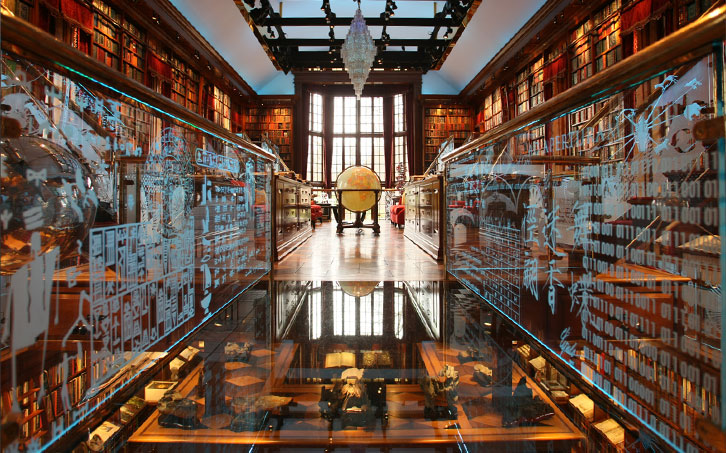
Housing not only a vast collection of somewhere in the region of 50,000 tomes, this ‘library’ is more of a museum. Tucked away in the many nooks and crannies are rare and interesting artefacts ranging from 45 million year old cat sized dinosaur fossils to a full set of glass eyes. The Russian Sputnik space probe to century old anatomical etchings. The facility is heavily inspired by invention, innovation and science with some serious Juxtaposing; An Apple II computer sat next to the first typewriter. Books bound in rubies and laced with gold are hidden away, treasures to be found only by the worthy.
Cat sized dinosaur – photo courtesy of WALKER Digital
The high walkways are glass bottomed. The illuminated, colour-changing glass panels are etched with scientific and astrological symbols and from the M.C Escher inspired maze like staircases right down to the ‘Tumbling Block’ Floor pattern – Again, M.C Escher – the true design of the place is breathtaking and enough to make your ‘jaw hit the floor’ like an old cartoon.
Unfortunately, the wonderfully designed building is an extension to Jay Walkers home in Ridgefield, Connecticut, and is subsequently off limits to the general public.
Calais Migrant Library – Livres de la Jungle
Not your traditional Library, this masterpiece was set up by British teacher, Mary Jones, who lovingly dubbed it ‘Jungle Books’.
Ms Jones began taking books up to the library a few years back, but decided she could and would do better.
Turns out, she did just that.
Since it began, she hasn’t only managed to stockpile hundreds of books, but also board games, generators and a 4G internet router. A router isn’t useful without a device to search the web – so, by popular demand, Ms Jones also managed to source a few laptops. This way, the frequent visitors to the library, which is housed in a makeshift shed, can do online research, use translations tools and even Skype loved ones. She listened to what the people of The Jungle required and delivered; making a real difference.
Ms Jones has said the library isn’t just a place for books; but a place for people. Where people with nothing can go to learn and to read. To interact and inspire themselves. It’s a place which will make life slightly more bearable for refugees fleeing their homes and countries from the devastating effects of war. Though the library is being overwhelmed with donations of books, there is emphasis on books in the native language of the refugees.
Unfortunately, recent events drove the occupants of The Jungle to set fires to their camp in an attempt to stop demolition experts from levelling the shanty town. According to Ms Jones, the fires,fed by the blowing winds, came dangerously close to the Library. She also stated that she didn’t mind taking it down if the frequent users of the library moved on and found asylum. It has served it’s purpose and she seems happy. If and when Jungle Books gets destroyed, she hopes another will be set up.
We do too.
To support Jungle Books, feel free to contact Mary Jones at maryjones@orange.fr.
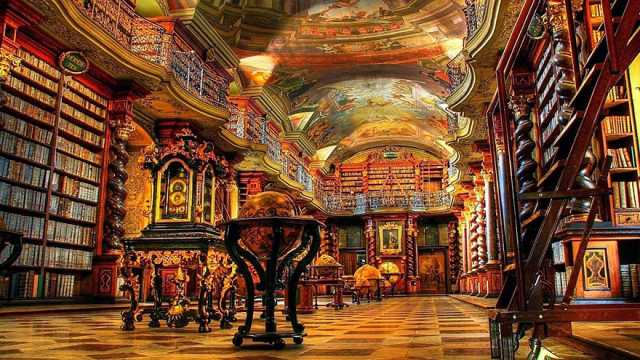
The Klementinum library – Czech Republic
Klementinum Library – photo via Disclose.TV
A true beauty, and a seemingly rare jewel hidden away in the deepest darkest depths of Prague. The Klementinum Library was opened in 1772 as the place of learning and knowledge for the Jesuit University. Jesuit being ‘Society of Jesus’. They founded schools and universities, colleges and places of research – cultural pursuits.
The fantastic and beautiful looking building houses close to twenty thousand books. Some of the rarer scripts in the native Czech language have been carefully removed and taken to to be scanned, so as to be made available to us all at a laptop near you.
The ceiling was painted by the artist Jan Hiebl, and with an astonishing level of detail, appears at first glance to be vaulted with a windowed roof. This is all a clever illusion to create the appearance of space and light; but, from the right angle, even the most diligent observer might be fooled for just a second. The beautiful varnished and spiraling shelves house a number of interesting and knowledgeable reads. A balcony on two levels overlooks the main hall, lined with ornate globes and gold leaf pillars.
This place is truly a beauty, and if you’re ever in Prague – Czech it out!
The library of the future
We’ve seen some of the magnificent places in which treasure troves of knowledge, culture and literature are housed. But where will our books be housed for future generations? In Norway, The Future Library has been set up as a 100 year project by Scottish artist Katie Paterson.
From 2014 until 2114, one writer every year will contribute a text, with the writings held in trust, unpublished for up to 100 years. Each writer has the same remit: to conceive and produce a work in the hopes of finding a receptive reader in an unknown future.
The manuscripts will be held in trust in a specially designed room in the New Deichmanske Public Library opening in 2019 in Bjørvika, Oslo. Intended to be a space of contemplation, this room – designed by the artist – will be lined with wood from the forest. The authors’ names and titles of their works will be on display, but none of the manuscripts will be available for reading – until their publication in one century’s time. The library room design is in collaboration with Lund Hagem Architects and Atelier Oslo.
Ben Garland is an aspiring writer of novels, short stories and, when he feels particularly inspired, the occasional screenplay. Based in the UK, he’s inspired by the written word on page and on screen. A blogger and news writer for Nothing In The Rulebook, Ben can be found most days and nights by his typewriter. He Tweets at @BenGarland8
Books from Nobel Prize winners Orhan Pamuk and Kenzaburo Oe are among those longlisted for the 2016 Man Booker International Prize.
The so-called “Man Booker Dozen” of 13 books in contention for the prize has now been made public. It is the first longlist ever to be announced for the Man Booker International Prize.
The Man Booker International Prize has gone through some changes recently, joining forces with the Independent Foreign Fiction Prize and now awarded annually on the basis of a single book.
The £50,000 prize will be divided equally between the author of the winning book and its translator. The judges considered 155 books, and the longlist will be narrowed down to a shortlist of six books, which will be announced on 14 April.
The eventual winner of the prize will be announced on 16 May.
The longlist was selected by a panel of five judges, chaired by Boyd Tonkin, senior writer on The Independent. On the selected books, Tonkin said: “The 13 books that the judges have chosen not only feature superb writing from Brazil to Indonesia, from Finland to South Korea, from Angola to Italy. Our selection highlights the sheer diversity of great fiction today.”
Nobel Prize winning authors Pamuk and Oe will be considered among the frontrunners for this year’s prize. Japanese author Oe’s book, Death by Water, will be his final novel, according to his publishers.
Their names were Eric and Dan, and for the past two years they have been the masterminds behind a truly awesome, and also beautifully simple, podcast – the Extra Secret Podcast, to be precise.
It’s an honor to introduce this detailed interview.
INTERVIEWER
Tell us about yourselves, your background and ethos.
EXTRA SECRET PODCAST
DAN: I was born in Grand Rapids, Michigan and have lived all over the Metro Detroit Area. I also lived in Madison, Wisconsin. Background: Never graduated college, went to a trade school and edited TV commercials for a number of years. I moved to Wisconsin where I became a professional body piercer for six years. Both of those things made me exceptionally unhappy so then I moved back to Michigan where I got a job at a comic book shop. If you listen to the podcast I’m notoriously out of touch with what’s going on in the world, so Eric finds things that get me worked up. Ultimately, I’m not a super angry person about everything but I do get frustrated with the world
ERIC : I’ve lived in Michigan my whole life. I went to elementary (primary) school, high school, and some of college with Dan. Ultimately, I graduated from Wayne State University with a degree in English and promptly got an office job that didn’t remotely have anything to do with my degree. I grew up on a steady diet of comics, cartoons, and sci-fi and that’s pretty much stuff that I’m still interested in to this day.
INTERVIEWER
Who inspires you?
EXTRA SECRET PODCAST
ERIC: I would have to say that a lot of my friends inspire me. I know it seems like an easy answer but I’ve somehow managed to be in close proximity to several musicians, visual artists, other podcasters or performers that do really amazing work. So I kind of feel like the odd man out (laughs). My friend Dot Org composed our theme music and my cousin composed the music for our After Dark episodes. I’m a big fan of British writer Warren Ellis, he’s always doing something interesting. My parents are some of the funniest people I know whether they know it or not.
Oh, and Supreme Leader Trump. All hail Trump! That last one was only half true. I live in constant fear of waking up this November to discover that our portion of the world has gone Mad Max. So there’s a definite drive for me to get as much good stuff produced before the world ends.
DAN: That’s a tough one… I read a lot. So, a lot of stuff that inspire me are things I read in comic books which I know can be seen as childish. I read a lot of stories of hope, lot of stories of not giving up, things of that nature. With my background of having a few problems in my life, it’s good for me to read those sorts of things. And it definitely helps when I get other people interested in the same stuff. Feels good.
INTERVIEWER
Can you tell us a bit about the Extra Secret Podcast – what inspired you to first set the podcast up; and how has it developed from then?
EXTRA SECRET PODCAST
DAN: A long time ago when I was still in Madison, I had started listening to some of director Kevin Smith’s podcasts. I really enjoyed what they did. It was just them having a conversation. I had come back to Michigan a few times and me and Eric had conversations about starting a podcast and doing it over Skype; but it never really came together until I moved back. I had another co-host lined up back in Madison but the conversation wasn’t there, it wasn’t really working. How has it grown? We’re less nervous now. We have a good rhythm. We’re good at taking seemingly innocuous things and filling an hour long show with our brand of weirdness.
ERIC: Some of my friends were podcasting, I loved what they were doing and I wanted in on the action. That sweet podcast action. As Dan said, we talked about starting our own podcast and it finally came to be when he moved back to Michigan. Since we’ve been doing it the format hasn’t changed much. We used to do four to five episodes a month, but we were both starting to burn out and finding the time became difficult. Twice a month is much more manageable. On occasion I’ll do an Extra Secret Podcast: After Dark episode which is just me and a rotating co-host. Sometimes it could be a friend or mine or someone I want to interview. Those are a nice break from the regular format, but the core show will always be me and Dan.
INTERVIEWER
How do you plan and prepare for each new episode?
EXTRA SECRET PODCAST
ERIC: Usually, the second we stop recording I’ll think of three other things I wanted to talk about. In the time between recordings I’ll keep my eyes open for funny news stories that I think we’ll be able to squeeze some humor out of. Other times I’ll have something weird or funny happen to me that will make for a good story on the podcast. I know it sounds cliché, but I carry a notebook and pen with me at all times just in case something happens and I have to commit it to paper ASAP. It also helps to structure the upcoming episodes so our conversations have some semblance of direction.
DAN: (laughs) Eric tells me what we may talk about! Basically the first half of the show is news, notes, gripes; the back half of the podcast is a bit more structured with a set topic. Eric is really the producer of the show, he gives me some direction. I’m notoriously forgetful from years of past substance abuse problems so he has to constantly remind me. I usually do some prep right before the show so I’m excited to talk about things. But the bulk of the heavy lifting is done by Eric.
INTERVIEWER
What does the average day look like to you?
EXTRA SECRET PODCAST
ERIC: I’m usually up around 4 or 5 AM everyday, which is awful. I’ll check my news feeds to see what’s going on in the world while I get ready for work. My work day usually starts around 8 and I get out for the day around 5 PM. My downtime is spent reading, catching up on the handful of TV shows I watch, and listening to music and so on. I’m very much a homebody, which a polite way of saying “hermit.”
DAN: I get up around 8 AM, feed the dogs, eat breakfast, get to my shop around 10:30. It depends on the day. There’s always something new coming into the comic shop so it keeps it fresh, something to look forward to. I’ve never had a day where I don’t want to be there. I love working there. My boss is cool and so are the customers. I don’t watch a ton of TV aside from stuff we discuss on the podcast. Pretty much my days revolve around nerd shit.
INTERVIEWER
What do you think a podcast should be for? Why are they important?
EXTRA SECRET PODCAST
DAN: I think a podcast should be for anything you want it to be. The great thing about podcasts is it’s a very open-ended thing. These days with people wanting to be “YouTube famous” or “podcast famous”…if you want to try and do it for a living that’s cool. But the problem with that is that you eventually start sounding like everyone else, because you’re trying to broaden your appeal. Podcasts are important because it’s one of the last things you can do that has no censorship. You can do whatever you want, you know? We’ve never been censored. We’ve talked about all sorts of weird stuff on the show and that’s not something you’ll hear on mainstream TV or radio. It’s very important for podcasts to have that freedom.
ERIC: I agree with Dan, it can be anything you want it to be. We generally keep things pretty light but on occasion we do get serious and talk about things that are bothering us. Medical issues, depression, and so on. I think podcasts are important because it’s a creative outlet. For me, I don’t have the time to sit down and write like I used to. I’d love to be able to sit down and write for eight hours each day but it’s not in the cards right now. But I do have time to sit down with my friend for an hour every couple weeks and put on a show. It certainly scratches that creative itch.
INTERVIEWER
Obviously, the rise of the internet has seen a big culture shift in the way we communicate. What role do you see podcasts playing in this new “digital era”?
EXTRA SECRET PODCAST
ERIC: To me, it’s almost like a resurgence of the Golden Age of Radio. There’s this new medium out there that’s potentially without limits. I really dig that shows like Welcome to Night Vale and Thrilling Adventure Hour are essentially just new radio plays where the listener has to use their imagination to fill in the blanks. And that applies to other podcasts too. There are podcasts for virtually any subject and I think that it makes for a more engaged listener.
DAN: It’s really kind of replacing radio. People are getting bored a little bit with pop music or talk radio. It all bleeds together. With a podcast you can listen to someone on the other end of the globe. We’ve never been closer together than we are now. Sometimes uncomfortably so.
INTERVIEWER
When there are so many podcasts, and so many different voices speaking at once – how do you try to make your voices heard?
EXTRA SECRET PODCAST
DAN: We’ve never cared about that. We have never decided that we’re going to go out and make people listen to us. We don’t advertise. It’s tough to reach a vast audience without dumping a ton of money into it. Good content will propel the show forward. Ultimately if you’re trying to do a podcast to get famous, have a million listeners…you’re doing it wrong.
ERIC: Yeah, we’re really just doing this for us. Making each other laugh is pretty much the mission and if anyone is listening, that’s really incidental. We have a small (very small) audience and they seem to tolerate what we’re doing so we’re happy with that.
INTERVIEWER
What are some of the main challenges you face?
EXTRA SECRET PODCAST
ERIC: Finding the time to record is always fun. Keeping a regular schedule for episodes can be difficult as well. When we stopped doing weekly episode we were shooting for the 15th and 30th of the month but even then we had to revise that to a “twice a month” schedule. I always worry that we may repeat ourselves, or that we’re getting complacent, or we’re just straight up boring.
DAN: Time. Getting the energy to do it. We used to do it weekly and that got to be very taxing. We were worried about running out of thing to talk about. We worried about not having enough time to do research for things. Finding quality stuff to talk about that’s not the same as everybody else is nothing thing. We try to focus a bit more on weird news sources and stuff that interests us. Stuff we’re passionate about.
INTERVIEWER
How would you define creativity?
EXTRA SECRET PODCAST
ERIC: For me, it’s just the art of making anything. Admittedly, It’s a pretty broad definition. But I do think there has to be some kind of intent behind the action of making something. It should evoke larger ideas. For our podcast we’re creating a larger narrative about two assholes forever trapped in each other’s orbit, two grown men barely in control of their own lives.
DAN: I’m not really much of an artist in the traditional sense. When I was younger I was into art and photography so I probably would’ve had a better answer for that then (laughs). Now, to me, whatever you decide to go out and do… I’m very literal in the sense that creativity is just creating. That’s me. I wish I had some mystical answer for you but that’s not how I am.
INTERVIEWER
What’s next for the podcast? Any exciting projects or episodes in the pipeline?
EXTRA SECRET PODCAST
DAN: We always talk about Motor City Comic Con in May. That’s always a good time. Mostly we take it week by week. We don’t tend to do big projects because we don’t have a ton of time on our hands.
ERIC: I’m sure I’ll be doing more After Dark episodes in the future, I’m always looking for interesting people to talk to. In the past I’ve had conversations with the musician Brook Pridemore and artist/storyteller Morgan Pielli both of which are archived at extrasecretpodcast.com!
The 8th March is an important day. It marks the yearly celebration of International Women’s Day – a global day celebrating the social, economic, cultural and political achievements of women, and marks a call to action for accelerating gender parity.
The fight for equality is, of course, not finished just because there’s a day about it (and a corresponding #hashtag). Recent analysis shows there remains a startling gender pay gap in the UK, and around the world women are still fighting for freedom, better opportunities, more resources, and against gender discrimination.
“The story of women’s struggle for equality belongs to no single feminist nor to any one organization but to the collective efforts of all who care about human rights,” says world-renowned feminist, journalist and social and political activist Gloria Steinem. International Women’s Day is all about celebration, reflection, advocacy, and action. So what can you do to mark the day? Here at Nothing in the Rulebook, we’ve compiled a list of great books that celebrate the lives and achievements of women around the world, along with some of the most important works of feminist literature. Enjoy!
A Vindication of the Rights of Woman by Mary Wollstonecraft
Published in 1792, Wollstonecraft’s tome is an inspiration for three centuries of subsequent human rights thinking. She identifies natural rights as being just that – rights; and not to be denied to any group in society by another.
We Should All Be Feminists by Chimamanda Ngozi Adichie
Adapted from her awesome TED Talk, the Nigerian-born author and outspoken supporter of women everywhere provides a brilliant, no-pulled-punches book on the discrimination and marginalisation of women all over the world, and the strength it takes to celebrate your own womanhood in a world of unequal sexual politics.
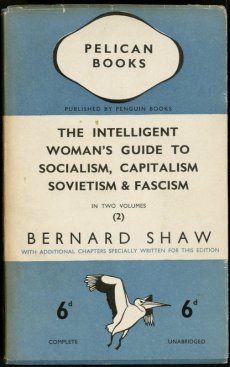
The Intelligent Woman’s Guide to Socialism, Capitalism, Sovietism and Fascism by George Bernard Shaw
Shaw’s 1928 work is a brilliant debunking of the myriad excuses for inequality. He argues that women of all classes must free themselves from economic dependence on men, and points to traditional family structures and familial roles as being at the heart of patriarchy. Capitalism is the villain of the piece (as well it should be), as Shaw argues for a humanity driven by forces of love and compassion, rather than self-interest. Intriguingly, he also posits that men will never be truly free or able to reach their full potential until women are free and released from bondage.
The Women by Hilton Als
Als’s book is memoir, socio-political manifesto, literary criticism and psychological study. The author explores both racial and sexual stereotypes in this stunning series of essays, which analyse the women who define his life; from his own mother to the mother of Malcolm X.
Until We Are Free: My Fight for Human Rights in Iran by Shirin Ebadi
The first Muslim woman to receive the Nobel Peace Prize, Ebadi’s work chronicles her treatment at the hands of the Islamic Republic of Iran – which stripped her of her home, her career, and finally her Nobel Prize, forcing her to live in exile in the UK. Yet through her book we also learn that she has never stopped working to defend the rights of women in her homeland: and never will.
The Second Sexby Simone de Beauvoir
One of de Beauvoir’s best known books, The Second Sex deals with the treatment of women throughout history and is often regarded as a major work of feminist philosophy – the starting point of second wave feminism. It is an exploration of the history of women’s oppression, and she points out that “No one is more arrogant toward women, more aggressive or scornful, than the man who is anxious about his virility.”
Feminism is for Everybody by bell hooks
This book should be mandatory reading for the likes of Roosh V and other so-called ‘Anti Feminists’. Hooks creates a short, easily digestible masterpiece with this collection of essays (so even people who clearly struggle with basic concepts and ideas like Roosh et al should be able to understand it). Within this excellent book, the author demonstrates how feminism effects everyone, regardless of gender, race or class.
Feminism at the Movies Edited by Hilary Radner and Rebecca Stringer
One for cinema-goers and film buffs, this essay collection covers more than just that which we see on the silver screens. It considers, analyses and explores a range of topics, from the female director as auteur, depictions of professional women in cinema and gendered violence on the screen. Loosely grouped into five categories (masculinity, a space for women, consumer culture, family, and violence), the 21 essays contained within this awesome book is perhaps so good because it is so accessible: it’s an academic textbook and thus fully referenced, yet holds no elitist jargon. It’s crisp, smart, true.
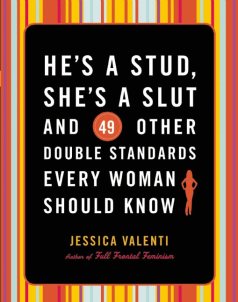
He’s a Stud, She’s a Slut, and 49 Other Double Standards Every Woman Should Know by Jessica Valenti
Double standards are nothing new – and women deal with them every day. Why is it that men grow distinguished and sexily grey as they age, while women just get saggy and haggard? Have you ever wondered why women are supposed to be simultaneously virginal and provocatively enticing at the same time? And why are there so-called “girl hobbies” and “boy hobbies”? Valenti addresses each of these questions and more with sass, humour, and in-your-face facts. It’s a book that looks to equip people who favour equality with the tools they need to combat sexist comments, topple ridiculous stereotypes and end the promotion of lame double standards.
Madame Bovary by Gustave Flaubert
When it was first published in France, Flaubert’s novel prompted an obscenity prosecution. Translated into English by Eleanor Marx in 1886 – the same year she published The Woman Question from a Socialist Point Of View – the novel deconstructs the prim, idealised vision of the “perfect” nineteenth century woman. How does Flaubert manage such a trick? Pretty simply, actually: he just gives her thoughts, feelings and desires – as though she were, get this, an actual, human being. Through the life of Emma Bovary, Flaubert shows us an objective, intimate perspective on the difficulties of womanhood that is just as pertinent today as it was when it was first printed.
If you don’t quite manage to get through one of these books by the end of today, don’t worry. And don’t go thinking you have to wait 365 days until the next #InternationalWomensDay. You don’t need a specific day to celebrate the achievements of women. Consider every day as being IWD and we’ll start to get there. And, if you’re a CEO or business owner, you could start by paying your female employees more (you should really do that right now, actually). Carpe Diem! #InSolidarity
In Norway, a thousand trees have been planted in Nordmarka, a forest just outside Oslo. They have been planted for an incredibly special purpose: in 100 years time, they will be used to make the paper for an anthology of books, which will form part of the so-called ‘library of the future’.
The Future Library – Framstidsbiblioteket – is a 100-year artwork launched by Scottish artist Katie Paterson. From 2014 until 2114, one writer every year will contribute a text, with the writings held in trust, unpublished for up to 100 years. Each writer has the same remit: to conceive and produce a work in the hopes of finding a receptive reader in an unknown future.
The first writer to the contribute to the project in 2014 was Margaret Atwood, who said of the project: “Future Library is bound to attract a lot of attention over the decades, as people follow the progress of the trees, note what takes up residence in and around them, and try to guess what the writers have put into their sealed boxes.”
Following Atwood as 2015’s author, novelist David Mitchell said: “Civilisation, according to one of those handy Chinese proverbs, is the basking in the shade of trees planted a hundred years ago, trees which the gardener knew would outlive him or her, but which he or she planted anyway for the pleasure of people not yet born. I accepted the Future Library’s invitation to participate because I would like to plant such a tree. The project is a vote of confidence that, despite the catastrophist shadows under which we live, the future will still be a brightish place willing and able to complete an artistic endeavour begun by long-dead people a century ago. Imagine if the Future Library had been conceived in 1914, and a hundred authors from all over the world had written a hundred volumes between 1915 and today, unseen until now – what a human highway through time to be a part of. Contributing and belonging to a narrative arc longer than your own lifespan is good for your soul.”
The manuscripts will be held in trust in a specially designed room in the New Deichmanske Public Library opening in 2019 in Bjørvika, Oslo. Intended to be a space of contemplation, this room – designed by the artist – will be lined with wood from the forest. The authors’ names and titles of their works will be on display, but none of the manuscripts will be available for reading – until their publication in one century’s time. The library room design is in collaboration with Lund Hagem Architects and Atelier Oslo.
You can watch a short video about the project, featuring Margaret Atwood, below:
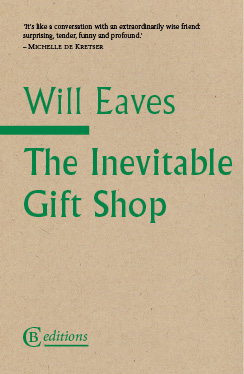
An artistic movement is forming. One that is open to spontaneity, artistic risk, emotional urgency and one which flies against traditional models. Will Eaves’s latest book, The Inevitable Gift Shop, is an example of this movement displayed in written form. We may call it a book at first mention, rather than a novel or a collection of poetry, because really this is simultaneously both of these things, and at the same time, something else and something new entirely. A combination of prose, poetry, literary critique and philosophy, it is collage, it is memoir, it is anything and everything that you want it to be. If there were rules to writing – which there aren’t (probably) – this book is rewriting them.
While mainstream publishing continues down a well-trodden but not exactly adventurous path – Julian Barnes suggests in an interview with the Paris Review there is little objective beyond “publishing copies of novels that are copies of commercially successful novels” – Eaves is cutting an entirely new path, machete in hand, through bush, briar and jungle into uncharted artistic territory.
So what does this new territory look like? In one word – episodic. In sections ranging in length from a single line to two or three pages, are contained mini-narratives and episodes, which sit alongside poems, and abstract thoughts and expressions of ideas. For instance, here runs a complete section early on in The Inevitable Gift Shop:
“The novel is the autobiography of the imagination”
Such lines make us question whether we feel we are reading a novel; an autobiography or, perhaps most intriguingly of all – an accurate representation of creative imagination.
Imagination, after all – and, indeed, so many of our thoughts and ideas – does not run in linear patterns. Rather, it comes in flashes; moments of clarity and inspiration. As Daniel Dennet notes in Consciousness Explained:
“While we tend to conceive of the operations of the mind as unified and transparent, they’re actually chaotic. There’s no invisible boss in the brain, no central meaner, no unitary self in command of our activities and utterances.”
Traditional forms of fiction, therefore, do not to justice to the reality of the human mind. Conventional fiction teaches us that life and our thoughts are coherent – they are linear and whole, neat and wrapped up. When the truth of the matter is quite the opposite; our lives, and our ideas, are fragments, and we stumble upon them as though they were bright splinters.
Eaves’s previous book – The Absent Therapist– worked within a similar form and structure. It brought together a succession of mini narratives, and a multitude of different characters and protagonists. In The Inevitable Gift Shop, we are again introduced to different characters, but more than anything, the protagonists in this book are ideas. We might call The Inevitable Gift Shop collage – a collage of the ideas that are created within the human imagination.
What’s fascinating about works of collage in literature, where short paragraphs and vignettes are brought together as a collection of fragments to create a whole – alongside Eaves’s latest two books, think Reality Hunger by David Shields or What I heard about Iraq by Eliot Weinberger – is the exciting sense of newness contained within them. In Reality Hunger, Shields contests that neither fiction nor non-fiction, in their current forms and structures, adequately meet the needs of the 21st Century reader. And in this new structure we see again here in The Inevitable Gift Shop, we perhaps see a possible alternative model for writing and literature. This is something Eaves touches upon early on in The Inevitable Gift Shop:
“A literary convention is a retrospective abstraction. It exists only in relation to the experiment or the revolution that overturns it. It doesn’t exist until someone does something new and you see how far you’ve come. Form and content, in other words. There is a widespread misconception about form, as the poet Elizabeth Jennings once pointed out: it is not a jelly mould into which one pours content. Rather, the two things are co-eval. Form will arise to express content, and the established forms (sonnets, novels, collage) are those that, like an evolutionary convergent body shape, have by long trial shown themselves to be optimally expressive.”
The novel and the sonnet have been with us now for centuries, with precious few innovations in form and structure between their invention and now. Collage has been with us since the 20th Century and has largely existed within visual media – art, montage in cinema. The marriage between collage and the novel (and indeed poetic forms) as displayed here is perhaps the beginning of a new revolution that overturns previous literary conventions. The question one might rightly ask when you see how well books like The Inevitable Gift Shop work is, “well, what’s taken so long?” It feels as though the book almost proves that the narratives we are accustomed to are long overdue a makeover.
In Self Help, Lorrie Moore wrote that “plots are for dead people” – the traditional narrative format and structure cannot serve the living. Eaves breaks apart the traditional model for something far more engaging; and far more alive. The poetry is, at times, penetratingly devastating simply for the real, life-lived truth it exposes – consider the line from The Crossings, for instance: “you choose a friend for life as you might choose a seat”. While the prose moves you, as you read it, through ideas and emotions, asking you to seek out new ways of looking at the world.
You can recognise good art and good writing if it surprises you. And, boy, can this book surprise you. Just as you are critiquing Shakespeare’s 37th Sonnet, a line of pure magic – “I eat fish with a clear conscious because they neglect their young” – will fly out and catch you off guard, shifting the tone in an exhilarating rush.
The structure of Eaves’s novel allows readers to pull away from notions of narrative as an important – or indeed central – part of any story or essay. This is important, because it allows us to move toward contemplation, and is more conducive to helping us expand our own understanding of both the ideas contained within the book, and the thoughts and ideas they inspire within us as we read.
Consider, for instance, Eaves’s skilful and fascinating literary critiques and analysis – present throughout the book in analysis of Shakespeare’s sonnets, but also Madame Bovary, and indeed the works of other literary critics. One of the longest sections in the book focuses on William Golding’s The Inheritors – a brilliant novel in its own right – and Eaves guides us through Golding’s book, its plot and themes, and leaves us considering not only the novel; but “the whole of human history” – a concept so brilliantly large and fascinating in itself that we immediately find our imaginations stirred, our horizons widened.
The writing is sharp and fresh, and the work as a whole is inquisitive, analytical, contemplative; significant. Subtitled “A memoir by other means”, there is something incredibly personal about the book, which is surely appropriate for a memoir, and in the end it leaves you feeling as though you’ve spent a long while in the intimate company of a stranger, who nonetheless somehow feels achingly familiar.
Frequently hilarious– “really what tortoises teach you about is abusive relationships” – there is almost a cinematic element. Both through the vivid descriptions of the natural and man-made world, and also in the way the collage effect feels not unlike a visual montage; whereby overall meaning is not to be found in any one section or episode but instead created by the juxtaposition of each of the different fragments and bits and pieces intercut together. Of course, while a viewer’s relationship with a montage is relatively binary – you watch the images on a screen in front of you – the reader’s relationship with The Inevitable Gift Shop is far more interesting. It’s interactive. By picking through the options, it’s possible to arrange the overarching narrative in different ways; and to find new meanings contained within it.
It’s a book that demands to be read and re-read – and then re-read again; both front to back, back to front, and in all other manner of combinations. The perfect book to revisit.






















 nothing in the rulebook