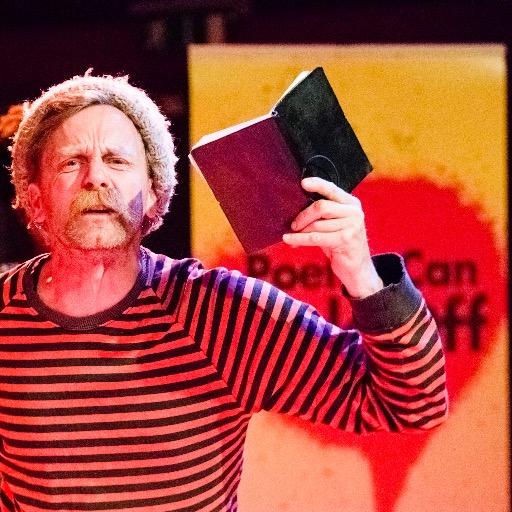
Heathcote Williams’ radical new work, Poetry Can F*ck Off is coming to The Cockpit Theatre, London on 29th, 30th, and 31st October 2015; and The Other Place Theatre, Brighton on 20th, and 21st November.
“Poetry Can F*ck Off is a revolution in poetry. And it’stherevolution in poetry”
-Jeremy Hardy
When Brainfruit artistic director and seasoned performer, Roy Hutchins began his daily visits to Brighton Occupy in 2011, he did what he does best – rouse the crowds with the words of radical poet, Heathcote Williams.
Williams, known for his idiosyncratic documentary/investigative poetry style, was in turn inspired by Hutchins’ activism to reflect on the role of poetry in all political uprisings, and Poetry Can F*ck Off was born.
“A picker pucker panoramic poetry parade”
–John Hegley
Performed with live music, Brainfruit’s epic production charts the great resistance movements from the Peasants’ Revolt to Occupy Wall Street. Over 80 poets are referenced in a 55-minute mind-bending maelstrom – a compendium of the courageous, creative voices who called for change, from Shelley to Ginsberg to Pussy Riot.
Their Edinburgh run culminated in Williams being awarded the most prestigious award of the festival: The Glasgow Herald Archangel – Lifetime’s Achievement Award.
“From Tahrir Square to Fukushima to Mesopotamia, this is not canonical school stuff –it’s electrifying and erudite, passionate and political”
-Three Weeks
Roy Hutchins is joined by Sameena Zehra, who cut her teeth performing AIDS awareness shows on the streets of Delhi; Jonny Fluffypunk, designated poet of the Bristol squat scene; Selina Nwulu, daughter of Nigerian refugees, charting her parents’ flight from the civil war in her poetry; and they are joined by a host of special guests – all underscored with live, original music from Dr Blue.
“A convincing case for poetry as weapon of choice in the revolution”
-Sabotage Reviews
In the light of recent political events, this radical work finds itself a part of a much larger movement of artists, liberals and activists calling for change, and the response (and in many cases participation) of the audience has been electric. The reminder that words alone can bring down a tyrant, encapsulate a vision, or simply embarrass complacent leaders into action, has never been more timely.
Auden said, “Poetry
Makes nothing happen.” Auden
Was quite mistaken.
The world that you know
Can have its entire shape changed
By just one poem. Poetry teaches
The heart to think.
“Poetry was school”
Roddy Doyle recalls.
“All poetry could fuck off.”
Professor Wu says:
“Thismuch needed poetic call to arms promises to provide a crucial rallying cry against authority figures whose pursuit of power at all costs threatens to reduce our society and culture to binary and uninspired norms of cultural subservience and insignificance. Nothing in the Rulebook wholeheartedly recommends you attend one – if not all! – of these upcoming shows. This revolution will be poetic.”
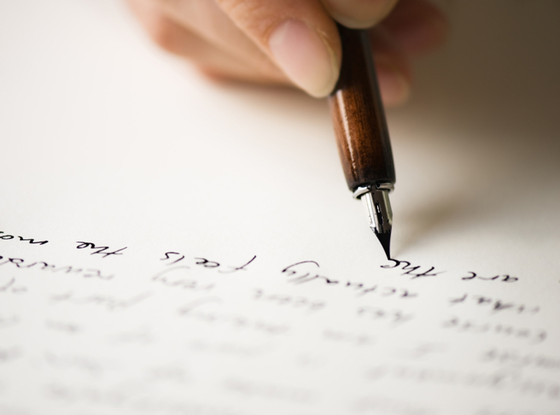
There is something about handwriting that is thoroughly human. Few things exercise – and exorcise – the often stubborn collaboration between mind and body like that direct line between the tip of the pen and the tip of the neuron. Pens become the corporeal transmitter of creative flow for writers, just as the paintbrush is for the artist; the camera lens for the photographer.
Yet in our digital world, we so often find ourselves only using the keyboards of our desktop computers, our laptops – or even our minimalist typewriters (if you swing that way). With such tools available to us, it can be tempting to forget the power of the pen and the importance of handwriting. But don’t just take our word for it! Here we’ve collected just a few thoughts of famous writers on the glorious, grounding physicality of penmanship…
John Steinbeck
In a series of disarming observations, Steinbeck captures the curious role of the pen as negotiator between brain and body in Working Days: The Journals of the Grapes of Wrath. This remarkable volume gives us a glimpse how the great writer used a diary as a tool of discipline when he embarked upon the most intense writing experience of his life – the masterwork that earned him the Pulitzer Prize.
Here, we see how the writer falls almost completely in love with his pen. In July, he notes:
“This has been a good pen to me so far. Never had such a good one.”
And by mid-August:
“What a wonderful pen this is. It has and is giving me perfect service – never stops flowing for a second and never overflows and blots a word.”
A year later, having dabbled with using a new pen (flirting with a younger model), he returns to his calligraphic home:
“There is no doubt that this fine old pen is better and smoother than the newer one. I think I’ll keep with this good old pen. I’ve done a lot of writing with it. I only hope it holds up.”
As his relationship with the pen develops, we see Steinbeck define fulfilment in a way we hope other aspiring writers take heart from. For it is not in writing for readers or writing for publishers or writing for commercial success that Steinbeck seeks happiness – but in the profound private fulfilment of simply writing:
“The perfect pen and the perfect paper and me working on work that pleases me and has no note for the critics.”
Or, more intensely:
“Oh! Lord, how good this paper feels under this pen. I can sit here writing and the words slipping out like grapes out of their skins and I feel so good doing it.”
Then perhaps Steinbeck captures in a single exquisite passage the almost mystical quality of writing by hand – the strange way the pen can become a projection of the creative psyche, channeling deepest longings and twirling patterns of thought as the hand drafts what might be the meaning of life itself:
“Here is a strange thing — almost like a secret. You start out putting words down and there are three things — you, the pen, and the page. Then gradually the three things merge until they are all one and you feel about the page as you do about your arm. Only you love it more than you love your arm. Some day I will be all alone and lonely — either dead and alone or alive and alone, and what will I do then? Then those things I have now and do not know will become so desperately dear that they will be aches. Then what? There will be no way to cure those aches, no way. In that coldness nothing will come. Things are leaving me now because they came too fast — too many of them — and being unable to receive them I threw them out and soon they will not come any more. This process is called life or living or any one of a number of things like that. In other words these are the soundless words, the words that have no being at all. The grey birds of loneliness hopping about. I thought that there might be a time or a condition different from that. But I know now — there isn’t any other way. “
Edgar Allan Poe
One of the masters of mystery and the macabre, Poe provides us with much reason to lament the rise of Kindels and e-readers, as he explains one of the key joys of a book is being able to write – in the margins – one’s thoughts as one reads, as though in an intimate, entwined conversation between yourself and the writer.
‘Marginalia’ are, to Poe, a playground for ideas and intellectual discourse – where one’s personal handwriting exhibits the mind at its most uninhibited. Certainly, a vital prerequisite for writers often afraid to write out one’s thoughts for fear of finding them flippant or trivial, as Poe notes:
“Marginalia are deliberately penciled, because the mind of the reader wishes to unburden itself of a thought; — however flippant — however silly — however trivial — still a thought indeed, not merely a thing that might have been a thought in time, and under more favorable circumstances. In the marginalia, too, we talk only to ourselves; we therefore talk freshly — boldly — originally — with abandonment — without conceit. . . .”
And Poe does not forget to point out that handwriting is marginalia’s most necessary vehicle. He asserts that personal script, and handwriting itself, create a window into one’s core attributes of character:
“I am far more than half serious in all that I have ever said about manuscript, as affording indication of character.
The general proposition is unquestionable — that the mental qualities will have a tendency to impress the MS [manuscript]. […]given a man’s purely physical biography, with his MS., and the moral biography may be deduced.
The actual practical extent to which these ideas are applicable, is not sufficiently understood.”
Mary Gordon
In her wonderful essay Putting Pen to Paper, but Not Just Any Pen to Just Any Paper, Gordon celebrates the glorious, grounding physicality of penmanship:
“Writing by hand is laborious, and that is why typewriters were invented. But I believe that the labor has virtue, because of its very physicality. For one thing it involves flesh, blood and the thingness of pen and paper, those anchors that remind us that, however thoroughly we lose ourselves in the vortex of our invention, we inhabit a corporeal world.”
Indeed, she posits that the tool itself is in itself a gateway – and it may transport us to a different sense of self:
“My pen. It is a Waterman’s, black enamel with a trim of gold. When I write with it, I feel as if I’m wearing a perfectly tailored suit, and my hair is flawlessly pulled back into a chignon. Elizabeth Bowen, maybe, only French. Anna de Noialles, but played by Deborah Kerr. My pen is elegant, even if I’m wearing the terry robe whose frayed state suggests a fashion statement from a gulag. My ink is Waterman’s black. Once while traveling I could only find blue-black. I used it for a few weeks, but it made me feel like a punitive headmistress.”
And, in copying out – by hand – the writing of poets, authors, musicians, Gordon finds this can create for her what all writers seek – inspiration:
“Into the notebook I am using for the fiction I’m writing, I copy paragraphs whose heft and cadence I can learn from. And some days, if I’m lucky, the very movement of my hand, like a kind of dance, starts up another movement that allows me to forget the vanity, the folly, of what I am really about.”
Perhaps this inspiration drives from the special physicality of handwriting, which Gordon notes can prove rather pleasurable:
“It is remarkably pleasant, before the failure starts, to use one’s hand and wrist, to hold and savor pleasant objects, for the purpose of copying in one’s own delightful penmanship the marks of those who have gone before. Those whom we cannot believe have ever thought of failing, or of (as I do each morning) envying hod carriers, toxic waste inspectors, any of those practitioners of high and graceful callings that involve jobs it is possible to do.”
And then, Gordon (and this article) concludes with the following thought – a passing warning to the pitfalls of modern technology:
“I don’t know what people who work on computers do to get themselves started. I hope never to learn firsthand.”
Oh-ho, saviours of the written word! As we are tucked in tighter to the rigid sheets of autumn, harder to shift in the mornings and their embrace distant in the evenings, have faith in the script. We’ve given you some ace reads for when the living is easy, but how’s about the times when the living is wretchedly autumnal? Billy the Echidna provides you with four sacred texts to notch on your bedpost.
High Rise – J.G Ballard
Billy the Echidna couldn’t be more Ballardian whether he’s fantasising about Ronald Reagan or delighting in the marmoreal veins of the Leaning Tower of Pisa. As a young Echidna, I was enthralled by the putrid, pornographic meld of sex and technology Ballard describes in Crash (the first time Billy remembers having to put down a book because he felt nauseous). First drafted as a social worker’s report, High Rise accounts an English tower block’s descent into mayhem as the tenants scrabble for clarity in its hierarchical, suffocating units. The book follows three residents of the building’s highest, middle and lowest floors as the psychological pressure of high-rise living crushes all reason within its corridors. Fans of Will Self and Michel Houellebecq will find a fantastic introduction to a profoundly depraved author – best to read before the critically acclaimed Ben Wheatley screen adaptation starring Tom Hiddleston is released later this year.
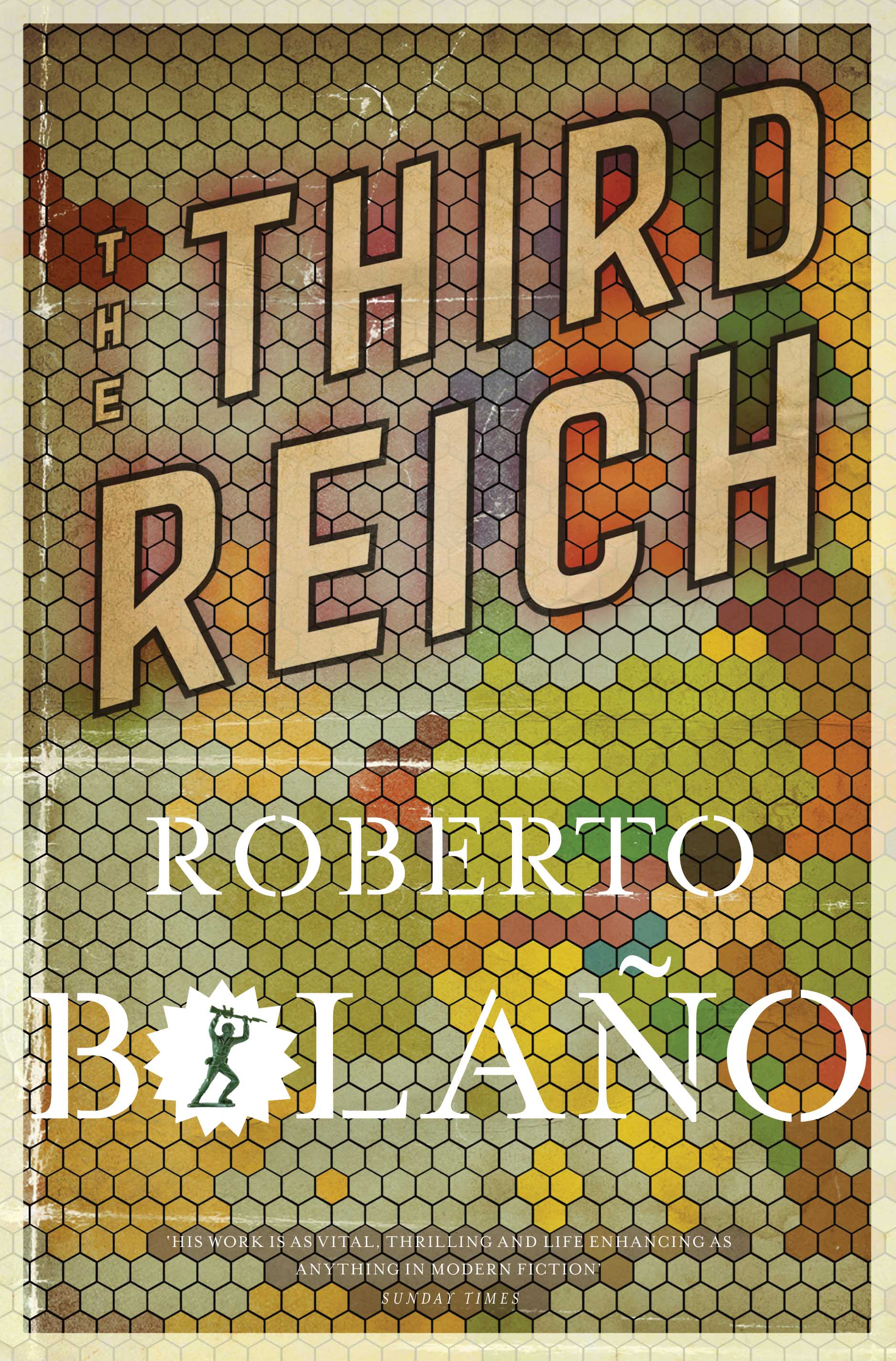
The Third Reich – Roberto Bolano
Posthumously published, this book was described as for “completists only” in a New York Times review but this Echidna couldn’t think it further from the truth. Written in the late 80s and most likely based on the Catalan beach town where Bolano resided, The Third Reich is an endearing exploration of mysteries found around the next corner. Udo Berger is a German war games champion taking his first love to his childhood holiday destination in Spain. When an unexpected, confusing, wind-surfing compatriot disappears from the small town, Udo must get to the bottom of it like the detective from his girlfriend’s novels he keeps second-guessing.
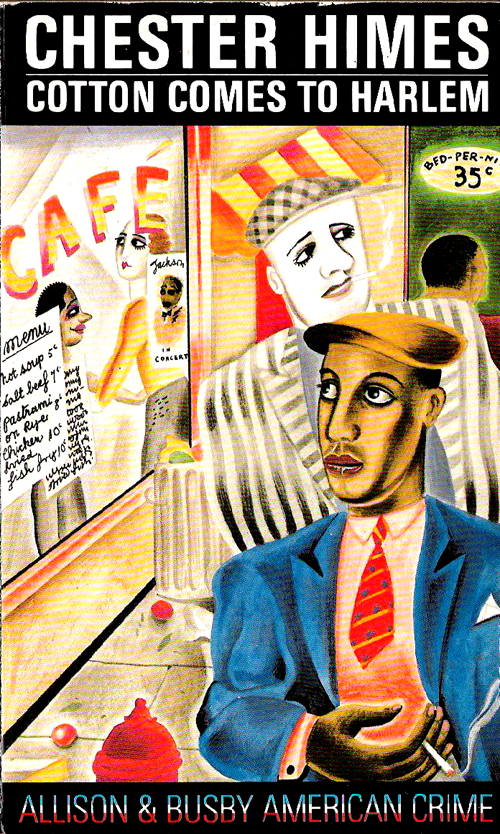
Cotton comes to Harlem – Chester Himes
Unlike the rest of the year, Autumn is a perilous time to catch a train. Falling leaves will bombard your carriage and your train will come to a panicked stop leaving you further from the beans on toast you’d planned for supper. What better to overcome this horrifying truth than a bombastic crime thriller? First published on the pages of Playboy, Cotton comes to Harlem is the story of black detectives Gravedigger Jones and “Coffin” Ed Johnson hot on the tail of a conman exploiting the racial divides of 50s New York. A no-nonsense satire of the black American experience. Check out the theme by Melba Moore from the Blaxploitation 70s remake for your daily soul dose.
Arts Council England is set to award Bath Spa University with £600,000 in funding to develop creative writing education in schools across the South West of England.
The grant is from the Creative Writing in Schools fund, and will support a three-year project called The Creative Writing Education Hub.
This project will be led by the university in partnership with Bath Festivals and the National Association of Writers in Education. The project aims to link nationally recognised writers with hundreds of schools in the region.
Bath Spa University
As part of the project, children aged eight to 14 will be given workshops by professional writers, thereby helping them to write and expand their imagination.
Alongside the programme, a series of workshops for teachers and writers will run concurrently to the schools programme, thereby helping to try and develop new approaches to teaching creative writing.
Participating schools will receive support to achieve an ‘Artsmark Award’, and pupils will receive help to achieve an ‘Arts Award’.
Phil Gibby, South West area director for Arts Council England, said: “We believe that every child and young person should have the opportunity to experience the richness of arts and culture and this funding will give more young people the chance to engage in and enjoy producing and showcasing their own creative writing.
“The consortium boasts some of the South West’s expert educators, researchers and writers whose joint leadership will make for a strong and unique programme of work.”
Bambo Soyinka, creative director of the project, said: “Creative writing should be part of every child’s education as it develops imaginative thought, language and literary skills.
“The Creative Writing Education Hubwill introduce school pupils from varied social and cultural backgrounds to the joys of creative writing and will enable young people to learn alongside professional writers.
“Over the next three years we will be researching and testing best practice models for creative writing education.
“We will share our findings through innovative events, workshops and digital platforms, to guide and inspire teachers, pupils and creative writing tutors.”
Bath Spa University is one of two lead applicants awarded a grant from the Creative Writing in Schools fund.
The other successful applicant, First Story, will use a grant of £600,000 to bring professional writers into secondary schools serving low income communities.
This fund targets the North and the South West because these are areas outside London where creative writing opportunities for children and young people could be improved.
Analysis
Professor Wu says: “Projects like this are absolutely crucial in a society increasingly devoid of imagination – and a stunted ability to think outside the box. Evidence suggests that creative writing – and, indeed, creativity and art in all its myriad forms – can improve a child’s enjoyment and attainment in English language and literature.”
“What is more, by encouraging children to think creatively, we encourage them to look at the world in new and interesting ways, which is critical for human society as a whole. Just think of those wise words of Albert Einstein: Logic will take you from A to B, but imagination will take you anywhere.”
Creativity, in all its myriad different forms, can take us to the edge of the world and look beyond. It can inspire, inform, influence. Used in the right way, it can illuminate the path ahead.
Because of this, Nothing in the Rulebook has been founded to emphasise such creativity. Yet we’re also here to highlight not just works of creativity; but the creative individuals who write our stories; take our photographs; create our artworks.
Our ‘Creatives in profile’ interview series offers creatives the opportunity to discuss their life and art at length. And it is an honour to introduce our latest detailed interview – with artist, writer, National Geographic Explorer and creative conservationist, Asher Jay.
Asher Jay
In the last 40 years, the world has lost over 50% of its vertebrate wildlife. Of course, hearing such figures one often echoes the sentiment ‘something must be done’. But what is that something? And who must do it?
Asher Jay believes that something is creativity – and is using her artistic inclinations to save the world’s threatened wildlife. Her cause-driven art, sculpture, design installations, films, writing, and advocacy advertising campaigns bring attention to everything from oil spills and dolphin slaughters to shrinking lion populations. “The unique power of art is that it can transcend differences, connect with people on a visceral level, and compel action,” she says.
‘Blood Ivory’. Original artwork by Asher Jay
Much of her best-known work spotlights the illegal ivory trade. In 2013 the grassroots group, March for Elephants, asked Jay to visualize the blood ivory story on a huge animated billboard in New York’s Times Square. Viewed by 1.5 million people, the internationally crowd-funded initiative aimed to provoke public pressure for revising laws that permit ivory to be imported, traded, and sold. “Conservation can no longer afford to be marginalized,” she asserts. “Today, we need everyone’s involvement, not just core conservationists.
She participated in the Faberge Big Egg Hunt in New York, where her oval oeuvre went on to raise money for anti-poaching efforts in Amboseli. Her upcoming projects will tackle biodiversity loss during the Anthropocene and expose threats to the world’s most traded and endangered mega fauna.
Nothing in the Rulebook is privileged to bring you this detailed interview.
INTERVIEWER
Tell me about yourself, where you live and your background/lifestyle.
JAY
It’s weird to admit, you don’t belong to a place, that you feel connected to all life on earth all the time, that you can be born somewhere and not have it define you in anyway, that you can be raised by the world at large, where every place, person, action and thought has come to undo you from the boxes that society tries to bind you within… but that is my story. My dad used to say, it wasn’t hard to parent me, because all it took to raise me was sunshine, water and dirt, but my mom maintains I was raised by wolves… perhaps that had something to do with my walking on all fours with my first sibling, a fluffy white Spitz by the name of Leander. I ascended the evolutionary tree over the course of my childhood, from T-Rex, to bat, to chimp. My family never told me otherwise, so I had the freedom to be, to breathe, without boundaries. It wasn’t until my Kindergarten teacher told me that I couldn’t bond with my classmates by grooming them, that I first realized I was human. That was incredibly disappointing to learn, but my mom was quick to assure me, that I could be chimp or bat whenever I felt like it, that the wild was where I came from, much like everyone else, but that most others had lost this ability to recall and relive their animal ancestry. I was encouraged to let the wild within extend into the wild beyond. However, for those who care about geographical locations, I was born in India, and I owe who I am, to several countries in Europe, to family, friends, and a horse named Chester in the UK, to Africa’s unbridled wilderness and an aggressive love affair with the filthy yet fabulous New York City.
INTERVIEWER
You once said, “Channel your inner mosquito.” Can you explain to our readers what exactly this means? What is special about a mosquito? What can we learn from mosquitos?
JAY
A mosquito has impact with every bite, just as we have impact with every breath.
INTERVIEWER
Is creativity – art and writing – your first love, or do you have another passion?
JAY
My first love is life. I love everything that life brings into focus, its dynamic range, vibrant spectrum of colors, light, shadow, balance, and depth… It sounds like I am speaking about my Canon equipment doesn’t it? Well, we hear often enough that life is what you make it, but I will qualify that by saying, life is what you bring your attention toward during the moment at hand. So I suppose life and cameras have something in common, they both require us to peer through a viewfinder and make the most of what the world has to offer in a given sliver of time and space. Look around you though, everything is life, there is nothing on this planet untouched by it. So I love life; I love all life on earth, I love my life! I get to be up in the air in a refurbished Gypsy Moth doing a loop-the-loop in Bedford one day, and swimming with Whale Sharks off the coast of Cabos the next, so my passion for life is as unbound as life itself. I also love life no matter the form it has found expression in, because we are all the same when we breathe, when we allow ourselves to just be.
‘Global Conversations’. Original artwork by Asher Jay
INTERVIEWER
Who or what inspires you?
JAY
Art inspires me, I often head to museums to look at creative expression from past to present, before I commit to a canvas of my own. I have a very visceral connection to visual media, in fact I have never met a painting I have liked that I have not wanted to lick… but the colors seldom taste as delicious as they look, which is unfortunate. This is why I enjoy cooking, food is rich in color and texture, and unlike most paint, and when organically produced, it is not toxic. Since I use my creativity to communicate urgent ecological concerns of our time, I am also inspired by the bold and borderless from the field, people who display extraordinary courage of conviction, and passion for life. Luckily, I encounter most of these individuals in person at our Mothership – the National Geographic Society- role models like Emmanuel De Merode, the former director of Virunga National Park, or Explorer in Residence, Lee Berger, a highly intuitive, yoda-esque, paleoanthropologist who has been an extraordinary source of wisdom and guidance for me. I am grateful for all the input I receive, without which I would have no output.
INTEVIEWER
Who outside of your field inspires you and why?
JAY
Every one I encounter inspires me in different ways, and it’s hard to discern where my field ends and someone doing something else begins, but I suppose I could stop being abstruse and arduous and admit to being inspired by every single contestant on Cupcake Wars. It combines my need for sugar with spontaneous ingenuity. On a side note – Nacho Duato (Ballet Choreographer), Paul Klee (artist), Alexander McQueen and Cristobal Balenciaga (Couturiers).
INTERVIEWER
Who has been the biggest source of inspiration throughout your career?
JAY
Wildlife, they don’t let me down like many of my role models have. (#TheDarkerSideofAsherJay haha)
INTERVIEWER
The work you do inspiring conservation tackles everything from the illegal ivory trade to overfishing in the Mediterranean. What drives you? And how do you manage multiple, different creative projects?
JAY
I am driven by caffeine each morning, but I guess the secret ingredients to my lifestyle are passion, love and happiness. It’s like, with the wild, I found my soul mate, the love of my life, now wouldn’t you do everything in your power to protect, nurture and give to the “one?” All my emotional states orbit wild, and I have fallen hard for its beauty, complexity and diversity. Wild keeps me tethered to the present tense; it’s Deepak Chopra unabridged. With the wild, all the human white noise of projecting for a future that hasn’t happened yet, and worrying about a past that is by gone fades away. It’s refreshing to just be, it is incredibly liberating. I love wild, because it has helped me understand the value of now, for now is all I need to contribute. I stay present, informed and open, and I say yes to life and flow with the go. All of it rather effortless, like my mom always says, “If you feel like you are working hard, then you are doing something wrong.” Managing multiple projects is easy when you are bursting with ideas, love what you do, and are caffeinated or on a sugar high in regular intervals.
It’s a privilege to be able to do what I do. I get to dive, I get to hangout with lions, travel extensively, innovate and collaborate with some of the most brilliant minds of the 21st century and fight for a collective wild future… so I am grateful every day, for all of it. It is really hard walking this path, I have immersive emotional meltdowns, eat my feelings on blue days, and I seem to have missed the memo on adulting, but as my generation says, Beyonce wasn’t made in a day. It’s just a lot of hard work, consistent action, self-integrity and self-belief.
INTERVIEWER
Both your artwork and your writing seems inherently tied in with your work as an activist. What do you make of creativity as protest? And where do you think it fits within some of the broader activist and protest movements currently at play throughout the world?
JAY
I know I often get cited as an art activist, but I am not entirely comfortable with that term. I think it is important to recognize the importance of art as a medium that can empower awareness and enable action but activism is ripe in negative connotations, as is protest. I don’t think we should be against something, because the minute we are, we give rise to an “us versus them” argument. I am not protesting the current paradigm, how can I when I live in it? I am a part of the problem, as much as I am a part of the solution. I have really begun to see that off late, what with my constant globe trotting to give talks and participate in field efforts; my carbon footprint is up the wazoo. I also occasionally do drink out of a plastic water bottles, life on the go encourages that sort of convenient consumerism, and I even catch myself eating things I have never eaten before, or feel morally against. Circumstances have a way of challenging what we hold to be true, but because I hold my self accountable, I don’t let myself off the hook when I misbehave. I am aware when I do something that isn’t congruous with what I say, and when I say something that isn’t in alignment with what I do. I really am striving to lead a life of reduced internal conflict, so I can enrich other’s lives holistically. I get it right sometimes and I fail on other occasions. I am still learning, but I think the greater solution lies in being inclusive. So I think we need to evolve past using words that denote violence and separation, like “activism” and “protest” and embrace resolved states that embody peace and coexistence, and enter an era of higher consciousness that promotes “inclusivity” and “unity” so we can do right by the largest number of living beings on this planet. It is time we recognized that we are all on a Noah’s Ark, and we should inhabit the earth cooperatively and consciously.
‘Every Soup Slays A Shark’. Original artwork by Asher Jay
INTERVIEWER
Since you’re involved with so many different causes, could you tell us a bit about how you choose the cause / the campaign? What are elements that you look for?
JAY
I don’t really choose causes, causes choose me. Caring about extinction, caring about pollution, caring about human trafficking, caring about women’s empowerment, is not a choice. For any compassionate, connected person, it is impossible not to feel compelled to contribute and be an instrument of change.
INTERVIEWER
Describe your process during the development of a campaign. Are you given a topic to focus on or do you choose what speaks to you? Do you travel to remote areas for research?
JAY
I have done all of the above to realize a campaign, however I try to put myself in the paws, hooves and fins of my true clients, the reason I got into this line of work.
INTERVIEWER
“You campaign in poetry. You govern in prose” – Mario Cuomo. It’s interesting to see how you move between literary forms in your writing – using a combination of poetry and prose. What does poetry mean to you?
JAY
Poetry, to me, is thought expressed in its raw and vulnerable form. It is sensual, sensory, and subjective, a medium you just dive in to and experience for yourself, rather like a work of art. A poem does not need to be figured out, it just needs to be consumed in its entirety, so it can reach you as only a poem can. Let your cerebral palate be tickled by the myriad flavors it sprinkles across your mind, heart and soul. I find poetry offers the unworked fragments of my subconscious freedom of articulation and like a decanter it helps my innermost workings find the space to breathe and be.
INTERVIEWER
Can writing right wrongs?
JAY
Any form of creativity can right wrongs and wrong rights, particularly when it deprives a being of the right to freedom, as is the case with some laws that deprive animals of their personhood based on humanity’s ability to calibrate intelligence. Writing is but a weapon, and it can be wielded just as easily to hurt, hinder and hold hostage, as it can be used to protect, permit and promote process.
INTERVIEWER
How would you define creativity?
JAY
Defining the word, creativity, would limit its dimensions and scope.
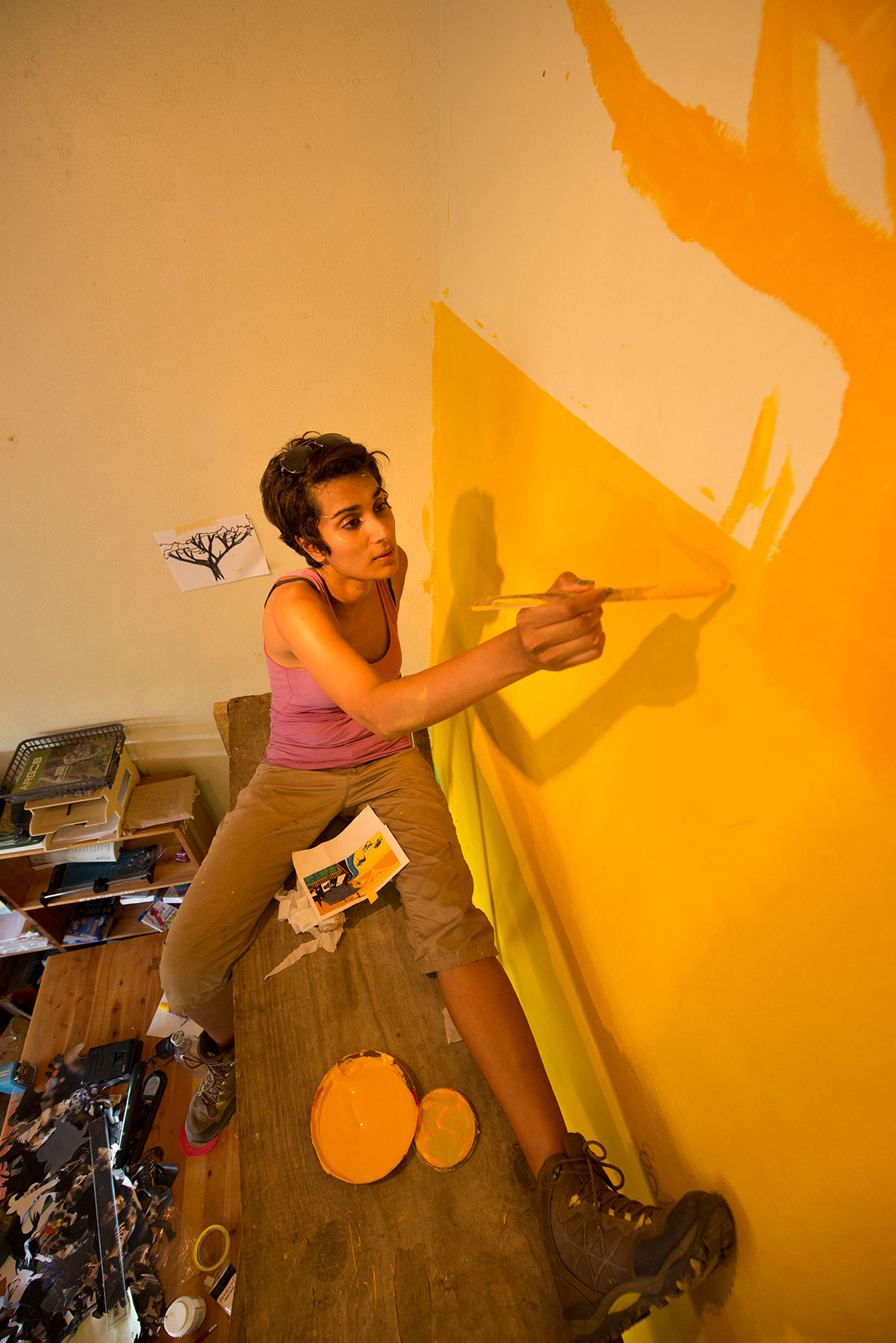
Asher Jay Covered in Paint
INTERVIEWER
Could you talk us through your creative process? How long does it take you to finish a piece?
JAY
It varies as much as public opinion on climate change, but always seems to involve hard science, baggy sweatpants, middle of the night epiphanies, gallons of coffee, academic research polls conducted in my apartment on my roommate and her boyfriend, and random paint stained body parts and occasionally my floor but don’t tell my super.
INTERVIEWER
In an internationalist, interconnected world, ideas and creativity are constantly being flung across community threads, internet chatrooms and forums, and social media sites (among many others). With so many different voices speaking at once, how do you cut through the incessant digital background babble? How do you make your creativity – your voice – stand out and be heard?
JAY
I think it’s important to listen to all the babble, to be tolerant, and give every expressed perspective an unbiased moment of your time. Then I mull it over, to see if the ideas or arguments presented make sense to me, if they feel ethically congruous and in the best interest of the marginalized, then I assimilate it, if not I bear it in mind and work on crafting a counter position based on scientific findings and hard numbers. I don’t make the mistake of assuming I know everything there is to know about anything, I remain receptive and willing to change my stance based on open, and rational dialogue. I maintain my voice and unique creative stand on issues by being malleable and forthcoming about my confusions and concerns.
INTERVIEWER
Great pieces of art often inspire great pieces of writing and literature – and great pieces of writing often inspire the finest pieces of art. Do you think the two naturally complement one another? How do you find balancing your work as an artist, with your work as a writer?
JAY
I don’t communicate in words when I see in pictures and I don’t see in pictures when I communicate with words, on the rare occasion both come together, and that’s pretty engaging for me, it feels like all my neurons are having hot sex with one another and resulting in one cerebralgasm after another.
INTERVIEWER
It was interesting reading your recent post on Tenerife – especially the way you note how its tourist-fuelled economy is “brash, irreverent, myopic, materialistic, irresponsible [and] itinerant”! This is travel writing as protest, and it’s difficult not to ignore your call to arms when you insist on the “importance of saving marine habitats [because] we owe one out of two breaths to the world’s cerulean expanse”. How important, do you think, art and writing are in drawing attention to these issues, which, despite not getting much coverage in the media, nonetheless have the power to significantly affect us all – no matter where we live?
JAY
Art and writing can breathe new life into a hackneyed narrative arc, while keeping the grey areas alive. The human mind has a way of separating situations and individuals into good and evil, vilifying those who commit a “wrong” and pitting them against the crusaders who fight the good fight, but more often than not, issues are more complicated than that. There are more variables to address and it is seldom a ‘one off’ incident. Take Cecil the Lion, everyone got riled up about him, but in a week he will be old news. The Exxon Valdez spill is still a problem, the oil hasn’t gone away in all these years, the animals in that ecosystem have forever been impacted, and my friends tell me that you can still smell the gasoline beneath the shore side rocks. The same is true of the BP Maconda spill, and Haiti’s reconstruction efforts but we are quick to forget, because people just like being entertained by sensationalized stories, and enjoy the feel good factor of doing a quick call to action, and moving on to the next thing. The engagement seldom results in the culmination of a long haul solution. We are all too distracted by the sheer volume of choices when it comes to causes and tragedies that we buy into them based on PR, not because they are a priority. Environmental degradation compromises our continued survival and health, it makes us vulnerable to the compounding impact of volatile externalities as a collective, but why think about that, when business as usual guarantees a pay-check that you can donate ten dollars from, toward a charity of your choice as you check out at your local health foods store? We are creatures of habit, and it is convenient to think, “we have been okay thus far, we’ll be okay going forward, technology will take care of the rest.”
INTERVIEWER
You mention the BP oil spill there, and have previously noted that it was absolutely pivotal in your career. Could you please explain why that’s the case?
JAY
It was the moment I realized, I had to participate more substantially, that signing petitions and recycling was simply not enough for me. It became apparent to me that this work is my calling.
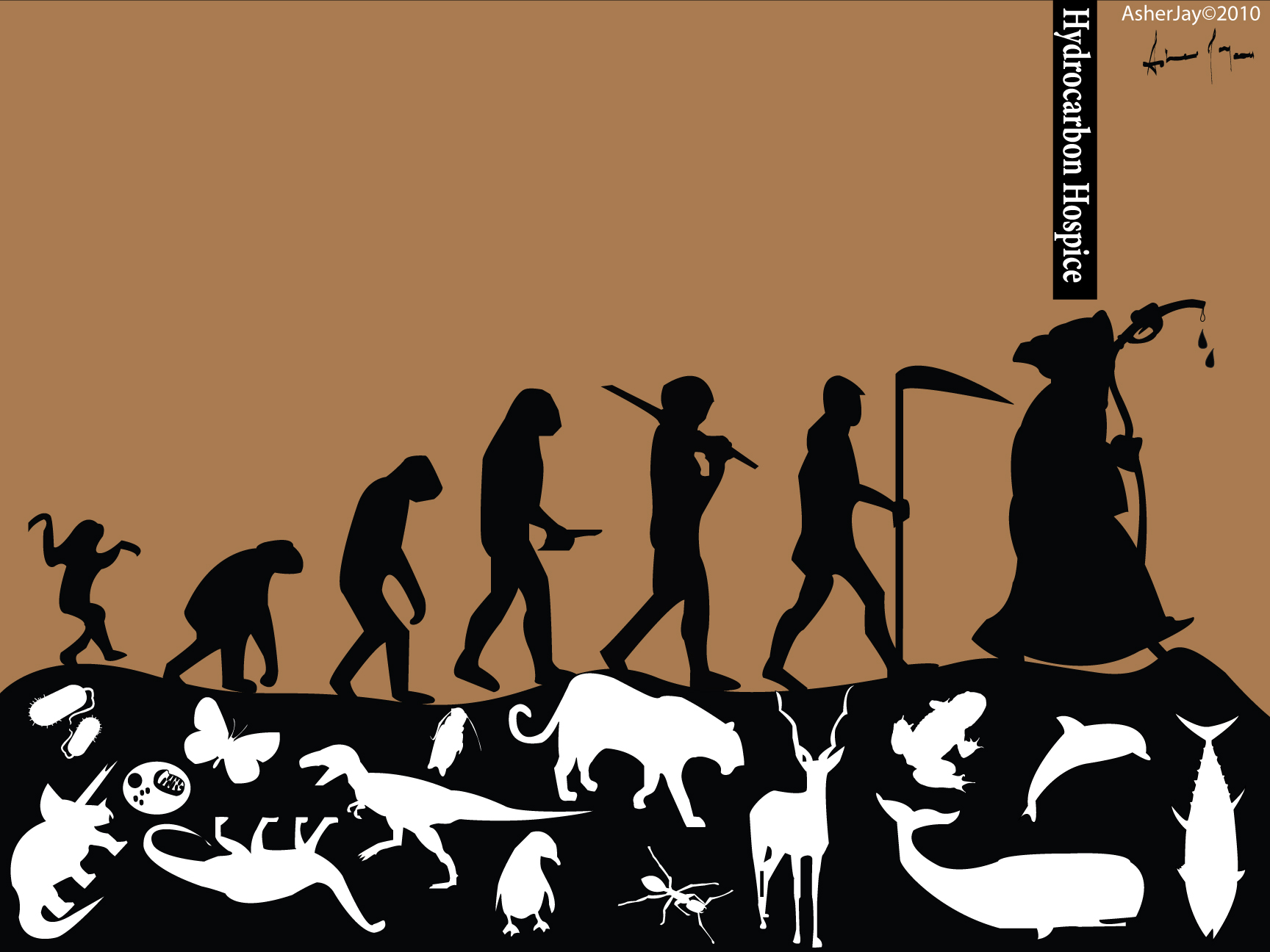
‘Hydrocarbon Hospice’. Original artwork by Asher Jay
INTERVIEWER
Do you have a specific ‘reader’ in mind when you write? Or a specific audience/viewer in mind for your artwork?
JAY
I write what insights I have, I create what comes to me, and it reaches those it is meant to mobilize. I do strategize the channels of dissemination, discern the target demographic and determine the benchmarks of a campaign or op-ed before launching it, but creative expression has a larger impact on shaping cultural consciousness than we have ways to measure it.
INTERVIEWER
For all writing, the importance of finding the right ‘voice’ is of course crucial. Often, writers’ speak of developing an ‘other’ – who provides that voice when they write. How have you created and refined your voice and tone for your writing – and do you have a separate, ‘other’ persona who helps you write?
JAY
No. Gosh, it is hard enough being me; I doubt I have the time to manage an alter ego, besides I strive hard to resolve duality, reduce conflict within the self and live a more unified life. Encouraging oneness would get infinitely harder if I fracture myself, and by extension my voice. It all comes from the same place within me.
INTERVIEWER
“For last year’s words belong to last year’s language // and next year’s words await another voice” – T.S. Eliot. There’s always a danger, when it comes to protest, activism and writing, that what we do becomes outdated – addressing last year’s problems using last year’s language. How do you keep your writing and artwork fresh? And what voice, do you think, we need for next year (and all the years afterwards)?
JAY
Trying to unite a modern world of ever-changing technological advances, social movements, fashion trends and a constantly distracting digital landscape with an irreplaceable and finite wild world keeps my art as fresh as the changing culture of society. Because people, communication and ideologies change, I must adapt my methods of reaching the masses in a way that will have an emotional impact on them and recruit them to a consciousness of compassion and concern for the larger picture, i.e., the wild world upon which our very existence depends. The voice of tomorrow will find expression when tomorrow becomes today. We need only take it a day at a time, and give it everything we have got. This day, this moment it includes everything that is, and everything that has ever existed, why isn’t that enough? Why can’t we do justice to all that exists now? Why can’t we make ‘now’ count?
INTERVIEWER
Could you tell us a little about some of the future projects you’re working on?
JAY
Launching a “Your Shot” assignment with National Geographic on September 7th, to build on the premise of my iStorm Faberge Egg from last year’s Big Egg Hunt. I will serve as editor and curate the content, picking out the best images from the submissions, but I will also be using the raw data/images to composite a larger story that will then be disseminated back to the public through an open source application. I have several other projects in the pipeline including an issue-artwork I created for Joel Harper’s All the Way to the Ocean children’s film and book, which will tour and sell in conjunction to Joel’s inspired efforts to raise youth awareness. Also finishing up a project called Beyond the Frame in Focus, which relies on multimedia to tell stories that are multidimensional. I shot a series of photographs while I was in the Serengeti last year, and while each image I clicked is a complete composition of a single moment, it is also incomplete as it excludes everything the lens isn’t able to bring into focus in that moment — the larger story. Through my ability to conceptually integrate various ideas into a single layout through paint, graphics, collage and collating scientific data/field information, I have seen begun creating works that go beyond the frame in focus. The questions I am looking to answer: What is not being told by the image captured? What else can I be bringing to light in that moment? I have also been incorporating notes from the field, and coining innovative ways to fold data into the layouts. The final works are highly textural, rich and uniquely different from any other project done thus far on African wildlife. I presented two pieces from this series at the National Geographic Explorer Symposium this year.
‘Up In Smoke’. Original artwork by Asher Jay
INTERVIEWER
And what about the future in general? Where are global trends and issues taking the world (and humanity along with it)?
JAY
The future isn’t here yet, lets do right by the present first. We don’t have the bandwidth to assess what our future will be like, bleak or bright, what we can do is take responsibility for the moment at hand, and do better than we have in moments past.
We are living in a world that no one wants to be a part of; everyone is desperate to escape it, one way or another, through emotional opiates, indulging experiences or by constantly awaiting what comes next. No one wants to be present, it’s far too boring in the digital age to be contained by the reality of your present tense, so everyone finds ways to leave or lose “now.”
INTERVIEWER
Creative types and writers have always been imagining the future – Brave New World and 1984 immediately spring to mind. What role do you think writing and art play in the way we think about ‘the world of tomorrow’?
JAY
It can imbue us with hope and fuel our imagination, as such oracular writing and art often does, but we should not confuse fiction with reality. Yes we are capable of modelling for a future based on hard facts and figures, especially when we have certain controls in place. We make specific assumptions as our foundation, upon which we build the model, but time and again we have failed to be cognizant of the fact that we are limited, and as such incapable of comprehending the complexity of compounding consequences. It doesn’t stop us from trying, but life and nature has a rewarding way of putting us back in our place, and giving us the freedom of acceptance that comes from surrender.
INTERVIEWER
Would you say you’re in the utopian or dystopian school of thought?
JAY
Neither. I don’t think projecting for a future that hasn’t happened yet has ever prepared us for how things have actually unfolded at any given point in our collective history. I try to anchor myself in the realities of our world without impressing my interpretations upon them, which at times is extremely hard, but deep down I recognize that things are the way they are and choosing to reject, accept, hope for a better tomorrow or surrender to a post-apocalyptic future, will not make this instant any different than it is. You see, how I perceive any aspect of reality only changes that aspect for me, not for others, so in truth, all that my perceptions, ideologies, aspirations and beliefs do, is isolate me from the rest of humanity and life, which honestly accomplishes nothing. It’s hard to be in an objective, unified place continually though, but I guess that is at the crux of the human condition.
INTERVIEWER
Say you met your future self (say from the year 2030) – what one question would you ask?
JAY
Are you present?
INTERVIEWER
If everything that was wrong with the world was righted, what would you write about? What art would you make?
JAY
If the things I write about and create art about get resolved, I will probably stop doing what I do now. I will adapt and find new purpose, because life will show me what the world needs from me at that juncture, or better yet I’d move to Africa and live in the bush wild with the elephants, lions and rock hyraxes I care so deeply for. I can’t imagine a more fulfilling way to spend my time if all this conflict gets effectively addressed by tomorrow.
‘When The Blind See’. Original artwork by Asher Jay
INTERVIEWER
And finally, could you write us a story in 6 words?
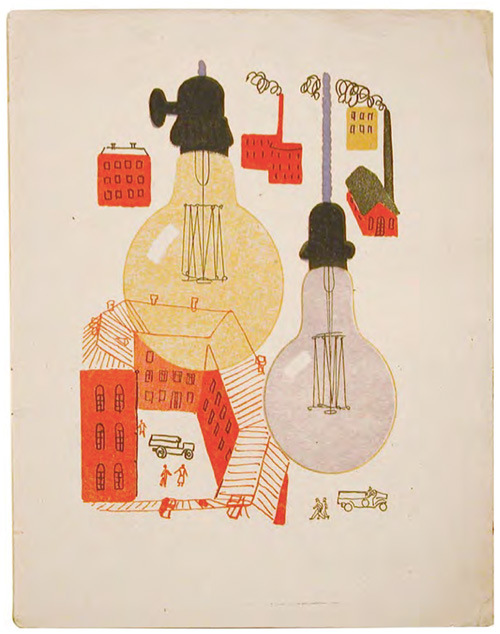
‘Inside the Rainbow: Russian Children’s Literature 1920-35’
Creatives of all forms remain in a constant, symbiotic tango with human nature and culture. All of human thought remains distinctly entwined with that strange, living thing we call culture. Literature, art, music, photography – these strands of culture both reflect who we are, in our values, our hopes, fears, ideals, and shapes who we become by influencing us and immersing us in what becomes an agreed upon notion of how we define ourselves. Culture mythologises certain values, while negating others – shaping our perceptions of the world, and in turn leading us to create – through writing and art, etc – our own culture.
This is rather succinctly summed up by E.B White, co-author of the must-have book for all aspiring writers ‘The Elements of Style’. In considering the responsibility of the writer, White asserts: “Writers do not merely reflect and interpret life, they inform and shape life.”
In nuce, then, what we have is a constant dialogue between our nature and what we come to believe is our nature. A notion captured by physicist Dave Bohm in a 1977 lecture: “Reality is what we take to be true. What we take to be true is what we believe… what we believe determines what we take to be true.”
The role of the creative
Within these constructed realities, then, creatives find themselves in a curious position of being at once channellers of a culture they did not create, and simultaneously being creators of that same culture. For writers and creatives, then, such a position comes with much responsibility. As White notes:
“A writer has the duty to be good, not lousy; true, not false; lively, not dull; accurate, not full of error. He should tend to lift people up, not lower them down […] The writer’s role is what it has always been: he is a custodian, a secretary. Science and technology have perhaps deepened his responsibility but not changed it. In ‘The Ring of Time,’ I wrote: ‘As a writing man, or secretary, I have always felt charged with the safekeeping of all unexpected items of worldly or unworldly enchantment, as though I might be held personally responsible if even a small one were to be lost. But it is not easy to communicate anything of this nature.”
“A writer must reflect and interpret his society, his world; he must also provide inspiration and guidance and challenge. Much writing today strikes me as deprecating, destructive, and angry. There are good reasons for anger, and I have nothing against anger. But I think some writers have lost their sense of proportion, their sense of humor, and their sense of appreciation. I am often mad, but I would hate to be nothing but mad: and I think I would lose what little value I may have as a writer if I were to refuse, as a matter of principle, to accept the warming rays of the sun, and to report them, whenever, and if ever, they happen to strike me. One role of the writer today is to sound the alarm. The environment is disintegrating, the hour is late, and not much is being done. Instead of carting rocks from the moon, we should be carting the feces out of Lake Erie.”
The creative custodian
Creatives, then, can see themselves as custodians, or secretaries, or interpreters, of culture. There is an ideal at the heart of this notion: that the role of the creative is to shine a light on the meaningful, to frame for the reader or viewer what matters in the world and why.
Yet, in a digital world of easy blogging and clickbait headlines, there must surely be a concern that the responsibility creatives have for maintaining standards and baked-in accountability has fallen away, replaced by journalistic laziness that would never have been acceptable in White’s heyday. The easy, instant gratification of Tumblr and other mediums also perhaps denigrate the creative integrity of photography and art – as writer and photographer Mike Dodson opines in an interview with Nothing in the Rulebook: “The great thing about technology now is that it has made everyone a photographer. The problem with technology now is that it has made everyone a photographer.”
There is an implicit accountability instilled within the heart of the creative that must, therefore, be recognized. A kind of truth standard that should be adopted before putting pen to paper, paintbrush to easel, finger to iPhone camera and Instagram upload. Ultimately, of course, the choice is ours as to which standards and expectations we adopt in creating whatever art we use to define ourselves. But it should be remembered that these choices will, fundamentally, “inform and shape life.”
Abundant in unpicked experienced, ready to be cherished
Together.
The milestones are your own,
You are the Wayfinders on this journey.
Remember each breath you take,
For the sensations change every day.
It wears different and beautiful faces,
This thing we share;
Love, simply.
About the poet
Hannah Fairney Jeans was constantly imagining as a young child. These ‘imaginings’ were brought to life by her favourite toy; her type-writer. Now, twenty years on, Hannah is still penning stories, still consumed by her worlds, and still in love with creation, and her type-writer.
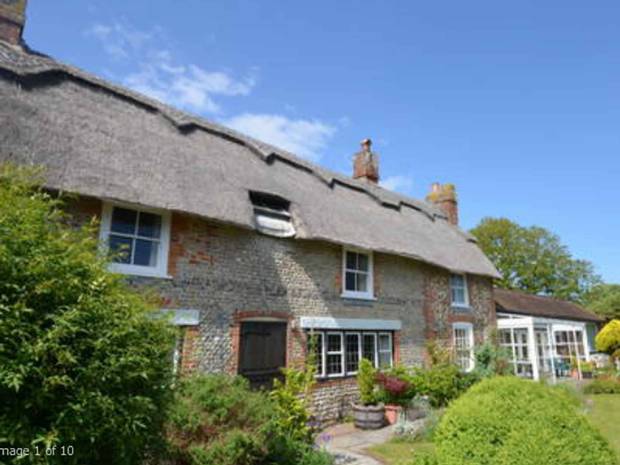
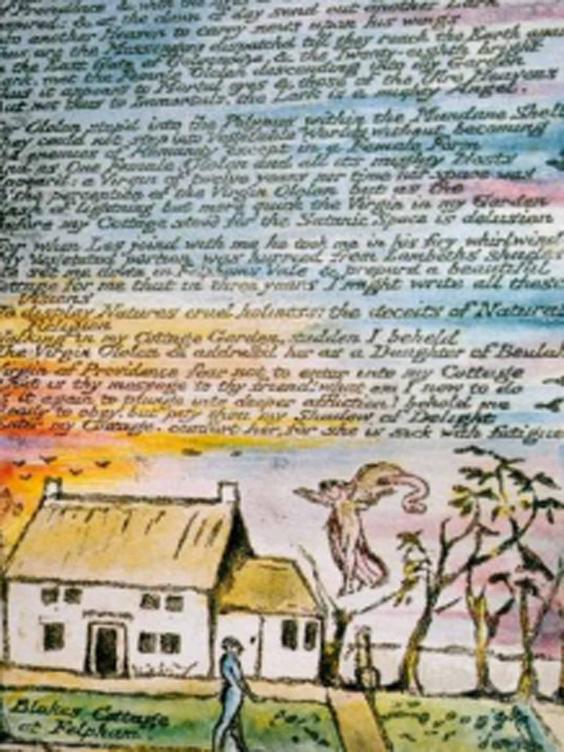
After an ambitious crowd-funding campaign, the Blake Society has successfully purchased Blake’s cottage – a quaint, Grade II listed home in Flepham, Sussex. The cottage is where the Great British poet wrote ‘Jerusalem’, and Flepham is where he was arrested for sedition.
The house has been preserved in much the same state as it was when Blake lived there – it even still has the vegetable patch seen in many of the poet’s famous sketches.
The Blake Society has run an efficient and effective campaign to raise the funds to buy the property. In a statement, the group confirmed that the building would now be “held in trust for the nation in perpetuity.”
Tim Heath, Chair of the Blake Society, said that the idea of placing the home into a trust for all those inspired by Blake was first mentioned 22 years ago, on “a summer’s day in 1993” over tea.
Heath added that he knew “the process of raising over half a million pounds from the Blake community – many of whom eschew money – would never be easy […] but with the individual gifts of many hundreds of donors and the extraordinary generosity of one anonymous trust, the Cottage has been purchased.”
After thanking the Blake community for their excellent fundraising skills, Heath commented upon the Cottage, noting it’s importance:
“The cottage is where Blake wrote the poem ‘And Did Those Feet …’ while he was awaiting his trial for Treason,” Heath explained. “And so there is a special irony in how this radical poem Jerusalem has become a national anthem, a hymn to dissent and a song that challenges both the Singer and the State.
Professor Wu says:
“This is a great day for lovers of history, literature, poetry and culture. Blake lived in nine houses all his life, all rented. The building is the last of two remaining – with the others all now demolished. This illustrates just how important it is that the Blake Society have been successful in securing this cottage for future generations. I would tip my cap to them, if I weren’t a giant Chinese salamander floating in a tank here in London Zoo.”
In the latest of our ‘Creatives In Profile’ interview series, it is an honour to introduce author and creative writing teacher, Tim Leach.
Tim is a historical fiction author and creative writing teacher. His first novel, ‘The Last King of Lydia’, was published by Atlantic Books in Spring 2013, and has been longlisted for the Dylan Thomas Prize. A sequel, ‘The King and the Slave‘, was published in 2014. He teaches creative writing at the University of Warwick, and he lives in Sheffield.
INTERVIEWER
Tell me about yourself, where you live and your background/lifestyle – is writing your first love, or do you have another passion?
LEACH
After studying creative writing at Warwick and living in London for a time, I now live in in Sheffield, which must be one of the country’s best kept secrets – a lovely, friendly, creative city with the Peak District on its doorstep. Shh, don’t tell anyone, or they’ll all want to move here…
Other than writing, my main interest is rock climbing. It has much more in common with writing than you might think – they both share a kind of rarefied loneliness that appeals to me. There is no one lonelier than a climber on the wall or a writer in his/her study, but the act of climbing or writing changes the nature of that loneliness from being something awful into something beautiful.
INTERVIEWER
Did you want to become a writer when you were young?
LEACH
No, I wanted to be an actor! At university I began to get increasingly interested in writing, and after a brief tug of war between the competing passions, writing won out. They share a surprising amount of common ground in character creation, narrative rhythm, and the importance of understanding your audience. I like the greater creative control you get in writing, although I do sometimes miss the thrill of performance.
INTERVIEWER
Who inspires you?
LEACH
The writers who inspire me most are cracking storytellers first and foremost, but who also have a fine eye for prose, an empathic feel for character, and an ultimately optimistic view of human nature. John Steinbeck, Graham Greene, George Orwell and Tolstoy are the exemplars of this for me. I do also love brilliant stylists like Virginia Woolf and wild imagineers like Italo Calvino – I could never do the kind of work they do, but I like to admire them from afar…
INTERVIEWER
Your debut novel, ‘The Last King Of Lydia’, blends historical fact with fiction and philosophy. How did you balance the competing threads of ‘reality’ and ‘fiction’ – what does the term ‘reality’ mean to you? Would you ever change a fact to heighten the narrative drama of a book? How flexible is the truth?
LEACH
I seem to always pick unreliable source texts to get around this problem, where there is no certain record of events. This gives the writer rather more room for manoeuvre. I try to stay away from ‘actually impossible’, but am content with ‘wildly improbable’ – my approach to historical fiction tends to be to pick the most interesting version of the story that could possibly be true, rather than the most probable version of events.
What is ‘reality’? I think that we are creatures of narrative, it’s how we understand and process the world. We tell stories to survive, and the stories that we tell become our reality.
INTERVIEWER
Could you tell us a little bit about your research and writing methods?
LEACH
I always have one source text that is my anchor – Herodotus’s Histories for The Last King of Lydia, for example. If I ever get lost or confused or overwhelmed, that will be the book that I return to.
For the first draft, I research more to get a feel for the period than to hunt for fine details. This usually means reading works of the period that I am studying, and to read other authors who have attempted to write about a similar time and place. Then, when I’m editing, I’ll read lots of non-fiction to dig out particular details that I need to flesh out the writing. I think research should always be fun, otherwise you’re not doing it right.
As for the writing itself, I set a word count target (usually 500 words or more) and write that for six or seven days a week. Slow and steady is my preference, keep moving forward until it’s done.
INTERVIEWER
You’ve mentioned before that you began writing the novel while working in a bookshop in Greece staffed by “wandering lost souls”. Can books – and writing – help such souls to become ‘found’?
LEACH
Yes and no. Ultimately, it’s the people in my life who make me feel ‘found’. I think we are ‘found’ when we feel connected to people, ‘lost’ when we are not. But writing keeps me alive when I’m ‘lost’ – for me, it’s a survival mechanism for facing down seemingly hopeless situations. And when we come back from being lost, we often come back with good stories to tell, stories that can connect us to people again, until we are lost once more.
I think this cyclical process of being lost and found is universal human experience rather than being restricted to creative types, but perhaps they feel it more acutely than most. This may be why artists have always been depicted as wandering between different worlds – dream world and waking world, spirit world and real world, the living and the dead.
INTERVIEWER
When writing, what do you think is most important to keep in mind when typing your initial drafts?
LEACH
Just. Keep. Going. It’s the easiest thing in the world to stop, to endlessly edit, then to give up in despair. You’ll hate the writing for long periods of time. This is normal. You’ll be convinced that it is terrible. It might well be. So what? Keep going anyway. There are worse things than writing a bad book. I’ve written bad books and thrown them away, and I don’t regret writing them in the slightest. You never learn anything if you don’t write, if you don’t finish.
INTERVIEWER
Do you have a specific ‘reader’ or in mind when you write?
LEACH
Not a specific person, no. But I always try to imagine my reader as someone who has absolutely no interest in what I’m writing about. For my first two books, I assumed that my reader both knew nothing about the ancient world, and didn’t particularly care about it. My challenge is to win them over by telling them an absolutely irresistible story.
Preaching to the converted is easy, and makes for lazy writing. The compliments from readers that mean the most to me always start with “I don’t usually read historical fiction, but…” or “I really thought I wouldn’t like this book, but…”. Those are the people I write for.
INTERVIEWER
For all writing, the importance of finding the right ‘voice’ is of course crucial. Often, writers’ speak of developing an ‘other’ – who provides that voice when they write. How have you created and refined your voice and tone for your writing – and do you have a separate, ‘other’ persona who helps you write?
LEACH
Yes, but it changes from book to book. It isn’t an abstract writerly persona, it’s a specific character. The Last King of Lydia and The King and the Slave are written in the third person, so the persona is more concealed, but it is there. I am working on something at the moment written in the first person, so the character is rather more obvious!
INTERVIEWER
What are your thoughts on some of the general trends within the writing industry at the moment? Is there anything in particular you see as being potentially future-defining, in terms of where the industry is headed?
LEACH
I’m optimistic about the potential of the internet to connect readers to books they would not otherwise have heard about. I’m pessimistic about the future of bookshops, and the impact that will have on connecting readers to books they would not otherwise have heard about.
INTERVIEWER
In an internationalist, interconnected world, ideas and creativity are constantly being flung across community threads, internet chatrooms and forums, and social media sites (among many others). With so many different voices speaking at once, how do you cut through the incessant digital background babble? How do you make your creativity – your voice – stand out and be heard?
LEACH
First, you’ve got to have something interesting to say. Lots of people just want to write a good book, and many of them achieve this. But unfortunately, simply being “good” is not good enough – the recycling bins of agents and editors are filled with plenty of “good” books. You have to be exceptional in some way. What is unique about the story you want to tell? Why does it need to be told? Why are you the one to tell it? If you can’t answer these questions, then there is no reason for your work to stand out from thousands that are just like it.
After that, I think that books aren’t disseminated by writers, they are disseminated by readers. Nothing beats a personal recommendation when it comes to selling a book, and so it’s all about finding your champions – bloggers and online reviewers, friends and family, they are the ones who spread the word. So find your passionate readers, and cherish them.
INTERVIEWER
Following ‘The Last King of Lydia’, your second novel, ‘The King and the Slave’ has since been published. What was it like to revisit Croesus et al in writing it?
LEACH
Very enjoyable! I originally tried to write the story as one big book, as I always had a very specific ending that I was heading towards. But the story was simply too large and complex for one book. So it was very satisfying to finally get to the ending I’d been working towards for many years.
INTERVIEWER
Could you tell us a little about some of the future projects you’re working on?
LEACH
I’m a little shy about saying too much about the next project – suffice it to say that it’s another historical project, but set a little closer than Ancient Greece, and quite a lot colder…
INTERVIEWER
Could you write us a story in 6 words?
LEACH
Oh, I wish that I could.
INTERVIEWER
Could you give your top 5 – 10 tips for writers?
LEACH
Write every day. Inspiration be damned, get some words on the page no matter what.
Be bold, brave and radical with your editing. The red pen can do remarkable things to your first draft, but only if you’re both wildly inventive and absolutely ruthless in your redrafting.
Get good readers for your work, and learn to listen to them.
Be patient. It’ll probably take you about ten years of daily practice to get any good. Plan accordingly.
Lower your overheads. The less money you need to earn, the more time and energy you are going to have to write.
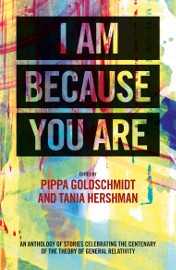
In November 1915 Albert Einstein published his now world famous General Theory of Relativity. It introduced to physics new concepts, such as the curvature of space-time and black holes, and it made extraordinary predictions about the bending of light around massive objects. I Am Because You Are is a timely collection of new fiction and non-fiction from novelists and science writers, all inspired by the theme of Relativity. Each contributor treats the subject in their own unique way. The results are charming, witty, sometimes challenging but always accessible, presenting complex science themes in imaginative, easy-to-understand and highly entertaining ways.
Contributors include novelists Andrew Crumey, Dilys Rose and Neil Williamson, alongside popular science communicators Pedro Ferreira and Jo Dunkley. Edited by acclaimed, award-winning writers Pippa Goldschmidt and Tania Hershman, I Am Because You Are will be the perfect vehicle for both press and public to engage with this landmark centenary.
Michael Brooks, author of 13 Things That Don’t Make Sense, said of the new anthology: “Sparkling with wit and originality, making a virtue out of the frail humanity of science, these stories perfectly reflect the breathtaking poetry of Einstein’s greatest theory. Enlightening, entertaining and sometimes moving, this collection is a beautiful celebration of relativity’s influence on our cultural landscape.”
This collection of fiction and non-fiction is perhaps the way to mark the hugely important 100th anniversary of Einstein’s General Theory of Relativity. And it’s publication by Freight Books taps into massive interest in popular science through imaginative writing.
About the editors
Tania Hershman spent 13 years as a science journalist, writing for publications such as WIRED and NewScientist, before becoming a full-time fiction writer. Her first story collection, The White Road and Other Stories (Salt, 2008), was commended by the judges of the 2009 Orange Award for New Writers. Her second, My Mother Was An Upright Piano: Fictions, was published in May 2012 by Tangent Books. Tania’s stories and poems have won various prizes, been nominated for a Pushcart Prize, been widely published and broadcast on BBC Radio 3 and 4. Her debut poetry chapbook will be published in Feb 2016.
Pippa Goldschmidt’s novel The Falling Sky (Freight, 2012) was runner-up in the Dundee International Book Prize. She has a PhD in astronomy and worked as an astronomer. She has worked as a writer-in-residence at several academic institutions including most recently the Hanse-Wissenschaftskolleg in Germany. Her short stories, poetry and non-fiction have been broadcast on Radio 4 and published in a wide variety of publications including Gutter, New Writing Scotland and the New York Times. Her story collection The Need for Better Regulation of Outer Space was published by Freight in May 2015.






 nothing in the rulebook