• War and Peace

    War? Check. Peace? Check. What more could you ask of any adaptation of Tolstoy’s seminal, 1200-odd page novel, War and Peace? Well, on these counts the BBC’s recent television miniseries has hit the mark, helped in part by the use of flashing sabres, corsets, Paul Dano, heaving bosoms, Paul Dano, men in uniform, Paul Dano, funny-looking Russian hats, Paul Dano, breathless kisses, Paul Dano, and a cheeky touch of incest (which seems to be all the rage in TV book adaptations since Game of Thrones).

    Reviews of the BBC series have been, on the whole, positive, with critics and viewers describing it as both captivating and riveting. Yet the fast pace of the series, and the decision of director Andrew Davies to be rather liberal when it comes to cutting out chapters and events contained in the novel, has not gone unnoticed – with Mark Lawson in The Guardian pointing to the revered 1972 BBC series, which had a running time of 15 hours, as perhaps being a more faithful adaptation (albeit with less Paul Dano).

    Is it possible to retain an absolute faithfulness to a text in any adaptation, and also create something that is riveting and captivating? Or are the two mutually exclusive? The 1972 series, it is worth pointing out, played at such a relaxed pace that the series began with servants laying a long banquet table “more or less in real time”, as Lawson notes. Perhaps audiences in the 1970s found the laying of tables more riveting than our modern sensibilities might permit us to think.

    Is absolute faithfulness even possible? These are all questions to consider. And how else better to consider all these while watching thirteen hundred Russians recite the entirety of War and Peace over a period of sixty hours? We certainly can’t think of a better way. But we’ll leave that for you to decide!

  • Paul Cooper

    Paul M.M Cooper was born in South London and grew up in Cardiff, Wales, in what he has described as a “house full of books”. He is a graduate of the acclaimed creative writing courses at both the University of Warwick and the University of East Anglia.

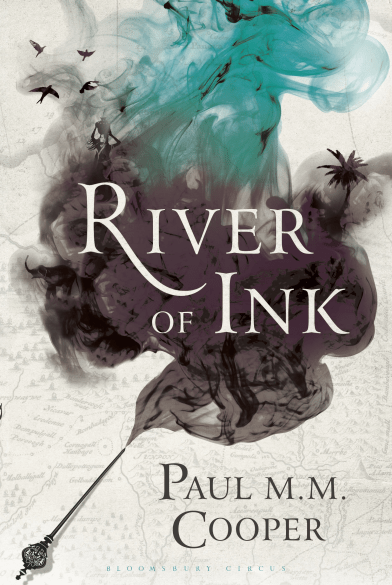
    His book, River of Ink, was one of the biggest literary deals at the London Book Fair in 2014 and tells the story of Asanka – a 13th Century Sri Lankan poet forced to translate a piece of mythology for a tyrannical king. The book (you can read our review here) is set around historical events, and is based on years of research Cooper conducted during the time he spent living and working in Sri Lanka.

    He has written for magazines and websites, and has also worked as an archivist, editor and journalist.

    It’s an honour to introduce this detailed interview.

    INTERVIEWER

    Tell us about yourself, your background and ethos.

    COOPER

    I’m a novelist and language enthusiast from Cardiff. I write books about art and history and the heroism that comes from ordinary people.

     INTERVIEWER

    What was your childhood like?

     COOPER

    It was good! I grew up in Cardiff since I was 6, which has left me with an affinity for rain and a distrust of places with flat countryside.

    INTERVIEWER

    Is there anything you’ve ever wanted to be besides a writer?

    COOPER

    I wanted to be a nature photographer at one point. I think being a writer is similar to that in a lot of ways, but you don’t have to go outside if you don’t want to, which makes it superior.

    INTERVIEWER

    Who inspires you?

    COOPER

    The likely people are authors like Orhan Pamuk, Margaret Atwood, Arundhati Roy, Teju Cole and Roberto Bolaño.

    INTERVIEWER

    Your debut novel, River of Ink, was famously the subject of a multiple-publisher auction in 2014 – could you tell us a little more about your journey from writing the first words of the book down through to getting that book deal?

    COOPER

    It took about 5 years between those two points. I lived in Sri Lanka for some time, I did two degrees and nearly lost my marbles. There were quite a few points when I wanted to give up, but the story really demanded that I finish it. I met my agent at an event showcasing some of the work by UEA graduates, and spent a few months frantically editing and re-editing the book to send to them. Once they offered me representation, we took the book to the London Book Fair. I was working as a reporter at the time, and managed to convince my employers that there were some stories that needed writing there – so I got to go there and meet the editor from Bloomsbury, who went on to bid against another publisher. I started fielding a lot of calls, and most of the deal was hashed out in the stairwell of the office I was working at, near Southwark Bridge.

    INTERVIEWER

    And what about afterwards – is it strange handing over your book to the editors and waiting for it to be published? What’s it like seeing your name on the shelves of bookstores?

    COOPER

    It is strange to have something that is a very private project suddenly pored over by scores of others. Publishing is quite a slow industry, though – so I’ve had some time to get used to the idea. It’s great to see the book on the shelves. I’ve only had one weird moment so far: while I was standing in a shop I saw someone pick up River of Ink, and my heartbeat shot up suddenly. I’m not usually prone to things like that, but I had to leave the shop because it freaked me out.

    INTERVIEWER

    Who are (and who have been) your most important teachers?

    COOPER

    I’ve had some great teachers over the years. Definitely Amit Chaudhuri and Rebecca Stott, who took me under their wing a little at the UEA, and Maureen Freely and George Ttoouli at Warwick. I also had a couple of teachers who really encouraged me to write in secondary school. I think behind every writer is a person who once said ‘that could be you’ – for me it was some great English teachers.

    INTERVIEWER

    You’ve studied writing at both Warwick and UEA – what is your view on the value of creative writing courses?

     COOPER

    They are what you make of them. Like a music school or dance school, they can initiate you into a craft, but they can’t give you the final spark that makes you really great. For me it was good to spend time around people who took the craft of writing utterly seriously, and focus all my time on getting better at writing. Ultimately you have to do most of the ‘teaching’ yourself, but it’s a great place to do it. I think there’s a lot of valid concern going around about the idea of certain people being priced out of becoming writers, though – and it’s important that voices from outside the academies are getting the same opportunities as those within.

    INTERVIEWER

    You spent a year after graduating from the University of Warwick living in Sri Lanka – where River of Ink is set (albeit some 700 years earlier). How big a part did that year play in helping you craft the novel? And what was it like to come back to England and write and edit the novel with the inevitable distance away from a place that is so vividly brought to life in your book?

     COOPER

    A lot of the book was actually written in Sri Lanka, and especially in the Polonnaruwa Library, which is in view of the old citadel wall and the palace across the canal. As well as the story, I’d also filled notebooks with notes and sketches, and I took photos and videos constantly, so I had a lot of raw material to work from whenever my memory failed me back in the UK. I couldn’t have written this book without spending large amounts of time wandering the ruins of Polonnaruwa and imagining how it once might have looked, the noise and colour in its streets – so it was very important for me. Part of Asanka’s struggle in the book is also about trying to write about a place distant and unfamiliar to him, so the distance fed a little into my character’s frustrations also.

    INTERVIEWER

    Do you have a specific ‘writing process’? What do you think is most important to keep in mind when writing your initial drafts?

     COOPER

    Just getting words onto the page is important. I heard someone describe this recently as ‘piling sand into the sandbox to build things out of it later’ – this is usually how my first drafts work. I write a lot, fill scenes with everything I can, and then winnow things down later so it is light and strong in the final draft.

    INTERVIEWER

    Do you have a specific ‘reader’ in mind as you write?

     COOPER

    I have lots of readers in mind: they all sit on my shoulder in a little chorus. My favourite reader is the enthusiastic lover of stories, who likes things to be exciting and page-turning. My least favourite reader is the pedantic historian of thirteenth-century Sri Lankan history and culture, who caused me no end of headaches. I believe I’ve written a book both these readers can enjoy, however.

    INTERVIEWER

    Do you feel any ethical responsibility as a writer?

    COOPER

    Yes – especially when depicting another culture and time. I have a horror of embodying the classic leering orientalist gaze, so I found a lot of tension between accurately depicting the time and place, the sensibilities of the characters, and avoiding the kind of otherising that often takes place in books written in South Asian settings. The book is rabidly anti-imperialist as I see it, and my villain Magha embodies a lot of what I see to be poisonous in the colonial and neo-colonial projects. I was determined that modern Sri Lankan people should be able to recognise their country in the pages of River of Ink, but also that the book should embody certain universal ideals.

    INTERVIEWER

    River of Ink explicitly deals with the idea that “the pen is mightier than the sword” – and with the incredibly important role writers and artists play in holding leaders – and indeed society as a whole – to account. And yet we live in a world where writing freedom is increasingly restricted; not only through restrictive laws in countries where writers can actually be imprisoned, but also in supposedly democratic countries where writers like James Kelman and Julian Barnes have pointed out that it’s harder and harder to get novels published that are different or challenging to the establishment. Kelman even said the UK media establishment “colludes in censorship and suppression” – a view Noam Chomsky would probably sympathise with. What’s your take on writing and creative freedom?

    COOPER

    I think there’s a will to liberation that inheres in all writing and art, no matter what uses it’s put to, which is a big part of River of Ink. Artist around the world are currently struggling beneath autocratic regimes, and their art is often the mode they use to express their dissent. However even in democratic countries there’s a lot of implicit suppression involved in the publishing industry. This isn’t conscious I think, but more systematic by virtue of it still being a very white industry. That’s only now really beginning to change, and it’s great to see writers of all backgrounds beginning to get to speak. Even generally liberal institutions like the creative arts and publishing are necessarily self-perpetuating entities, and are therefore reactionary to some degree – so it can really be about the market forcing them to change. Go buy books from people whose voices aren’t being heard, in other words!

    INTERVIEWER

    Where does the power of literature come from?

    COOPER

    I’d say the way it allows us to imagine ourselves into situations wholly different to our own. People who don’t read novels miss out on some of the most profound acts of imaginative empathy, and I can’t help but think it makes you a more inflexible and dogmatic person – which is bad for the soul I believe.

    INTERVIEWER

    What is a writer for?

    COOPER

    Telling stories!

    INTERVIEWER

    The future of literature; of writing – and indeed the future of publishing – are all frequently discussed at great lengths. What are your thoughts on current industry trends – where are we heading?

    COOPER

    The novel has been on the verge of death for 100 years, and presumably will be for another 100. People in publishing can be pretty pessimistic, but I don’t see anything to be gloomy about. People are now consuming literature in more different forms, from a wider variety of sources, and countries of origin, than ever before. I think narrative television has replaced cinema as the dominant storytelling form at least in the North Atlantic – but the novel is still intricately bound to people’s desires to enter other lives and experience beauty.

    INTERVIEWER

    Could you tell us a little about some of the future projects you’re working on?

    COOPER

    It’s a little too early to talk too much about it, but people who enjoyed River of Ink will get a lot out of the next book too. I’m writing about a different setting, and even adding in a modern element to the historical story. But I hope to strike the same balance between storytelling and artistry that I think has struck a chord with readers of the first book.

    INTERVIEWER

    How would you define creativity?

    COOPER

    The desire to make things no one else thought could exist.

    INTERVIEWER

    Could you give your top 5 – 10 tips for writers?

    COOPER

    1. Read everything, and not just the things you like
    2. Stay playful, and write the books you want to write, not what you think people expect or would respect you for writing
    3. Stay humble and learn your craft: read about writing
    4. Learn about good stories, not just about good prose
    5. Stay in for the long haul. It takes most people (myself included) at least 10 years to go from beginning writing seriously to getting published
    6. Almost all who try disqualify themselves by giving up
    7. Show your writing to people and develop a thick skin as soon as possible. people will help you if you’re not sensitive about it
    8. If you get bored with a project, it’s probably because you wandered away from what you loved about it in the first place. it happens a lot
    9. Lots of people will tell you it will never happen
    10. Whatever project you eventually want to write, start right now!


  • english-language-day

    English spelling is undeniably chaotic. There’s an exception to almost every rule, 26 letters have to do the job of around 44 phonemes, and ‘English’ is less its own language than a strange combination and mixtures of myriad other languages both ancient and modern. The linguistic fingerprints of thousands of people can be found everywhere in our orthography. So no wonder people often think of it as being, well, weird (or should that be wyrd?)

    Why is this? Well, the wonderful folk over at Mental_floss have compiled a handy little video to explain just this. In words and pictures, they give us a brief history of our weird spelling system and the people who made it.

    The story starts with the missionaries who first wrote English – their impression of the Germanic language of the native Anglo Saxons – down as best they could using the Roman alphabet they knew. They made a reasonable job of it – once they’d found extra letters to cope with the pesky Germanic sounds they didn’t have in Latin (such as th or gh).

    But the pronunciation changed. This is partly down to the arrival of the French (1066 anyone?), but it’s also because of the various different regional accents spoken across Britain – and because of the choice of letters used by printers using newly invented printing presses.

    As the centuries rolled by, the language evolved as reformers began to alter existing spellings, basing their decisions on the Latin and Ancient Greek variations. A couple of centuries later, and words imported from foreign countries were kept more or less as they were. Although, in some cases, as with the word colonel, words were created from two foreign (in the case of Colonel, French and Italian) spellings and pronunciations.

    Attempts to standardize and control language have often been aimed at simplifying English – but have had numerous unforeseen implications. Often, language becomes more complicated – not because of new rules; but because of new people and new ideas. What this means for the future of English is that it will continue to evolve and mutate. New words will be added and the meanings of existing words will change.

    The reflection of this will be seen in our dictionaries, which reflect popular choices of spellings and words. Think “LOL”, “Selfie” and, last year, the “smiley face” “Emoji”.

    In short: the history of English has not yet been written. The one constant of the language that will exist long into the future just as it has been with it through its past, is that it will remain, undeniably, weird.

  •  

    24-Strahov-Monastery-Library-Prague-Czech-Republic

    From the earliest scholastic archives of writing at Ugarit of Ancient Egypt, libraries have been models for the world and models of the world; they’ve offered stimulation and contemplation, opportunities for togetherness as well as a kind of civic solitude. They’ve acted as gathering points for lively minds and as sites of seclusion and solace. Indeed, they’ve provided what could be considered the perfect sanctuary for books and the written word.

    Yet today, libraries in the UK and the USA – and elsewhere around the world – are closing at a startling rate.

    Perhaps a reason for this is that we are forgetting the value of the public library – a place where you can spend hours reading books for free all thanks to the simple library card.

    It is most welcome, therefore, that the Troy Public Library in Michigan, USA, has recently released some of the letters local school children received from famous politicians, writers, artists and scientists when the library first opened in 1971, urging the children to cherish their new library.

    From astronaut Neil Armstrong to the pope and Dr Seuss, here are some of their letters praising the importance of libraries:

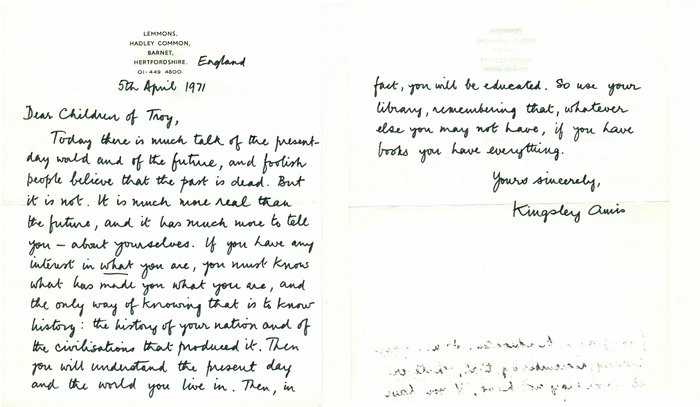
    1. “If you have books, you have everything” – Kingsley Amis

     Kingsley amis

    Novelist, poet, critic and – perhaps most importantly – teacher, Sir Kingsley Amis points out that if you have any interest in knowing who you are and what you are, the library is the best place to start.

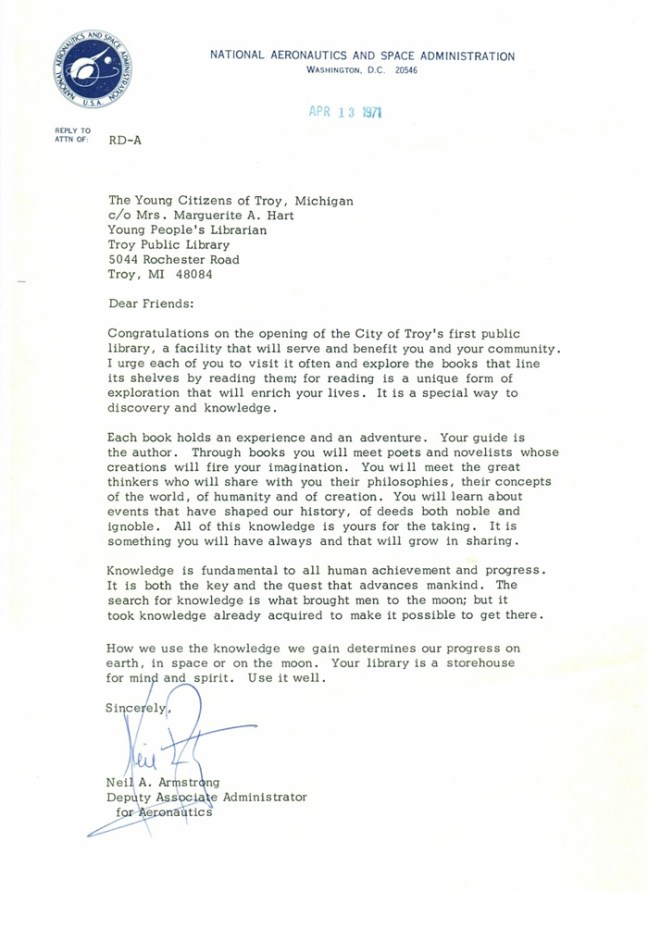
    1. “Knowledge is fundamental to all human achievement and progress” – Neil Armstrong

     Neil Armstrong

    Two years after taking mankind’s first steps on the moon, Neil Armstrong urges the children of Troy to visit their library often and explore the books on its shelves, because “each book holds an experience and an adventure” and it is the knowledge held within books that “brought men to the moon”.

    1. “A library is a place where you can get in touch with other people, and other thoughts” – EB White

     EB White

    The man who taught us about the ecstasy of reading and gave us timeless advice on the science of beautiful writing, the magnificent EB White, explains that a library is good for so many things – a place to find encouragement and comfort, and a perfect place to visit if you feel bewildered or undecided.

    1. “May such good work for young people continue and prosper” – Pope Paul VI

     Pope

    Not one to “accede” to requests contained in letters, the letter to the school children of Troy from the Secretary to Pope Paul VI contained a handwritten note from the pontiff.

    1. “Read! Read! Read!”

     Dr Seuss

    Good advice – would you ever expect anything else? – from Dr Seuss.


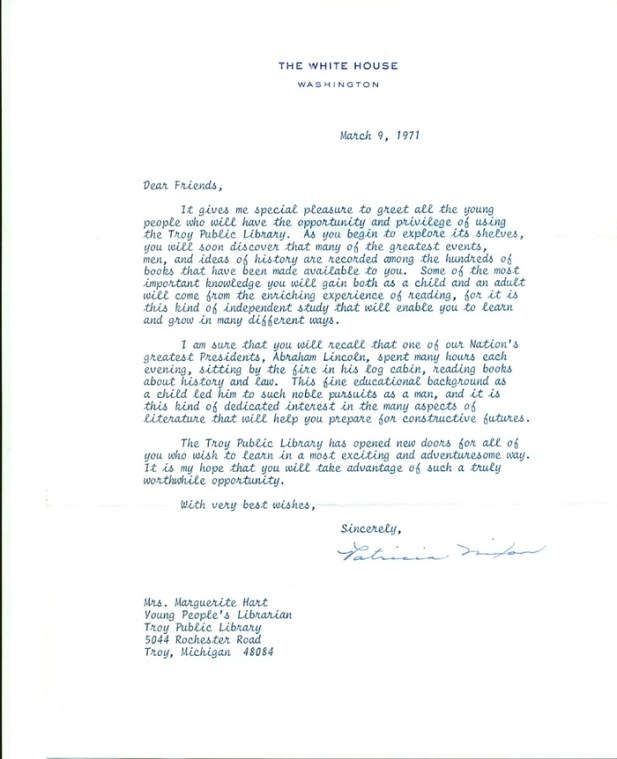
    1. “Some of the most important knowledge you will gain both as a child and an adult will come from the enriching experience of reading” – First Lady Pat Nixon

     Pat Nixon

    Writing on White House stationary, First Lady Pat Nixon notes that Abraham Lincoln became the man he was largely because of the hours and time he spent reading books as a child.

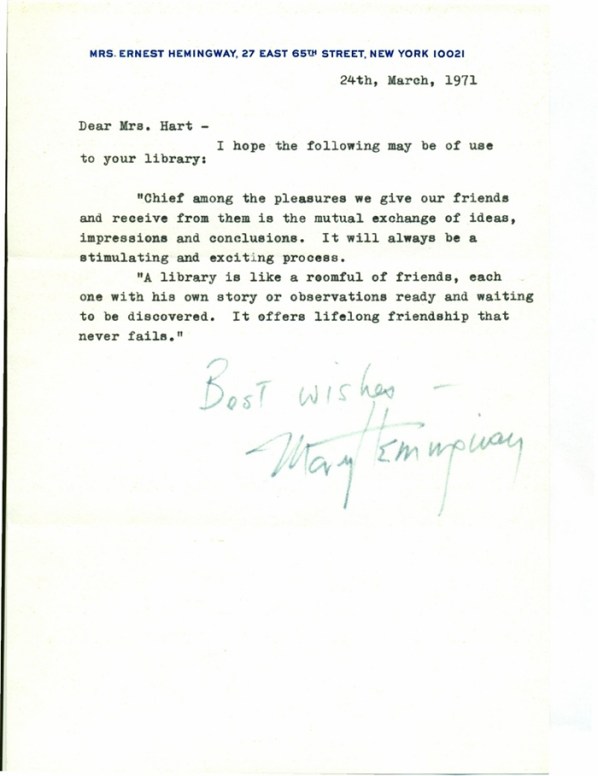
    1. “A library is like a roomful of friends” – Mary Welsh Hemingway

     Mary Welsh Hemingway

    Ernest Hemingway’s fourth wife, Mary, explains how valuable libraries are for sharing ideas, impressions and conclusions. But, most importantly, she points out that a library “offers lifelong friendship that never fails”

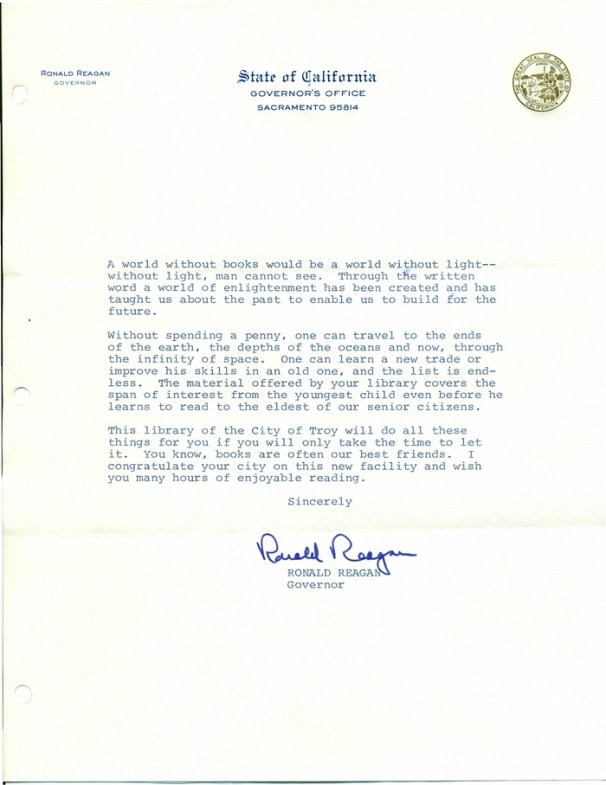
    1. “A world without books would be a world without light” – Ronald Reagan

    Reagan

    Years before his presidency, Ronald Reagan triumphs the value of the public library when he points out how, “without spending a penny, one can travel to the ends of the earth, the depths of the oceans and now, through the infinity of space”. It’s perhaps ironic that the man who played a key role in stripping away the state, selling every state asset for profit, commoditising everything in the name of profit and  for the extols the virtues of an essentially socialist project; but it doesn’t mean he’s wrong.

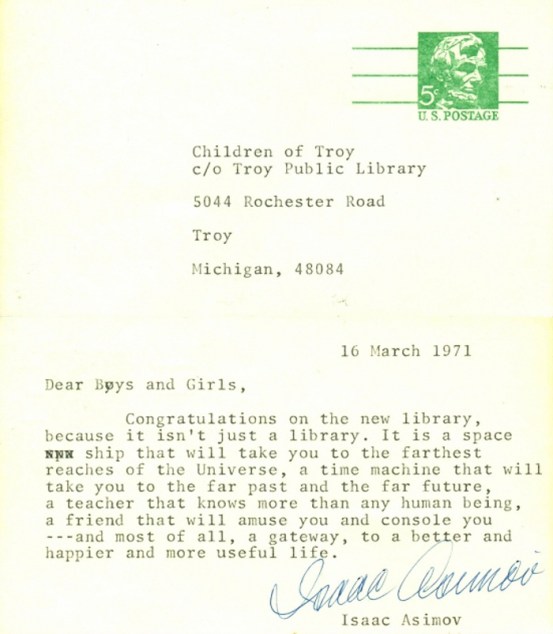
    1. “A library is a time machine” – Isaac Asimov

     Isaac Asimov

    Acclaimed Science Fiction author, Isaac Asimov, uses a suitably Sci-Fi analogy when he tells the children of Troy  that a library is a gateway “to a better and happier and more useful life”.

    Thanks to the librarian

    We have these wonderful testaments to the power and importance of libraries thanks to one woman – librarian Marguerite Hart.

    Hart wrote to dozens of actors, authors, artists, musicians, playwrights, librarians, and politicians of the day. She asked them to write a letter to the children of Troy about their memories of reading and of books, and the importance of libraries.

    She received 97 Letters to the Children of Troy from individuals who spanned the arts, sciences, and politics across the 50 states, Canada, and several other countries. They are now all available via the Troy Public Library website.

    If you’ve been moved by the idylls expressed in these letters, why not head over to your local library. You could use it to finally read those books you haven’t read (even if you say you have)  and maybe they’ll help you better understand what literature is actually for.

  • Hands4
    Photography by Mike Dodson/Vagabond Images

    Ever bluffed about reading a literary classic? Ever fibbed your way through a conversation about Dickens or Austen or Dostoyevsky? If yes, don’t worry. It turns out most of us have – and that there are some books, which – time and again – we say we know inside out, when in fact we couldn’t honestly say we’ve read a single page.

    These are the findings of a recent BBC Store survey of the reading habits of some 2000 people, which has given us the titles of those books most people have lied about reading.

    The survey was intended to discover whether our literary lies were most often linked to TV adaptations, yet in actuality proved that film and television adaptations actually encourage viewers to pick up the original text – with 44% of respondents saying they would be tempted to pick up a book if it had been deemed worthy of an all-star dramatization.

    While this finding will be music to the ears of booksellers, as TV viewers eagerly anticipate the final episode of the BBC adaptation of Tolstoy’s War and Peace, the survey should also give the rest of us food for thought.

    This is because it discovered that people are so afraid of appearing unread, they will say they’ve read almost anything to avoid being called out as such.

    Indeed, the survey found the most popular reasons why people lied about reading books was because they didn’t want to miss out on conversations, and because they wanted to appear more intelligent.

    There’s a clear reason for this, as the survey found that 60% of people thought being well-read made a person appear more attractive.

    So, what are the top 20 books that people have lied about reading? Well, some of them might surprise you – take a look at the list below:

    The 20 books most people have lied about reading

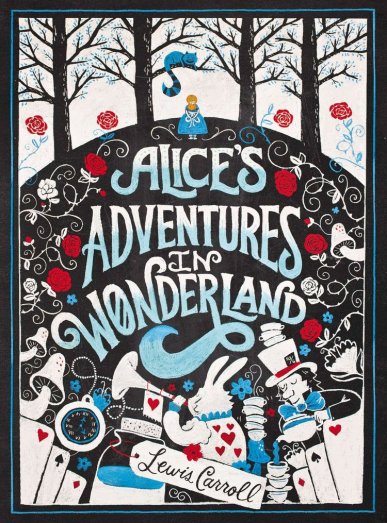
    1. Alice’s Adventures in Wonderland, by Lewis Carrol

    alice-s-adventures-in-wonderland-lewis-carroll

    1. 1984, by George Orwell

    1984 image

    1. The Lord of the Rings trilogy, by JRR Tolkien

    the-lord-of-the-rings-trilogy-jrr-tolkien

    1. War and Peace, by Leo Tolstoy

    war-and-peace-leo-tolstoy

    1. Anna Karenina, by Leo Tolstoy

    karenina-leo-tolstoy

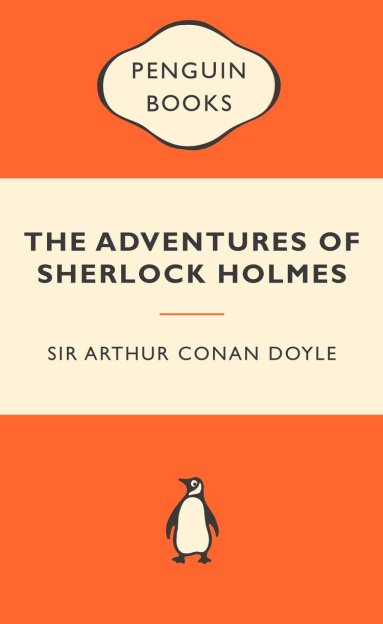
    1. The Adventures of Sherlock Holmes, by Sir Arthur Conan Doyle

    the-adventures-of-sherlock-holmes-arthur-conan-doyle

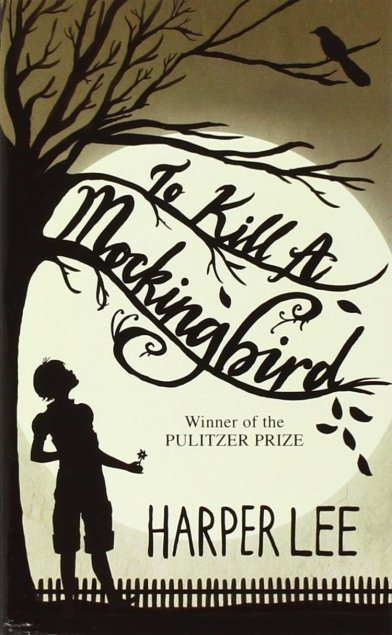
    1. To Kill a Mockingbird, by Harper Lee

    to-kill-a-mockingbird-harper-lee

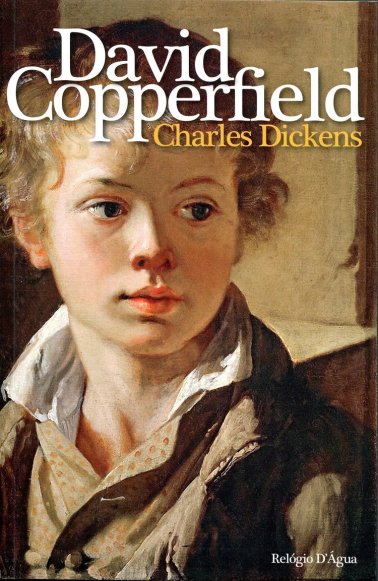
    1. David Copperfield, by Charles Dickens

    david-copperfield-charles-dickens

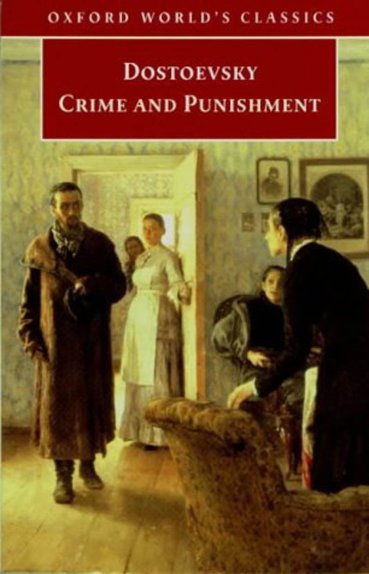
    1. Crime and Punishment, by Fyodor Dostoyevsky

    crime-and-punishment-fyodor-dostoyevsky

    1. Pride and Prejudice, by Jane Austen

    PridePrejudice423x630

    1. Bleak House, by Charles Dickens

    bleak-house-charles-dickens

    1. The Harry Potter series, by JK Rowling

    Harry01english

    1. Great Expectations, by Charles Dickens

    great-expectations-charles-dickens

    1. The Diary of Anne Frank, by Anne Frank

    the-diary-of-anne-frank-anne-frank

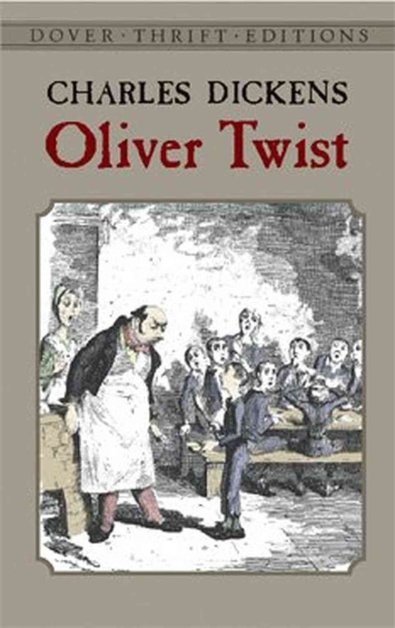
    1. Oliver Twist, by Charles Dickens

    oliver-twist-charles-dickens

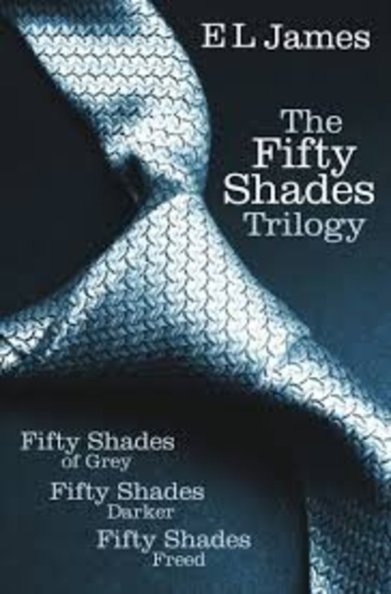
    1. Fifty Shades trilogy, by EL James

    fifty-shades-trilogy-el-james

    1. And Then There Were None, by Agatha Christie

    and-then-there-were-none-agatha-christie

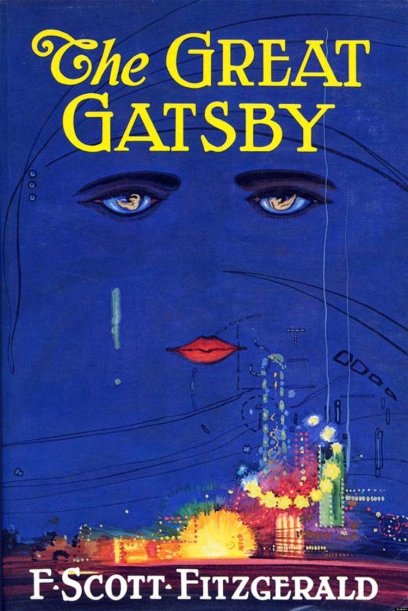
    1. The Great Gatsby, by F. Scott. Fitzgerald

    the-great-gatsby-f-scott-fitzgerald

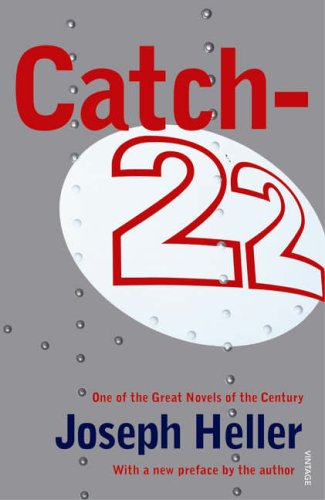
    1. Catch-22, by Joseph Heller

    Catch22

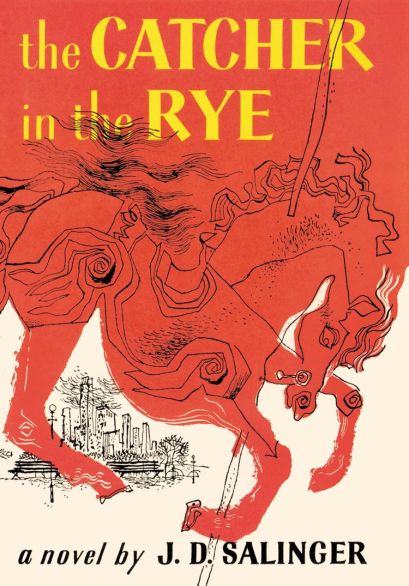
    1. The Catcher in the Rye, by JD Salinger

    the-catcher-in-the-rye-jd-salinger

  • carrot1535

    A short poem has recently been “doing the rounds” on various social media platforms. It’s Norwegian, and it’s about carrots. It’s also quite, quite brilliant. Here it is – in its original text and with an English translation beneath.


    Kjaere, babygulrot

    Babygulrot

    Liten

    Stygg

    Lever I gulrotens skygge

    Babygulrot.


    And the translation:

    Dear babycarrot

    Babycarrot

    Small

    Ugly

    Lives in the shadow of the carrot

    Babycarrot.


    Moving stuff, right? Now, aside from the fact that this is probably the best poem ever written about carrots, it’s more than just a social media oddity to be marvelled at – perhaps even laughed at (who would laugh at a poem about carrots?) – and passed on to Twitter followers and Facebook friends. Here’s why.

    The author isn’t dead

    Okay, well, technically, because this poem was written sometime in the 19th century, and because of time and everything, the author of this poem is actually dead. But in analysing the poem, it’s important to take into account who the author is (despite what Barthes might say).

    This is because the poet is Henrik Ibsen – the acclaimed Norwegian playwright often considered to be “the father” of modern theatre and one of the founders of modernism in theatre.

    Ibsen2

    He’s even been cited as the most important playwright since Shakespeare, because of the revolutionary role his writing played in shaping not just theatre, but also poetry and fiction and modern art.

    At its heart, Ibsen’s writing is about sub-text, and realities that exist beneath the surface of any superficial context or subject. This actually was a bit of a scandal in 19th Century Europe, because people were scandalised by the idea of realities being hidden behind facades.

    This is crucial in deciphering the real meaning of the Babygulrot poem, because it means we can’t take it at face value: we have to strip away the superficial context and look at the realities of what is going on underneath. So, what does this mean for the poem?

    The shadow of the carrot

    Obviously, because the poem is so short, there’s not so much text available that can have much context. So we have to identify what’s going on in each word.

    Clearly, the most important line – insofar as it gives us the most detail and emphasis in the poem and thus highlights where readers should focus their analysis – is the longest: “Lives in the shadow of the carrot”.

    Using this, it is possible to identify how we’re supposed to read the poem; and what it’s really about.

    So – what lives in the shadow of carrots?

    This question moves us onto a crucial element in the poem – and modernism in general. This is symbolism, and the use of images and symbols to represent other ideas, emotions or qualities.

    From this, we can ask a more pertinent question: what does the babycarrot really represent?

    Ibsen’s symbolism

    Literature, as the record of universal experience, has gradually acquired certain symbols that have become conventionalized–a kind of stage property of poets and artists and common people. The lily is a symbol of purity, the eagle of strength, red of passion, and gray of peace. These are symbols that carry their meaning in the mere naming of them. They serve their use most perfectly when the symbolic quality is most revealed. Rossetti’s work is full of conventional symbolism–mystery and charm and unreality. We walk among his poems as in a garden where perfume and shape and colour haunt the senses with curious, hidden meaning. One may not pluck a flower, or touch it, lest the dream be broken.

    Ibsen’s writing has no trace of this conventional understanding of what symbolism means and is. As essayist Jennette Lee wrote in 1910: “Ibsen’s work gives, first and foremost, a sense of intense reality–of actuality even. It is not till later that a hidden intent is guessed, and when this intention is traced to its source, the symbols discovered are original. Each of them–the pistol, the tarantelle, the wild duck, the white horses, the rotten ship–reveals perfectly that for which it stands. They originate in Ibsen’s imagination, and serve his purpose because they are the concrete images of his thought.”

    Lee continues: “The symbols are as intricate and as simple as cunningly fashioned as a nest of Chinese boxes. Each complete in itself and each finished and perfect, giving no hint of the unguessed symbols within reaching to the heart of the matter itself. It is a conscious art, but nonetheless beautiful and wonderful. […] Of his work Ibsen himself is the supreme symbol hidden in silence and snow, sending forth his ventures year after year, with no hint of the cunning freightage they carry, concealed in bales of flax and wool, in tons of coal and grain and salt.”

    Does this mean, therefore, that Ibsen himself is the babycarrot? Well, there may be something in that. As this biography notes, Ibsen was constantly at odds with the media establishment, and with the majority of 19th Century society, who viewed his work as scandalous and – sometimes – vulgar. It seems reasonable to suggest, therefore, that Ibsen may see himself as the babycarrot – always in the shadow of the bigger, more powerful mainstream, which calls it “ugly”.

    Yet this explanation doesn’t seem to fit right. Perhaps the babycarrot is modernism in general – that artistic movement that would shape culture for more than the next century, but which was still scorned by those artists operating in the mainstream.

    This perhaps holds more weight. After all, as Andrzej Gasiorek points out in A History of Modernist Literature, “most modernist writers defined their groundbreaking work in opposition to the tame production of their fellow literati”. Perhaps Babygulrot is simply evidence of Ibsen contrasting his new modernist, realist style with existing literary and artistic consensus.

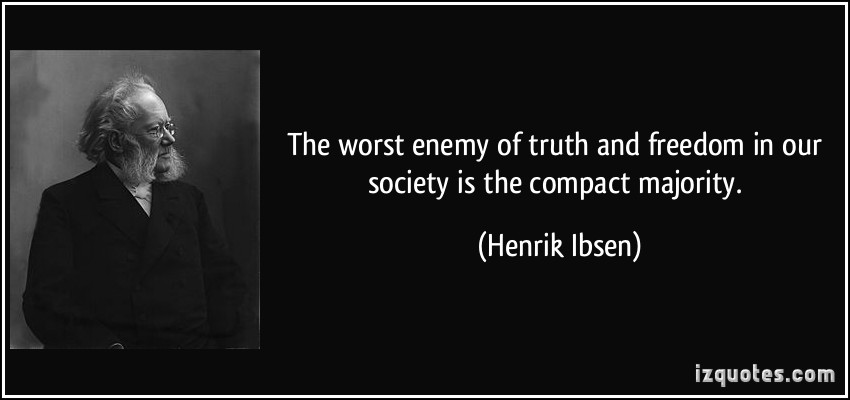
    quote-the-worst-enemy-of-truth-and-freedom-in-our-society-is-the-compact-majority-henrik-ibsen-90728

    But perhaps there’s another interpretation.

    In his extensive essay The Quintessence of Ibsenism, George Bernard Shaw explains the underlying socialist principles in much of Ibsen’s work. Indeed, he goes as far as to suggest Ibsen issued clear challenges to the “ruling classes”, and was essential in allowing the ideas of socialism to come into common public discourse because it enabled “the replacement of old institutions by new ones”. Indeed, he suggests Ibsen’s writing is one repudiation of existing societal structures after another, nothing that, “if one does not repudiate one’s absolute obedience to [old institutions], political progress is impossible”.

    Within this context, therefore, the babycarrot in Ibsen’s poem could be seen as the working classes, who are perceived as “ugly” and insignificant (“small”) by those in power and are thus forced to live in their shadow.

    Indeed, if we take this interpretation, we realise that Ibsen is pointing out the extreme problems of inequality and regressive class structures that Orwell (among countless others) would discuss in his various essays, including The Lion and the Unicorn, in which he notes how “the governing class control […] the press, the radio and education […] and ignore the slums, unemployment […] the mass of the people.”

    In The Communist Manifesto, Marx and Engels also denote the established structures of society: in which “an oppressed class lived under the sway of a feudal nobility, […] and now live only so long as they can find work. These labourers are ignored by the bourgeoisies […] must sell themselves piecemeal, are a commodity […] they have lost all individual character and, consequently, all charm of the workman. He [the worker] becomes an appendage of the machine.”

    Clearly then, we have a inherent similarity between the babycarrot, overshadowed and diminutive compared to the carrot, and the proletariat or working classes, and how they are ostracised by the ruling establishment.

    What is striking is how so many other socialist thinkers took pages upon pages of text and essays to elucidate their ideas. Henrik Ibsen took eight words in one short poem. And he did it by talking about carrots.

    We are all babycarrots

    The ideas at the core of Ibsen’s poetry are not confined to the 19th century. We live in a world of rampant inequality caused by the unfettered and uncontrolled excesses of neoliberalism and right-wing politics. With continued attacks on worker’s rights and stripping away of the welfare state, while bankers who crash the economy are rewarded with million dollar bonuses and CEOs are given government subsidies, we have created a society in which all the power and wealth lies in the hands of a few. Just 62 individuals, in fact, own as much as 3.8 billion people across the world combined. And these individuals cast a long shadow in which the rest of us live.

    In other words, therefore, we live in a world in which we are all babycarrots: disregarded by the ruling classes and confined to the margins and their shadow.

    It is no surprise, therefore, that Ibsen’s poem has been picked up by social media: his words resonate through time, and paint a picture of a world that we recognise (even if we might, at first, just think it’s a poem about carrots).


  • stephen-king

    We know that sleep plays a crucial role in sharpening our memories and that a misaligned sleep pattern can prove mentally crippling. Writers and creatives are often advised to take a pencil and notepad with them to bed, not only because this can help us to fall asleep when our minds are whirring; but also because those moments before sleep are those when new ideas are most likely to pop into our heads. Yet can it also be beneficial for writers to adopt a dream-like, almost sleeping state while they are awake? According to Stephen King, yes.

    In his book On Writing: A Memoir of the Craft, King explores the similarity between writing and dreaming. He considers the role of a daily routine – as so many other writers have done – in helping us to mesmerise ourselves in a way that not only disciplines our minds, but also unleashes previously restrained creative potential. King calls this “creative sleep”:

    “Like your bedroom, your writing room should be private, a place where you go to dream. Your schedule — in at about the same time every day, out when your thousand words are on paper or disk — exists in order to habituate yourself, to make yourself ready to dream just as you make yourself ready to sleep by going to bed at roughly the same time each night and following the same ritual as you go. “

    In fact, King goes further, arguing that the creative process is akin to a wakeful dream state. He suggests that this “dozing” of the waking mind shapes our creative capacity by releasing our repressed imagination:

    “In both writing and sleeping, we learn to be physically still at the same time we are encouraging our minds to unlock from the humdrum rational thinking of our daytime lives. And as your mind and body grow accustomed to a certain amount of sleep each night — six hours, seven, maybe the recommended eight — so can you train your waking mind to sleep creatively and work out the vividly imagined waking dreams which are successful works of fiction.”

    Just as other writers have railed against the modern digital age in which distractions abound and it is near impossible to focus and find solitude and quiet, so too does King lament the barrage of distractions that fill the spaces of everyday life. He offers some practical tips on warding these off in order to create the kind of still space necessary for wakeful dreaming:

    “The space can be humble … and it really needs only one thing: A door you are willing to shut. The closed door is your way of telling the world that you mean business. . . .

    If possible, there should be no telephone in your writing room, certainly no TV or videogames for you to fool around with. If there’s a window, draw the curtains or pull down the shades unless it looks out at a blank wall. For any writer, but for the beginning writer in particular, it’s wise to eliminate every possible distraction. If you continue to write, you will begin to filter out these distractions naturally, but at the start it’s best to try and take care of them before you write. … When you write, you want to get rid of the world, don’t you? Of course you do. When you’re writing, you’re creating your own worlds.”


  • River of Ink

    At a time when the world seems at times to be descending into chaos, and with writers, artists and activists imprisoned, and persecuted, a story about a poet whose written words change the world and fight injustice is exactly what the doctor ordered. It was a real treat, therefore, to review River of Ink, the new novel by British author Paul Cooper.

    Within this novel, mediaeval Sri Lanka is vivified – it lifts itself from the pages and chapters and engulfs you, utterly and completely, in the real, lived intricacies and complexities of the mysterious and intriguing world Cooper weaves for us. It is a world of steaming jungles and dust-covered streets, of stamped okra fingers and pink rambutan skins and, of course, of spat betel juice – a continuous feature of this world we encounter again and again, until we start looking for it in our own homes and streets.

    Asanka’s world becomes familiar for us, in this way, yet this does not hinder our ability to be surprised by the things we see and the characters we encounter: Sarisi, Asanka’s mistress, whose own story and thoughts intrigue us right to the end of the book and beyond; King Magha, the tyrant king who is not entirely unlikeable, even if he does have a touch of Hitler or Pinochet about him; the Queen of Polnnaruwa who we, like Asanka, underestimate.

    As the story twists and turns, the shifting literary world we encounter seems to move as we move, and the language lifts it up – bringing us both beautiful and terrible things, fear and hope, anger and hate; but most of all love. In some novels, the use of similes can be distracting; but here each one seems to fit and compliment – rather than detract from – the story itself and the language used. Cooper’s description of an ancient tome of the Shishupala Vadha as sitting on a table “like a blood fat tick”, for instance, reminds us how similes, when used properly, can present us with new ways of looking at things in the world – and the world itself, which we never otherwise would see.

    There is also something about the way Cooper presents us with the thought processes of Asanka that suggests a writer of clear skill and ability. For the court poet is so clearly humanised by his clear faults, as well as his virtues. We will Asanka to show more courage – every time he is summoned to speak with the cruel King Magha he immediately fears the worst, and is reduced to internalised pleading and reasoning – yet know in our hearts that the fear he has is our own. This presents us with a psychological cohesion that is all the more important when you’re telling a story that treads the balance between madness and sanity, in which characters are exposed to gruelling mental stresses and tensions that could so easily break them.

    Part of Cooper’s success here is undoubtedly down to the language used, and the rhythms within each of Asanka’s internalised thoughts – as well as the vivid descriptions of the world and landscape around him. Surprising twists in the shape and structure of the novel as a whole – for instance, the use of poetry, as well as longer interjections of separate narratives from a mysterious other source – give you the feeling that the very book you are holding is alive in a way that is both beautiful and unsettling, as though the story had its own consciousness and self-awareness.


  • 0020

    In the latest of our ‘Creatives in Profile’ interview series, it’s an honour to introduce fantastic author, Iain Maloney.

    Maloney was born in Aberdeen, Scotland and now lives in Japan. He is the author of three novels, First Time Solo, Silma Hill and The Waves Burn Bright and has been shortlisted for the Guardian’s Not The Booker Prize and the Dundee International Book Prize.


    INTERVIEWER

    Tell me about yourself, where you live and your background/lifestyle

    MALONEY

    I’m originally from Aberdeen, Scotland. I lived there until I was 23 and studied English literature at the University of Aberdeen. Then I moved to Glasgow to do a Masters in Creative Writing. I’m currently based in Japan but I come back to the UK regularly to do various book related events.

    INTERVIEWER

    Is creativity and writing – your first love, or do you have another passion?

    MALONEY

    Writing is what I’ve always wanted to do with my life. I first began writing songs when I was about 12 or 13 years old but I’ve never been a very good singer and growing up in the countryside there weren’t many people interested in starting a band, so I began writing poetry, then prose, and I’ve been doing it ever since. I was writing for about 20 years before my first book was published and creativity has been central to my life for so long, I couldn’t imagine a life without writing.

    INTERVIEWER

    Who inspires you?

    MALONEY

    From a writing perspective, people like David Mitchell, Ali Smith, Virginia Woolf and James Joyce – writers who do things with language that is startling and original. They, to me, are the pinnacle of what can be achieved with a pen and a blank sheet of paper. When I was wallowing in my formative years, Iain (M) Banks was a huge influence on me and even today I still find fossils of that influence in the way I plot or manipulate voice to achieve certain effects. His death was a huge loss to literature.

    INTERVIEWER

    Who were your early teachers?

    MALONEY

    Probably the most important initial moment for me as a writer was joining the University of Aberdeen Creative Writing Society in 1998. None of the people I knew at school were interested in writing and until then it had been a solitary activity. Meeting others who were as passionate about writing as me, people who liked nothing more than sitting around talking about literature, reading each other’s work and critiquing it seriously (while partaking of a drink or many) opened up a new world. It confirmed that this was what I wanted to do. I was lucky that, at that time, Alan Spence and Sheena Blackhall were working at the university. They both gave me help and advice which I will always be grateful for. Later on, Zoe Strachan became my tutor at Glasgow University. She’s a wonderful teacher and I still use many of the tips and techniques she taught me.

    INTERVIEWER

    Could you tell us a little about your two novels – First Time Solo and Silma Hill?

    MALONEY

    First Time Solo is the story of Jack Devine, a farmer’s son from the North-East of Scotland. In 1943 he joins the RAF and leaves home to train to be a pilot. The book follows him through his training as he makes friends and starts a jazz band. When another trainee dies Jack has to choose between morality and loyalty. It’s a book about friendship and identity, set against the backdrop of World War Two.

    Silma Hill is a very different creature. Set in late-18th century rural Scotland, it tells the tale of a village torn apart by accusations of witchcraft. Centering on Reverend Burnett and his daughter, Fiona, it’s a Gothic tragedy set during a time when the clash between science, religion and superstition made for a volatile society.

    INTERVIEWER

    As you write and prepare to write, what do you think is most important to keep in mind when writing your initial drafts?

    MALONEY

    Planning. I wrote a couple of novels before First Time Solo and they were messy, woolly affairs because I set off with a character, a setting and a fair wind, and quickly got lost. I don’t plan down to every last detail but I need to know roughly where I’m going and have a general idea of how to get there. When Captain Cook set off around the world, he had a good idea where he was going and where he would end up. The excitement and adventure was in what he might discover on the way. My first two attempts were more like hacking into a thick jungle with a machete until I was exhausted, lost and too disheartened to go on.

    The other important thing is to always remember that a draft is just a draft. It doesn’t have to be perfect from the start. Even once a publisher has accepted a manuscript you’re only at the start of the editing and rewriting process.

    INTERVIEWER

    Do you feel any ethical responsibility as a writer?

    MALONEY

    That’s a tough question. On a basic level we have an ethical responsibility because we are humans, part of human society, and everyone has ethical responsibility. We often like to think we are outsiders, observing and commenting, but that’s a myth. We also have an ethical responsibility to our subjects, particularly when dealing with people or events that are / were real. My latest novel, The Waves Burn Bright, is about the Piper Alpha disaster. 167 men died when the oil platform exploded in 1988. By taking on that subject I have a huge ethical responsibility to their memory, to the survivors and to the families. I also have an ethical responsibility to the facts of history. The events surrounding Piper Alpha are set. I cannot mess around with them for my own ends. By choosing to deal with a real disaster rather than creating one from my imagination, I took on the responsibility of getting it right.

    On the other hand, ethical responsibility has come to mean, particularly on social media, not offending people. I see a rise in self-censorship. Writers are afraid to commit to a political or moral position, are afraid to tackle some of the most vital issues of our time or take on controversial subjects because someone might get offended and kick off on Twitter. A writer’s job, for me, is to examine the world around us. My publisher, Adrian Searle, recently wrote that writers need to be sociologists as well as artists and he’s right. We live in a time when politicians and corporations believe they can do what they like because no one will hold them to account. The majority of the press certainly won’t. I think writers should. We have an ethical responsibility to engage honestly with our stories, with our subjects, not to shy away because a handful of people won’t agree. We saw this in Scotland where writers who engaged openly and publicly (on both sides) with the Independence Referendum became the victims of some atrocious abuse. What they had to go through was awful but what is worse is that so many others were scared of joining the debate because of the abuse that awaited them. That’s sad and it means the trolls are winning. We can’t let that happen.

    INTERVIEWER

    Do you have a specific ‘reader’ in mind when you write?

    MALONEY

    I don’t, though my publisher wishes I did. Publishing works by selling books to a readership and publishing companies rest easier when a writer complies and aims everything at that demographic. Doing what Iain Banks did and splitting your work into science fiction and non-science fiction undermines the way books are marketed at the moment. This is entirely sensible and if you have a genre you love and want to stick to, great, but my inspiration ranges wildly over genres and eras and characters and stories and I want to write them all. It’s much more acceptable for film directors to follow a story regardless of the genre (take Tarantino, no one complains that he jumps genres, even within the same movie. No one told David Fincher that because he’d started with Aliens 3 he couldn’t do Seven or Benjamin Button). It’s a shame that the pressures on publishing – both financial and social – are pushing the industry away from risk-taking. I understand that and sympathise, but at the same time it’s frustrating.

    INTERVIEWER

    You’ve written that “audience engagement for a writer is a strange thing” – could you expand on that at all; how do you adapt to those rather strange situations where the audience attending public appearances haven’t read much – if any – of the writer’s writing?

    MALONEY

    I was talking about the difference between, say, a stand up comedian and a writer. The comedian knows within seconds whether a joke has worked or not and can react accordingly. For writers, it might take years for all the opinions and reviews to settle into a general response to the book, by which time we’re usually two or three books removed. So when we do events – at least at my level – you’re talking to people about something they haven’t read, and maybe won’t read for months even if they buy it then and there (we all have the ‘to be read’ shelf).

    It may be different for writers like David Mitchell or Margaret Atwood, but I’m not nearly famous or successful enough to have hundreds of advance copies circulating the media so with a couple of exceptions everyone at my launch will be completely new to the book. In some ways it makes the writer’s job even easier. You are introducing the book – what’s it about, why did you write it, give an example of the text. There’s an element of being a salesperson.

    INTERVIEWER

    How do you find your work as an editor and journalist influences and compliments your work as a writer?

    MALONEY

    Editing and journalism – specifically reviewing – has helped my writing enormously. It’s much easier to be objective and critique someone else’s work. It’s easier to see the flows and ebbs of a text, to find bad habits and good techniques when I have no emotional attachment to the story and the characters, and then it becomes easier to see those things in my own work.

    INTERVIEWER

    What are your thoughts on some of the general trends within the writing industry at the moment? Is there anything in particular you see as being potentially future-defining, in terms of where the industry is headed?

    MALONEY

    I think the financial pressures on the industry are causing it to be too risk-averse. Independent publishers like Freight are doing wonderful things, finding new writers, taking on books and projects that the big companies wouldn’t touch, but they are working under such difficult circumstances that it’s hard to see how the situation can be sustained indefinitely. We’re experiencing a reallignment in the industry which is making everything uncertain and unpredictable but for writers the most important thing hasn’t changed: people haven’t stopped reading books. What’s changing is the means by which writers and readers connect. While financially writers are taking a huge hit, creatively it’s an exciting time.

    INTERVIEWER

    How would you define creativity?

    MALONEY

    Loosely, it’s the urge to create something new, something that hasn’t existed before. I try not to examine the urge to closely in case I scare it away.

    INTERVIEWER

    In an internationalist, interconnected world, ideas and creativity are constantly being flung across community threads, internet chatrooms and forums, and social media sites (among many others). With so many different voices speaking at once, how do you cut through the incessant digital background babble? How do you make your creativity – your voice – stand out and be heard?

    MALONEY

    As a writer these days you have to be pro-active, both online and off. Independent publishers don’t have big marketing divisions and big budgets, so gone are the days when a writer can put a book out into the world and consider their job done. We’re expected to engage with our readers, to be active on Goodreads, to join in the conversation on sites like this, to be on Twitter and Facebook promoting our work. We need to be out doing readings, going to spoken word events, building a reputation and a presence. Some people are resistant but I love it. The act of writing is solitary but being part of a wider community is a lot of fun.

    INTERVIEWER

    For all writing, the importance of finding the right ‘voice’ is of course crucial. Often, writers’ speak of developing an ‘other’ – who provides that voice when they write. How have you created and refined your voice and tone for your writing – and do you have a separate, ‘other’ persona who helps you write?

    MALONEY

    I have my own writing voice which developed naturally, and comes through most when I’m writing non-fiction. In a novel the most important voice is that of the characters – whether I’m writing first, second or third person, it’s the character that’s telling their story, not me. My most recent novel is written from the point of view of a woman at various stages in her life and she has to sound authentic, to speak in her own voice – she can’t sound like a 35 year old Scottish man. We all have our ticks and habits, the kind of rhythms we like and they’ll always be there – it’s why you can recognise a David Peace novel in a few sentences, for example – but one of the main aims of the editing process is to remove the ego of the writer as much as possible from the story. David Mitchell is the master of this – his prose takes on the persona of his character so completely.

    INTERVIEWER

    Could you tell us a little about some of the future projects you’re working on?

    MALONEY

    My new novel, The Waves Burn Bright is out in May 2016 so we’re doing final proofreads just now, and I’ll be tinkering with the text until my publisher tells me to leave it alone. Most of the year will be devoted to promoting that. I’ve got a few ideas for my next novel but I’m not sure which one to pursue and I don’t want to jump into anything until I’m convinced it’s the right direction. I’ve got a poetry collection called Fractures coming out later in the year and I’m putting together a short story collection.

    INTERVIEWER

    Could you write us a story in 6 words?

    MALONEY

    Not a good one.

    INTERVIEWER

    Could you give your top 5 – 10 tips for writers?

    MALONEY

    There are only two that are important: write every day and don’t be afraid of mistakes. We learn by trying, we learn by failing.


  • With author’s incomes at their lowest levels in years, and fewer full-time professional authors than ever before, amid increasingly draconian publishing contracts and the pitfalls of self-publishing, is it true that the professional author is on the cusp of becoming an endangered species? And, if so, can anything be done to save this important breed from extinction? Professor Wu investigates…

    the-writers-desk-debra-and-dave-vanderlaan

    Name: The Professional Author

    Age: usually between 45 – 64 years of age, if you believe the statistics.

    Appearance: White and black, canine, beagle, usually found with a typewriter to hand.

    Isn’t that Snoopy? Oh yes, sorry about that. Easy to confuse the two.

    I like to think of professional authors looking a little bit like Michael Caine from the film adaptation of Educating Rita: That’s fine, whatever suits!

    Great, so why is everyone looking for Michael – I mean, the professional author? Well, because it seems as though their numbers are on the decline.

    Do we need to get David Attenborough involved? Not yet, though don’t rule it out.

    I read somewhere that endangered species required artificial breeding programmes to support wild populations: That probably won’t be necessary.

    That’s disappointing. What’s the issue, then? Declining incomes, mainly. Writers are increasingly seeing their income from writing decrease – through lower royalty revenues and lower advances for their books.

    But surely this is a prime example of an industry where the workers really do control the means of production, shouldn’t writers be receiving more money, not less? You might think so – and that’s why a lot of authors are so concerned about these developing trends.

    Has someone written a letter? You bet they have! Philip Pullman – you may have heard of him…

    Did that thing that Catholics didn’t like? Close enough. His Dark Materials collection of books are international best sellers. There was even a film made out of the first one, though we don’t like to talk about it.

    Gotcha: He’s now heading up a charge from the Society of Authors, which points out that authos remain the only essential part of the creation of a book, and that it is in everyone’s interests to ensure they can make a living. They’ve taken particular issue with unfair royalty terms offered to writers by the publishing houses.
    But the publishing industry is in dire straits itself, no? That’s true, and partly indicative of a disconcerting trend within the wider creative industries – whereby the organisations in charge of producing new pieces of culture – art, novels, films and so on – are increasingly choosing to invest in pieces of art that have a guaranteed income attached: so you have copies of novels that are copies of other commercially successful novels, and films that are remakes of these successful books, and so on.

    So writers should get aboard self-publishing, is that what we’re saying? Unfortunately it’s more complicated than that. As the prize-winning author James Smythe points out, self-publishing is even less of a way of earning money from you writing if you’re any good than conventional publishing.
    Ah, not so positive: No, quite the opposite, in fact. It’s critical that we begin to recognise the importance of books – and those people behind them – to our society and to our culture.
    It sounds like this actually could do with a good David Attenborough documentary: That actually might not be such a bad idea, thinking about it.

    There’s something about his lovely, David Attenborough voice, isn’t there? Exactly. Lully David Attenborough with his lully David Attenborough voice. He’s probably preoccupied focusing attention on the issues of man-made climate change, though – which is also pretty important.

    There’ll be no writers at all if we don’t have a planet we can live on anymore: Very true.

    Do say: “Writers of the world, unite! You have nothing to lose but your draconian publishing contracts.”

    Don’t say: “But wasn’t 50 Shades of Grey originally published as an e-book?”