Ohoho! Saviours of the written word. We here at Nothing in the Rulebook have been on a fact-finding treasure hunt to find out what is happening in the world of UK libraries.
These fantastic buildings, which have been, for hundreds of years, the perfect sanctuary for books, too often fail to receive the recognition they deserve. While countless of famous voices, including acclaimed author, Neil Gaiman, have urged us in recent years to support our libraries, here in the UK our libraries are threatened by cuts to government spending.
Indeed, not only are 10% of existing UK libraries currently threatened with closure, the number of libraries in the UK today has fallen by almost 400 in the last 6 years.
But enough talk – we promised you an infographic! And an infographic you shall have. Here it is below!
In October 2013, acclaimed author Neil Gaiman – who gave us these wonderful rules for writing – wrote a detailed article in The Guardian – edited from his lecture for the Reading Agency – in praise of libraries. He wrote: “libraries are about freedom. Freedom to read, freedom of ideas, freedom of communication. They are about education (which is not a process that finishes the day we leave school or university), about entertainment, about making safe spaces, and about access to information.”
Yet Gaiman notes a concern that in the modern era people are beginning to forget how valuable libraries – and librarians – are. He writes: “I worry that here in the 21st century people misunderstand what libraries are and the purpose of them. If you perceive a library as a shelf of books, it may seem antiquated or outdated in a world in which most, but not all, books in print exist digitally. But that is to miss the point fundamentally.”
Of course, Gaiman knows a thing or two about libraries. He does, after all, have one of the coolest personal libraries that we here at Nothing in the Rulebook have ever seen. And while it may not be totally surprising that someone whose work is filled with references both mythological, historical and literary would have a pretty extensive bookshelf or three, the plethora of books on show in Gaiman’s basement library is still awe-inspiring, and also kind of breath-taking. You can see a full set of pictures over at Shelfari. But here’s a tantalising glimpse for y’all below.
And while Gaiman may have an understandable bias to support libraries and literature, there’s little room for argument with his position that we need to do all we can to support libraries – especially at a time when so many are threatened with closure. Engaging and thoughtful, as always, Gaiman argues: “We have an obligation to support libraries. To use libraries, to encourage others to use libraries, to protest the closure of libraries. If you do not value libraries then you do not value information or culture or wisdom. You are silencing the voices of the past and you are damaging the future.”
Our support for libraries shouldn’t just extend to those famous sites known for the beauty of their architecture or the size of their archives (though of course they are incredible in their own right). Rather, it should be universal – railing against cuts to libraries throughout the UK and elsewhere in the world. Supporting organisations, such as The Library Campaign or Voices for the library, would be a start here.
But perhaps the best way to support both your libraries and yourself is to make use of these fantastic public spaces. Because it’s not just about raising money or social media awareness. Libraries – and literature – are about something more than that. As Gaiman writes: “We all – adults and children, writers and readers – have an obligation to daydream. We have an obligation to imagine. It is easy to pretend that nobody can change anything, that we are in a world in which society is huge and the individual is less than nothing: an atom in a wall, a grain of rice in a rice field. But the truth is, individuals change their world over and over, individuals make the future, and they do it by imagining that things can be different.”
Now, if that isn’t enough to get you out and down to your local library, maybe this picture of Neil Gaiman holding some milk will do the trick?
We’re pretty sure you couldn’t resist such a photo. So before you head off to check out the awesome power of libraries and books near you, (and to make sure you never miss a picture of Neil Gaiman holding some milk), subscribe to our free, regular newsletter of everything interesting.
New Welsh Review, in association with the University of South Wales and CADCentre, has announced the longlist of nine travel nonfiction essays for the New Welsh Writing Awards 2016: University of South Wales Prize for Travel Writing. Both new and established writers based in Wales, England and Ireland are in the running for the top prize, including the award-winning travel writer John Harrison.
The Prize celebrates the best short form travel writing (5,000-30,000 words) from emerging and established writers based in the UK and Ireland plus those who have been educated in Wales. The judges are New Welsh Review editor Gwen Davies and award-winning travel writer Rory MacLean.
The longlist of writers is here below (author name, location, title of work):
Virginia Astley (Dorchester, England) – Keeping the River
Evan Costigan (Kildare, Ireland) – West Under a Blue Sky
Hannah Garrard (Norwich, England) – No Situation is Permanent
John Harrison (London, England) – The Rains of Titikaka
Gerald Hewitson (Holyhead, Wales) – Oh my America
Julie Owen Moylan (Cardiff, Wales) – Anxiety and Wet Wipes on Train Number Four
Nathan Llywelyn Munday (Cardiff, Wales) – Seven Days: A Pyrenean Trek
Mandy Sutter (Ilkley, England) – Bush Meat: As My Mother Told Me
Gwen Davies, editor of New Welsh Review said: ‘This prize has gone from strength to strength in its second year, with an increased number of entries and an excellent standard of writing. Branching out from our previous theme of nature, this year’s longlist of travel nonfiction sees a move towards the political.’
Davies continues: ‘Such essays follow the progress of a pioneering school from its refugee-camp origins in Ghana; a Nigerian domestic scene where subtle and interdependent racial and class issues are seething under a tight lid; the rise and fall of the pre-Columbian city of Tiwanaku in Bolivia and the underground (and underwater) currents of Mayan culture in the Yucatan, Mexico. In gentler pastures, meanwhile, language, geography, history, culture, religion and philosophy are given room to reflect in pieces that champion the humble Thames-side lock-keeper, the etiquette of the Trans-Siberian station pitstop; silence and spirituality on a Pennsylvanian Quaker residency, and the highs and lows of the grand narrative on trek through the Pyrenees.’
The shortlist will be announced at an event at Hay Festival on 1 June 2016 (3-4pm) and the winner at a ceremony at the Royal Welsh College of Music and Drama in Cardiff on 7 July 2016 (6-8pm).
First prize is £1,000 cash, e-publication by New Welsh Review on their New Welsh Rarebyte imprint in 2016, a positive critique by leading literary agent Cathryn Summerhayes at WME, as well as lunch with her in London. Second prize is a weeklong residential course in 2016 of the winner’s choice at Tŷ Newydd Writing Centre in Gwynedd, north Wales. Third prize is a weekend stay at Gladstone’s Library in Flintshire, north Wales. All three winners will also receive a one-year subscription to the magazine. In addition New Welsh Review will consider the highly commended and shortlisted nominees for publication in a forthcoming edition of its creative magazine New Welsh Reader with an associated standard fee.
New Welsh Review have also launched their Best Travel Book Poll inviting readers around the world to vote for their favourite all time travel book in the English language. A longlist of 20 titles have been selected by co-judges Gwen Davies and Rory MacLean with nominations from the students of the University of South Wales and librarians across Wales. The public can now vote for the shortlist and winner which will be revealed on 1 June and 7 July respectively. For more information visit http://www.newwelshwritingawards.com/best-travel-book-poll/
It’s also one we perhaps don’t ask ourselves enough: for at its heart is a difficult subject to face – the matter of whether we are a) brave enough to quit our soul sucking day jobs to do what we really want, and b) actually destined to be writers and artists.
Indeed, we must recognise the sentiment of acclaimed poet Charles Bukowski famous poem, So, you want to be a writer (Don’t do it) – “if it doesn’t come bursting out of you, in spite of everything, don’t do it”. And we must question whether or not we really possess within ourselves the burning desire to write, to create art, and whether we actually find some solace in the excuse our jobs give us not to act on our creative impulses. As though there were some fear that, should we in fact have the freedom to do so, we would end up just sitting around all day watching TV and eating toast in our pants.
‘Accountant’ by Mike Dodson/Vagabond Images. How in the hell can a man enjoy being awakened at 8.30 a.m. by an alarm clock, leap out of bed, dress, force-feed, shit, piss, brush teeth and hair, and fight traffic to get to a place where essentially you make a lot of money for somebody else and asked to be grateful for the opportunity to do so?
Bukowski, of course, understood better than most the crippling effects of capitalist working structures. He is, after all, the man who asked: “How in the hell could a man enjoy being awakened at 8:30 a.m. by an alarm clock, leap out of bed, dress, force-feed, shit, piss, brush teeth and hair, and fight traffic to get to a place where essentially you made lots of money for somebody else and were asked to be grateful for the opportunity to do so?”
It is the sort of question that can only ever be asked by someone who has lost years of his life to the mundanity, and creativity-stifling world of modern work. And before he became a full-time writer, Bukowski took a string of blue collar jobs, working as a fill-in mail man for the US Postal Service from his 30s right on into his 40s.
Like many creatives today, Bukowski also found himself stifled by working for the man. In 1969, the year before his 50th birthday, he was still working as a mail man, and pulling some gigs here and there on some small underground magazines. And it was from this position Bukowski found himself faced with the challenge we set out at the start of this article: to essentially “put up or shut up” – and quit his stifling job for the risky life of poet and writer.
Bukowski had caught the attention of Black Sparrow Press publisher John Martin, who offered the poet $100 a month to quit his job and dedicate himself solely to writing. While many creatives might dither here, adding up the costs of bills and thinking perhaps even of pensions; Bukowski was in no doubt about his decision. He took the chance gladly, and just two years later, Black Sparrow Press published his first novel, titled – appropriately – Post Office.
It was an opportunity Bukowski did not forget – although it did take him time to remember to thank his early champion; writing to Martin some 17 years later to express his gratitude. Belated the letter of thanks may be; but it nonetheless remains beautiful, and incredibly poignant today. The missive emanates Bukowski’s characteristic cynicism, but also his deep sensitivity, and a touch of self-conscious earnestness.
The letter is here below, in full;
“August 12, 1986
Hello John:
Thanks for the good letter. I don’t think it hurts, sometimes, to remember where you came from. You know the places where I came from. Even the people who try to write about that or make films about it, they don’t get it right. They call it “9 to 5.” It’s never 9 to 5, there’s no free lunch break at those places, in fact, at many of them in order to keep your job you don’t take lunch. Then there’sovertime and the books never seem to get the overtime right and if you complain about that, there’s another sucker to take your place.
You know my old saying, “Slavery was never abolished, it was only extended to include all the colors.”
And what hurts is the steadily diminishing humanity of those fighting to hold jobs they don’t want but fear the alternative worse. People simply empty out. They are bodies with fearful and obedient minds. The color leaves the eye. The voice becomes ugly. And the body. The hair. The fingernails. The shoes. Everything does.
As a young man I could not believe that people could give their lives over to those conditions. As an old man, I still can’t believe it. What do they do it for? Sex? TV? An automobile on monthly payments? Or children? Children who are just going to do the same things that they did?
Early on, when I was quite young and going from job to job I was foolish enough to sometimes speak to my fellow workers: “Hey, the boss can come in here at any moment and lay all of us off, just like that, don’t you realize that?”
They would just look at me. I was posing something that they didn’t want to enter their minds.
Now in industry, there are vast layoffs (steel mills dead, technical changes in other factors of the work place). They are layed off by the hundreds of thousands and their faces are stunned:
“I put in 35 years…”
“It ain’t right…”
“I don’t know what to do…”
They never pay the slaves enough so they can get free, just enough so they can stay alive and come back to work. I could see all this. Why couldn’t they? I figured the park bench was just as good or being a barfly was just as good. Why not get there first before they put me there? Why wait?
I just wrote in disgust against it all, it was a relief to get the shit out of my system. And now that I’m here, a so-called professional writer, after giving the first 50 years away, I’ve found out that there are other disgusts beyond the system.
I remember once, working as a packer in this lighting fixture company, one of the packers suddenly said: “I’ll never be free!”
One of the bosses was walking by (his name was Morrie) and he let out this delicious cackle of a laugh, enjoying the fact that this fellow was trapped for life.
So, the luck I finally had in getting out of those places, no matter how long it took, has given me a kind of joy, the jolly joy of the miracle. I now write from an old mind and an old body, long beyond the time when most men would ever think of continuing such a thing, but since I started so late I owe it to myself to continue, and when the words begin to falter and I must be helped up stairways and I can no longer tell a bluebird from a paperclip, I still feel that something in me is going to remember (no matter how far I’m gone) how I’ve come through the murder and the mess and the moil, to at least a generous way to die.
To not to have entirely wasted one’s life seems to be a worthy accomplishment, if only for myself.
“The main rule of writing is that if you do it with enough assurance and confidence, you’re allowed to do whatever you like,” writing legend Neil Gaiman said. But of course, the main rule of articles and lists of tips and rules about writing and for writers is that there will never be just one hard and fast rule: quite the opposite, in fact. So while Kurt Vonnegut’s first rule of writing is that one should never “use semicolons”; Zadie Smith takes a different view, arguing that you should “make sure you read a lot of books.”
When there are so many rules and pieces of advice out there, which ones do you follow? This is a question perhaps best suited to another article; yet a good place to start is – as it so often is when it comes to writing and literature – with one of the true literary greats: Margaret Atwood.
In 2010, inspired by Elmore Leonard’s 10 Rules of Writing, The Guardian asked authors for their personal lists of dos and don’ts. We’ve gone through the whole list and, week by week, will be bringing you the timeless counsel of the great writers of the 20th and 21st centuries. So without further introduction, we bring you Margaret Atwood with her personal writing commandments:
Take a pencil to write with on aeroplanes. Pens leak. But if the pencil breaks, you can’t sharpen it on the plane, because you can’t take knives with you. Therefore: take two pencils.
If both pencils break, you can do a rough sharpening job with a nail file of the metal or glass type.
Take something to write on. Paper is good. In a pinch, pieces of wood or your arm will do.
If you’re using a computer, always safeguard new text with a memory stick.
Do back exercises. Pain is distracting.
Hold the reader’s attention. (This is likely to work better if you can hold your own.) But you don’t know who the reader is, so it’s like shooting fish with a slingshot in the dark. What fascinates A will bore the pants off B.
You most likely need a thesaurus, a rudimentary grammar book, and a grip on reality. This latter means: there’s no free lunch. Writing is work. It’s also gambling. You don’t get a pension plan. Other people can help you a bit, but essentially you’re on your own. Nobody is making you do this: you chose it, so don’t whine.
You can never read your own book with the innocent anticipation that comes with that first delicious page of a new book, because you wrote the thing. You’ve been backstage. You’ve seen how the rabbits were smuggled into the hat. Therefore ask a reading friend or two to look at it before you give it to anyone in the publishing business. This friend should not be someone with whom you have a romantic relationship, unless you want to break up.
Don’t sit down in the middle of the woods. If you’re lost in the plot or blocked, retrace your steps to where you went wrong. Then take the other road. And/or change the person. Change the tense. Change the opening page.
Prayer might work. Or reading something else. Or a constant visualisation of the holy grail that is the finished, published version of your resplendent book.
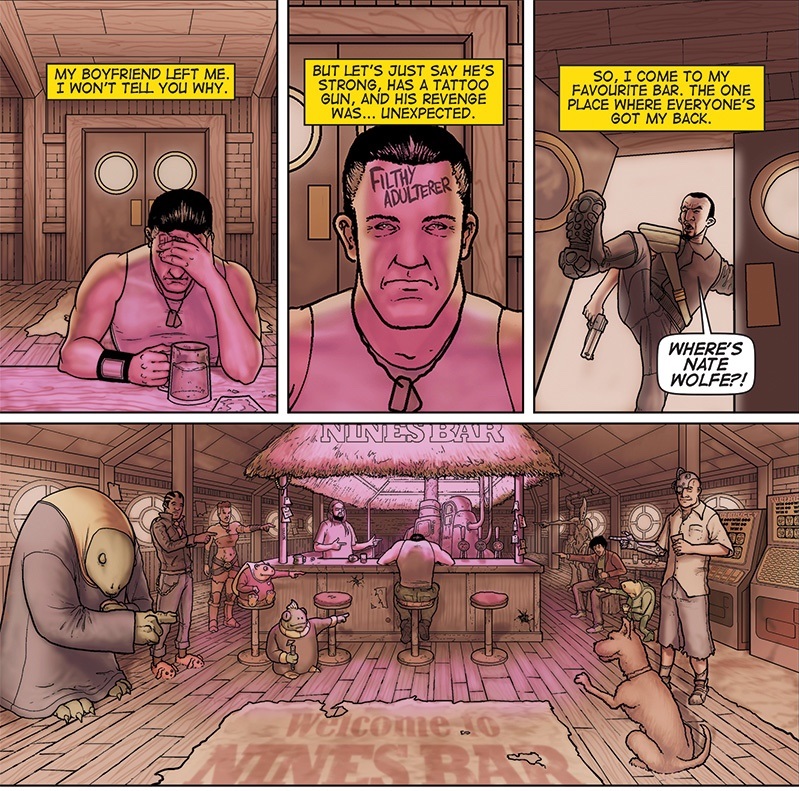
Opening to the 5-page story, Dude, what the hell happened to your…? Read it in full here.
Like any medium you want to break into, with comics, it’s important to know where the opportunities for aspiring creatives are. So, what’s the state of British comics today?
Go into a comic-book store, and an overwhelming number of the comics on offer will be American: Printed in America, and overseen by editors based in America. In terms of easy contact and accessibility, this is not ideal for anyone living on a tiny, remote island somewhere in the far reaches of the North Atlantic Ocean.
So, instead, you might visit a homegrown store like WHSmiths. Again, many of the comics found here are American reprints, with 2000 AD being the main exception. This was the comic where, in the 1980s, most – if not all – of the brightest stars in UK comic-book history got their first big break. Today, as pretty much the lone survivor of the once-healthy British comics scene, it still represents the quickest route to a professional comic-book career. Unfortunately, however, it seems to rarely publish new writers; its time-honoured vehicle for doing so, the short twist-ending stories known as Future Shocks, having apparently largely disappeared from the magazine’s repertoire.
(For anyone who does want to get a story into 2000 AD, though, check out the ‘Thought Bubble’ convention in Leeds later this year. The magazine’s editors will be there running an X-Factor-style talent show, where, within a given limit, writers get to pitch a Future Shock story. The winning entry will be published in the magazine.)
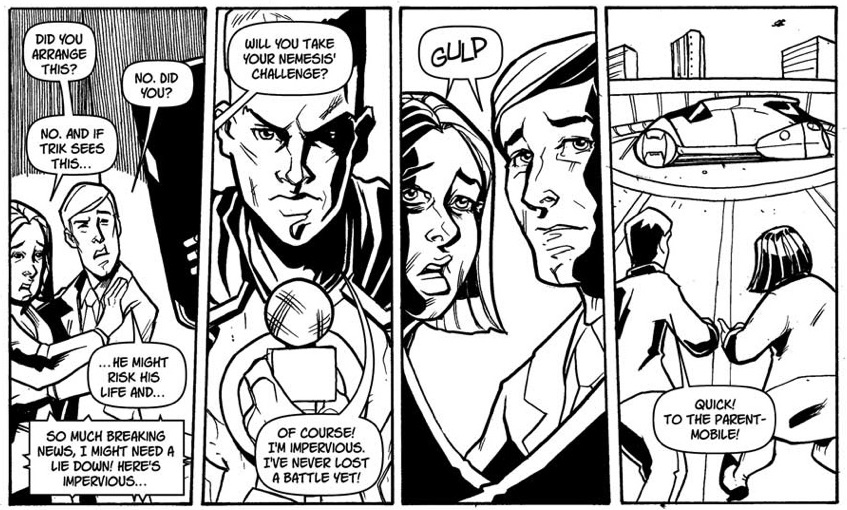
It’s superheroes, but not as we know them. From the story I Love You Thi$ Much – read it in full here.
But fear not! Despite this surface veneer of doom and gloom, there are opportunities and excitements to be found in surprising places.
For starters, while genuine British comics are in short supply, a part of the WHSmith’s magazine-panoply that does seem to be thriving is the children’s section. And in several of these children’s magazines, comics are printed as a regular feature, with their creative talent sourced in the UK. These magazines have a good circulation – some in the region of 50,000 per month – and would make an excellent port of call for any comic scribes looking to break into the business via the automatic cachet of having worked on an established franchise. More than that, if you’re story did address certain issues, you would at least be talking to readers who haven’t already made up their minds (obviously, their infantile brains won’t be able to even notice the sophisticated political, theological, nay, ontological points you’ll be making, but the illusion of making a difference could give you a real warm glow). At the last time of checking, those children’s magazines open to comic script submissions included: Adventure Time, Teenage Mutant Ninja Turtles, Dr Who Adventures (although I believe this is fully booked up until the end of the year) and The Phoenix Magazine.
But more than that, what’s staggering is how easy it is to have a chat, even grab a drink, with some of the top figures in the medium. For instance, David Lloyd, artist of the world-famous V for Vendetta, attends a monthly open-to-the-public meeting in Brighton called ‘Cartoon County‘ – a superb series of live interviews with comic book creators – and is down-to-earth, approachable, and generous with his time. In fact, he’s also the mastermind behind new digital comic anthology Aces Weekly, another potential place for new writers to get published.
Then there’s pre-eminent comic critic Paul Gravett, author of 1001 Comics You Must Read Before You Die. He seems lovely – nowhere near as aggressive as that title suggests – and often comes to an informal, monthly meeting at the Southbank Centre (details here).
Then there’s John Totleben, my favourite comic artist of all time, who just happened to be at a local comic convention, where anyone could go up to his table and talk to him.
And then there’s Kieron Gillen, writer of Marvel’s flagship comic Darth Vader, who recently did a free event on his creative process in Peckham Library.
You get the picture. The point is, the British comics scene seems to have an amazing, supportive network, where it’s not hard to meet and learn from some of the creators positioned near the top of the industry pyramid. Whether this is because they’re good souls, or because maltreatment from the industry they’ve devoted their lives to has left them with insufficient funds to distance themselves from the great unwashed masses, is something every aspiring creator will have to judge for themselves. Whatever the case, it’s good news, so I’d earnestly recommend taking advantage of these, and similar, social groups and events.
Finally, beyond getting published and meeting other creatives, it’s now easier than ever to build a portfolio by making your own comics. Artists looking for assignments are only ever an email address away. As for where to find them, the anthologies FutureQuake and Psychedelic Journal of Time Travel are great places to start, with all of the artists’ contact details at the back of the publications.
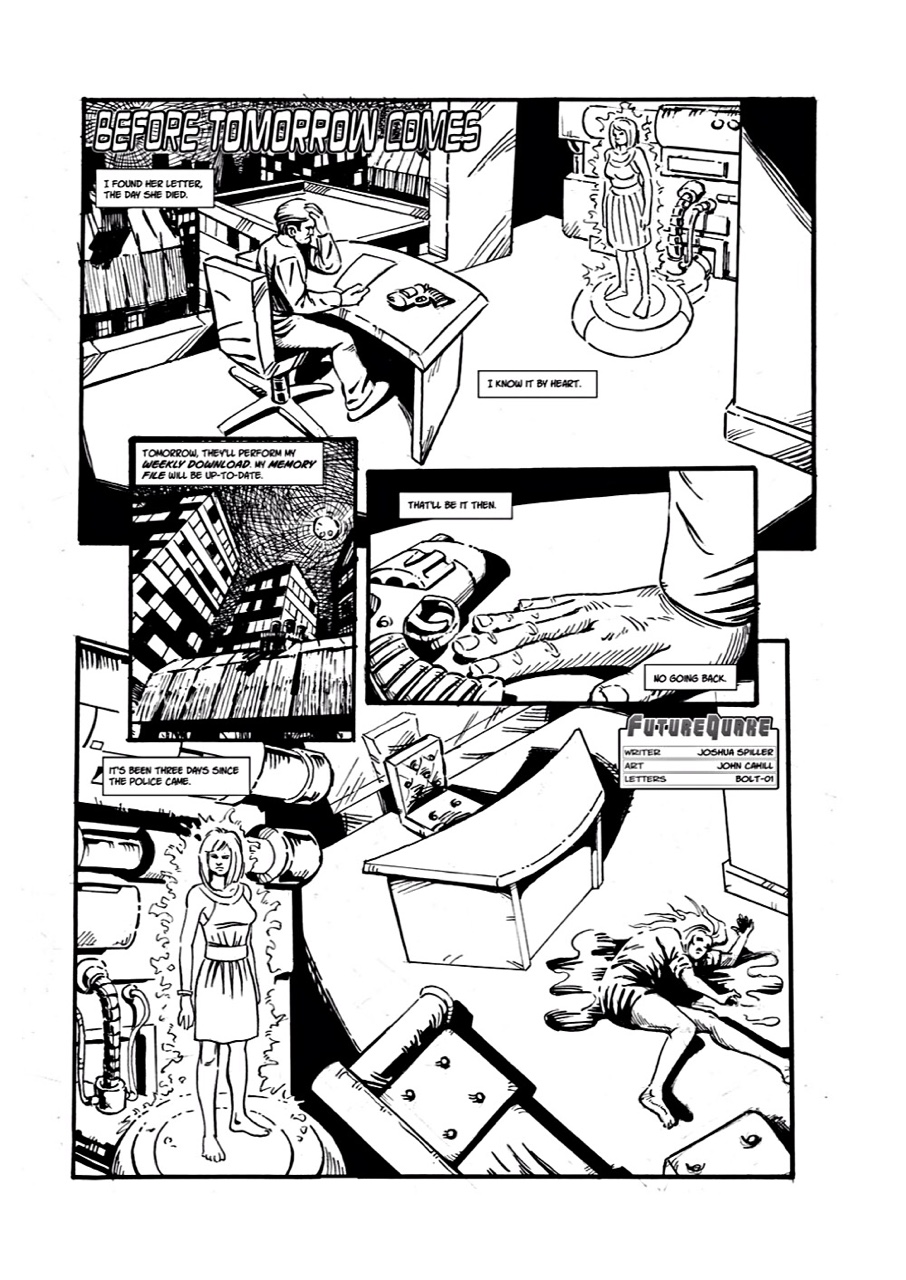
Sci-fi love, memory transplants, and murder. And the clock is ticking…from Before Tomorrow Comes. Read it in full here.
(Personally, I offer £40 a page, as it’s what I can afford. This puts some artists out of my price range, but it’s still enough to get some fantastic work.)
And of course, as a side note, conventions are always a useful spot to meet editors in person, and perhaps get a gig or at least open up the possibility of that happening in the future. The full list of UK & Ireland comic conventions for 2016 is here.
Well that, my faceless and anonymous friends, is pretty much that. There you have it: the bulk of the info I’ve amassed over the past three months of trying to progress in this wayward bastard medium, distilled into one ten-minute article. Hopefully useful for you; vaguely depressing for me.
Good luck with all of your creative endeavours. And if there are any artists reading this who would like to collaborate, just drop me a message on the link below. See you in the funny pages.
About the author
Josh Spiller is a published writer of comics, short stories, and scripts, and is currently looking for representation for his first novel. He’s also interacted with the “real world” by reviewing restaurants and theatre pieces for Flux Magazine and The London Word, and is worried that this bio is too self-centred. You can judge his work here, joshspillercomics.tumblr.com; and his very soul here – @JoshSpiller.
In 1930, the great economist John Maynard Keynes predicted the working week would be drastically cut – to perhaps 15 hours a week, with people choosing to pursue leisure as their material needs were satisfied. Yet despite rising living standards, we are working longer hours than ever before. As the post-war compromise between big business and labour has been rolled back, the world of “ruthless corporate management” that legendary writer Willa Cather broke free of at the turn of the 19th century seems to be returning: leaving us with mountains of work and no opportunity to do anything else with our lives.
So how can we fight back, and start reclaiming our right to live rather than just work and exist? Well, getting involved with unions and politics might be a start – and it seems lots of us are doing just that; with sales of left-wing literature seeing huge increase in sales at the same time as leaders like Jeremy Corbyn and Bernie Sanders are coming to prominence in the UK and USA, while radical left parties in Greece and Spain also win successive political victories.
But if you don’t have time to man the barricades, there are still ways of freeing your mind, even if you remain technically shackled by post-Fordist employment.
Yet how can you find time to read War and Peace when you can’t find the time to do anything other than answer emails all day?
The good news is, you don’t have to pick up a huge novel in order to experience the richness of brilliant writing and find examples of brilliant literature. In fact, below, we’ve compiled a mini-collection of incredibly short and incredibly beautiful stories from some of the greatest writers. And the best bit? You only need a few minutes to read them; and they are totally free (so don’t let the capitalists tell you that only things that cost money have value).
Here, then, you have a plan of action: reclaim your soul from your employer and take your lunch break today. Go outside, or find a relaxing environment inside if the weather is bad – and read these great pieces of writing. The stories below provide poignant revalations about life and, at only a few pages each, they can be read in the time it takes to eat a sandwich.
Saviours of the written word: go forth!
Pygmalion – John Updike
In 1966, John Updike told Life Magazine his subject was “the American Protestant small-town middle class”. His short story, Pygmalion, published in 1981 in the Atlantic, seems to fit the bill here – although the religion and class of the characters are never mentioned outright. The story is about a man who can’t understand a social gathering until his wife performs it, with pitch-perfect mimicry, back at home later in the evening. And, of course, it’s about much more than that, too.
A schoolteacher seems to be followed by death. This strange story is a fantastic example of escalation – and dark comedy. We are encouraged to question both death and life – and the value we place on different things in the world – as the schoolteacher rather nonchalantly reacts to the events around him. Writers, take note here how Barthelme never uses an unnecessary word – and instead uses avoidance techniques and ellipses to highlight movement of times and trains of thought, and to also give the impression that something is awry. It’s an absurd world, which is nonetheless perfectly crafted. Post-modern and funny to boot – nothing is as it seems.
A curious story indeed, from a true literary genius. It takes Saunders less than two pages in this story to make readers question their understanding of right and wrong – and even question reality. Told from the perspective of an overprotective father, desperate to guard his kids from his neighbour, lines blur quickly – to the extent that we are quickly dragged into a violent world seemingly headed toward chaos.
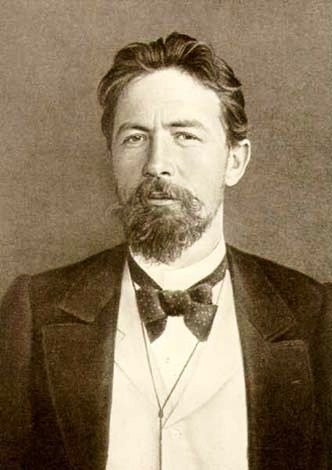
Chekhov’s short piece tells the story of Nellie, a young girl, who looks into a mirror and sees her future, which involves a desperate, hopeless attempt to save her husband from typhus. The story shows the battle between a young girl who believes in the power of love even while coming up against the harsh realities of life — the surprise ending shows how quickly those realities can be forgotten.
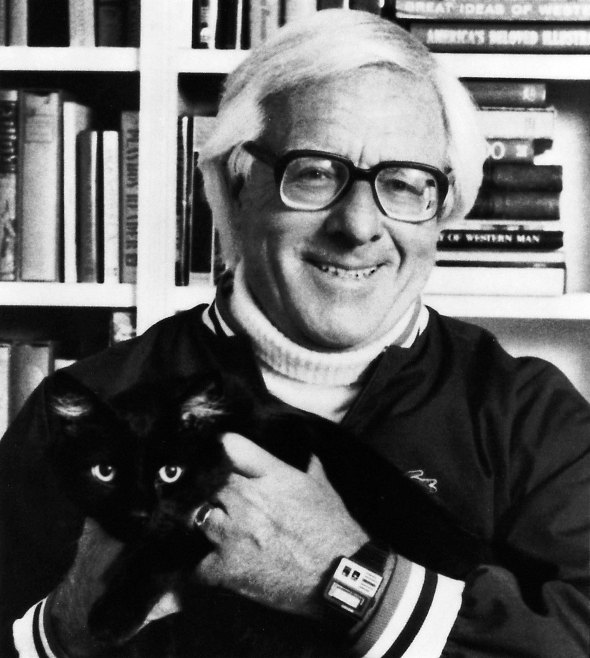
What would you do if you only had one more night? This is the subject science fiction legend Bradbury explores in this fascinating story, in which he explores a world where everyone has the same dream that the world would end – yet no one erupts into panic. Instead, the unstated end of the world lends a kind of calmness to society with everyone following their daily routines as planned. Touching and poignant.
‘“Go away. I am not making myself ill.” No; she was drinking in a very elixr of life through that open window.’
An early feminist writer, Chopin wrote her short stories in the Southern States of the USA during the 19th century. In this moving, intelligent piece, the events of which take place within the space of an hour, she examines how marriage – no matter how loving – can still become a prison for women.
Like all good stories, this one is set on a fox-breeding farm. From here, Nobel Prize winning author Alice Munro details the work on the farm – the killing, skinning and preparation of the foxes – and tells the story of the painful process of growing up. Not only does the piece provide a smart commentary on gender roles, it also explores ideas of family – and of freedom.
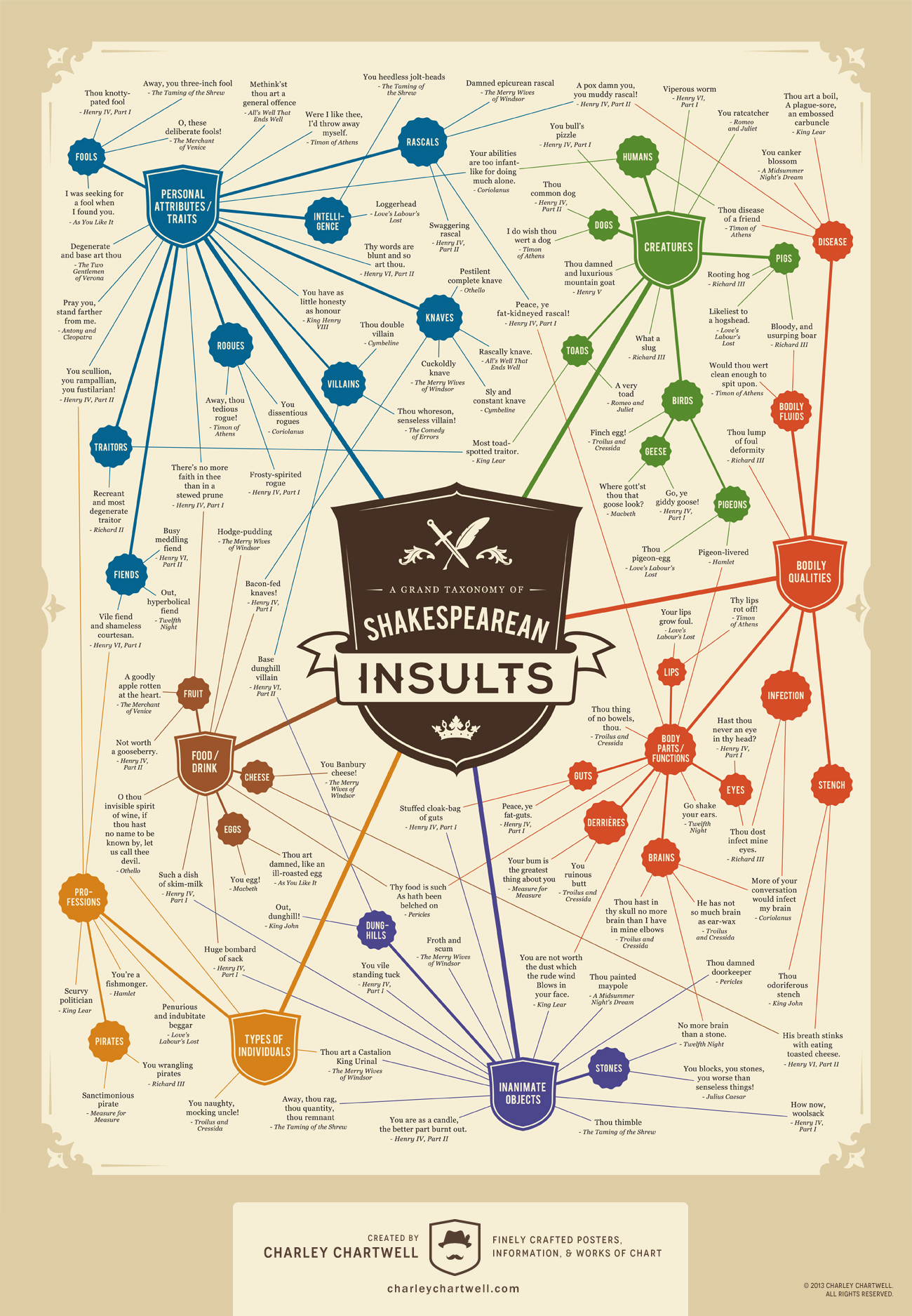
The wonderful poster will come in handy in this modern age of Twittersphere rants, rages and online trolls: what better way to deal with someone telling you to impolitely go away, than by calling them a canker blossom or a viperous worm? We certainly can’t think of any.
Indeed, your comeback repertoire is in line for a nifty upgrade, where you can take Shakespeare’s dagger-like wit and make it your own. The poster features 100 of his greatest put downs and zingers.
Divided into various sections – including ‘personal attributes’ (try “thou knotty pated fool”), ‘bodily qualities’ (try “thou thing of no bowles, thou”), and ‘professions’ (in an age of political scandal, “scurvy politician” has a certain ring to it) – you can easily choose which retort is most appropriate for whatever situation you find yourself in.
Featuring lines from a variety of Shakespeare’s plays, including Richard III, Henry VI, All’s Well that Ends Well and Hamlet, we thought we’d pick out a few of our favourites, which we’ve listed here:
“Go, ye giddy goose!” – Henry IV, Part I
“There’s no more faith in thee than a stewed prune!” – Henry IV, Part I
“You heedless jolt-heads” – The Taming of the Shrew
“You sanctimonious pirate” – Measure for Measure
“Thou damned and luxurious mountain goat” – Henry V
“You canker blossom!” – A Midsummer Night’s Dream
But of course, we want to know what you think! Which of these will you be using in your next online trolling battle, or quick-witted response when Muriel from Accounting tells you your company expenses form is all out of whack? Let us know in the comments below!
By now, David Foster Wallace has acquired a quasi-mythical status among followers of both literature and pop-culture. That there has recently been a film made about him, The End of the Tour, starring Jason Segal, has only fuelled the fascination and discussion that follows the late writer around. He is certainly no longer seen as “just a penis with a thesaurus”, as John Updike dismissed him in a 1997 review.
With his 2005 speech to students at Kenyon College, This is Water, having gone viral, and a plethora of articles and blogs written about him, it seems we just can’t get enough of a man we have elevated from tortured literary genius admired by an intense cult following into a huge presence in our cultural and public consciousness – a man seen by some as a sort of modern literary saint; a professor of sustaining wisdom who is there to shine a light to guide our way forward, and also who can help us make sense of a world, which so often seems senseless.
But what was he actually like as a teacher, as a professor? His various novels and essay collections aside – we gain intriguing insights through the collection of interviews Wallace took part in that are available online. And we can now gain an extraordinary look at what those students he taught might have encountered, via the course syllabus he wrote for the class he taught at Pomona College in 2005 – available to us all via Scribd.
We totally recommend you check out the full text, but we thought we’d pick out some of our favourite bits, including what Wallace describes as the “basic course spiel”:
“The goals of [this course] are to survey certain important forms of modern literature […] and to introduce you to some techniques for achieving a critical appreciation of literary art. “Critical appreciation” means having smart, sophisticated reasons for liking whatever literature you like, and being able to articulate those reasons for other people, especially in writing. Vital for critical appreciation is the ability to “interpret” a piece of literature, which basically means coming up with a cogent, interesting account of what a piece of lit means, what it’s trying to do to/for the reader, what technical choices the author’s made in order to try and achieve the effects she wants, and so on. As you can probably anticipate, the whole thing gets very complicated and abstract and hard, which is one reason why entire college departments are devoted to studying and interpreting literature.”
Some other gems:
“There is no such thing as ‘falling a little behind’ in the course reading; either you’ve done your homework or you haven’t.”
Or:
“Our class can’t really function if there isn’t student participation – it will become just me giving a half-assed ad-lib lecture for 90 minutes, which (trust me) will be horrible in all kinds of ways.”
It’s also fascinating that Wallace tackles the question of himself as teacher head on in this syllabus. He writes: “[I am] not a professional literary scholar. In fact, though my job title at the college says “Professor of English”, I am not a professor, because I do not have a Ph.D.”
And, in an admonishing statement, he also notes that his experience as a teacher is limited – in fact is something he is essentially learning as he goes along: “There may be a certain amount of pedagogical clunkiness about this section of [the course]. You will, in effect, be helping me learn how to teach this class.”
Yet there’s no doubt that Wallace takes his teaching seriously – and for anyone who likes to think of him as the sort of spiritual mentor or teacher you might find in the swamps of Dagobar, think again. Wallace warns students: “I draw no distinction between the quality of one’s ideas and the quality of those ideas’ verbal expression, and I will not accept sloppy, rough-draftish, or semiliterate college writing. Again, I am absolutely not kidding. If you won’t or can’t devote significant time and attention to your written work, I urge you to drop [the course] and save us both a lot of grief.”
Whether we like it or not, David Foster Wallace sits securely within the epicentre of our culture. There is no shortage of “virtue signalling” carried out these days when we discuss modern society – and there is an eagerness often encountered by people keen to show they know about him (and perhaps even have Infinite Jest – read or otherwise – on their bookshelves).
Yet Wallace would perhaps never himself thought of himself as the teacher or guide that we have made him become – and this syllabus provides us with intimate, tangible glimpses of that.
Well the carrots are cooked! We hope you’re ready to start swallowing grass snakes, because we’ve got some of the most bizarre idioms – along with some information about their origins and meanings – for you to get excited about. It’s time to pay the duck (unless an elephant has stomped on your ear, of course!).
Enjoy, amigos:
To slide in on a shrimp sandwich
Language of origin: Swedish.
Meaning: It refers to somebody who didn’t have to work to get where they are.
Used in a sentence: “Wow, the CEO’s son really slid in on a shrimp sandwich.”
To blow little ducks
Language of origin: Latvian
Meaning: To talk nonsense or to lie.
Used in a sentence: “Stop blowing little ducks, Monique! I know you stole all the shrimp sandwiches.”
Enough to cobble dogs with
Language of origin: English (UK)
Meaning: Refers to a surplus of something. For instance, if a cobbler has enough leather to cobble an animal that has four feet, then that cobbler definitely has a surplus.
Used in a sentence: “There are enough idioms here to cobble dogs with.”
The carrots are cooked!
Language of origin: French
Meaning: The situation can’t be changed
Used in a sentence: “It’s a shame Jeremiah has sold his cobbling business, but the carrots are cooked!”
It jumped the shark
Language of origin: English (US)
Meaning: The moment a television show or other cultural phenomenon stops being relevant and starts being ridiculous.
Used in a sentence: “The latest episode of Hippos vs octopuses really jumped the shark this week.”
You have tomatoes on your eyes
Language of origin: German
Meaning: When you can’t see what everyone else can (but refers to physical, real objects, rather than abstract meanings).
Used in a sentence: “Oh Eunice, you must have tomatoes on your eyes if you can’t see the large cat on my head.”
To swallow grass snakes
Language of origin: French
Meaning: to be so insulted by something, you are unable to think of a reply or find the right words to say
Used in a sentence: “I can’t believe you’d say such a thing, Candice. I must have swallowed grass snakes!”
The thief has a burning hat
Language of origin: Russian
Meaning: When someone has uneasy conscious that betrays itself.
Used in a sentence: “How did I know it was Mervyn’s fault? Let’s just say the thief has a burning hat.”
Pay the duck
Language of origin: Portuguese
Meaning: To take the blame for something you did not do.
Used in a sentence: “I’ll pay the duck, even if it was actually Prunella who put the cat on Gwenda’s head.”
Did an elephant stomp on your ear?
Language of origin: Polish
Meaning: To have no ear for music
Used in a sentence: “Crikey, Dermot, did an elephant stomp on your ear? That wasn’t music; it was the sound of dog being cobbled in a back alley.”
The pussy cat will come to the tiny door
Language of origin: Croatian
Meaning: What goes around, comes around
Used in a sentence: “At first, it was hard for me to accept being left at the alter by Stefan for his super-secret agent ex-boyfriend, but then I realised: it’s just a matter of time before the pussy cat comes to the tiny door.”
12. There’s nothing in the rulebook that says a giraffe can’t play football!
Language of origin: English
Meaning: There’s nothing to stop you: do anything and everything that you can imagine
Used in a sentence: “You should totally set up a collective of creatives, where people can share awesome tips on writing, art, photography and everything else, and maybe even put together a list of a dozen crazy idioms that folk might enjoy. After all, there’s nothing in the rulebook that says a giraffe can’t play football!”








 Josh Spiller is a published writer of comics, short stories, and scripts, and is currently looking for representation for his first novel. He’s also interacted with the “real world” by reviewing restaurants and theatre pieces for Flux Magazine and The London Word, and is worried that this bio is too self-centred. You can judge his work here,




 nothing in the rulebook
.jpg)


