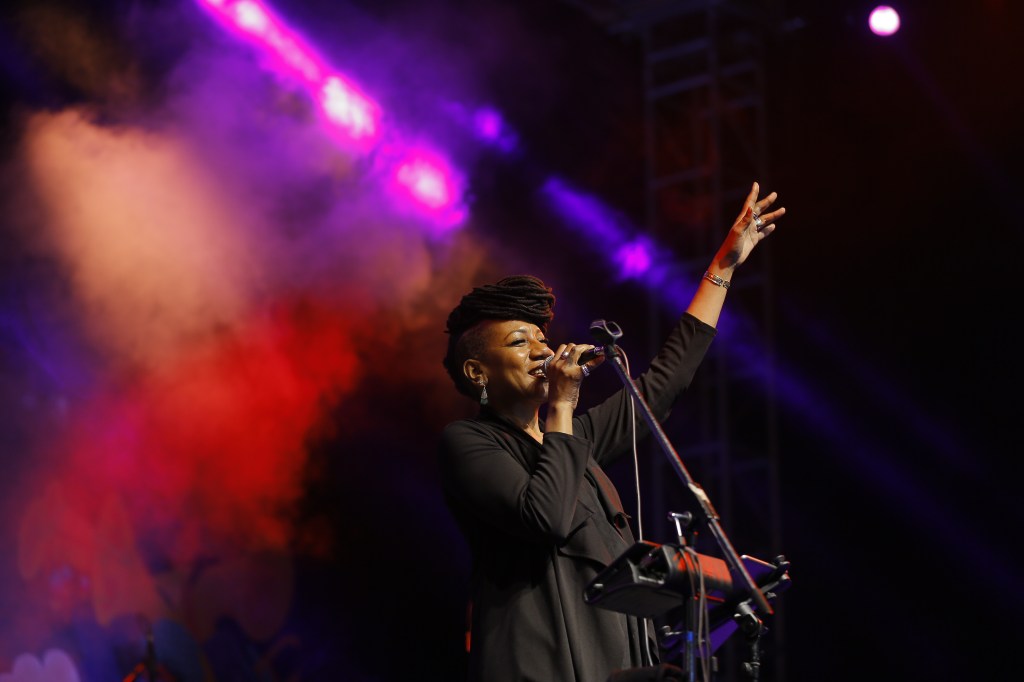
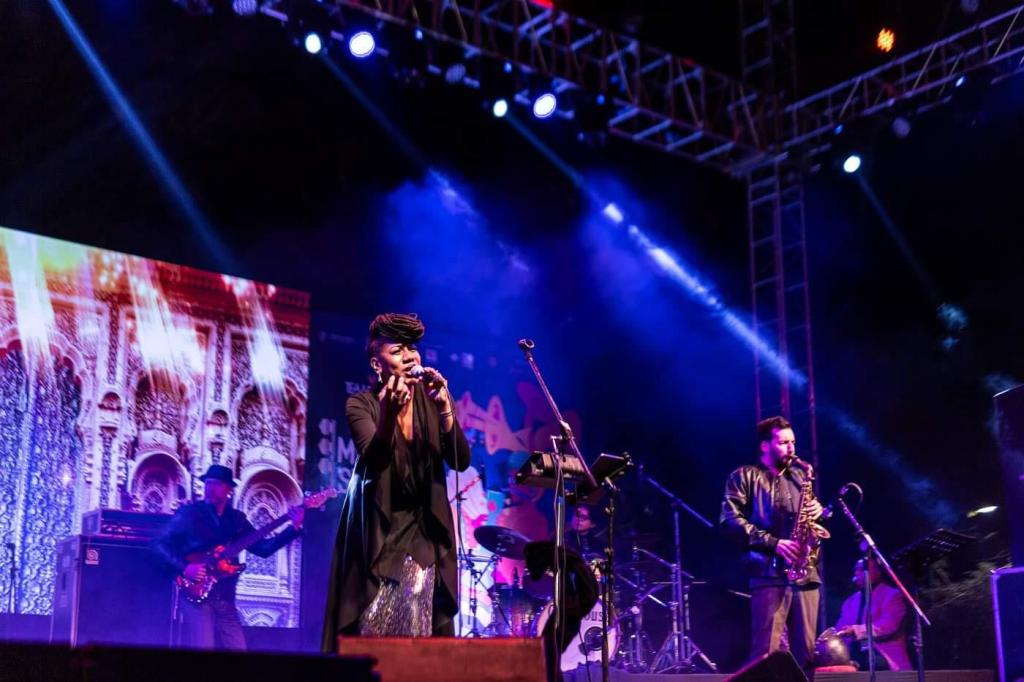
Lisa Marie Simmons and Note Speak on tour in Jaipur in January 2020.
Lisa Marie Simmons is one of the many musicians and creative artists who are refusing to let the global coronavirus pandemic interfere with their urge to create new work.
Simmons and her band, Note Speak, have released their new album, Amori E Tragedie In Musica, despite having to cancel their planned tours of Europe and the US due to the coronavirus outbreak.
Like so many artists and creative people in the world right now, Note Speak have had to grapple with how to promote themselves and their work amid Government-imposed lockdown measures. Based in Italy, Simmons told Nothing in the Rulebook that “everything is closed, with just pharmacies and supermarkets open for a few hours during the day. And to add tot hat, the media is contributing to mass panic and prison riots.”
Amid such an unprecedented situation, then, at least some positive can be drawn from the reception to Note Speak’s new album.
Described by composer, musician and poet, Regina Harris Baiocchi, as “poetic mastery of sound and silence”, Baiocchi says that Amori E Tragedie In Musica should allow Simmons and the band to forge “their rightful place in the annals of music history.”
Weaving spoken word, jazz, R&B, and funk into one genre-bending album, Simmons headlines as lead vocalist, composer and lyricist, while Marco Cremaschini is the project’s co-composer, pianist, and music director.
Over the course of the album, Simmons’ vocals are joined by those of joined two other singers, Machan Taylor and Miles Simmons. Accompanying the vocals, you find trumpeter Fulvio Sigurtà and his rich, bell-tone sound on three tracks. Violinist Laura Masotto channels Paganini and Stuff Smith via Regina Carter without sacrificing her formidable identity. Guido Bombardieri’s haunting bass clarinet and alto saxophone move across Eric Dolphy’s altar.
Meanwhile, Marco Cremaschini (keys), Joy Grifoni (upright bass), Marco Cocconi (electric bass), percussionists Valerio Abeni (drums), Maurizio Giannone (percussion), Marco Mondini (cajón), and Valeria Bonazzoli (udu) anchor the band with inventive colors worth hearing again and again.
To underline just how good this new album is, Baiocchi points to the passion, energy and inspiration behind it, as she says:
“Some artists troll outside themselves for inspiration but Lisa Marie’s poetry sacrifices a quart of her own blood. Her voice is honey-soaked Sista wit that defies category: think Fat Beats & Brastraps with choral roots siphoned through Milano—and you’re in the ballpark. Lisa Marie Simmons, Marco Cremaschini & Company create delicious music that makes manna taste like table scraps.”
With praise like that, there’s little doubt that fans will be in for a treat as and when lockdown restrictions are lifted and Note Speak can once again tour the globe. But in the meantime, Simmons and company remain upbeat and creative as ever, and you’ll be able to catch them in Nothing in the Rulebook‘s ‘Lockdown Lit’ video anthology project (launching later in April).
Help creative artists during the coronavirus by supporting their work. Amori E Tragedie In Musicais available via Bandcamp and is, of course, also accessible through Spotify.
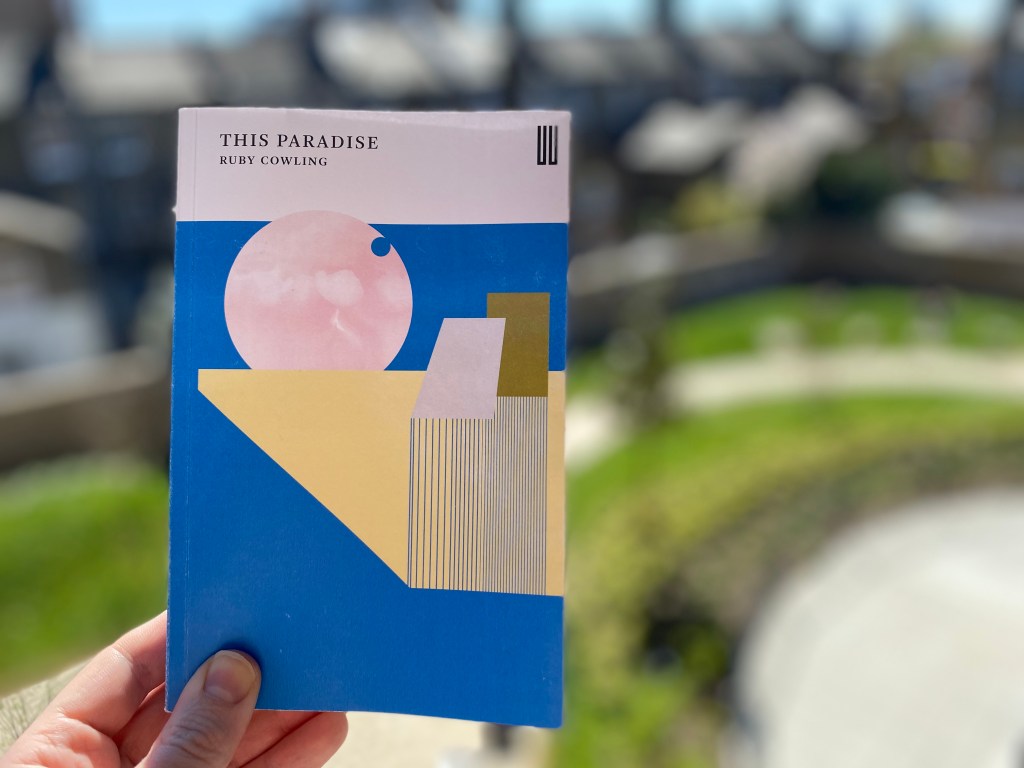
It is rare to stumble upon a book that is so relevant and appropriate to the context in which you read it that it both impresses and disturbs you with its prescience. Yet this is exactly the reaction that stirs within you as you read This Paradise – the debut collection of stories by Ruby Cowling.
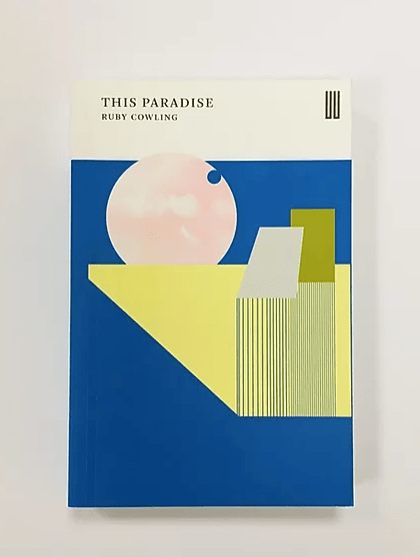
Published by fabulous independent publishers, Boiler House Press, this is a book that catches your attention from the get go – and not least because of the striking (and brilliant) cover design (what was that about judging books by covers?) The first story, Edith Aleksander, b.1929, is a startlingly beautiful investigation into old age, youth, memory, and nostalgia that packs a punch far weightier than the 8 pages you’ll devour in no time at all.
This is a common feature of each of the stories in the collection – they all share an ability to leave you thinking about them for far longer than it takes you to read them. And, the chances are, they’ll come back to haunt you days and weeks later, perhaps while you take your daily government-sanctioned exercise or try to drown out the incessant onslaught of terrifying news currently enveloping our lives.
Yet while the stories share this common trait, each is completely different from the other. Experimentations in form, style, and perspective abound; with stories variously including simultaneous plot & monologue (‘The Two Body Problem’), futuristic epistolary framing devices (‘[Superfar]’), as well as text messages as a dialogue/narrative device, and ongoing ‘live’ news reportage that runs along the margins of ‘The Ground is Considerably Distorted’ – a story about an unfolding political scandal that does an impressive job of capturing not just the arc of a narrative that seems so familiar to us from our daily dose of media babble, but also in the way the scandal is covered by journalists and the media at large.
It’s also fascinating to study the different subjects of each of the stories. There is a clear familial theme that carries along throughout, more noticeable in some cases than others, and while some stories focus keenly on the intimate details of a person’s life and relationships – as with ‘Mating week’ – others take a step back to capture global-scale events, including the effects of catastrophic climate breakdown and aforementioned political scandals.
In an interview with Nothing in the Rulebook, Cowling says she is “compelled by questions of where we’re going with the environment, technology, and accelerated societal change…and big companies and governments and how we as individuals form and are formed by them.” She also says that there’s “loads of rain in the book” – all of which is true. It’s undeniably a book that captures the ferocity of the environmental damage being dealt to the Earth by humans, as well as the dangerous effects such damage is tolling out in return. Yet while there is certainly a lot of…weather…in This Paradise, it never feels as though the author is forcing this down our throats as some cli-fi books tend to do. And it is the subtlety with which Cowling invokes the dangers facing us that will leave readers reeling.
The variety of styles in the collection may mean that some readers favour certain stories over others (surely to be expected of any story collection); but every story is of such a high quality it is genuinely hard to pick a favourite. For this reviewer, few stories have ever managed to walk such a delicate tightrope between terror, science-fiction, kitchen-sink realism and also – perhaps counterintuitively – hope, than the near perfect ‘Flamingo Land’, which nestles in the middle of this excellent collection.
That the terror of this story is caused by a maths formula might admittedly be something many English literature graduates can sympathise with. But it is also wrapped up in a genuine real-life terror lived by so many people when encountering the horrors of the worse kinds of government bureaucracy – that which sets out to penalise people for being vulnerable and poor rather than controlling the out-of-control free market capitalism that indentures them. In ‘Flamingo Land’ we follow the trials of one family trying to exist within increasingly impossible parameters that have been set by a government so clearly oblivious to the real lives people live. The consequences of not following the rules are devastating – not least because the cruelty of the familial separation they involve doesn’t feel a million years away from our current world, in which the children of migrants crossing borders are taken from their parents and put in cages. It’s terrifying precisely because it doesn’t feel like dystopian science fiction; it feels like the actual world in which we live.
So far, so horrifying. Yet what ‘Flamingo Land’ – and Cowling – does so brilliantly is end this story not on one of the bleak notes it could; but rather one of beautiful defiance and protest. Without revealing spoilers, we’ll simply highlight the final sentence of the story as a shining call to arms for anyone who feels otherwise despondent when looking at the world around us:
“No one, not even the people with the power, can force things to be exactly the way they want them to be – not always, maybe not ever.”
The best stories – and the best writers – hold a mirror up to our own lives and world without us realising we are looking into a mirror at all. In This Paradise, the stories Cowling has written do just this. For that, it should be a collection all readers seek to pick up and read.
It may be true that over 2 billion people around the world are currently in lockdown as a result of measures imposed by governments to try and mitigate the spread of the coronavirus COVID-19. But it’s also true that there are countless creative folk continuing to write, paint, and create new work amid this current global crisis. And so, we’re incredibly pleased to still be bringing you interviews with some of these brilliant creative people.
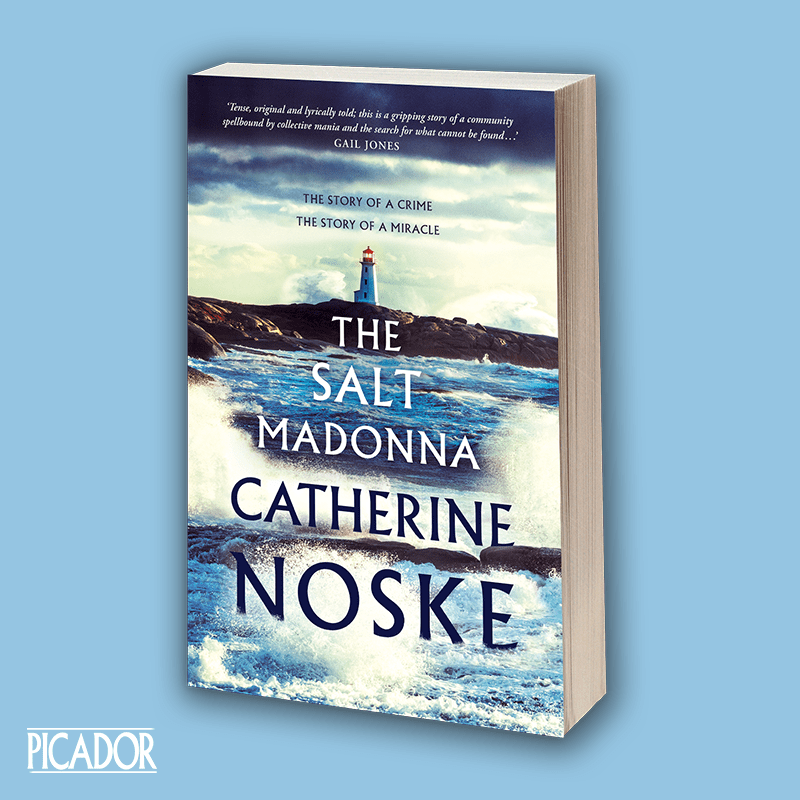
Australian writer and academic Catherine Noske has been awarded the A.D. Hope Prize, twice received the Elyne Mitchell Prize for Rural Women Writers, and was shortlisted for the Dorothy Hewett Award in 2015. The editor of Westerly Magazine, Noske’s debut novel The Salt Madonna was described by The Guardian as a “must read” book for the coronavirus lockdown.
InNoske’s novel, crimes and miracles collide in a page-turning, thought-provoking portrayal of a remote community caught up in a collective moment of madness, of good intentions turned terribly awry. Published by Picador, The Salt Madonna has been described by Australian novelist Gail Jones as “tense, original and lyrically told; […] a gripping story of a community spellbound by collective mania and the search for what cannot be found.”
It’s an honour to bring you this detailed interview.
INTERVIEWER
Tell us about yourself, where you live and your background/lifestyle
NOSKE
I am an academic, teaching and researching in Creative Writing at the University of Western Australia. My work includes editing Westerly Magazine, which is a huge privilege, and something I love doing. I live in Scarborough, a suburb of Perth (Australia, not Scotland), with my husband, my cat (Oliver) and my dog (Max). We’re close to the beach – I grew up in the country, I don’t love cities, so being near the beach is a saving grace.
INTERVIEWER
Is writing your first love, or do you have another passion?
NOSKE
Writing was an early love, but I think horses were my first passion! I began riding as a six-year-old, and it is my sanity now. My horse Izzy lives a little way north on an agistment property outside the city. Most of my spare time is spent out with her, and horses still tend to appear in my stories. They are a symbol to me of the subconscious – you can’t lie to a horse. They show you your inner self, reflect back emotions you didn’t realise you were holding.
INTERVIEWER
Who inspires you, and why?
NOSKE
It might sound clichéd, but my mother inspires me more than anyone else. She has always loved her work, and taught us kids to follow our careers seeking the same passion. She also invested us with a healthy respect for the natural world, and a delight in it.
INTERVIEWER
You’ve recently published your first book, The Salt Madonna, which has been described by Cassandra Atherton as “Australian Gothic at its most sublime and uncanny”. What does the term ‘Australian Gothic’ mean to you – and what aspects of Australian culture and history do you think are most uncanny?
NOSKE
The term ‘Australian Gothic’ has a loaded history. The Gothic is ultimately a European genre, transplanted with colonialism. In the early years of settlement, it was taken up as a mode of measuring the country by European standards – seeing (and claiming) by imposing a set structure of values. England was the model of civilisation, and Australia was topsy-turvy, the ‘dungeon of the world’ (as Gerry Turcotte wonderfully describes it). Everything here was inverted: the seasons were reversed, swans were black, trees drop their bark, not their leaves… None of these are anything but natural to the Australian environment, but in colonial eyes, they became perverse and thus Gothic. The legal fiction of terra nullius worked in the same way – seeing the land as empty allowed colonials to see Aboriginal peoples as less-than-human, and thus legitimised the violence and dispossession that those peoples suffered.
I started writing TSM as part of my PhD thesis, which was interested in tracing that history through contemporary literature – looking to understand how colonialism continues to shape the way white Australians specifically describe the land. As a white Australian writer of European heritage, I need to understand the forces which shape my privilege and define my relationship with the country, and might be inflecting my assumptions and ideas about the landscape. So I was deeply interested in the Australian Gothic when I stared writing, and understanding what baggage it carries with it as a form. In the contemporary setting, the uncanny lens can be used in the same way, but turned in the opposite direction – can be applied to challenge the structures of power which still operate in society. Robbie Arnott’s Flames, released by Text Publishing last year, is a great example of this. I’m not sure if I have achieved the same sleight of hand, or if I have fallen back into the same old traps of uncanny landscapes… but this is what I set out to try and do! Cassandra’s response is very flattering in those terms.
INTERVIEWER
How did you come to choose the setting for your book – the small island town of Chesil?
NOSKE
Chesil is a based loosely on my home in rural south-west Victoria. I should be clear – Chesil is very much a heightened and imagined space. I’m not sure it would be recognisable as my home to anyone but me and maybe my immediate family. It is influenced as well by other small towns I know, and some I have only visited. Setting my story on an island was a way of detaching it not only from society in terms of plot, but also from reality, and from my own history. Small rural towns can be wonderful places, but they also have a strange logic of their own, and I wanted a space in fiction where I could explore that without being beholden to the way I remembered the actual place.
INTERVIEWER
How do you think the stories of a landscape and people can shape our understanding of a specific location, and – in turn – what role can a place or town have upon the people who hail from there?
NOSKE
Story is everything! I’m a strong believer in the idea that place is made, not inherent. It is constructed actively in language and our memories and our imagination. And in turn, the way we narrate our lives is derived from the traditions of language and power we inherit. This is not a simple relationship, it is symbiotic and multifaceted. Where I am from and where I live now has shaped a lot about the way I write, as well as the way I know and engage with other places. Conversely, my writing has changed the way I think of my home now, and the things I notice most strongly when I return there.
INTERVIEWER
It’s been said so often that ‘all writing is autobiography’. How many of your own experiences have found their way into The Salt Madonna?
NOSKE
Quite a few! Mostly the happy ones. Thankfully, the darker elements of the plot are entirely fictional. But one of the early comments I got in drafting was that some relief was needed, that some light and love needed to come into it, for it to be bearable. (People accuse me of writing depressing stories all the time.) I try not to steal from life, but it definitely happens, and when it does I try to ensure that it is with some ethical awareness of what is at stake… My family are used to me doing this, I think. It is a running joke that my memories can’t be trusted, as the line between recollection and fiction is a little too poorly defined. And a close friend once gave me a t-shirt which says ‘Careful, or you’ll end up in my next novel.’ She knows me too well.
INTERVIEWER
What does it mean to be an Australian writer working in a country engulfed by some of the most catastrophic effects of the climate crisis?
NOSKE
It is terrifying. The recent fires have been horrible on so many levels – not only the lives lost, but also the cost to the environment, the prospects for species loss and ecosystem collapse that have come out of these events. Combined with this is the fact that we’re only now (January) at what would normally be the beginning of our fire season… And at the same time, Queensland is now experiencing floods. Aside from being a writer, being human right now is depressing. The extreme weather effects of the climate crisis are more and more obvious with each year, and our government still seems to be doing very little to redress the situation.
So being a writer in this context comes for me with a huge sense of responsibility, to make your writing ‘count’ – not only to represent the reality of the climate crisis with an ethical awareness and sensitivity, but to support the voices of those who are most disadvantaged by it, and otherwise (politically) under-acknowledged. I think I feel this onus most powerfully in my editorial work with Westerly – I have been trying to make a space for diverse voices, and for those most affected by the recent bushfires to speak out. But even in my own writing, I’ve been feeling a desperation to make the people in power listen, notice, pay attention, to make changes!! The fires have made it very clear to me that it is the system which needs to change, if we are going to prevent further damage and loss. Individuals can alter their carbon footprint only minimally compared to the change government can effect. But even then, I think we are also now faced with a future wherein being a writer will also mean recording our natural world for posterity, mourning and memorialising that which we stand to lose.
INTERVIEWER
Thinking about the Australian literary scene at the moment – what are some of the trends that we should be taking notice of, and who are the authors we should be paying attention to?
NOSKE
In the same vein, most lately I’ve been really excited by the developments both in lyric essay/creative nonfiction and in climate fiction (cli-fi). Both genres to me have huge scope to do important real-world work. More generally, I’m excited about quite a few of the releases coming this year – people like Donna Mazza, Sean O’Beirn, Alison Whittaker, Elizabeth Tan, James Bradley, Mandy Beaumont, Jamie Marina Lau, Evie Wyld, Danielle Clode, John Kinsella, Ella Jeffrey… I could keep going! Working with Westerly means I get a lot of updates on coming releases – it is always very tempting.
INTERVIEWER
When writing fiction, can you tell us a little about your creative process? How do you go from blank page to fully formed story?
NOSKE
Very slowly. TSM took me ten years to write. For me, a setting usually comes first – an image or a place that feels important. After that, I try to develop the voice that sits within it, with all that voice implies in terms of characters and tone and emotions. It’s never terribly directed, and usually quite organic at this point. But once I know the feel I want, then I start planning a little more, trying to imagine how the work as a whole might come together, or what sort of shape it could take. I am not a plot-driven writer, so I find the plotting part hard. It generally gets built slowly and in pieces, different plots for different characters, most of which never see the light of day. I like playing with structure, though, so drafting usually involves a few different ‘experimental’ versions, each one changing the approach or the perspective somehow.
INTERVIEWER
What are your hopes for The Salt Madonna?
NOSKE
That people will read it, first. Secondly, that they will enjoy it, or find it intriguing in some way. Thirdly, that anyone who does read it will forgive its weaknesses! And finally, that it has some meaning that people find relevant (and perceptible).
INTERVIEWER
So many writers think of little else than holding their finished novel in their hands for the first time. How does it feel to have achieved what so many will only ever dream of?
NOSKE
It feels a little surreal. I have been working on this novel longer than I have been married – it has been a big part of my life for a long time. And I’m not sure I’ll miss the writing, but I have had to remind myself a couple of times now that it is done, and that I shouldn’t keep working on chapters and voices and plots. But it is also very confirming. It’s lovely that Picador think it worthwhile putting out into the world.
INTERVIEWER
Do you feel any personal responsibility as a writer?
NOSKE
In all kinds of ways – to the people and places who have influenced and informed my writing, but also to the world, as I said above, in the era of climate change, to record what we stand to lose, and try and push for change. In TSM, I was responding to social pressures that I felt as a woman, and to ideas about power and truth, and how stories can be used by those in power to maintain a status-quo which suits them, ultimately taking over peoples lives.
INTERVIEWER
In an age of ‘abject’ incomes for writers, how can aspiring creatives pursue their passions while also making ends meet?
NOSKE
I find this question a really difficult one, especially when talking to my students. There is no easy way to balance pursuing a career as a writer with supporting yourself financially. I am incredibly lucky that my job aligns with my passion, and provides me with the opportunity to write and research as part of my day-to-day. I couldn’t be more grateful for that. But it is depressing that this is not the reality for most writers, particularly in an era wherein writing is such an essential cultural activity – it gives us a space to respond to and consider climate change, it can offer a point of connection and identity for people and communities suffering trauma, it can advocate for change. Ideally, we would see arts funding expanded in times of crisis… but this is unlikely. So all I can usually say to students is to take your passion seriously, and don’t minimise the importance of having that in your life. If you’re passionate about it, writing has a value beyond money. And if that means working a job you’re not 100% passionate about, to finance your time writing, then that’s not necessarily a bad thing to do – as long as you insist on having time to write.
INTERVIEWER
What’s next for you and your work? Are there any exciting projects we should be looking out for?
NOSKE
I’m currently working on a new MS, which might never see the light of day – a work combining lyric essay and poetry, trying to find a way to map in language the experience of a weekend’s walking on the Bibbulmun Track in Western Australia. I’ve no idea what it will come to – its in the very early stages now. But a couple of the poems have been published in journals online, and I’m really enjoying the writing process.
Quick fire round!
INTERVIEWER
Favourite book?
NOSKE
Impossible. There’s never one.
INTERVIEWER
Curl up with a book or head to the movies?
NOSKE
A book.
INTERVIEWER
Critically acclaimed or cult classic?
NOSKE
Critically acclaimed.
INTERVIEWER
Most underrated writer?
NOSKE
Randolph Stow, Shirley Hazzard – there are a lot of wonderful Australian writers who deserve more attention.
INTERVIEWER
Most overrated writer?
NOSKE
That seems harsh. Also dangerous. Could be I overrate myself…
INTERVIEWER
Who is someone you think people should know more about?
NOSKE
William Barak
INTERVIEWER
Russel Crowe, or just a normal crow?
NOSKE
Ha! An Australian raven, ideally. They make the best noises.
INTERVIEWER
Do you have any hidden talents?
NOSKE
None worth exposing.
INTERVIEWER
Most embarrassing moment?
NOSKE
I got my tongue stuck to a fridge once. That was a low.
INTERVIEWER
Something you’re particularly proud of?
NOSKE
My family and my husband.
INTERVIEWER
Could you write us a story in 6 words?
NOSKE
Hours ago, a message: ‘Home soon.
INTERVIEWER
Could you give your top 10 tips for aspiring authors?
NOSKE
In no particular order: Write instinctively, impulsively, unthinkingly. Experiment with form, shape, structure, and learn from the ones that don’t sing for you. Trust the feel of a good line in your head, even if others doubt it. Edit incessantly, and experiment with that too. Write from experience, sure, but don’t tie yourself down to it. Find new ways to see the world as often as you can. Make sure you constantly question the limitations of your vision. Write the unexpected, in the world rather than your plot-lines – write the things you see that others don’t. Trust in the simplicity of animals, they don’t know how to lie. And trust your writing when it feels the same.
Books – and all stories – that involve time travel are always walking a delicate line. The perception of readers today is so great that any inconsistency within the way the actual act of time travel works in the book will be immediately pick up on and can be used to disregard the other qualities of the story. And yet, anything that tries overly hard to overcomplicate the processes also risks alienating the reader by making the whole topic overly confusing.
So, any writer who attempts to pull off a book where the capers involved all come about through time travel either deserves plaudits for bravery or for someone to have a chat with them to see if they’re feeling okay. It’s certainly not something for the faint of heart; which is why it is exceptionally thrilling to read something where the whole device works so effortlessly, and brings with it so much joy and fun (things which sometimes seem in short supply these days).
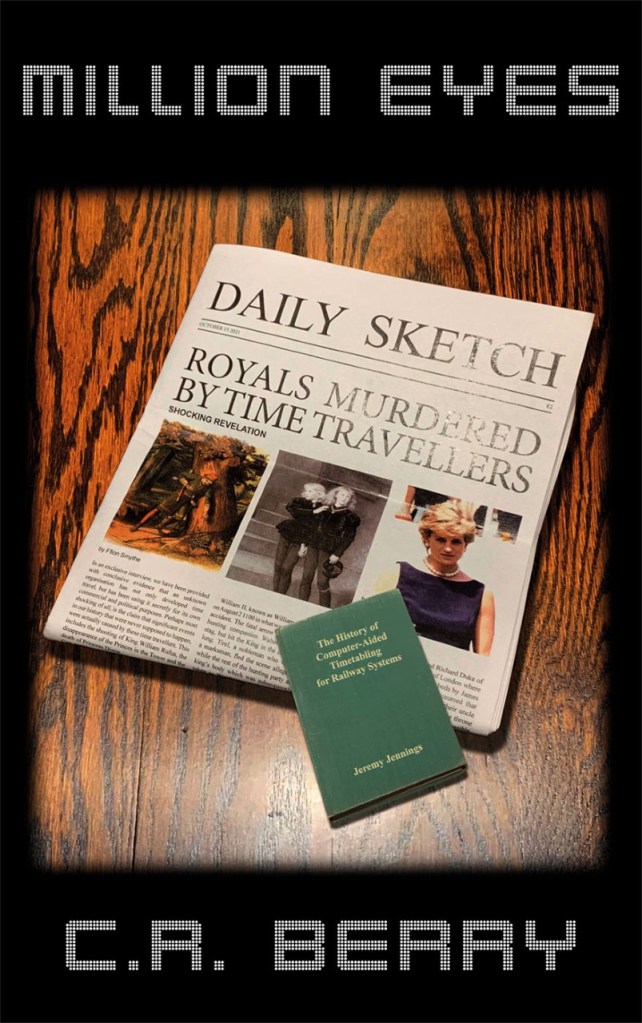
Million Eyes by C.R. Berry does just this – taking readers on an adventure across the ages on a time travelling crime caper where we meet ancient kings and courtiers, but also to members of a suspicious organisation who have had a hand in royal assassinations and other key historical events throughout the centuries.
It’s a fast-paced thriller and one in which you feel the author is always in total control of the time travel dynamics behind it. You’d expect nothing less, of course, as Berry has already written an extensive article on the various time travel devices available to authors – and the different pitfalls and challenges that must be navigated when using each one.
The attention to detail Berry brings to the time travel plot device is also brought to the way the author brings to life the different historical periods readers encounter as we zip along different timelines. Whether that’s reimagining the medieval English forests where King William II met his untimely end, or the mid 1990s – and the car crash that killed Princess Diana. It’s an admirable skill and clear that Berry has devoted a lot of hours of research to make sure all the details not only fit together for the story, but wouldn’t be called out by any forensic historians (time travelling or otherwise).
The speed at which the pace of plot moves along is refreshingly fun – you can zip through this book very quickly and it’s a fine way to spend a weekend under coronavirus lockdown. But it does mean that, with so many different characters to keep track of, it can be a struggle to emotionally connect with them all. Fortunately, there’s a lot of dialogue which helps bring the characters we meet to life and, while there are times the conversations don’t entirely feel fully true, it does help you orient yourself within the “timey-wimey” twists and turns of the plot.
There’s a touch of both Mantel and Philip K. Dick to this story; and the theory of altered timelines with a mysterious book at the centre of the plot certainly brings to mind the latter’s masterful Man in the High Castle. While Million Eyes doesn’t quite reach the same lofty heights as these titans, there’s certainly something in this book for fans of both historical fiction and sci-fi to enjoy. Indeed, it’s a book for readers from all places (and indeed, all times), and perfect for anybody in need of a few thrills, and lots of fun.
With over 2 billion people around the world now officially under some form of lockdown measures to help counter the spread of the coronavirus, it seems people are – more than ever before – reaching for books and stories to help them through this unprecedented period. The American Book Association (ABA) has reported a 250% increase in online traffic to its online stores, while Bookshop.org (launched only in February this year) reported a 400% increase in sales. In the UK, Waterstones reported a 17% increase in sales over the course of a few days – yet was widely criticised for using this as a reason to keep its bookstores open while businesses across the country were shutting up shop. The UK’s Nielsen Book also reported sales of fiction books rising by a third. Even our own pages of Nothing in the Rulebook have seen record traffic to our compilations of sites that allow you to read thousands of famous books for free – and we’ve even made it into the top 5 list of lockdown resources that have been put together by the University of Hong Kong.
Yet despite this surge in demand for books, the lockdown is undeniably making it harder for readers to get hold of them. And with news that Amazon is deprioritising book sales amid the coronavirus crisis, it seems that it is independent book stores and publishers who are coming to the rescue (twas it ever thus?)
So, since Jeff Bezos won’t do it – we’re going to tell you about a bunch of indie bookshops and publishers that are still sending out lockdown deliveries…
An independent bookshop in Royal Wootton Bassett, Wiltshire, UK, these lovely folk are still accepting orders and delivering books – just drop them a line on any of their social media channels or email them at info@bassettbooks.co.uk
Slightly unique in this list in that the Big Green Bookshop was always an online venture – shipping physical books worldwide to people despite having no physical premises. Yet they’ve managed to adjust to the strict lockdown measures despite changes to delivery partners and recently announced that they were able to continue to send out books to customers (though you’re limited to one book per order, unfortunately folks…but that just means you have to make your order count and pick a great title from their catalogue!)
Boiler House Press is an indie publisher based out of the University of East Anglia – home of the world-renowned Creative Writing MA. They’re still firmly fulfilling orders through their website and shipping out books to readers. Check out their catalogue and special offers online.
Winner of Best Independent Bookshop in Wales 2019 Book Awards – these guys have a top notch bookstore and a lovely cafe to boot, but while you’ll have to wait until the end of the lockdown to visit in person, the store have confirmed you you can order any book from them for delivery anywhere in the world.
An independent bookshop run by ‘illiberal bigots’ in Norwich. The store offers hand-picked new fiction & nonfiction, plus poetry, small press, children’s, cookery & art titles. The shop is now shut BUT they are still posting books with free postage & packaging. They are still also hand-picking (with clean hands) self-isolation book packs!
Established in 1984, Book Works is a contemporary arts organisation dedicated to making and publishing books. While their studio and physical publishing offices are closed, they’re still very much fulfilling deliveries as the team work remotely during the coronavirus lockdown. Browse their selection online.
Whilst the shutters might be down on one of the best loved indie bookstores in London, you can still order the books you love through their online shop and email them for recommendations.
They’re also offering free delivery to Tower Hamlets residents (until May 1st) and can post anywhere in the UK.
To pass the time if you’re stuck at home, you might like to enter their 2020 Short Story Competition.
In pre-lockdown times the cafe, bar and bookshop of Brookspinner would be thrumming with a vibrant community of book-loving customers. While the store, bar and cafe are now closed, the team are still delivering book orders (limited to a single book per order) and have over 400,000 book titles available to choose from.
A lovely Welsh indie bookshop offering mail order deliveries on their book range. They also offer arts and crafts materials, stationery, greetings cards and vouchers by mail. And, in another sign that literary creative folk are just they best, the Browsers Bookshop team are also giving out charity bags of books and arts and craft materials to local food banks, foster carers and disadvantaged children via local schools.
These fine folk run a lovely independent bookshop and cafe in Haggerston, London. And in very good news indeed, they’re very much keeping on going as much as is possible – offering to accept orders and take queries from customers, even though their delivery partners have forced them to temporarily halt delivering orders via post. What they have done, though, is launch a fabulous new podcast, Burley Fisher’s Isolation Station — as a place to interact with their community and to showcase the writing they would usually promote through the shop. Do have a listen through their website or by using your favoured podcast platform!
This UK independent printing press is continuing to service all PayPal orders from their own website, and they’re also able to supply trade orders for any bookshops offering a similar service who are unable to access their titles from the wholesalers.
Readers should also check out their lovely ‘Instead of a Card’poetry pamphlets – which make perfect presents to send to folks you might not see in person for a while – unusual, beautiful, worthwhile and definitely not for throwing away.
C.B. Editions are a bit of a favourite of ours here at Nothing in the Rulebook – as this wonderful independent printing press has published some truly unique and brilliant books – like This is the place to be by Lara Pawson and the award-winning Murmur by Will Eaves. So, we were pleased as punch to hear they were continuing to ship their books internationally during the coronavirus lockdown – with UK residents benefiting from free delivery.
What’s more, C.B. Editions are also offering a special ‘Lockdown Subscription’, where readers can sign up to receive work by Stephen Knight, Todd McEwen, Gert Hofmann, and Will Eaves.
An independent bookshop in the heart of historic Hexham, and described by (excellent) indie publishers Bloodaxe Books as “a wonderful bookstore”. The store may be closed but the company are still taking orders and even delivering locally by hand (albeit while keeping within social distancing guidelines).
Desperate Literature is a new international bookshop in Madrid, Spain. Along with the very best collection of used English books in the city, the shop also carries a large selection of quality books in Spanish, French and a variety of other languages.
The store strives to be a space where good literature serves as a vehicle for dynamic cultural, linguistic and social exchange between Madrilenos, extranjeros and travellers from around the world.
While the lockdown in Spain has seen the physical bookshop close, Desperate Literature are still delivering across Spain and indeed internationally, and they’ve introduced a special ‘lockdown offer‘ to boot.
Established in 2013, this is a radical bookshop based in Nottingham, UK. It received the Independent Bookshop of the Year award at the British Book Awards in 2018 and is connected with the excellent Five Leaves Publishing independent press. Not only are they still sending out deliveries, you can also order some of their special ‘Mystery Packages’ of books they’ll pick out for you to a value of your choosing.
Full Circle Editions are an East Anglia-based publishing house producing beautiful, collectible books with arresting writing and art. They’re also keeping on keeping on despite the COVID-19 lockdown – which means you can freely browse (and, crucially, order) their fabulous selection of books from the comfort (and safety) of your own home.
Voted the UK’s best independent bookstore in 2019, the shop has announced that many of its team have been placed on ‘furlough’ and acknowledged there were some issues with suppliers; AND YET, they’ve also got a huge number of books on their stocks and they are KEEN TO GET THEM TO YOU. If you order over £40 worth of books they’ll ship them to you for free. Check their selection of books out here.
A cool independent bookshop in Penarth just outside Cardiff, Wales, Griffin Books are also continuing to take orders for books via phone, email or social media and posting them throughout the UK (and beyond). They are also hosting lots of online author events, storytime sessions and general book chats – all details can be found on their website.
A well-stocked independent bookstore in Devon, UK, run by a friendly & knowledgeable team. Their store may be closed but, as they confirm on their website, their publishers distribution centre has created an outstanding delivery system that enables them to post books to customers through the post, while protecting the safety and wellbeing of their team.
One of the world’s leading specialist publishers & booksellers of military history, Helion Books are still sending out their large selection of book titles to readers. They’ve also run a couple of lockdown offers where you can get discounts on their catalogue – so do check out their website and social media pages to make sure you don’t miss out on these.
This Sheffield-based poetry publisher are founded on an ethos of craft, care and collaboration. They’re still posting orders daily – and even delivering some orders by hand to readers in Sheffield.
An independent Bookshop, Cafe, Deli & Home shop in St Boswells, Scottish Borders. Winners of the ‘Best Small Shop in Britain’ award in 2018. They’re continuing to deliver (beautifully wrapped) books to customers.
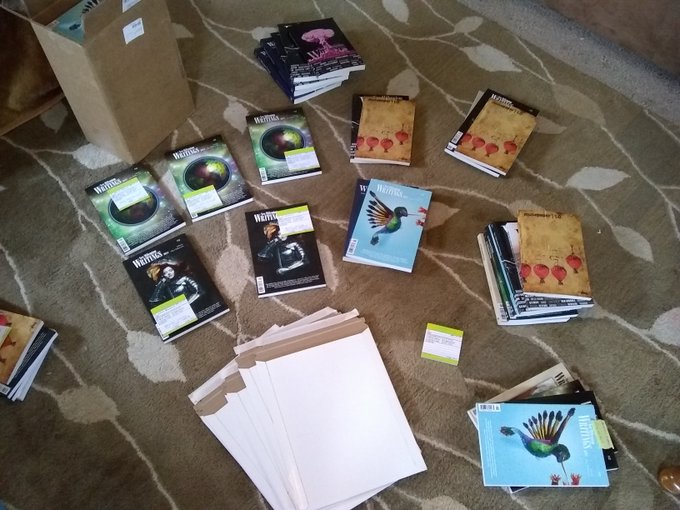
For the past 23 years, the folks behind New Millennium Writings have made it their mission to encourage, award, and publish writers and poets. And this hasn’t stopped amid a global pandemic and lockdown – as they continue to pack up orders while working from home. Browse their selection here.
Established in 1978, Newham Books is one of east London’s leading independent bookshops. Though the store is closed, they are still accepting and fulfilling individual orders.
Established in 1974, this is a radical & community not-for-profit bookshop, run by a women’s collective. If that wasn’t cool enough, they’re still supplying mail orders, from their vast stock of wonderful, challenging, life-affirming books. They can still order many books for you, though some are now hard to obtain. Search their website & email them for availability nfn@newsfromnowhere.org.uk
Southampton’s premier independent community bookshop isn’t just offering books for those in need of a good read; in true community style they are also offering to deliver food, toiletries and cleaning products, too!
Like Bricklane Bookshop, they’re offering free delivery to local residents in the immediate Southampton area – but they’ll also ship anywhere around the UK so do browse their online catalogue and remember that they also have an extensive supply of ebooks and audiobooks available, too.
The oldest independent bookstore in Calgary might have closed its doors to its physical stores during the lockdown; but its continuing to offer free deliveries (and curbside pickup) to residents in dire need of some literary relief. Check out their website to browse their catalogue and keep up to date about delivery information and book availability.
A beautiful independent bookshop in Holmfirth. They’re still able to order directly from their supplier in single book orders. Which means you can still support this fabulous indie bookstore and get that book you just can’t do without during the lockdown. All you need to do is email them at read.holmfirth@gmail.com with a book and an address and they’ll do the rest.
These literary champions are based in Dulwich, London, and they are offering free & safe local home delivery to the following postcodes: SE22, SE21, SE23, SE4, SE5, SE14, SE15. If you’re based farther afield, you can order from them by emailing shop@ryebooks.co.uk, and they’ll aim to get your books to you within a couple of days.
Established by Sam Read in 1887, this award-winning small bookshop in the Lake District has closed its doors but is still fulfilling orders and providing free local delivery.
Currently rebranded as the ‘Socially Distancing Shelf’, this is a truly unique bookstore in the heart of London dedicated entirely to books published by women – in store you can absolutely lose yourself browsing the shelves, which include rare books and first-class first edition copies of books by female authors, as well as rediscovered books just waiting to be read. Though they’re currently shuttered – you can still support them by ordering a gift voucher which you can cash in for one of their excellent books on the other side of lockdown. Doing so also helps bookstores like this stay afloat during this unprecedented crisis.
Seren is Wales’ leading independent literary publisher, specialising in English-language writing from Wales. They’re intending to supply books for as long as the present terms of lockdown continue, and beyond when they are eased, of course!
An independent bookshop in Bristol, UK, stocking a tightly curated range of fiction, non-fiction and children’s books. They’re also very happy to provide (and receive) recommendations. After a bit of turbulence, the team have confirmed that they’re able to continue receiving book orders and sending out deliveries via their online ordering service. So please do bombard them with your requests and they will get books through your door with pleasing efficiency.
Looking to get lost in translation? You need look no further than Strangers Press – who are dedicated to publishing the finest literature in translation in collaboration with the British Centre for Literary Translation, University of East Anglia, and The National Centre for Writing. Browse their catalogue through their online shop and order away as usual!
Unbound are a unique, award-winning publisher. They have a TONNE of great titles available through their online catalogue and have also announced that all of their e-book titles are now HALF PRICE, which is absolutely brilliant news to any readers looking to get their hand on some great new stories. Add to that, the crowdfunding part of their business is still very much in full flow – with supporters able to play a vital role in helping make prospective books a reality, and in return pick up fabulous rewards, from their name in the back of a book, to personalised art prints, meetings with famous authors, or even a personalised ‘paw-trait’ of your dog. Check out some of the titles that are close to reaching their targets and which you could help push over the line right here.
Despite coronavirus, this Irish bookstore is still dispatching books to customers. Alongside these literary delights, you can also order from their catalogue of craft supplies, art supplies, wool, fabric, haberdashery, and upholstery supplies.
Based in Dulwich, Londoners have long loved browsing the delightful and well-stocked shelves of the Village Books shop. Now you’ll have to make do with browsing their digital shelves; but they’re still offering to deliver you books – and, what’s more, the team are also on hand to offer you advice and recommendations on what books to read and buy.
Travelling to the London Library, where I was to watch Creation Theatre’s adaptation of H.G. Wells’ The Time Machine, I saw many people in face masks. The corona virus is on everyone’s mind. Fewer people are handshaking, door handles are being touched with sleeves, a cough on a tube carriage is met with frowns, and scarves drawn over noses. There is something eerie and manic in the air. Who would predict that in a few weeks, we would be in lockdown?
At the start of the performance, we are met by a spectral, pixelated man who greets us with a foreboding monologue, setting the scene, which had in many ways, already been set by my journey to the library. We are then met by the Time Traveller, played by Clare Humphrey, who, with wild-eyed intensity, pleads with us to follow her, for time has gone awry and things are not as they seem. She is affable, terrifying, and even tender in a few moments. She is the glue that binds the show together, guiding the audience through the story with assurance and an impressive rapport.
Clare Humphrey as the Time Traveller – played with wild-eyed intensity
We are led through the London Library, which becomes a character itself; reading rooms ebbing with musty light, iron grated floors in the back-stacks, creaking along with Humphrey’s apocalyptic monologuing. There is something very steampunk and rickety about the whole affair. And the actors bleed seamlessly into the environment, lurking in shadowy nooks, creeping between the looming shelves. This is immersive theatre, done right. Director Natasha Rickman has created a living, howling production that ebbs from the shelves; almost as if the library itself is dreaming.
We meet a computer, played by Graeme Rose, along the way. Here, the complexity of time travel, its repercussions and paradoxes, are explored. Writer Jonathan Holloway deftly navigates this murky subject, keeping the audience engaged with wit and wonder. The bootstrap paradox is touched upon, as is Zeno’s arrow, which grows into a discussion on the limitations of language, particularly when describing the nature of time. It is rare to see a piece of theatre so heavily rooted in science fiction. It was a welcome change, and a heroic undertaking – exploring the mysteries and paradoxes of the universe in such a small space of time, while also rooting the story in emotion and giving the characters three dimensions.
The play really shone in the interactions between the characters. While the audience interaction and monologuing was enjoyable, and impressively delivered, it was in the moments of conflict, the exchange of ideas between characters, that the show became great. There is a scene between the Time Traveller and DRI, played by Sarah Edwardson, that gripped and would not let go. The Time Traveller attempts to warn DRI of the impending apocalypse, of the dystopian class division, of how livestock are made insensate, and begin to gnaw on each other, breeding pandemics. The Time Traveller is a voice of hope, DRI, the voice of tragic resignation. This battle that takes place is stunning in its emotion and vivid in its real-world associations.
Indeed, it is revealed after the show concludes that the show was written in 2019, before any talk of corona virus. The show is a work of disturbing prescience. It is also one that offers very little hope, with the Time Traveller’s voice, in the final scene, being silenced. It leaves you with a sense of injustice, in this regard. There was no happy ending. But perhaps this is the sort of thing we need to see now – a stark reminder that the world will decay if change is not enacted. Those who come to theatre for escapism will find no escape here, rather a wild-eyed roughing up.
About the author of this review
Christopher Baker is a writer, published in the Writers of the Future 35th anthology, with theatre work that has won The Stage Award at Edinburgh Fringe. He is currently studying an MSt in Creative Writing at Oxford University and previously graduated from the Warwick Writing Programme with a First Class BA Hons. He is a blue belt in Brazilian Jiu Jitsu. His twitter is @TufferBaker
Yesterday, we got my grandmother set up on my Dad’s old iPad so we could call her on Facetime. She only lives a few doors down but she is in her seventies, has a long-standing medical condition and has been told to self-isolate. Self-isolation is her usual operational setting. If something can be done from home or by someone else, my grandmother is all for it. But my mother and I have both had colds in the last week and so we’re barred from the premises. We left the iPad in the porch and backed away, hoped the scribbled instructions on the piece of paper would be sufficient.
My grandmother is not a stranger to the wonders of technology. We’re friends on Facebook and, recently, she’s taken to waving at me through Messenger – something I’m not sure even I know how to do. No one else waves at me but Maureen. When I press on the notification, the yellow hand fills the screen: A WAVE FROM MAUREEN. Hello Maureen.
But she’s never used an iPad. So, when the instructions on the paper proved insufficient, we had to call her. Tricky, as my grandmother is deaf.
Enter Paul. Paul is my grandmother’s partner. He is an expert on two subjects: birds, and the Battle of Monte Cassino of January to May 1944. When it comes to technology, anything to do with the internet in particular, he feels personally offended.
‘Well I don’t see how it can be anything but BT,’ he told me last month as I tried to connect their decade-old laptop to a new modem.
‘BT hasn’t got involved yet, Paul,’ I said, as we stared at the flickering start-up screen. ‘I mean, it’s not even had a chance. The computer’s doing this all on its own.’
Paul also doesn’t always understand that when you talk through a phone you don’t have to scream.
‘CARON???!’ he yelled when my mother called him.
‘Hi Paul,’ my mother said, holding the phone away from her ear.
‘CARON???!’
‘Yes?’
A few seconds of silence. Then: ‘…DID YOU JUST CALL ME?’
‘Yes, I did,’ said my mother. ‘I am. Calling you.’
‘OH.’
‘I’m trying to call Mum on the iPad,’ my mum went on. ‘Are you with her?’
‘YES.’
‘Can you check if she’s connected to the internet?’
‘HOW????’
‘On the top right-hand side of the screen, next to the battery symbol, there should be a little triangle.’
‘A WHAT?’
‘A… a triangle. Like a wedge shape. Is it there?’
‘I CAN’T SEE ANYTHING.’
Quieter, in the background, my grandmother: ‘What? On Facetime?’
‘NO, ON THE BATTERY.’
‘No,’ my mother said. ‘Not on the battery, next to it.’
Grandma: ‘There’s nothing there.’
Paul: ‘THERE’S NOTHING THERE.’
‘Ok… you’ll need to put in the internet password. It should be on the modem.’
Sounds of a major operation, as Paul moved from living room to hallway. ‘I HAVE IT,’ he screams. ‘IT’S A LITTLE ‘J’, THE NUMBER THREE-’
‘No, Paul,’ my mum said. ‘I don’t need to know that. Mum needs to know that. She needs to type it in.’
‘OH.’
Paul read out the internet password to the street. Grandma tapped it in.
‘Ok,’ my mum said. ‘Now, can you see the little wedge symbol?’
‘It’s actually more of a fan,’ said my Dad, who had joined us in the kitchen.
‘WELL I DON’T KNOW WHAT IT IS,’ said Paul. ‘BUT THERE’S SOMETHING.’
‘Right,’ my mother’s eyes were now closed. ‘I’ll try and call you.’
She pressed the button. A few sinister beeps, then the mmmmwwwwaaaa: there she was. A black silhouette against the standing lamp.
‘Ok, Mum,’ my mother said. ‘We can’t actually see you because of the light. Could you move to the side slightly?’
The silhouette shifted, broke into colour. My grandmother. Her fluffy white hair, furrowed brow, pursed lips.
‘Oh bloody hell,’ she said. ‘I look terrible.’
‘You have to look terrible on Facetime,’ I said. ‘It’s the law.’
We did the usual – had the conversation everyone is having with their friends and relatives: How are you? Not so good, it’s all mad isn’t it? Yes but what can you do? Just crack on. Paul was still watching television in the background. He was watching a detective drama, or at least I hope he was, because interspersed with our conversation were lines about people getting beaten over the head, blood results, traces of narcotics where there shouldn’t be. Then:
‘How do you end the call?’
‘You press the button at the bottom.’
‘Oh yes, I see.’
The camera span around. We were looking at the bottom row of books on a shelf.
‘No,’ my mum said. ‘You’ve just spun the camera around. We’re looking at the-’
The camera span again. We’re staring at my grandmother again, but from a lower angle. Her brow was closer, mouth down-turned; we could almost see up her nose.
‘It’s the red one. You need to press the-’
Gone.
Nothing in the Rulebook editor, Ellen Lavelle, is a graduate of the University of Warwick’s prestigious Writing Programme. An aspiring novelist and screenwriter, she has worked with The Young Journalist Academy since the age of fourteen, writing articles and making short films for their website. She’s working on a novel and interviews authors for her blog – you can follow her @ellenrlavelle on Twitter. She is currently commissioning features for Nothing in the Rulebook and can be reached via the nitrbeditor@gmail.com email address.
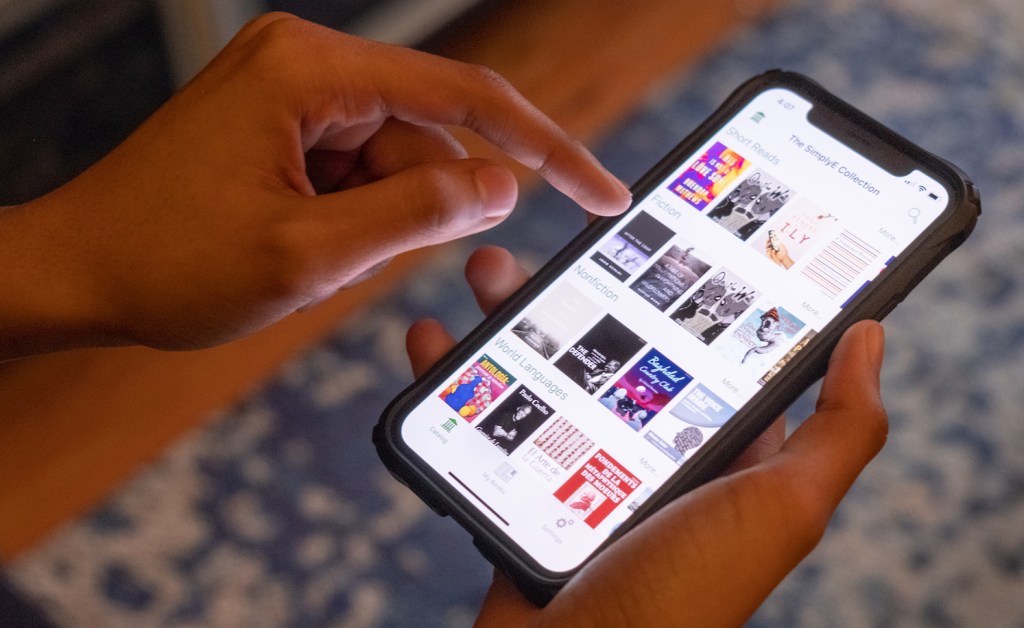
As people around the world adopt social distancing measures to help fight the coronavirus pandemic, The New York Public Library has an app that allows anyone with a library card (and an iOS or Android phone) to “borrow” any of the 300,000 e-books in the collection.
SimplyE is The New York Public Library’s free e-reader app that makes it easier than ever to borrow e-books. It is available on the App Store or Google Play.
Developed by NYPL as an open source initiative, now other libraries can provide a consolidated and clear view of their e-book collections.
A library official said:
“We know the Library is a critical resource for New Yorkers of all ages, which is why we have taken steps to expand access to our online offerings while our branches are temporarily closed.
Apply for a library card through SimplyE to gain access to an array of digital resources, including e-books and audiobooks, as well as databases available from home during our period of closure.”
Surge in demand
To keep up with the surge in demand for their ebooks, NYPL has introduced a limit on how many books you can e-check out. The limit is 3 titles per person; from children’s books to best sellers.
In a statement, the library said: “Please note that as a result of the Library’s temporary closure, we have already seen a surge in our e-book usage and anticipate further increases. In order to maintain the best possible service for the greatest number of users, we have therefore placed a new limit on e-book checkouts as a way to increase the number of books available and reduce wait times for all patrons. This includes checkouts through the Library’s main e-reader app, SimplyE, as well as through other apps used to access NYPL e-books, such as Overdrive/Libby and Cloud Library.”
Two obsessions keep finding their way into my writing. Throwing villains off high places, ideally with a protracted death scream. And time travel.
As a glutton for time travel, I’m certainly not alone. The whole world is going nuts for it right now, the concept showing up in more books, movies and TV shows than ever before.
Why? I think there are two reasons. One is that 21st century life is just so fast. The information age has given us so much more to do, but no more time to do it. Time is not just against us, it’s beating us, which is why we crave the ability to control it. Time travel offers relief from the unrelenting pace of life.
The other reason is less deep. It’s just so goddamn fun. It never gets boring because the storytelling possibilities are as infinite as time itself.
But even though more and more writers are using time travel, that doesn’t mean it’s easy. Do it wrong and you can end up with plot holes bigger than a temporal rift. One of the reasons my new book, Million Eyes, took so long to write was because of how much thought had to go into the time travel. It was bags of fun to write, sure, but my god was it hard. And while I’m really happy with how it’s turned out, it took a lot of sleepless nights, alcohol and drawing diagrams of timelines to get there.
For those willing to brave it (and some do say that writing time travel is not for the sane), here are some handy tips I’ve picked up while navigating this precarious path.
1. Choose your mode of time travel—and know how it works
Your first step is obviously, how are your characters going to travel in time? Can they control when they end up? How do they get back? Do they travel in time and space, or just time?
With a physical time machine like the DeLorean or the TARDIS, you just key in the time you want to go to and viola. Much weirder examples include hypnotising yourself (Somewhere in Time) and reading old diaries (The Butterfly Effect). Uncontrolled time travel includes the many temporal rifts in Star Trek, the magic stone circle in Outlander, and the anomalies in Primeval.
In Million Eyes, the characters swallow a pill that displaces them in time. The time travel can be both controlled and uncontrolled. Authorised time travellers have a chip in their heads that allows them to ‘read time’ and select a time to go to. Without this chip, the time travel is uncontrolled and there’s no way of determining when you’ll end up. (Well, there is sort of a way, but you’ll have to read the book to find out!)
Be creative; just make sure you understand exactly how your mode of time travel works.
2. Establish what your time travel rules are
More important than anything is establishing how time travel works in your story and what the rules are. The usual options are as follows.
The past can be changed and all changes have the potential to alter the future.
The past can be changed, but changes don’t alter the future, they create a brand-new reality that exists in parallel with the old one.
The past cannot be changed, and any ‘changes’ are predestined to happen and already part of the timeline.
The past can be changed, and those changes alter the future, but certain changes made to restore the future are already part of the timeline being restored.
I know—4 sounds complicated. A good example is the Star Trek: The Animated Series episode, Yesteryear. Spock gets deleted from the timeline after his younger self gets killed. Spock resolves to go back in time and rescue himself, then it’s established that Spock saving his younger self was, in fact, part of the original timeline (Spock remembers it). That means he’s predestined to go back and fix things.
Another example is Doctor Who. In the Fires of Pompeii, the Pyroviles are planning to conquer Earth in 79 CE and convert millions of humans into Pyroviles. Because this would drastically alter Earth’s future, the Doctor is forced to stop them. How he stops them is by triggering the eruption of Vesuvius, an event already part of the timeline he’s trying to keep intact.
I use 4 in Million Eyes (I like complicated). I won’t spoil anything specific, but there’s a point where the timeline is changed and the characters go back and fix it, but their actions in fixing the timeline constitute already established events.
Be very careful about mixing up the four options in the same story. 4 is basically a blend of 1 and 3 anyway, but if you want to incorporate 2, you need to be clear why and how. Don’t do what Star Trek 2009 did. That flashy and expensive bit of nonsense told us that Spock and Nero’s time travel had created a new reality, something that was at odds with all prior depictions of time travel in the Star Trek universe.
3. Don’t worry too much about paradoxes and pleeease don’t try and incorporate the ‘disappearing rule’
Part of the fun of writing a time travel story is having a super-weird paradox at the centre of it. Some of the most popular time travel stories are built around paradoxes. The pocket watch in Somewhere in Time is an ontological paradox, where an object gets stuck in an infinite loop and exists without ever being created; Old Elise gives the watch to Richard, who travels back in time and gives it to Young Elise. Similarly, in the Terminator films, Cyberdyne creates Skynet and the Terminators using the damaged CPU from the first Terminator sent back in time. In effect, the Terminators are created from themselves.
But one paradox that writers get really hung up on is the grandfather paradox. The grandfather paradox is the one about going back and killing your own grandfather, thereby erasing your own existence so you’d never be able to go back in time in the first place. This often leads writers to incorporate what I call the ‘disappearing rule’, a manifestation of the ‘erasing your own existence’ part.
Basically, don’t. It didn’t work in Back to the Future, as amazing as those films were, and it certainly didn’t work in Looper. (As I don’t wish to give anyone an aneurysm, please see my article for the Time Travel Nexus if you want to know why.)
My advice would be to follow the rule described by sci-fi author Orson Scott Card: If you go back in time, you can make any changes you want in the past and you’ll continue to exist, because the very act of travelling in time takes you outside the timestream and removes you from the effects of changes in history.
Still with me?
4. Meticulously research any historical periods your characters travel to
I’ve been tripped up by this before. In an early draft of Million Eyes, I described a sycamore tree in 1100-era England—except sycamores aren’t native and weren’t growing there until around 1500. A writer friend of mine, with an evidently better knowledge of trees, noticed.
This is how meticulous you have to be. You have to research everything about the world your time traveller finds themselves in. How did people dress? What did their houses look like? How did they light and heat them? What did they eat? Where did they go to the toilet? What did they do for money?
Also important to remember is how much the English language has changed. Would your time traveller understand what the locals are saying? Early English, Middle English and Modern English are all very different and then there was the Great Vowel Shift from the 1400s, which saw a massive change in how everything was pronounced.
It can be a slog, but it’s worth it. There’s a keen-eyed historian out there just waiting to pick apart your work. Don’t give them the satisfaction of finding anything.
5. Be careful if you’re a pantser
A plotter plans out their novel before they write it. A pantser doesn’t. They ‘fly by the seat of their pants’ and make everything up as they go along.
With Million Eyes, there was no way I could write it without a detailed outline of everything that was going to happen. You’ll see why if you read it. Basically, there are causal loops and predestination paradoxes galore.
Causal loops, by definition, need advance planning, because something your character does at the end affects things happening much earlier—like the Bad Wolf arc in Doctor Who, where the Doctor and Rose are stalked throughout the series by what turns out to be a message from Rose’s future self. If you don’t plan out these kinds of stories, you could end up with something jumbled and disjointed, riddled with continuity and logical errors.
If you’re brave enough to go time travelling in your writing, you’ll have an absolute blast. Just keep these points in mind and remember that, with a time travel book, your readers will already be suspending their disbelief. The trick is to maintain enough coherence and consistency so as not to dangle their disbelief over a ravine.
About the author
C.R. Berry is the author of the time travel conspiracy thriller trilogy, Million Eyes. The first book is out now and available to buy. Described by Berry as The Da Vinci Code meets Doctor Who, it incorporates conspiracy theory-laden events such as the disappearance of the Princes in the Tower and the death of Princess Diana into a fast-paced, twisty page-turner. An accompanying short story collection, Million Eyes: Extra Time, is available for FREE download from publishers Elsewhen Press.
Diana, Princess of Wales, was murdered by time travellers. That’s according to an exciting new conspiracy thriller just released today (9 March) in paperback.
The new book, called Million Eyes and written by conspiracy fiction author C.R. Berry, is set in a world where time travel has secretly been invented by a huge global conglomerate. Two characters, an ex-history teacher and a university graduate, team up to find out what’s going on. They learn that several big events in our history weren’t supposed to happen. These include the suspicious shooting of King William II in 1100, the still-unexplained disappearance of the Princes in the Tower in 1483, and the untimely car crash that killed Diana, Princess of Wales, in 1997.
The book comments on the startling amounts of power that big technology companies have over our lives. It also addresses the significance of the monarchy in Britain.
“It’s a book aimed at people who love conspiracy theories, Dan Brown and Doctor Who,” says Berry. “Even though the book is fictional, it stays true to many of the real-life events it incorporates and explains ‘what really happened’—such as the involvement in Diana’s death of the still mysterious Fiat Uno that was never traced.”
Berry acknowledges that including an event so fresh in people’s minds was a risky move. “I knew from the get-go that including Diana might be controversial, particularly in a sci-fi context. Indeed, while the reviews of Million Eyes have so far been really positive, one reviewer said she was uncomfortable that Diana was in it, having conversations with other characters, and that there are scenes of the crash itself. However, people have been incorporating real-life tragedies into fiction for centuries. Look at how many books, movies and TV series have been made about 9/11.”
Million Eyes is published by Elsewhen Press and available both as an ebook and a paperback directly from the publisher. Reviewers have called it “shocking”, “tense” and “addictive”, with a “deliciously dark vein of humour”. Berry will be signing copies and talking about the book at Waterstones in Farnham, Surrey, on Friday 13th March at 7pm.
Also available is a collection of short stories called Million Eyes: Extra Time. This contains new and previously published stories that introduce readers to the Million Eyes universe and cleverly interweave JFK, Paul McCartney, Queen Elizabeth I and the Loch Ness Monster. This can be downloaded for free from Elsewhen Press.









 nothing in the rulebook