An eternal, largely ineffable question has long been asked of books and the so-called ‘art of reading’. What, precisely, does reading do for the human soul?
Broadly speaking, books, reading and writing are about communication and creating connections with other human beings – people who exist beyond the page, and within the words before us. Books help us know other people – often those long dead – and help us better understand the world around us. In the process of reading, we come to know ourselves more deeply in a way that is borne out of an instinctive curiosity – a creative restlessness that exists within each of us, which we bring to each book we open.

These tomes – both big and small – open passageways and portals to other lands and ears, and in doing so provide guidance on how we might live in our own lives and surroundings.
Little wonder, then, that the masterful E.B. White likened reading to a drug-like experience:
“Reading is the work of the alert mind, is demanding, and under ideal conditions produces finally a sort of ecstasy.”
Indeed, this extraordinary essayist went further, in a short essay titled “the future of reading”, penned in 1951, and in it White writes:
“As in the sexual experience, there are never more than two persons present in the act of reading — the writer, who is the impregnator, and the reader, who is the respondent. This gives the experience of reading a sublimity and power unequalled by any other form of communication.”
The intimacy of the reading experience described here reflects an intensity discovered by countless other writers, readers, and thinkers. Perhaps one of the best articulations of this feeling is captured by Franz Kafka.
In a November 1903 letter, for instance, a 20 year old Kafka writes to a childhood friend, that “some books seem like a key to unfamiliar rooms in one’s own castle” – highlighting as he does so the curious ability books and literature possess to provide more insights into our own selves than we might think possible.
Kafka expands on this sentiment in another letter, penned in January 1904:
“I think we ought to read only the kind of books that wound and stab us. If the book we’re reading doesn’t wake us up with a blow on the head, what are we reading it for? So that it will make us happy, as you write? Good Lord, we would be happy precisely if we had no books, and the kind of books that make us happy are the kind we could write ourselves if we had to. But we need the books that affect us like a disaster, that grieve us deeply, like the death of someone we loved more than ourselves, like being banished into forests far from everyone, like a suicide. A book must be the axe for the frozen sea inside us. That is my belief.”
But of course, the art of reading needn’t always be seen as something intense. Put simply, it can also be joyous.
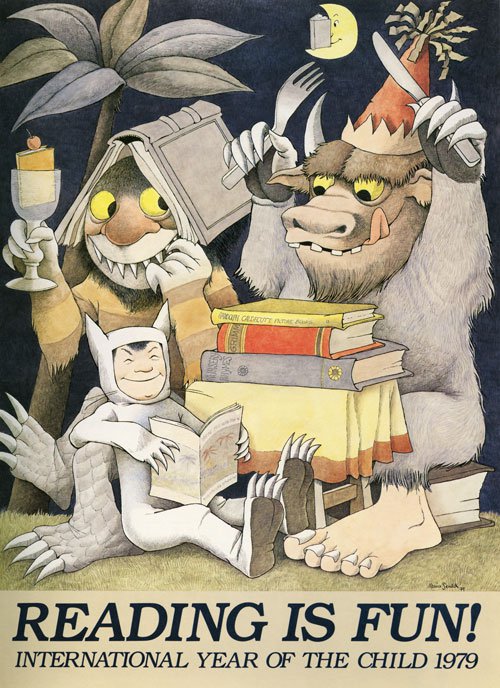
Nowhere is the importance of simple literary pleasure demonstrated than in the wonderful collection of posters by illustrator Maurice Sandak. Within this large-format tome are the artist’s enchanting posters celebrating the love of books and the joy of reading, many featuring his iconic Wild Things.
In the introduction, Sendak notes: “all of the pictures collected here were done for pleasure, and are offered up now with the hope that they will give pleasure”.
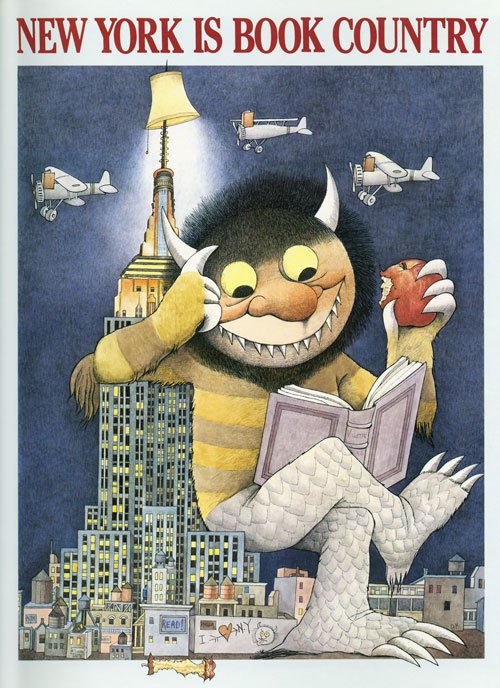
We’ve provided some of these posters throughout this article, and we hope you agree that they not only give pleasure; they also illustrate clearly the pure, infinitesimal joy that is possible to find within the pages of a good book.
In this digital age, some might suggest that books are no longer necessary – that they belong to a previous era. Yet such thinking is not only flawed; but in fact is dangerous. For books, as Susan Sontag told us: “are not only the arbitrary sum of our dreams, and our memory. They also give us the model of self-transcendence […] a way of being fully human.”
Books – and literature – therefore, are a vital part of our lives, because they keep us in touch with our humanity. They keep us in touch with life.


Leave a reply to “If you have books, you have everything” – scientists, artists and politicians on the value of the public library | nothingintherulebook Cancel reply