• The-pen-is-mightier-than-the-sword.jpg

    Our world faces catastrophic climate breakdown. True facts are now described as ‘fake news’, and biased media reported hailed by pseudo-Nazis as gospel truth. Political turmoil is growing as inequalities deepen across so many dividing lines in society. In such times, a challenge facing us all as artists, creatives and writers – but also simply as human beings – is to examine what role we ourselves have to play.

    We have previously written about the need for writers to tackle the subject of climate change in their poetry and novels and non-fiction accounts – while we have also paid tribute to Ursula Le Guin’s rallying cry for all writers to imagine new alternatives to our capitalist system.

    But what exactly is our duty, in these times, as writers and creatives? What stories do we need to tell?

    What is the story of the world?

    Fortunately for us, guidance on this question can be found from the minds of great writers – living and dead – who have pondered this precise topic. In East of Eden, for instance, Steinbeck opens the book’s 34th chapter with a mediation on the most fundamental foundation that sits beneath this essential question: if we have a duty to describe the stories of the world that matter, what exactly is the story of the world? Steinbeck writes:

    “A child may ask, “What is the world’s story about?” And a grown man or woman may wonder, “What way will the world go? How does it end and, while we’re at it, what’s the story about?”

    I believe that there is one story in the world, and only one, that has frightened and inspired us, so that we live in a Pearl White serial of continuing thought and wonder. Humans are caught — in their lives, in their thoughts, in their hungers and ambitions, in their avarice and cruelty, and in their kindness and generosity too — in a net of good and evil. I think this is the only story we have and that it occurs on all levels of feeling and intelligence. Virtue and vice were warp and woof of our first consciousness, and they will be the fabric of our last, and this despite any changes we may impose on field and river and mountain, on economy and manners. There is no other story. A man, after he has brushed off the dust and chips of his life, will have left only the hard, clean questions: Was it good or was it evil? Have I done well — or ill?”

    Understanding human beings

    In an earlier journal entry, Steinbeck even suggests that tackling the injustices in the world is not even possible if the writer first doesn’t understand the human beings who exist within it. He opines:

    “In every bit of honest writing in the world… there is a base theme. Try to understand men, if you understand each other you will be kind to each other. Knowing a man well never leads to hate and nearly always leads to love. There are shorter means, many of them. There is writing promoting social change, writing punishing injustice, writing in celebration of heroism, but always that base theme. Try to understand each other.”

    In a similar vein, the novelist Zadie Smith argues that to believe anything can bring about fundamental change is in fact naïve – and to honestly understand what drives the world forward (and how to subtly shift perceptions) you have to first appreciate the motivations of humankind. In a speech given in Germany in 2016 after receiving a literary award, she says:

    “People who believe in fundamental and irreversible changes in human nature are themselves ahistorical and naive. If novelists know anything it’s that individual citizens are internally plural: they have within them the full range of behavioral possibilities. They are like complex musical scores from which certain melodies can be teased out and others ignored or suppressed, depending, at least in part, on who is doing the conducting. At this moment, all over the world — and most recently in America — the conductors standing in front of this human orchestra have only the meanest and most banal melodies in mind. Here in Germany you will remember these martial songs; they are not a very distant memory. But there is no place on earth where they have not been played at one time or another. Those of us who remember, too, a finer music must try now to play it, and encourage others, if we can, to sing along.”

    Yet within this, Smith sees no reason not to use art – and writing in particular – to reshape narratives, to influence others, and ultimately keep striving for that which we are all searching for, especially in these sometimes dark times: human progress, and illuminating the path ahead on which we can strive to make a better world. She says:

    “History is not erased by change, and the examples of the past still hold out new possibilities for all of us, opportunities to remake, for a new generation, the conditions from which we ourselves have benefited… Progress is never permanent, will always be threatened, must be redoubled, restated and reimagined if it is to survive.”

    On the protection of democracy

    Smith’s line of argument calls upon all of us to continually work to reimagine and challenge existing political and social structures. This calls to mind the thoroughly excellent arguments of that legendary titan of literature, Walt Whitman, who, in his collection Specimen Days, calls on all free-thinking people to continually challenge and probe the status quo. Whitman writes:

    “I can conceive of no better service in the United States, henceforth, by democrats of thorough and heart-felt faith, than boldly exposing the weakness, liabilities and infinite corruptions of democracy.”

    What it interesting here is how Whitman lived through times that do not sound dissimilar to our own. He saved lives through the Civil War, witnessed the “miserably-waged populations”, the corrosion of idealism and collapse of democratic values into corruption and complacency. Yet the great American poet faces this dispiriting landscape with a defiant optimism, arguing that this is in a way the most countercultural act of courage available to us:

    “Though I think I fully comprehend the absence of moral tone in our current politics and business, and the almost entire futility of absolute and simple honor as a counterpoise against the enormous greed for worldly wealth, with the trickeries of gaining it, all through society in our day, I still do not share the depression and despair on the subject which I find possessing many good people.”

    Ultimately, Whitman notes that the only way to preserve democracy in America is also to preserve nature (to hark back to our call to tackle the catastrophic breakdown of our climate for a moment here). And, as current US President Trump and his collection of lunatic criminals in the Republican party continue to show flagrant disregard for the planet and its natural environments, this is a thought that is well worth revisiting. Whitman writes:

    “American Democracy, in its myriad personalities, in factories, work-shops, stores, offices — through the dense streets and houses of cities, and all their manifold sophisticated life — must either be fibred, vitalized, by regular contact with out-door light and air and growths, farm-scenes, animals, fields, trees, birds, sun-warmth and free skies, or it will morbidly dwindle and pale. We cannot have grand races of mechanics, work people, and commonalty, (the only specific purpose of America,) on any less terms. I conceive of no flourishing and heroic elements of Democracy in the United States, or of Democracy maintaining itself at all, without the Nature-element forming a main part — to be its health-element and beauty-element — to really underlie the whole politics, sanity, religion and art of the New World.”

    Truth above all

    Of course, it is easy to present arguments in favour of protecting the world and become downhearted when these are dismissed by the despots around the world – from Trump in the US through May in the UK, Putin in Russia to the incompetent National Liberal coalition in Australia – and ignored as being part of some fabrication or over-exaggeration of ‘progressives’ (as though we would feel foolish if we were to accidentally be fooled into creating a better world for nothing). ‘Fake News’ is everywhere, as we are all told. Here, it feels fitting to draw upon inspiration from legendary journalist Rebecca Solnit, who presses upon us our need to continue to stick to accuracy and truth when writing stories. In her collection of essays, Call them by their names, she writes:

    “Precision, accuracy, and clarity matter, as gestures of respect toward those to whom you speak; toward the subject, whether it’s an individual or the earth itself; and toward the historical record.”

    In an era of ‘alternative facts’, where language is increasingly used for malicious purposes, Solnit strives to persuade us of the importance of calling things as they are:

    “To name something truly is to lay bare what may be brutal or corrupt — or important or possible — and key to the work of changing the world is changing the story.”

    More than a century after Nietzsche contemplated truth, lies, and the power of language to both conceal and reveal reality, Solnit writes:

    “There are so many ways to tell a lie. You can lie by ignoring whole regions of impact, omitting crucial information, or unhitching cause and effect; by falsifying information by distortion and disproportion, or by using names that are euphemisms for violence or slander for legitimate activities, so that the white kids are “hanging out” but the Black kids are “loitering” or “lurking.” Language can erase, distort, point in the wrong direction, throw out decoys and distractions. It can bury the bodies or uncover them.”

    Breaking the narrative

    Ultimately, Solnit calls on writers to continue to strive towards that goal of truth – for exposing the truth, using language that is accurate, that lays bare the reality of situations. Through truth, she argues, we can break and reshape narratives and stories that have been spun by the powerful against the powerless – and hopefully move toward a world where the only thing that is fake is Trump’s hair. She writes:

    “The writer’s job is not to look through the window someone else built, but to step outside, to question the framework, or to dismantle the house and free what’s inside, all in service of making visible what was locked out of the view. News journalism focuses on what changed yesterday rather than asking what are the underlying forces and who are the unseen beneficiaries of this moment’s status quo… This is why you need to know your history, even if you’re a journalist rather than a historian. You need to know the patterns to see how people are fitting the jumble of facts into what they already have: selecting, misreading, distorting, excluding, embroidering, distributing empathy here but not there, remembering this echo or forgetting that precedent.

    Some of the stories we need to break are not exceptional events, they’re the ugly wallpaper of our everyday lives. For example, there’s a widespread belief that women lie about being raped, not a few women, not an anomalous woman, but women in general. This framework comes from the assumption that reliability and credibility are as natural to men as mendacity and vindictiveness are to women. In other words, feminists just made it all up, because otherwise we’d have to question a really big story whose nickname is patriarchy. But the data confirms that people who come forward about being raped are, overall, telling the truth (and that rapists tend to lie, a lot). Many people have gotten on board with the data, many have not, and so behind every report on a sexual assault is a battle over the terms in which we tell, in what we believe about gender and violence.

    […]

    Future generations are going to curse most of us for distracting ourselves with trivialities as the planet burned. Journalists are in a pivotal place when it comes to the possibilities and the responsibilities in this crisis. We, the makers and breakers of stories, are tremendously powerful.

    So please, break the story.”

    You heard it here first, comrades. So, what are you waiting for? Get breaking!

    If youd like to contribute to our site – and show off how good you are at breaking narratives – please contact us.


  • bojackhorseman

    If you’re reading this article, the likely reason is that you’ve seen the name BoJack Horseman and clicked on a link somewhere out in the wilds of the internet or social media. You’ve recognised the name and it’s peaked your interest. Why have you heard that name? Simple – because since BoJack Horseman was released in 2014, it has gained critical and popular acclaim – showered in praise for the way it skilfully probes existential anxiety, interweaving zany, offbeat comedy with sometimes sly humour, as well as intensely sad or ‘dark’ moments. It’s popular, in other words; and for good reason: it’s real.

    That a cartoon show about a substance-abusing middle-aged horse feels like the most real thing many people have seen for so many years says more about our current cultural malaise than we might like to admit. But it doesn’t make it any less true.

    One of the factors that makes BoJack feel so real – so relatable – is the fact that the characters in the show must face the consequences of their actions. No character is “too big to fail” (in the way the banks that crashed the global economy were allowed to carry on Scott-free while the average person has had to shoulder the burdens and crises they created). As Arielle Bernstein writes in an article for The Guardian:

    “Throughout the series, we see child BoJack, eager and wide-eyed in his little sailor suit, being verbally abused by his mother and father. But while the series encourages us to see BoJack’s own self-absorption as a response to a traumatic childhood, it also insists that BoJack not be given a free pass. In his heart of hearts, BoJack is never a “bad guy” per se, but his thoughtless choices often have very real impacts on everyone around him.”

    Yet, while this is an admirable aspect of the show – that it has created extremely well-rounded characters who we can relate to – the true ‘realness’ of the show comes from the way it counters other aspects of our current society.

    The power of the image

    Firstly, we must consider the use of images in both the show and in our culture – and the way in which BoJack Horseman subverts what Lacan would term ‘natural’ images with referent – or ‘signified’ images. At its very basic, this is ultimately a joke about the fact that we are all animals – the playful humour of seeing a golden Labrador wearing a v-neck t-shirt, rocking aviator sunglasses and being obsessed with the skunk from next door is funny and surreal. There is also a clear use of Lacanian mirror imagery between BoJack and his ‘inverted mirror’, Mr. Peanutbutter. Mirrors can also be found between the ‘real’ BoJack and his TV personality on 90s sitcom Horsin’ around, as well as his TV detective character, Philbert – and during this portrayal the mirror line blurs completely in Episode 11, “The showstopper”, in which we all witness a very real “crossover episode”, to coin a favourite line from the show. Once again, visual and symbolic mirrors abound in series five episode 7, when we meet not BoJack, but ‘Bobo the Zebra’.

    Yet for all BoJack’s surrealism and superficial escapism, the heart of the show carries messages that, simply, resonate with audiences. The escapism that BoJack and his cohorts pursue is the same that we ourselves seek. That it feels ‘honest’, and ‘true’ is often conflated as being ‘dark’ – as though the idea of a person who doesn’t quite feel that everything is okay within themselves, despite being rich and famous, and takes actions that are nearly always morally ambiguous or questionable, is in someway only explainable if we describe it as “dark”. Doing this, however, otherises such concepts and thus fails to recognise that the real reason the show has such an avid following and has picked up such critical acclaim is because the ‘dark’ aspects of the show aren’t dark at all – they are in fact extremely relatable, particularly for anyone who has ever found that their entire construct of societal expectations has been built around lies meant to satisfy shareholders; not to satisfy our egos or our real natures or purposes. Indeed, when faced with this realisation and reality, the actions that BoJack pursues, the depression, the anger, anxiety, denial, etc. – these become not only normal or relatable, but actually natural reactions to an extremely unnatural world and society.

    In an excellent documentary series, The Century of the Self, Adam Curtis explains how, since the 1960s, there have been attempts by both psychiatrists and those in power to make us feel as though certain natural human responses to life are the symptoms of serious psychological or mental disorders. This is partly because the financial, marketing and operational models on which capitalism – and particularly consumerism – relies, have been built on the ideal of human beings as rational, self-serving, individuals. This, of course, flies in the face of evidence that suggests human beings are quite often irrational, altruistic members of communities, tribes and societies as a whole.

    Living in a world in which we are told that to feel sad is a sign of a serious mental disorder; in which we are told we can only ever aspire to satiate our own desires by buying more and more things, despite the fact that we are ultimately just searching for real, meaningful connections with other people, places us all in an existential crisis that is vividly and expertly portrayed in BoJack Horseman.

    Again, images are important here. In both societies (that of BoJack’s Hollywoo and our own world), materialism – and the images that go with it – run rampant. Consumerism is the order of the day; and both TV show and our reality are subject to the fact that consumerism as a socioeconomic is fundamentally built upon the engineering of desire through psychological manipulation, which is achieved by using images – including advertising and peer pressure – to make us inclined to purchase more and more stuff.

    Why does this matter? Being bombarded and overwhelmed by images that are not real – that lack any substance beyond activating something in us that makes us feel empty and fuels our desire to consume, ultimately creates a genuine emptiness and aching for reality. As David Shields notes in Reality Hunger: 

    “Living as we perforce do in a manufactured and artificial world, we year for the ‘real,’ semblances of the real. We want to pose something real against all the fabrication.”

    The problem with materialism

    BoJack lays bare the problem with materialism and consumerism in a way precious few TV shows have dared to do.

    An impressive body of academic research suggests that materialism, a trait that can afflict both rich and poor, and which the researchers define as “a value system that is preoccupied with possessions and the social image they project“, is both socially destructive and self-destructive. It smashes the happiness and peace of mind of those who succumb to it. It’s associated with anxiety, depression and broken relationships.

    Depression, anxiety, broken relationships; socially destructive and self-destructive. Remind you of anything?

    There has long been a correlation observed between materialism, a lack of empathy and engagement with others, and unhappiness. But research conducted over the past few years seems to show causation. For example, a series of studies published in the journal Motivation and Emotion in July showed that as people become more materialistic, their wellbeing (good relationships, autonomy, sense of purpose and the rest) diminishes. What’s more, as we are repeatedly bombarded with such images through advertisements, and constantly described by the media as consumers, we become more selfish, and more likely to act and behave in the ways large corporations need in order to make continual disgustingly large profits.

    The irrationality of society

    For years, then mainstream cultural programmes have adopted the use of imagery and story narratives to support and reinforce the myths that keep them in power and maintain the status quo – to help the consumerist models function; and to keep us spending money, buying more things – all in the ultimate pursuit of our supposed individual happiness.

    There are obviously numerous problems with this – not least from a moral perspective. Yet events in recent years have markedly laid out some of the flaws in this approach.

    In the first instance, the collapse of the world financial system (triggered in part by massive acquisition of unsustainable personal, individual debts) and subsequent global recession has forced millions of people in Western Society to live in times of extreme austerity. Among many other (perhaps more pressing) issues with this – such as child poverty, rising crime, inequality, – the era of low wages and job scarcity or insecurity that has been created by the austerity model has made it impossible for people to actually exist and function within the previous consumer system as they had been told to. In other words, they had been denied the means with which to participate in the consumerist culture. How can you buy the latest deluxe car when you can’t afford to heat your own home or pay your rent?

    Without the means to participate in consumerism, people have started to recognise that the society in which they live, and the dreams they have been told to pursue, are in fact not recogniseable, achievable, or real. The reality of their situation is that the entire system has been broken – and so a world which continues to expect them to accrue personal debt in order to buy the latest fashion trend is not a world in which they can be rationally expected to live.

    Beyond the fiction of reality

    This all, ultimately, leads us back to BoJack – a world in which to be self-aware is often to become self-destructive. To recognise the faults in the world can lead to despair (because you can’t hope to change things); but also in which ignoring reality and going along with societal pressures is to sacrifice any true sense of identity. Indeed, those characters which lack depth or sense of realness are those who lack any self-awareness – a ‘Ryan Seacrest type’, for instance; a character with so little identity he is only a trace (again to use a Lacanian term) of somebody else. In this world, the most natural response is one that does not seem ‘natural’ – as the system would like you to believe – but rather, to respond to a system that is entirely broken by becoming broken yourself; or reacting to the impossibility of the ask placed upon us as individuals by coming to impossible conclusions (see any of Mr Peanutbutter’s whacky ideas for starters here). The show feels real because the characters are negotiating a broken society that mirrors our own. As Slavoj Zizek has noted: “beyond the fiction of reality lies the reality of the fiction.” We are drawn to the reality of the fiction (in this case, a television show about a celebrity horse) because it is what Lacan would describe as the signifier of something we inherently lack in our own world: reality and realness. We experience so few ‘real’ images, that ones that signify truth – the reality of our situation – become precious and to be treasured.

    Ultimately, this helps us more effectively bond with the characters and empathise with them. This is important – particularly in a world in which reports of loneliness are skyrocketing – because it illustrates how BoJack Horseman becomes nourishing, even redemptive; we become less alone inside because we recognise that our reaction to the impossibilities of the world is not confined to our own skulls. BoJack Horseman, then, helps us become less alone inside.

    And that’s why we need it.

  • Nothing in the Rulebook’s resident book reviewer Tom Andrews digs into ‘The study circle’, by Haroun Khan, published by Dead Ink Books.

    The Study Circle

    This debut novel by Haroun Khan follows two friends from a South London council estate. Ishaq is devout and well educated, a regular at the titular Islamic study circle. His education at a university may give him a way out of the brutal poverty of the estate. His friend Shams is less fortunate and is obliged to make ends meet anyway he can, even if the means are not entirely legal or safe. The pair are caught between the gentle and wise Ayoub, the leader of the study circle, and Mujahid, who justifies his own criminal activities with radical politics and mangled religion.

    Khan, writing from some personal experience, gives an unrelentingly grim portrait of the estate. It’s a hopeless and forgotten place, where violence is never far away, and the police are more of a threat than a source of protection. Choices and opportunities are impossibly limited; the characters wonder if it is possible for them to ever truly leave the place behind. Again and again, it is emphasised that outsiders simply do not understand the everyday challenges faced by young people in such an environment, abandoned and alienated while at the same time demonised and discriminated against by the society they live in.

    This is a very timely, of the moment book that deals with issues of Islamophobia, racism and poverty in modern Britain. Unfortunately, it doesn’t deal with them in the context of an always engaging novel, but sometimes heavy-handedly in the form of extended essay passages between minimal slices of here and now events.

    The last third of the novel is the first time that I had any sense of interest in what would happen next, any sense of drama. This welcome change of pace redeems at least some of what has come before, but how many would persevere to this point? It is not a long novel, but it would benefit from some editing.

    The writer himself admits to feeling uneasy while writing this and says, ‘There is a lot I have said here that people can take issue with.’ That’s unavoidable when dealing with such heavyweight issues of race, religion and class. It certainly gave this reviewer uncomfortable things to ponder.

    About the reviewer

    tandrews

    Tom Andrews is a Genetics graduate and book lover based in Somerset. He has previously attempted music and game reviews. He tweets at @jerevendrai 

  • Dancer's feet

    When I was ten I saw a ballerina tear her Achilles tendon. I was sitting on the side of the stage during a recital rehearsal, unrolling a leg warmer on my left thigh. It was April, and I could hear heavy rainfall beating against the emergency exit doors of the theatre. My face was warm, and one of my legs was aching with a cramp. I sipped some water from my bottle as I looked at the girl who was going over her pas de deux behind the curtains opposite me. I knew her name was Camilla because she was the most promising dancer in our school, even though she was only fifteen. She was talking angrily to her dance partner, Alex, but I could not hear what she was saying. He was a handsome boy with wavy hair, and all the girls in my class were obsessed with him. Through the white empire-waist costume Camilla was wearing, tight on her flat chest and broad around her thighs, her ribs and backbone were visible. When I saw her walking towards me, I hastily looked down.

    “Is this yours?”

    I raised my eyes. Camilla was pointing at my water bottle. I nodded. From up close, I noticed that her hair was dirty and that she had a violet bruise on her neck, the shape of a jellyfish. She had an unlit cigarette in her right hand. She grabbed my bottle with her free hand and gulped like she was dying of thirst. Then she put it back next to me.

    “Camilla!” Maria, our ballet teacher, joined us on stage. She was pregnant at the time, her belly round like a melon, bags under her eyes that were puffy and purple. “What are you doing?”

    “Smoking.” Camilla talked to Maria as if they were equals, which surprised me, as I feared Maria more than anyone else. Maria took the cigarette from Camilla’s hand and broke it in two.

    “You’re rehearsing.” She stared into Camilla’s eyes until she nodded, like a rebellious daughter annoyed by her mother. “Get ready now!” Then Maria noticed me, sitting at their feet: “Cecilia, after Camilla bothers to try her choreography, it’s your turn.”

    Camilla and Alex danced like swans. She looked pale and weightless, while he touched her and lifted her. They ran away from each other and then jumped back into each other’s arms. I counted her pirouettes as her gown opened like a moonflower. Then I heard a snap, and Camilla fell. It was an audible pop; it echoed all over the stage. Alex stepped back, unsure of what to do. The music went on. Camilla was not crying.

    “Fuck,” she screamed, panting.

    Maria hurried on stage as I looked from behind the curtain. She knelt next to Camilla and caressed the back of her ankle.

    “It’s the tendon,” Maria said, “I’m calling an ambulance.”

    “No!” Camilla almost shouted and grabbed Maria’s arm. Her ankle was twisted, quickly swelling up. I wanted to go closer but I couldn’t.

    “She’ll be fine.” I turned, and Alex was right behind me. I wasn’t sure whether he was talking to me or not, but I could tell from his face that she wouldn’t be fine at all.

    *

    I straighten my back and grit my teeth. I can feel blood staining my pointe pads; I did not have time to place them properly on my toes.

    “Smile!” Maria shouts to the entire class, yet it feels like she is addressing me only. I’m her favourite, but she hates me. She has been my teacher since I was three. Now, after thirteen years, nothing has changed. She still treats me as if she doesn’t understand that I have feelings. I suspect she doesn’t have any.

    I complete the sequence of assemblés and échappés, my ballet shoes clacking against the polished wooden floor, my hand holding on to the barre. When the music stops, the smiles drop off every girl’s face at once. Maria takes the CD out of the player. We are all waiting for her response, our necks sweaty, our legs shaking with exhaustion. Once, she took the CD out and threw it on the floor, then started shouting at me, saying that I was “rude”, “stupid” and “unfit” for the class. Turns out I kept yawning before starting the choreography.

    This time, Maria turns to us and says: “Class is over.” She never says “well done” or “good job” or anything like it, but, if she doesn’t complain or insult any of us, it means she’s satisfied. I’ve learnt that silence can also be a compliment.

    We leave class dragging our feet, looking forward to getting rid of our uncomfortable tights. In the changing room, the radiators are not working. I take my bag and clothes and walk to the bathroom; I don’t feel like talking to anyone. Sara follows me. She is older than me, like everyone else in the class. This year, her acne is gone and her blonde hair has grown long and glossy. When she rehearses without tying it in a chignon, it swings and arches like a golden rainbow.

    Sara sits on the cold floor of the bathroom and wipes her sweaty chest with toilet paper. She starts removing her shoes slowly, first the heels and then the toes, which have become glued to the pointe pads. I remove mine quickly; I’d rather feel the pain hitting me all together. I stuff the pointe pads in my bag, then I rapidly place my feet under the freezing water coming out of the sink. Sara does the same. Our feet look terrible, mine covered in blisters, hers missing a couple of nails.

    “Ballet shoes are not for everyone,” Maria has always told us. When we were ten and got our first pairs of pointes, we all looked at them with excitement. The satin was shiny and the sole was hard; it smelled of leather. I used to put them on at home, and jump and spin around my mother’s grand piano, coming up with choreographies that I would then perform in front of my family.

    After getting dressed, we walk back to the changing room through a narrow, poorly lit corridor, then to the entrance, where all the other girls are waiting for someone to pick them up. I walk past them, stuffing my hands inside the sleeves of my coat. I see the lights of the cars driving away from the parking lot, chasing one another until they fade into darkness. I look at the illuminated windows of the terraced houses and at the floating moon. The outlines of other passers-by seem ghosts under the lamp posts, and I am glad they cannot see my horrible feet.

    *

    Alex has come to class today for a new pas de deux assignment. I haven’t seen him in six years, since the day Camilla tore her tendon. Sara, whose mother is friends with Alex’s parents, says he passed the auditions for the ballet school at La Scala Theatre but then quit because he wanted to go to university to study psychology. He has changed: he has tattoos on both his hands, his skin is stretched on his muscles and a hint of beard has appeared on his chin. He is sitting on the floor next to Maria and watches us as we perform the choreography alone, one after the other. I see him out of the corner of my eye: sometimes he stares blankly, other times he checks us out in a way that makes me feel uncomfortable.

    Emma, our headmistress, paces back and forth in the room, clapping her hands to the rhythm and shouting “posture!” She is in her forties, her hands are rough and wrinkly, and her long black hair looks dry. Still, when she moves, only hinting at the steps of the dance with her graceful limbs, she seems younger than any of us.

    Maria is quiet, as always when Emma is around. Earlier today, I heard them talking about the costumes we have to wear for the next recital. Emma suggested we paint our faces red, which did not sound like a good idea to me. I still remember the dance contest when we had blue paint on our cheeks and so much glitter on our eyelids that some got into my left eye. It started to ache and water right in the middle of our performance, and everyone thought I had become emotional.

    After she has observed all of us carefully, Emma says: “Cecilia will dance with Alex.”

    The other girls whisper in disappointment.

    “Does anyone have a problem with that?” Maria asks. Anna, who is shorter than me and as skinny as a twig, speaks up: “The best choreographies are always assigned to the same people.” Last week she almost fainted. I think she doesn’t eat much anymore; she keeps swallowing weight loss pills before class.

    “Like who?” Maria stands up, walks closer to her.

    “Cecilia is the only one who did a solo.” Anna’s top is slick with sweat and sticks to her back.

    “Cecilia remembers the steps of the choreography and doesn’t complain.”

    Anna flushes, and I notice her hands are shaking. Emma takes me by the arm and turns to everyone else: “You can leave early today girls. Good job everyone.”

    I remain alone with Emma, Maria and Alex. He stands up and stretches. I wipe the sweat from my forehead.

    “This is not a pas de deux as you imagine it. It’s not too graceful, too perfect, too clean,” Emma says. I look at Alex’s tattoos and then at my pink bodysuit.

    “I want this to start quietly. You smile, you touch each other gently. Then you let go. Can you do this Cecilia?”

    “Yes,” I lie.

    “Good. Then let’s just try one sequence before you go home. Alex’s running after you, he catches you. So you stand and your arms reach out… remember?” We both nod and get into position.

    “Five, six, seven, eight!”

    Alex runs after me, and his hands brush against my naked back. He takes me, and I raise my arms to the ceiling.

    “Hold it!” says Emma, “Hold it Cecilia, you are a tree, a tree in the wind!”

    I let my arms swing gently, and wonder what kind of tree I am.

    “Your arms are branches, your hands are leaves!”

    I feel Alex’s hands tight on my waist, his breath on my neck. I move my fingers and wrists, and tilt my head back, laying it on Alex’s shoulder. I decide that I am a weeping willow, like the one that grows in my grandmother’s garden, shading the daisies and cobblestones against the sun. Its branchlets turn yellow in autumn and look like a cascade of golden tears.

    After class, Alex lights a cigarette outside, cupping his hand around the end. The tattoos on his hands are feathers, one for each finger. He has nice knuckles. I wonder if he remembers that I was there when Camilla got hurt. But that was a long time ago.

    “Are you sad?” he asks me.

    “Why would I be?” I remove the pins from my hair and let it loose on my back. He watches me as if we were intimate and not two strangers.

    “Your friend hates you because you got the part.” He tilts his head a bit, his smile is cheeky.

    “She’s not my friend.”

    He laughs, ties his curly hair in a knot and walks away.

    “See you tomorrow,” he says, without turning around.

    *

    Back home, I skip dinner and fill the bathtub with hot water and vanilla soap, as the smell of minestrone comes from downstairs. I undress slowly, my muscles tired and aching. I throw my clothes on the floor like waste paper. The water burns my skin but I slowly sink until I am completely immersed, my hair dancing around my face in slow motion. I close my eyes.

    I hear a muffled knock on the door. When I re-emerge, my mum is folding my clothes, crouching on the bathroom floor. I rub the soap from my eyes and look at my toes that creep out of the suds, covered with plasters.

    “How was class?” my mum asks.

    “Tiring.”

    “And this new guy Alex?”

    “Too good.”

    “Better than you?”

    “Yes.”

    My mum runs her fingers through my wet hair: “Should you practise more?”

    “I already practise two hours every day. I also need to study.”

    “But if you want to do the auditions for La Scala…”

    The moonlight filters through the slats of the blind, striping her face. She takes my feet into her hands and rubs them gently.

    “It’s my life not yours,” I say.

    “Don’t talk to me like that.”

    My mum wanted to be a ballerina but her family couldn’t afford to pay for her ballet classes. Once, I saw a photo of her dressed up in a light blue tutu, taking a bow in front of an invisible audience. The colours were faded and there was a blemish on the lower part of her face, so I couldn’t figure out whether she was smiling or not.

    “I’m sorry, I’m just tired.”

    “I’ll bring you something to eat.” She leaves the door slightly open, the light of the corridor illuminating the flowery tiles of the wall. I fall asleep in the cooling water, my head resting on the edge of the tub.

    *

    “Five, six, seven, eight!”

    Alex and I rehearse two hours every day after my class with Maria. Emma supervises the choreography, sitting on a white plastic chair, swinging her head left and right to the rhythm. Alex does not seem to struggle with anything. I sweat too much, weigh too much, forget too much.

    *

    “Five, six, seven, eight!”

    Some days Emma dances with Alex to show me what I do wrong. As they sway around the room in perfect harmony, they seem to hear each other’s thoughts, their steps echo in tune. I feel like an off-key note.

    “We have to do this together, you know,” Alex says to me as we take a break, stretching at the barre. “It’s like finding a compromise.” I think that I’m not good at compromising but I nod.

    *

    “Five, six, seven, eight!”

    My horoscope says: “It is important for you to keep at least one foot on the ground, as powerful emotions are likely to take over the scene.” As Alex lifts my body in the air, his hands on my thighs, my back arched backwards to form a right angle with my hips, I wonder if the “foot on the ground” thing is physical or metaphorical. I start liking our practise, our stretching breaks, the cigarette he smokes before we go back home, hungry and exhausted.

    *

    “Five, six, seven, eight!”

    I learn that he is always a bit early with the tempo, that pirouettes are not his strength, but he jumps so high he seems to defy gravity. I learn that our bodies have a way of reading each other that slips beyond the things we tell – or fail to tell – each other. When my fingers brush against his shoulders I imagine I am opening windows, letting his light peek through the clouds.

    When he runs after me, Emma repeats: “Cecilia is the direction you are going Alex! She is your path!”

    *

    “Five, six, seven, eight!”

    Emma hasn’t come to class today because her daughter is sick, so we have to practise without her. I look at Alex and myself in the mirror, at how his tattoos jar with my pale skin, his hair band that barely holds his curls back with my perfect chignon. The floor is dusty and covered in signs left by my pointes. We try the choreography until the sunshine does not come through the windows anymore, and we are left with the feeble light that comes from the bulbs hanging from the ceiling.

    “I’d better go home for dinner,” I say as I put on my oversized sweater. Alex nods.

    “Do you want me to walk you?” He has never asked me that before.

    “That’d be nice.”

    He smiles, picks up his bag. I open the door and, as I am about to walk out, he closes it from behind me, covering my hand with his. He kisses me, and I taste mint and smoke and remember when, as a child, I was looking at him with Camilla, wanting to be like her. I am like her now but I’m not sure it is a good thing.

    *

    On Saturday Sara insists that we go to a house party thrown by a boy from Anna’s high school. I drink too much beer, the kitchen table is sticky, and the people keep jumping in the swimming pool with their clothes on.

    I love you like a love song baby. Anna and Sara drag me to the centre of the living room to dance. I look at them and copy their moves; the rhythm is repetitive and shallow but it’s nice to let go. And I keep hitting re-peat-peat-peat-peat. Anna takes my hand and makes me spin; she doesn’t seem to hate me now, she looks beautiful in her leather dress, her curls loose. A tall boy comes up to me, offers me a plastic cup filled with wine. I, I love you like a love song baby.

    “That’s Marco, he’s from my school, go and talk to him,” Sara whispers in my ear and pushes me towards him.

    “So you’re a dancer,” Marco smiles, a bit awkwardly. He is wearing a nice, ironed shirt. I take the cup from his hand and gulp down the wine.

    “Yes, but what I should really have been is a singer. Everyone kept saying it for years.”

    “Wow. Really?” He sips from his drink. He seems more confident now, enjoying the idea of me singing for him.

    “No. That was a joke. No one has ever told me that.”

    He stares at me, confused, then laughs out loud. Before he can say anything, I feel the weight of someone’s arm across my chest and I turn and see Alex, a cigarette between his full lips, a wrinkled blue shirt looking too big on him. The music grows louder and Alex carries me outside, leaving Marco and his ironed shirt empty handed. The street is quiet and still.

    “Let’s go home,” Alex says. He drops his cigarette, and I watch it glowing and bursting into sparks as it hits the ground. He drives me home, in silence. Re-peat-peat-peat-peat. The screen of my phone illuminates with Sara’s message: “you okay? Why did you leave?” I type: “practise tomorrow,” and wonder why I keep doing this, going to ballet classes, spending most of my days with people I don’t really like. I come to the painful realisation that I don’t have an answer.

    Alex kisses me goodnight in front of my door, then drives away. From outside, I see my parents’ faces lit up in front of the television screen. I unlock the front door with difficulty, then walk up the stairs to my room. I hear the soft steps of my father’s slippers following me from the living room. I jump on my bed and hide under the sheets, my alcohol smelling clothes still on. My father’s head pops in, accompanied by a gentle knock.

    “How was the party?”

    “Fun.”

    “Your mum is upset. The recital is in one week.”

    “Tell her it’s fine.”

    He nods. Doesn’t leave. It looks as if he is about to speak but then he closes my bedroom door behind him, and I am left alone in the dark.

    *

    I draw a big amount of brown eyeliner across Sara’s eyelids and smudge it with my fingertips, as we have run out of eye shadow. She is struggling to flatten her chest inside her bright red tutu.

    “Can you stay still?” I ask.

    “Why do I have big boobs?” she moans.

    I spread some glitter on her cheeks and chest, then I fix my own headdress, whose orange and yellow feathers won’t stay in place. We are standing in a corner of the changing room, next to a harlequin costume that is hanging from the ceiling and keeps ticking our necks with its sleeves. The room is an explosion of colours, as girls and boys of every age walk around, trying to find space for their own bags and costumes, swearing whenever a hairpin falls and gets lost on the messy floor. Most of the older girls are stretching, leg warmers wrapped around their ankles and feet. The place smells of sweat and deodorant. The music that is playing upstairs, on the stage, is muffled by the buzzing that reigns backstage. Every now and then, the head of a ballet teacher pops in and tells us to lower our voices.

    I crouch on the floor and close my eyes, focusing on the sound of Sara’s hands rifling through my make-up bag. I wonder where Alex is; he is late and I am meant to perform with him right after the dance with Sara and the other girls. I feel Sara’s fingertips finishing the touches of my winged eyeliner.

    “You’re up next,” Maria’s voice comes from the stairs. I know she is talking to us, even before she walks down and repeats: “Cecilia, Sara you’re up next. Then I want Anna, Clara, Francesca, Paola! Quick!” She grasps Sara and me by the arms and drags us upstairs. We leave the changing room and enter the darkness of the stairs. We go past younger ballerinas who are already waiting in their yellow tutus, biting their nails. Emma’s husband is smoking by the door at the top of the stairs, keeping it open; the cold air makes me shudder and paranoid abut my muscles.

    Maria speaks on my behalf: “Shut the door, Mario! Can’t you see they’re about to go on stage?” She keeps holding our arms, as if we weren’t able to walk by ourselves.

    I stand behind the curtains with Sara, looking at the girls on the other side of the stage, as they twitch their hands and fix their shoulder straps and headdresses. Emma presents our choreography, a dance inspired by The Firebird with music by Igor Stravinsky. Then the audience applauds, and the lights go down.

    My pointe shoes do not make any sound as I walk towards the centre of the stage with Sara, the other ballerinas spreading around us. I look up and smile; the light suddenly illuminates me, and the music starts playing. I stare at the upper part of the audience, where faces seem to melt into one another. My arms are wings, my fingers are light and long, my palms are speaking. When I jump near the curtains, I see Maria’s apprehensive face. She is counting to help us keep the rhythm. I finish the dance landing on my feet after an assemblè. The audience claps and shouts, I can see my mum’s proud face in the crowd; she is sitting in the front row.

    We run backstage, and, in a second, a thousand hands are touching me, removing my tutu, working on my chignon and make up.

    “She’s up next!” Maria says. Sound and light operators make room, pushing younger girls behind. Alex, already in his white costume, is stretching his neck with his eyes closed as if I wasn’t here. I stand half naked behind the curtains, trying to fit into my empire dress, as Maria wipes off my Firebird make up with a wet tissue. An assistant covers my cheeks in white foundation and my lips and cheekbones with red lipstick.

    “The hair!” Maria removes the pins of my chignon, pulling the skin of my head. My eyes tear up but I have no time to recompose myself, as Maria pushes me towards the stage. I feel Alex’s hand into mine and I follow him.

    There is only the two of us now, our bodies curved one on the other like two piled up spoons. We start dancing in the silence and our shoes echo on the floor, our breaths fill the air. We dance in circles, as if there was a revolving door between us, its glass never letting us touch each other. Then the music starts, his fingers grip mine, and I start doing my pirouettes. In a second, my neck paralyses. I lose my balance and fall; I feel Alex’s hands letting me go as I land on my ankle. A shooting pain makes me gasp. I try to stand up as gracefully as I can, but my leg cannot carry me and I fall again. I hear Maria’s whispers behind the curtains: “stop the music for fuck’s sake.” Silence, followed by Maria’s and Emma’s light steps on stage.

    “I am sorry but we have to interrupt the recital, our ballerina has been injured, nothing serious, no need to worry.” Emma speaks into her microphone, and her words echo in the theatre. I raise my eyes and see the audience, all silent and staring back at me. One small figure detaches from the mass, the gracious silhouette of my mum, running towards the stage. She is wearing her best silk dress.

    “I’m sorry, I’m sorry,” I whisper, as Maria and Alex lift me up and carry me backstage.

    Back in the darkness of the curtains, the cold pavement is like freezing water against my back. My mum and Alex remove my ballet shoes, exposing my damaged feet that I don’t want anyone to look at.

    “You’ll be alright,” Alex tells me.

    *

    The parking lot is empty in the early morning light, except for Maria’s light blue beetle car. I know I can always find her here in the morning; she prepares the choreographies before the afternoon classes. From the window of the ground floor, I see her standing at the barre, stretching her arms. I limp inside with my crutches.

    “You look better,” Maria says when she sees me. There is a freshness in her face that I have never noticed, maybe it is the summer air or her blonde hair, always messily tied up, now loose and brushed.

    “Last week before I can put these crutches away,” I smile.

    “When do you finish your physical therapy?”

    “Two more months.”

    “So you can only do the winter recital. That’s fine. You can catch up with the choreographies afterwards, maybe you can come here every day after lunch, we’ll work together.” She speaks hastily, as if she was eager to make things go back to the way they were as fast as she can.

    “I’m not coming back here,” I blurt it out all at once.

    “What did you say?”

    “I’m not coming back to classes in September,” I repeat.

    “Why?”

    “I want to focus on school, then try to go abroad for university.”

    Maria takes a strand of my hair and smoothes it with her nervous touch.

    “Think about it. You still have time to change your mind.”

    “Yes,” I say, but I know I won’t. “Thanks for everything you have done for me. I’ll come back and visit.”

    Maria seems to struggle with words.

    “You are one of our best dancers,” she says.

    “You have been a great teacher. You pushed us to our limits.” I turn around, the wooden floor creaking under my crutches.

    Her voice follows me: “Alex says you haven’t been replying to his calls.”

    “Say sorry to him from me. I’ll see him around, I guess.”

    About the author

    CostanzaCostanza Casati is a writer and screenwriter. After completing her Master’s in Writing at the University of Warwick, she currently works as a freelancer journalist for the Canadian magazine HOLR and as a screenwriter for Erminio Perocco’s feature-length documentary about the 16th century Venetian painter Tintoretto. The first chapter of her historical novel has been published in Manifest: New Writing from Warwick and her short film Sguardi is available on Youtube.

  • 14-10-31-secret-writer-300x199

    Writers are always told they ought to read more: to learn the rules, to understand the language better, to figure out which stories work and which don’t. As Stephen King notes, you need to “read widely, and constantly work to refine and redefine your own work as you do so.”

    Yet is there a greater power literature has that can help improve a writer’s skills? Something that goes beyond a simple ‘monkey see; monkey do’ instruction tool?

    German born poet, novelist, and painter Herman Hesse touched upon this power in a 1920 essay simply titled ‘on reading books’. Arguing that reading books helps spark something within our minds that other form of media fail to do, he suggests that the act of reading helps improve our associative thinking that turns the reading material into a springboard for indiscriminate curiosity from which to leap far beyond the particular substance of the particular book. He writes:

    At the hour when our imagination and our ability to associate are at their height, we really no longer read what is printed on the paper but swim in a stream of impulses and inspirations that reach us from what we are reading.”

    Reading, then, can spark a person’s imagination in such a way that genuinely new and unique ideas can flourish. Just as solitary exercise can stimulate the creative energy required to produce original pieces of work (as we’ve detailed here), reading is important to writing, because it opens channels. It expands our potential and helps us grow – to better understand the world. Our minds are free to linger on thoughts they otherwise would not; in a kind of simulated – but nonetheless stimulating – solitude that helps us better understand who we are, at our very deepest levels, as human beings.

    As US President Theodore Roosevelt opined when asked whether he saw there to be any ‘rules’ for the act of reading himself:

    “[We] all need more than anything else to know human nature, to know the needs of the human soul; and they will find this nature and these needs set forth as nowhere else by the great imaginative writers, whether of prose or of poetry.”

    Intriguingly, though reading is a solitary act, it can make a person feel less alone. As Rebecca Solnit writes in her essay ‘Flight’:

    “Like many others who turned into writers, I disappeared into books when I was very young, disappeared into them like someone running into the woods. What surprised and still surprises me is that there was another side to the forest of stories and the solitude, that I came out that other side and met people there. Writers are solitaries by vocation and necessity. I sometimes think the test is not so much talent, which is not as rare as people think, but purpose or vocation, which manifests in part as the ability to endure a lot of solitude and keep working. Before writers are writers they are readers, living in books, through books, in the lives of others that are also the heads of others.”

    If it is true that the most important qualities to be a writer are imaginative ability, intelligence, and focus, reading avidly helps curate and foster these skills. Yet in the process of reading so much, we can step beyond simply doing what we ought to be doing, and discover more about the world; and also ourselves.


  • As poetry enjoys somewhat of a renaissance thanks to social media, ever more aspiring writers are using platforms like Twitter to get noticed. With over 100,000 social media followers, Birmingham-based poet Maavi Raja writes about his poetic journey so far.

    #poetry.jpg

    When you think about poetry and making something like poetry as a career, or as a full-time passion, money or profit is far from the first thing one thinks about when getting into this field. Poetry begins as a hobby, or a natural inclination to beautify things with something as simple as the words we create, the words we speak, the words we think; manufactured and developed from the feelings we establish.

    Of course, there is profit to be made, if you become a best seller. But that’s not what it’s ever been about for me. I developed my love of poetry when I was finishing school – this was 10 years ago and, back then, kids my age saw poetry as soppy and something to be looked down on.  But the last couple of decades have always been about fashion trends and pop culture phenomena. Trying to poke your head up in the classroom and make a case for poetry when everyone is obsessed with the latest celebrity trend, video game, TV show or tech gadget isn’t necessarily the easiest way to make yourself extremely popular.

    But, still, poetry was something I loved. To begin with – I read and read whatever poems I could find. Then I started to write my own work – though I didn’t write an original piece until I was 18. For a long time, I tried to hide away what I’d written until my friends discovered them and told me I had a talent. They started asking why I am wasn’t sharing my work and writing with the world. Of course, I had no belief in myself or my capabilities at that point. I never went to college or university, so my level of education was no more than GCSEs.

    It’s easy to point at statistics that show that our current social model often leads to inequality – for example, that children from low-income neighbourhoods are far less likely to get a higher education than those from rich areas. But the truth is, as someone so minimally educated, I genuinely never believed I could achieve anything. Yet my friends believed in me and pushed me to make a start and, so, I started to share my work on Twitter.

    It was 2012 when I received my first accolade and bit of recognition, and to be quite honest, this was what changed my life completely.

    I received celebrity recognition from Kim Kardashian (yes, that Kim Kardashian), who tweeted me and told me she loved my work. This resulted in the building of my own fan base and the accolades just continued to come in, year by year. I received much more celebrity recognition, just recently, from Paris Hilton. It’s a little ironic that the same sort of pop culture trends that were distracting all my classmates from poetry were the ones who helped kick start my poetry career.

    In 2016, I was invited to do an interview on BBC radio. I was interviewed about my writing and the purpose of my writing, which is of course, to tend to the younger generation on the experiences I write about. This was prior to my first book “A Poetic Life”.
    Now, I’ll admit this book didn’t do well. This was my first attempt and I had no idea what I was doing and the formatting was very poor. This motivated me to improve and do better. The following year, I released “The Heart’s Speech”, which sold over 300 copies with minimal marketing. I’m so thankful for all those readers who bought the book, it’s an incredible feeling to see your hard work connect with other people. This year, 2018, I released “Moonlit Verses” which I like to think is my best work (of course I’d say that, wouldn’t I?). I have no idea how well this will sell; but I can only hope that my work will reach the audience I’m hoping it will.

    This year, I’ve also started performing at Poetry Jams organised by the BeatFreeks collective. They host a poetry session on the first Thursday of every month at different venues for a set time. Most recently, it’s being hosted at Waylands Yard.

    To be quite honest, I never believed I’d be here today. I sit on 140,000+ followers on Twitter. I have my own author page on Amazon, a verified knowledge panel on google which basically means now, that the internet recognises me and acknowledges me as an established author. I’ve dreamt for something like this for a long time, but I continue to dream and I’ll continue to graft as I always have done and see where my writing will take me in the future.

    About the author of this post

    Maavi RajaMaavi Raja, 25, is a poet from Birmingham, UK. From the age of 18, Maavi has been writing and sharing his works with the social media world. Inspired and influenced by personal and external experiences, Maavi wants to contribute to the world in his own way. Now author of 3 books, Maavi has amassed over 100,000 followers on Twitter, alongside celebrity recognition and various accolades. Maavi’s dreams have slowly manifested piece by piece and continues to hope they do as he continues to write.

  • Fenn chest picture.jpg
    The treasure chest? Photo courtesy of Forrest Fenn

    If more people knew that poetry could make you rich, perhaps there would be fewer bankers and oil tycoons trying to destroy the planet. Yet this is a secret not often spoken: that you really can make your fortune through poetry (well, specifically, one poem).

    It all begins with a treasure chest – as so many good stories do – and an ageing octogenarian with a lust for adventure, and literature.

    In the late 1980s, Forrest Fenn, a billionaire art dealer, was told he had terminal cancer. Deciding to go out with a bang, he sold his art gallery, many of his possessions, and purchased a suite of ancient artefacts, gold coins, and a Romanesque treasure chest dating from 1150 AD. Within this box he placed his treasure, and prepared to walk into the desert, chest in hand, and end it all with a bottle of whiskey and 52 sleeping pills.

    But his cancer never returned. In 2010, Fenn decided to go ahead and hide his treasure anyway (just this time without his accompanying dead body).

    He struck out into the wilderness and hid the chest, then wrote a cryptic poem that – if deciphered – would act as a map that would lead one intrepid poetry-loving explorer directly to their fortune.

    Eight years later – the chest remains resolutely hidden and unfound. While Fenn claims one hunter came within 200 feet of the treasure, the poem has not been fully deciphered.

    If you fancy laying your hand upon an estimated £1.9 million treasure made up of gold coins, pre-Columbian gold animal figures, Chinese jade carvings, a 17th-century Spanish ring with an inset emerald, rubies, sapphires and diamonds, all you have to do is crack the poem, which he included in his memoir ‘The Thrill of the Chase’.

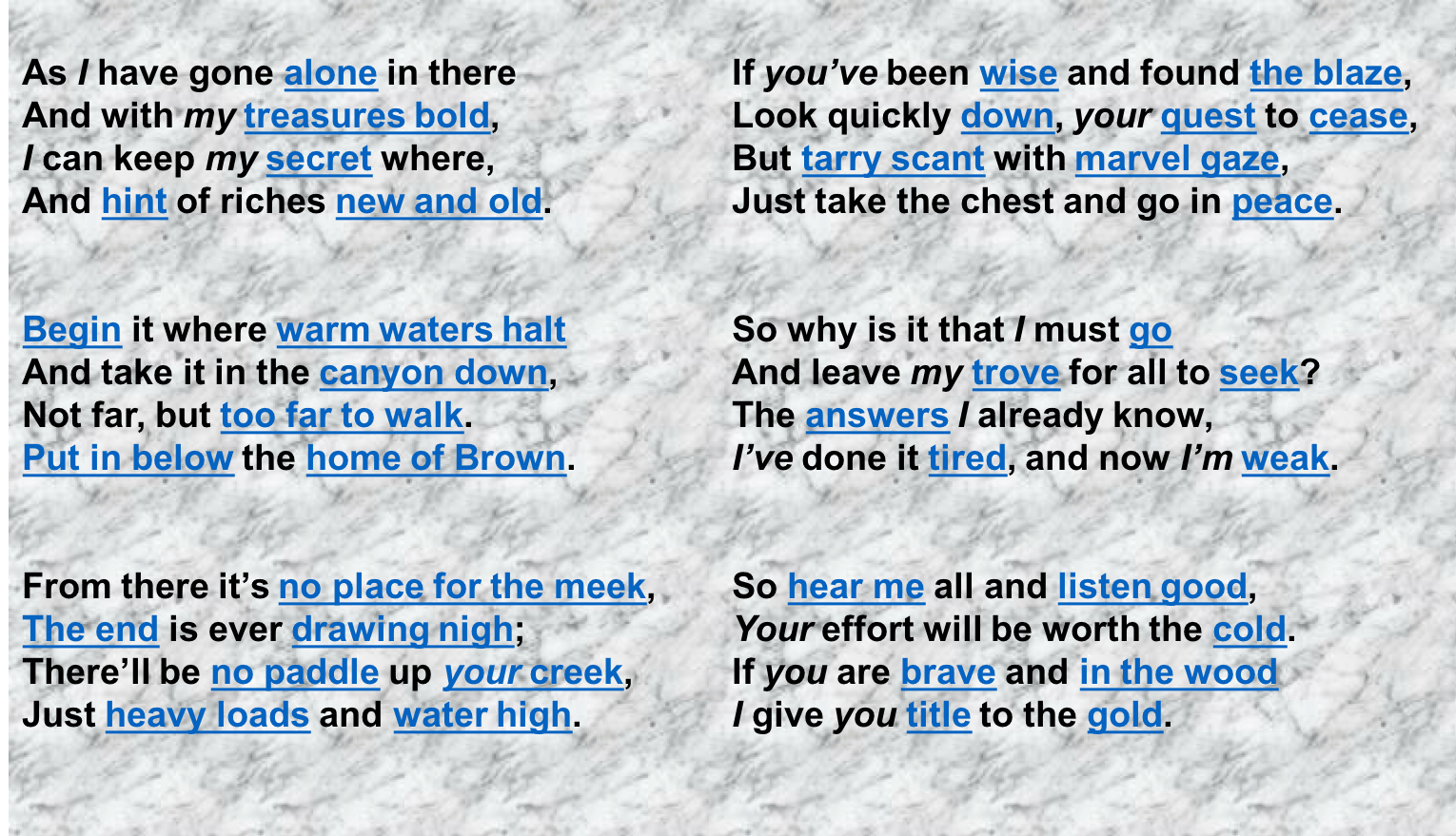
    To save you time, we’ve copied the poem out for you here below in its entirety:

    Forrest Fenn poem.png

    As I have gone alone in there

    And with my treasures bold,

    I can keep my secret where,

    And hint of riches new and old.


    Begin it where warm waters halt

    And take it in the canyon down,

    Not far, but too far to walk.

    Put in below the home of Brown.


    From there it’s no place for the meek,

    The end is ever drawing nigh;

    There’ll be no paddle up your creek,

    Just heavy loads and water high.


    If you’ve been wise and found the blaze,

    Look quickly down, your quest to cease,

    But tarry scant with marvel gaze,

    Just take the chest and go in peace.


    So why is it that I must go

    And leave my trove for all to seek?

    The answers I already know,

    I’ve done it tired, and now I’m weak.


    So hear me all and listen good,

    Your effort will be worth the cold.

    If you are brave and in the wood

    I give you title to the gold.

    Seems easy, right? Well, before you embark on your epic adventure, be warned: six treasure hunters have already died in their respective quests for Fenn’s chest. Some have drowned, others have fallen down cliff faces and sheer drops.

    When pushed on this matter, Fenn insists the treasure is not in a dangerous or inaccessible place – and suggests people seek the treasure in the warmer months, when the terrain is less hazardous.

    Some treasure hunters have branded the entire exercise “nonsense” or “a hoax” – yet Fenn remains unmoved. He claims the chest is in the Rocky Mountains, north of Santa Fe and around 5,000 ft above sea level. Of people who have gone missing or headed out into the desert, he says they have simply misinterpreted his poem:

    “If your solve is in the desert. Get a new solve.”

    What is perhaps most interesting about this entire endeavor is not that thousands of people worldwide have struck out in the hope of finding buried treasure – but that even more have attempted to decipher and engage with a simple 24-line poem.

    Over the years, Fenn’s poem has inspired Talmudic interpretation. One Searcher on the website Fenn Clues posits that, based on the first line, “We are almost surely looking for a location that satisfies ‘alone.’ So, a Solitary Geyser or a Lone Indian Peak would fit the bill.” Other determinations are more arcane. Some ‘searchers’ – as those who have set out to find the treasure refer to themselves – insist the “blaze” in the 13th line refers to a turtle-shaped tattoo on the chest of a character in Marvel’s illustrated version of the 1826 novel The Last of the Mohicans.

    If only Alfred Lord Tennyson and Sylvia Plath had hidden more chests of ancient treasure – perhaps every English teacher’s job would have been made that much easier.


  • IMG_9320
    Will Eaves makes the shortlist of the Goldsmith Prize for the second time.

    The Goldsmith Prize – the literary award for “fiction at its most novel” – has nominated the author for the second time for his acclaimed novel Murmur, inspired by the real-life tragedy of Alan Turing.

    Published by CB Editions – an exemplar of quality in independent publishing – Murmur follows The Absent Therapist as the second of Eaves’s books to be nominated for the prize.

    It should perhaps come as little surprise to see Eaves on the shortlist once again. His work has repeatedly pushed the boundaries of modern literary writing, with Murmur, in particular, a real treat. As Nothing in the Rulebook’s own Professor Wu wrote:

    “For all that the writing is excellent (as we have come to expect with Will Eaves); and for all that the book grapples with a veritable menagerie of ‘worthy’ ideas (there are so many more we could have discussed at length in this review); and for all that it provides another worthy voice to consider in the ongoing conversations surrounding artificial intelligence – none of these are really what the book is ‘all about’, or what readers should take away as being the most important aspect of Murmur. Because ultimately, what it all comes down to is that this is a novel about love. And it is the way in which Eaves presents this most human of emotions, that really makes this novel truly intelligent.”

    The Goldsmith Prize was co-founded by Goldsmiths and the New Statesman in 2013 to reward “fiction that breaks the mould or extends the possibilities of the novel form”. In its four years it has launched new literary stars – Eimear McBride, who won the first prize – and changed the debate around what readers and publishers look for in a novel. Ali Smith has credited the prize with altering the publishing landscape: “The change it’s made is that publishers, who never take risks in anything, are taking risks on works which are much more experimental than they would’ve two years ago,” she told the Bookseller in 2015. “That, to me, is like a miracle.”

    At a time when mainstream publishing so often seems concerned with publishing novels that are little more than copies of previously commercially successful novels, literary awards like the Goldsmith Prize are vital in supporting and promoting the work of new and adventurous writers.

    Eaves has been joined by five other excellent authors, each with searingly original books of their own that very much hold the potential to reshape the way we approach the construction of novels.

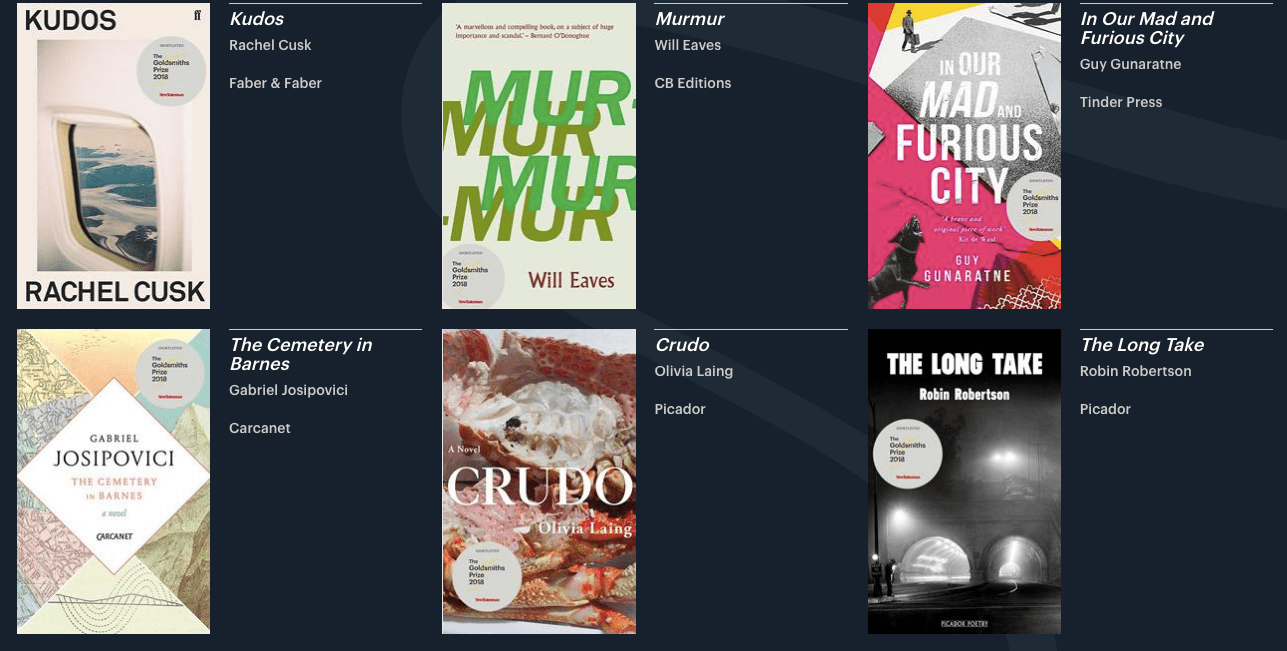
    Indeed, as Professor Adam Mars-Jones notes: “the 2018 shortlist offers a tasting menu of all that is fresh and inventive in contemporary British and Irish fiction. There’s poetic language here, not all of it in the verse novel selected, Robin Robertson’s The Long Take.  There’s the language of the streets, fighting to be heard, in Guy Gunaratne’s In Our Mad and Furious City and the language of an overmediated world in Olivia Laing’s Twitter-fed Crudo. There’s a cool survey of the unbalanced present in Rachel Cusk’s hypnotic Kudos, while the deceptively quiet unspooling of Gabriel Josipovici’s The Cemetery in Barnes shows the powerful effects that can be achieved without ever raising your voice.’

    The full list of shortlisted books is below:

    Screen Shot 2018-10-01 at 13.06.03.png

    Rachel Cusk – Kudos

    Will Eaves – Murmur

    Guy Gunaratne – In Our Mad and Furious City

    Gabriel Josipovici – The Cemetery in Barnes 

    Olivia Laing – Crudo

    Robin Robertson – The Long Take

    The winner of the award will be announced on 14 November. More information on the award can be found online.

    Check out Nothing in the Rulebook’s interview with Will Eaves here. 

  • prisoner_bible__86693

    “In your cell reading, it’s like meditation. You can shut off the rest of the world, your problems, and just focus.” – Anonymous prisoner, HMP Pentonville, UK.

    3 years ago, the UK High Court overturned a Conservative government-imposed ban on books inside prisons. Campaigners argued that books were an integral part of the rehabilitation process for prisoners, and a number of charities, notably The Reading Agency and Books to Prisoners have long championed literature as a tool of redemption and education.

    Let’s explore this in more detail.

    Transformation and metamorphosis

    Books that seem to be popular among many prisoners are those that hold pertinent messages of transformation, like Shantaram, by Gregory David Roberts. These stories seem to help inmates craft a new identity for themselves – convincing them of the possibility of not only surviving but even thriving within the tough environment of prison.

    And, with an estimated 50% of UK prisoners unable to read or write, the ability to access books, or participate in reading groups, provides not just motivation; but other practical skills, too.

    Rod Clark, Chief Executive of Prisoners’ Education Trust, explains: “a seemingly simple book can be incredibly valuable to someone serving a prison sentence – from teaching him or her to read, to developing a love of learning, to feeling empathy for characters to encouraging people to tell their own stories”.

    A great escape

    An age-old, oft-made joke is that you can escape prison by reading a book. But it’s not simple escapism that literature offers those serving hard time; but something far more important – hope. For prisoners who are able to access and engage with literature – at whatever level, freedom doesn’t have to begin for them when their cell doors are opened and they are finally allowed to walk back out onto the streets in some distant future. It can begin immediately – whenever they open up the pages of a book.

    This isn’t simple idealism. Rather, it is based on hard evidence that reading can dramatically improve the lives of prisoners. In the Critical Survey, ‘Reading for Life’: Prison Reading Groups in Practice and Theory, research concluded that another vital benefit of providing prisoners with books to read was that it helped alleviate feelings of depression. The author of the survey, Josie Billington, explains:

    “A rich, varied, non-prescriptive diet of serious literature […] proved especially important in encouraging participants to engage in discussion and address their depression directly.”

    The survey found that, not only were inmates starting to claim direct benefits of feeling happier, more content as a result of the literature they were reading; but that they were becoming more self-aware as a result of reading it. The authors note that there was “a significant proportion” of prisoners who found that, by engaging with specific set texts, they were able to rediscover old or forgotten, suppressed or inaccessible modes of thought, feeling and experience.

    That prisoners, then, are often drawn to books about transformation may not be so surprising. For through their engagement with literature, many are undergoing a personal metamorphosis of their own.

    As Wolfgang Iser recognised long ago, literature has the power to change and restore. This is because when you read a story, you can find yourself temporarily transported from bad, anxious, troubling or unhappy thoughts because of your absorption in a story. In this way, the relationship between a reader and a fictional work is different from that between an observer and an object – it is different from that between a viewer and a television set, also. It is an active relationship that requires the reader to possess a moving viewpoint which travels along inside that which it has to apprehend. Readers have to create worlds and characters for themselves, partly through their imagination, and partly guided by the author of any given text.

    This is why readers become “caught up in the very thing they are producing,” as Henry James put it, which means “they have the illusion of having lived another life.”

    Real rehabilitation

    This is a powerful reaction to produce in a human being – and one that helps readers discover new awareness of empathy for others. When readers empathise with people in books, they are mimicking the same empathy they would feel for people in similar situations in real life. For prisoners who have often struggled with notions of the impact their actions have on others, this is a critical part of their rehabilitation.

    Again, this proposition is based on hard evidence. In 2014, the UK Ministry of Justice produced a report that indicated prison inmates who had access to educational courses that focused heavily on literature and reading were 8% less likely to reoffend than those who did not have access to such courses.

    Freedom through literature

    What all this seems to come down to is the way prison, in its current form, is designed not only to keep inmates physically confined; but mentally restricted, too. Yet by closing down the thoughts of prisoners, you restrict the opportunity for their minds to perceive of the world as a land of opportunity and freedom; and instead only as a place of narrow paths that likely follow the same routes that ultimately lead back to prison.

    Literature – and access to it – changes such a worldview. Reading helps support the inquisitive mind of the individual human to discover new ways of looking at the world. As John Steinbeck wrote:

    “The free, exploring mind of the individual human is the most valuable thing in the world. And this I would fight for: the freedom of the mind to take any direction it wishes, undirected.”

    So, let’s make the case to help prisoners free their minds through books; let’s make this the moment when prison libraries are given due attention, improved where necessary, made much more accessible for all prisoners and put at the heart of a learning culture in prisons. Through prison libraries and reading groups, it might be possible to create an oasis of sanity and a door to a new world.


  • Adrian van
    Peter Raynard’s debut poetry collection ‘Precarious’, is published by Smokestack Books

    In a hotel room on a bright August Monday morning this year in Cork, I am near to tears. My wife and I are packing our bags – she to go home to England, me to stay in Ireland and do two readings as part of a poetry exchange programme between Cork and my home town of Coventry. We had a lovely weekend away, eating nice food, and taking in the sites, which included the Pride festival on Sunday. I was exhausted. But I was exhausted before we came away. I felt depressed. But I felt depressed before we came away. I was very anxious, but I was…. Such emotions come in waves, sometimes as a result of events like these, other times just simmering away – they rarely leave me.

    Having a book published is an incredible feeling; full of excitement, joy, and fear. Precarious is my debut poetry collection, and so one reason fear raises its hydra head, is the dread that my work is no good. That my publisher was wrong believing in me, and the readers will find that out. Being working class and having never written a creative word until my early 30s, I still have to pinch myself when I say that I am a writer but ‘imposter syndrome’ persists. Luckily, those who have read my book, have really liked it – poetry and non-poetry readers alike. One of the greatest feelings is knowing that my friends, and their friends, have enjoyed it; one even took the book into work and read my poems from the factory floor.

    I have poly-endocrine disorder, which means my adrenal, thyroid, and pituitary glands either don’t work at all, or only drip feed me vital hormones when they should be giving me a steady flow. Essentially, I have no fight or flight to life’s stresses, and a weird metabolism (fast, fast, slow, slow, slow, slow, st…). When I am at home, doing the day job of domestic care (a.k.a. househusband), and writing – whether it be features for my blog Proletarian Poetry, or editing another poet’s work, I am better able to manage it, even though it regularly involves retreating to my bed.

    Although a publisher helps with the selling of your book, most writers know they have to get out there to promote it, and this is where the problems started for me. Thus far this year I have read in London (three times), Cheltenham, Oxford, Newcastle, Huddersfield, Ledbury, Bristol, Hay-on-Wye and Derby, with Swindon, Merthyr Tydfill and Coventry to come. I love reading to audiences. I have always enjoyed being in front of people. In my previous job, working for a charity as an organizational development consultant, I spoke in front of people from the World Bank, to small community centres in North England, to a group of fishermen on a beach in the Philippines. Before each front-facing event, I would be sick with worry (I would be sick before playing competitive sports at school). But it was not a sickness brought on by a lack of confidence, or that something would go wrong, it just felt, and still feels like a natural reaction to presenting myself and my ideas or poetry in front of strangers – albeit strangers who are nearly always lovely people.

    “You deal with depression in a solitary way. You withdraw from people, social media, the news.”

    My readings in Cork went well. I was very well looked after by Paul Casey from the legendary O’Bheal and my poetry partner Jane Commane. It was a great experience, meeting lots of new people, talking poetry, mental health and politics. I felt so at home in an ‘Irish’ setting, one I had grown up with in my part of Coventry (known as ‘County’ Coundon). On my return, I was unwell for about two weeks. This came in the form of bed-ridden exhaustion, anxiety, physical pain, depression, and nausea.

    This has been a year of extremes. Like sliding into a warm pool with bubbling water, only to be hauled out naked by the throat and thrown into the rain lashed sea. Trying to swim back to shore involves a whirligig of thoughts; each interaction or conversation with another person is gone over endless times – did I listen to the person enough? Was I arrogant, self-centred, unempathetic? So, when meeting lots of people, or having a number of things to do, the swirl of thoughts is overwhelming. I read on that Internet somewhere that people aren’t programmed to interact with hundreds of people in one sitting.

    You deal with depression in a solitary way. You withdraw from people, social media, the news. If you can, you seek help – GPs, CBT practitioners, therapists. Measures of improvement are tested by dipping a toe back in. Lurk on social media without comment. Lightly pick over benign news items, or seek out intellectual solace through books and podcasts (I listen to episodes of In Our Time and This American Life). You may then go to another person’s reading. Passing these tests, you start to re-engage.

    This is a dangerous time for those recovering from depression. It has been likened to ripping off a scab, you retreat to tend to an open wound, one you knew wasn’t going to go away altogether, but hoped it wasn’t going to be as painful as before.

    About two years ago, when I was not out in the world very much, I made the positive move to give up hope. My endocrine conditions were not going to be cured, and their effects would have to be managed. I did this having read the poet, Lucia Perillo’s experience of living with Multiple Sclerosis. This quote from her summed up my decision. “Hope is ravenous like the gulls, and we are being eaten alive.” I am lucky that I am not young and won’t have to deal with this for another forty years. I am lucky that I have family and friends, who although don’t really understand what I am going through, are there to support me. Importantly, I don’t need to claim benefits, as my partner works.

    I have done much more than I ever thought I would in my life. I have a great set of friends, travelled the world both with work and leisure (often the two combined), got three degrees, written and edited books, married a wonderful person, have two great sons, a niece and two nephews (three if you include my sister’s dog). That must be what matters now. My health can’t cope with high levels of engagement with folk or issues anymore – I really am not up for the fight, in fact the language of fighting in ill-health terms is very damaging. People don’t lose a fight with being ill, they do as they are advised and treated, and look to a positive outcome.

    All of this will happen in the next couple of years – a slow withdrawal. And, despite high levels of anxiety, I am really looking forward to the rest of the readings I’ll be doing over the next six months. But I will also look forward to not doing them, and concentrating on writing. Maybe I’ll write a book of fiction. My poetry brother Richard Skinner, Director of Faber Academy, is the master teacher of novel writing, so I may try my hand at that. I just have to make sure it is never published! Now that is something I can control. Sláinte.

    About the author of this article

    Peter Raynard Photo (6)

    Peter Raynard is the author of two books of poetry. ‘Precarious’ his debut collection is published by Smokestack Books, and ‘The Combination: a poetic coupling of the Communist Manifesto’ by Culture Matters. He is also the editor of Proletarian Poetry: poems of working class lives – http://www.proletarianpoetry.com