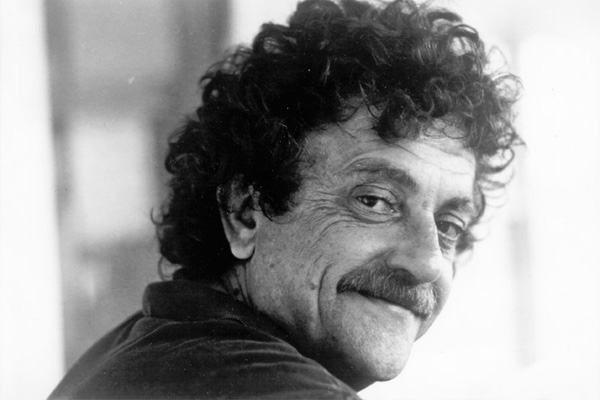
Fourteen novels, three short story collections, five plays and five works of non-fiction stand as a towering testament of Kurt Vonnegut’s ability to show us the fantastic in literature, and the extent to which books and writing can make us feel sublime. He is rightly admired by writers, readers – and most people who have had the fortune of stumbling across some of his work. Countless resources exist within the babbling expanse of the internet, based on his writing, and what he can teach us about writing – from the perspective of the writer, the reader, and the human being.
In this article, we attempt to bring some of these resources together – a mini-compendium featuring some of Vonnegut’s timeless wisdom on writing.
A first rule: no semicolons
By way of introduction, we believe it is of paramount importance to highlight Vonnegut’s self-defined “first rule” of writing. Lovers of the semi-colon should look away now.
In a delightfully dogmatic writing rule of thumb, Vonnegut offers the following advice for aspiring writers: “A First Rule: Do not use semicolons. They are transvestite hermaphrodites representing absolutely nothing. All the do is show you’ve been to college.”
Leave those semicolons by the wayside, then. Now, onwards and upwards!
An old favourite: the shape of stories
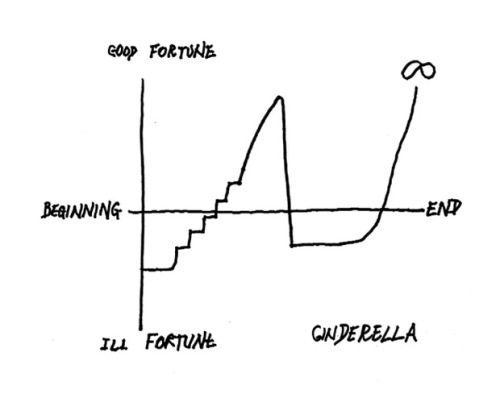
A much viewed clip available on YouTube is an old favourite of the team here at Nothing in the Rulebook. In it, Kurt Vonnegut maps out the shapes of stories, with equal parts irreverence and perceptive insight, along the “G-I” axis (Good Fortune and Ill Fortune), and the “B-E axis” (Beginning and Entropy). The footage, an excerpt from a much longer talk, is best accompanied by the transcript of the full talk – in ‘A man without a country’, an almost-memoir Vonnegut published in 2007.
The fundamental thesis behind the delightful graphs Vonnegut uses to depict everything from Cinderella to Kafka to Hamlet, is that, in his own words “stories have shapes which can be drawn on graph paper”.
The shape of Cinderella
Yet this thesis, which he submitted in pursuit of a master’s degree, was rejected – according to the man himself – because “it was so simple, and looked like too much fun”.
We’ll let you decide for yourself what you make of it:
Interestingly, these plottable graphs have been creatively reimagined by graphic designer Maya Eilam, in new infographic format.
The importance of style
Vonnegut’s 1985 essay, “How to Write with Style”, published in the anthology How to Use the Power of the Printed Word, begins by reprimanding what he perceives as the impersonal sterility of journalistic reporting. This fuelled by Vonnegut’s musings on the single most important element of style, which writers of all creeds must possess – a revelation of self.
“Newspaper reporters and technical writers are trained to reveal almost nothing about themselves in their writing. This makes them freaks in the world of writers, since almost all of the other ink-stained wretches in that world reveal a lot about themselves to readers. We call these revelations, accidental and intentional, elements of style.
These revelations tell us as readers what sort of person it is with whom we are spending time […] Why should you examine your writing style with the idea of improving it? Do so as a mark of respect for your readers, whatever you’re writing. If you scribble your thoughts any which way, your reader will surely feel that you care nothing about them. They will mark you down as an ego maniac or a chowderhead — or, worse, they will stop reading you.”
Choose to ignore such a warning at your peril!
Find your routine
The idea of finding your ‘routine’ as a writer is often bandied about and discussed at great lengths on various writing forums, threads, advice boards, literature festivals, creative writing seminars and classes, and so on. Writing is, after all, a discipline; and is perhaps more about working terribly hard at something and focusing intently on that, rather than simply spending your days living life as a “creative”.
Yet recognising the importance of a writing routine and actually developing one is a trick not learned easily – and made more difficult by our increasingly 24-7 lifestyles (both working and social). For inspiration, Vonnegut serves as an icon to aspire to, with his gruelling daily routine, often noted in a marvellous collection of his letters.
In one letter to his wife, Jane, dated 28 September, 1965, for example, Vonnegut describes how he would work for 90 minutes before a short break for breakfast at 8am, then continue working until 10 am. Here, he then walks into town, runs errands, swims at the local pool, returns to his house for lunch at noon, then spends the afternoon preparing for his classes (he was working at the prestigious Iowa Writers’ Workshop at the University of Iowa), then an evening spent reading and listening to jazz music. Throughout the day he does “pushups and sit-ups” and occasionally visits the cinema, where he has his heart broken.
Perhaps it’s time we all brought a little more discipline and heartbreak to our writing routines!
8 Simple tips for writing a great story
There are plenty of such #WritingTips lists floating about. But Vonnegut’s simple list on how to write a good short story deserves repeating in full:
Use the time of a total stranger in such a way that he or she will not feel the time was wasted.
Give the reader at least one character he or she can root for.
Every character should want something, even if it is only a glass of water.
Every sentence must do one of two things — reveal character or advance the action.
Start as close to the end as possible.
Be a Sadist. No matter how sweet and innocent your leading characters, make awful things happen to them-in order that the reader may see what they are made of.
Write to please just one person. If you open a window and make love to the world, so to speak, your story will get pneumonia.
Give your readers as much information as possible as soon as possible. To hell with suspense. Readers should have such complete understanding of what is going on, where and why, that they could finish the story themselves, should cockroaches eat the last few pages.
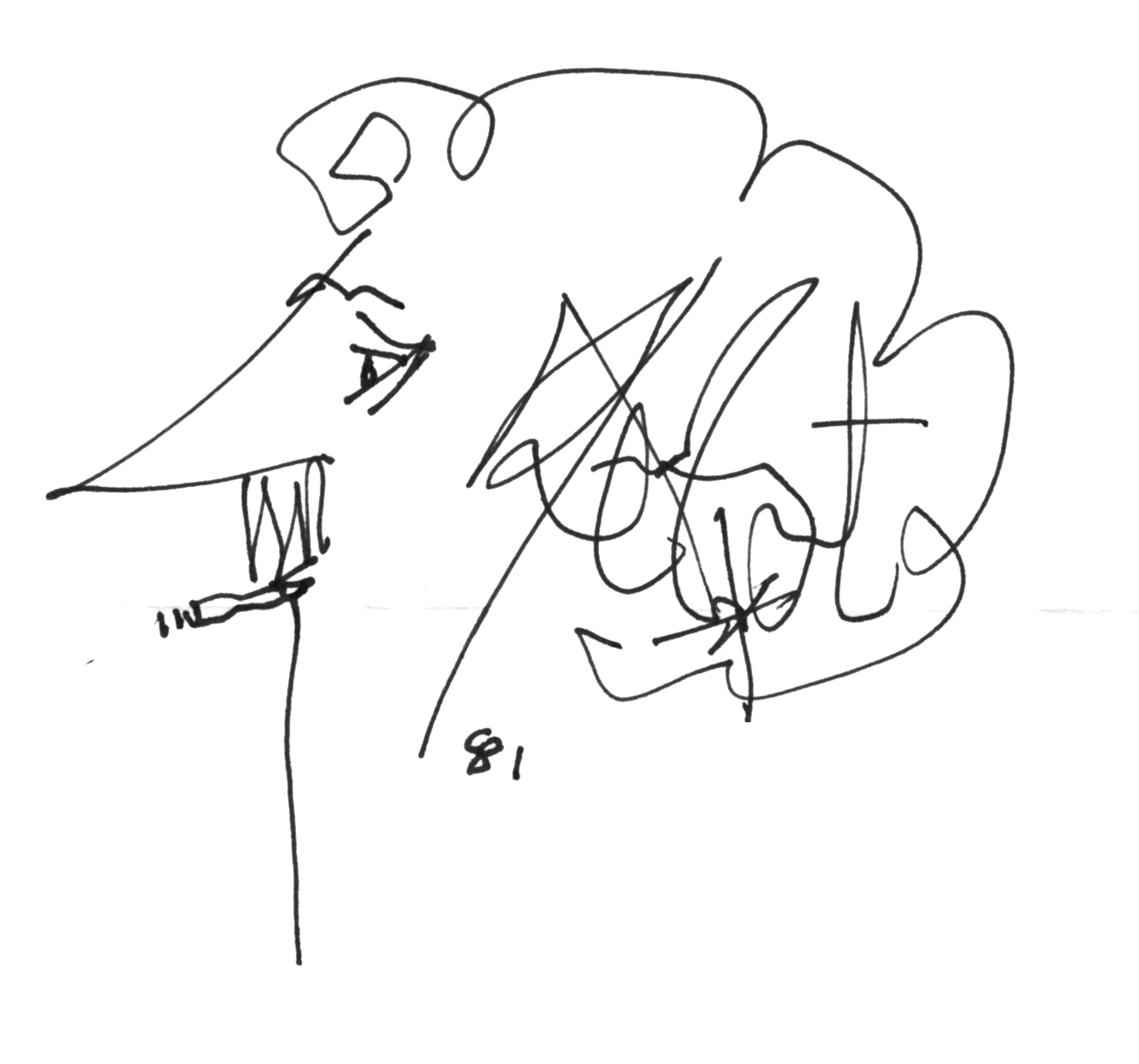
Vonnegut’s signature self portrait
Make your soul grow
Finally, one last, and perhaps most important piece of advice from Kurt Vonnegut. One year before the author’s death, he wrote a letter in reply to a group of New York City school children who prevailed upon him to come and visit their school. His thoughtful reply provides advice that goes beyond tips for writing or reading; and instead simply teaches how to lead a good life.
A transcript of the letter here follows:
November 5, 2006
Dear Xavier High School, and Ms. Lockwood, and Messrs Perin, McFeely, Batten, Maurer and Congiusta:
I thank you for your friendly letters. You sure know how to cheer up a really old geezer (84) in his sunset years. I don’t make public appearances any more because I now resemble nothing so much as an iguana.
What I had to say to you, moreover, would not take long, to wit: Practice any art, music, singing, dancing, acting, drawing, painting, sculpting, poetry, fiction, essays, reportage, no matter how well or badly, not to get money and fame, but to experience becoming, to find out what’s inside you, to make your soul grow.
Seriously! I mean starting right now, do art and do it for the rest of your lives. Draw a funny or nice picture of Ms. Lockwood, and give it to her. Dance home after school, and sing in the shower and on and on. Make a face in your mashed potatoes. Pretend you’re Count Dracula.
Here’s an assignment for tonight, and I hope Ms. Lockwood will flunk you if you don’t do it: Write a six line poem, about anything, butrhymed. No fair tennis without a net. Make it as good as you possibly can. But don’t tell anybody what you’re doing. Don’t show it or recite it to anybody, not even your girlfriend or parents or whatever, or Ms. Lockwood. OK?
Tear it up into teeny-weeny pieces, and discard them into widely separated trash recepticals. You will find that you have already been gloriously rewarded for your poem. You have experienced becoming, learned a lot more about what’s inside you, and you have made your soul grow.
Calling all new and aspiring jazz writers, the latest Write Stuff jazz journalism initiative returns for its 13th year in November at London’s Southbank Centre with a new series of workshops and mentoring sessions held during theEFG London Jazz Festival.
Founded and organised by Jazzwise and Serious, the Write Stuff gives new jazz writers a free opportunity to work with professional journalists to improve their writing skills and develop an understanding of music criticism and the workings of the jazz and mainstream music press and the blogosphere, as well as getting to see a wealth of concerts!
The Write Stuff will include sessions on feature writing and live reviews by Jazzwise writer and BBC broadcaster Kevin Le Gendre; an insight into the history and development of the UK jazz and music press with Jazzwise editor and publisher Jon Newey; online journalism with Jazzwise’s deputy editor Mike Flynn and input from other writers and jazz industry figures.
Several Write Stuff participants have gone on to have pieces published in The Guardian, The Wire and Jazzwise as well as work within the wider jazz and broadcasting industry. This year’s participants will have their work posted on both the Jazzwise and festival’s websites and one review considered to be of particular merit will be published in a subsequent edition of Jazzwise.
How to apply
If you are interested in participating in the Write Stuff please submit by email a 300-word review of a gig/concert that you have seen recently, together with a CV and full contact details byMonday 28 September 2015tolearning@serious.org.uk.
Applicants must be 18 years old or over and be available in London on all of the following dates:
• Friday 13 November (evening);
• Saturday 14 – Sunday 15 November,
• And Saturday 21 – Sunday 22 November.
I paused. There was a noise above my head, in the attic. It was intermittent. I wasn’t sure if I’d heard anything at all it was so indistinct, so gentle. The child which remained somewhere within me played with the idea of ghosts and spirits but I wasn’t intrigued enough to venture into the cold space that topped the whole house in wintry mystery. It had been a while since I had climbed the stairs up there. I resumed brushing my teeth with a stiff-shouldered shrug. My bed and hot water bottle were waiting for me, and silence had returned to keep me company.
It was the day after and I was in the garden. I wasn’t able to move all that well because I had wrapped up so tightly against winter, refusing to let in a single gust. Still, my face was furiously chilled, and my nose felt a separate extremity with the cold. At times I touched it with my gloved hand or scrunched it up just to move it about. The thought of a cup of English Breakfast tea warmed me, and the promise of it spurred me on. The field beyond the sparse lawn was veiled in crystal, and the early light offered a pearlescent shine. In fact every piece of patchwork land which stretched undisturbed to the distant horizon was painted in the same frosty hue. Each naked tree of the arboretum was paler in suspended death, the branches ready to snap. The leafless hedgerows were tangled streaks of caliginous grey against the earth; the ice-dry veins of the countryside. Nothing moved, except myself. Turning my back on the austere scene I proceeded to the open barn.
The barn was dark despite its facelessness. The machinery was dark too. The red of the tractor had become a sanguine brown, the green of the mower a murky sea colour and the black of the old car chassis blacker still. Above, in the wood-worm beams numerous items were suspended; rusted oil lanterns I had replaced long ago with torches; an ancient canoe which I had never used; rope, coiled like snake-skin.
The smell of fuel left its addictive trace on the exposed, broken carburetor which I knew lay abandoned upon the wooden workstation tucked into the deepest shadows of the old barn. The enjoyable scent accompanied that of the log pile I had to tackle before I could have that cup of tea.
And there they were, the logs, crowded together as if for protection. You’ll all burn eventually I said to myself. I reached down to collect the long-handled axe my father had left to me years ago. I dragged the tool to the chopping block, it felt heavier than last winter. Or perhaps I was weaker. I let the handle slip through my hand gradually until the axe hit the ground with a dull, resigned thump, and then I propped it against the block. I returned to the huddled logs and continued to load the rusted wheelbarrow with them, pushing them to the end of their road. The single wheel left a harsh trail in the crunchy, pale grass.
With a deliberate tempo I began the task. Each blow echoed from the barn behind, only to be shouted across the open expanse of the field in front. The countryside almost barked back in retaliation, and each sound bounced from the wall of my house. The arc and swing of the axe, its downward plummet and inevitable thud savagely marked the passing of time, and soon only kindling remained of the botched logs and sizable chunks of the clean-cut ones. I refilled the wheelbarrow with the butchered wood and left the axe to suffer the cold.
I looked up at the house. The attic windows, two eyes with pyramid pupils, stared across the land I had been gazing at. Like captive’s facing an enemy interrogation, they had a clandestine look. I remembered the bodiless noise I had heard in the attic, but again, was not certain if I had imagined it. And so I let the memory go.
***
I was in the garden again, but not for logs. I needed the stepladder to replace the light in the high-ceilinged drawing room. On my way to the garage I passed my car, the only car; the once-white-now-ashen estate. I still needed to take a look at the guts of it, to try and locate the cause of the splutter whenever the ignition was turned. I paused briefly, only to scratch the rust from the passenger door’s handle. I approached the large garage. The broken padlock hung limply, feigning protection, its mechanism no longer functioning. I considered throwing it out, but as I pulled open the heavy door with both hands the inclination left me. I had neglected to put on my gloves, and so my fingers reluctantly left the frigid surface of the handle. I rubbed my hands against one another and entered. The fragile light form outside fell through the crack in one severe splinter, cutting the darkness in two. The stepladder was in the light’s path. I marched to it, my lungs already chilled, my breath already short.
I hitched the stepladder under one arm. En route to the house I paused again, but it wasn’t my car which took my attention. The fountain was frozen. I broke the ice, cracking the hostile cover and promising myself I would do it the next day and the day after, and continue throughout the perpetual winter until the sun usurped the chill and stole my deed from me.
The drawing room was cold; I hadn’t heated the room for a while. Warmth never seemed to linger so I had given up trying the year my father had died. I opened the stepladder beneath the broken light. The neglected fireplace was beautiful in its dormancy. Before I climbed the stepladder I brushed the dust from the marble mantle. It was as I removed the spent bulb and slotted the new one into place that the slightest of sounds reached my ears. It had come from the attic, I was certain this time. My brow furrowed with the doubt that almost immediately pushed against the momentary certainty, and I kept still, one ear cocked upward. The noise didn’t occur again, but my heart felt a little quicker for the interruption. I returned the stepladder to the garage. Closing the door, I positioned the broken padlock, and turned my back on it.
The heat of my house wasn’t able to purge the frostiness from my limbs, nor did the tea do much to warm me. I made my second cup, the tinkling of the teaspoon stirring in the one-and-a-half sugars the only sound to grace the many vacant rooms. Even the fire seemed hushed, and outside there was nothing. It smelt of extinction and seclusion. As I tapped the teaspoon a final time on the edge of the aged cup I heard noises above, in the attic. They were a little more urgent, a little less soft. I exhaled and, pushing ghosts and spirits from my mind, began the ascent, leaving my tea to steam its life away.
At the foot of the attic stairs I lingered, and as if waiting for such an action, another noise sounded. A whispered beat. I climbed carefully until I reached the trap door. When I opened it the noise ceased with a violent blast of cold. I closed the wooden door behind me quietly and stood, the image of a statue. I turned my head slowly, my eyes falling over each corpse of furniture, each piece of moth-eaten fabric, each damaged toy with colourless faces and eyeless sockets. Old shelving units leaned this way and that under the weight of dusty boxes containing perhaps old photographs or once-sentimental trinkets. Mounds of faded newspaper cuttings rested precariously atop stacks of obsolete books. Some, it seemed, had been disturbed recently. I licked my lips and scoured the cluttered yet vacant space. Everything was shrouded by an insubstantial murk.
Then I saw it, the starling.
I was spooked by life, life that was carried on oil-coloured wings. I had startled it too, and at once it erupted about the eaves, its flapping noise suddenly frantic, no longer delicate. I followed it with my eyes, immediately captivated by its fervor, its movement. Some of the newspaper cuttings were blown about in a haze of dust which clouded my vision of the creature momentarily. Its silhouette became clearer as the dust settled back into place, coating the newly exposed areas. I inched closer, willing the starling to be calm, but I only panicked it further. It crashed against the large, slanted window pane before hurtling across the messy space, barely avoiding the detritus of bygone years I could not recollect the details of. It didn’t pass me, but it seemed to sense that its space was shrinking. One last attempt at the impenetrable pane drew it to a shuddering stop. I thought it had broken its neck but it looked at me, its tiny chest twitching with its heart’s troubled beat. Its black eyes seemed so full of fear that I halted.
I observed it, as it observed me. It was odd to see something so animated, I had become so accustomed to stillness. The colours of its plumage were like dark rainbows, peppered with pinpricks of white. A bird-shaped galaxy. Gradually, ever so gradually, I extended my arm, stretching my fingers until they gripped the cold latch, but my fingers were oddly warm. They had been so icy, white twigs, but now they were pink with life. I pulled and pushed and the window opened.
I waited. The starling waited too, uncertainty in the eye that watched me. Then it hopped once onto the window sill, and again into grateful flight. I hurried to watch the creature find its home. There it was, a graceful dot in the leaden sky rapidly being consumed by the otherwise lifeless space. I shivered, my hands were cold again.
About the author
Hannah Fairney Jeans was constantly imagining as a young child. These ‘imaginings’ were brought to life by her favourite toy; her type-writer. Now, twenty years on, Hannah is still penning stories, still consumed by her worlds, and still in love with creation, and her type-writer.
Creativity, in all its myriad different forms, can take us to the edge of the world and look beyond. It can inspire, inform, influence. Used in the right way, it can illuminate the path ahead.
Because of this, Nothing in the Rulebook has been founded to emphasise such creativity. Yet we’re also here to highlight not just works of creativity; but the creative individuals who write our stories and our poetry; take our photographs; create our artworks.
Our new ‘Creatives in profile’ interview series offers creatives the opportunity to discuss their life and art at length. And it is an honour to introduce our latest interview – with writer, editor and photographer, Mike Dodson.
Mike runs Vagabond Images – his photographic work, which is used by myriad different organisations from the BBC to Pearson. Cutting his teeth as a copywriter and editor, he wrote in various wage brackets for various publications of various respectability,including Beware The Cat, Time Out, the Easy Jet in-flight magazine, and Square Meal. He now writes short stories, maintains a blog, and continues to contribute to a range of organs, from Viz and Private Eye to the Metro newspaper and sundry other voices.
INTERVIEWER
Tell me about yourself, where you live and your background/lifestyle.
DODSON
Via quite a significantly misspent youth in the punk, goth and metal scenes, I developed a strong desire to write, and somehow ended up in London studying Media Communications at Scumbag College. I fell out of there with half a pretend degree, and found myself surfing the very edge of the dot-com boom as a copywriter, where for three years companies fell apart around me, until I settled down into an editorship for a while. My father introduced me to photography in the early part of the new century, and, hindered by a complete inability to draw, photography became my medium of choice.
I still live in London, now with my beautiful wife Cat, and together we drink too much and associate with misfits. I’m a hugely disappointed, hopelessly romantic, pathetically optimistic misanthrope, and think that humanity has so much potential if only it just decided to apply itself.
INTERVIEWER
How do your passions for writing and photography complement one another?
DODSON
A lot of my writing is relatively visual in its discourse. I’m quite passionate about music, and my tastes are influenced hugely by detailed and coherent lyrical content, which has in turn influenced both my writing and photography. I think generally the two should stand separately beyond children’s books, although I know they don’t. A photograph should tell you of itself just as writing should; good writing should not need illustration, and good photography should not need description.
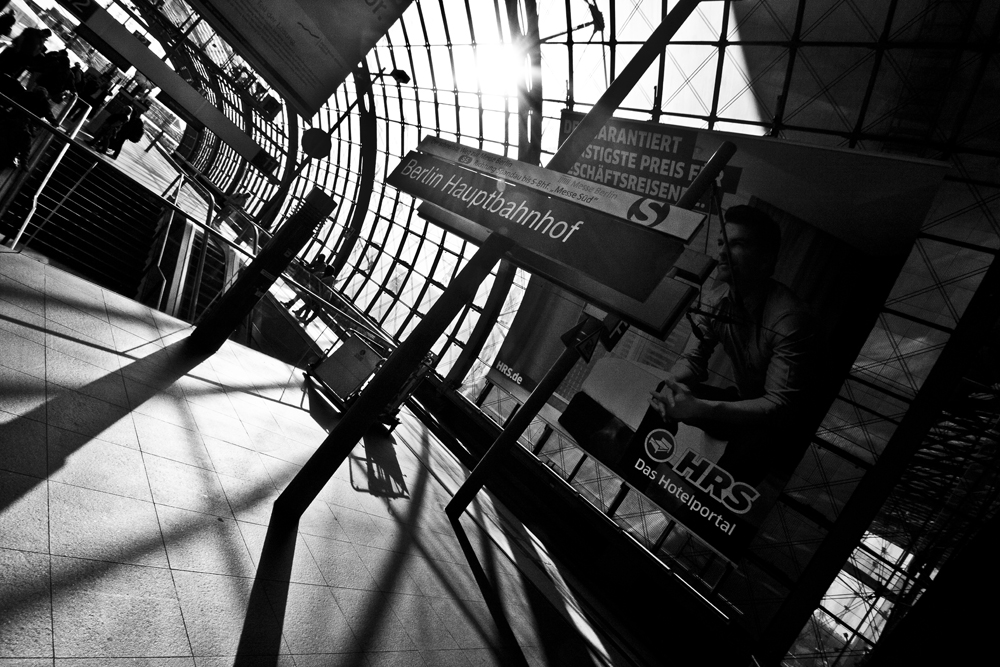
Berlin-Hauptbahn. Photography: Mike Dodson/Vagabond Images
INTERVIEWER
Do you have any other creative passions?
DODSON
I used to hit things and make a noise behind some musicians for a while, and retain an irritating habit of playing nearby surfaces when I’m thinking. I retain my interest in music, but of late I’ve become interested increasingly in moving photographic composition, and will be developing my work there in the near future.
INTERVIEWER
Who inspires you?
DODSON
Anyone I’m able to or think I could have a drink with. I dislike pomposity, but I’m a fan of experimentation – one of the main influences I’ve taken in photography is perhaps Roy Lichtenstein’s snapshot/comic frame approach. The concept of framing a moment intrigues me – the interesting side of that most tedious of conversations ‘Yah, but what IS art?’
I like descriptive and passionate song lyrics, the clean lines of art deco, and the rebellion of punk. In terms of people, I’ve written some terrible, terrible poetry at girls I’ve wanted to sleep with – does that count?
‘Boy’. Photography: Mike Dodson/Vagabond Images
INTERVIEWER
Your work as Vagabond Images highlights numerous different photographic themes – from landscape pictures of British and American countryside, to intense urban scenes, sinister backdrops packed with brooding emotion, as well as imaginative profiles and shots of the people who live in all these different worlds. What catches your eye as a photographer?
DODSON
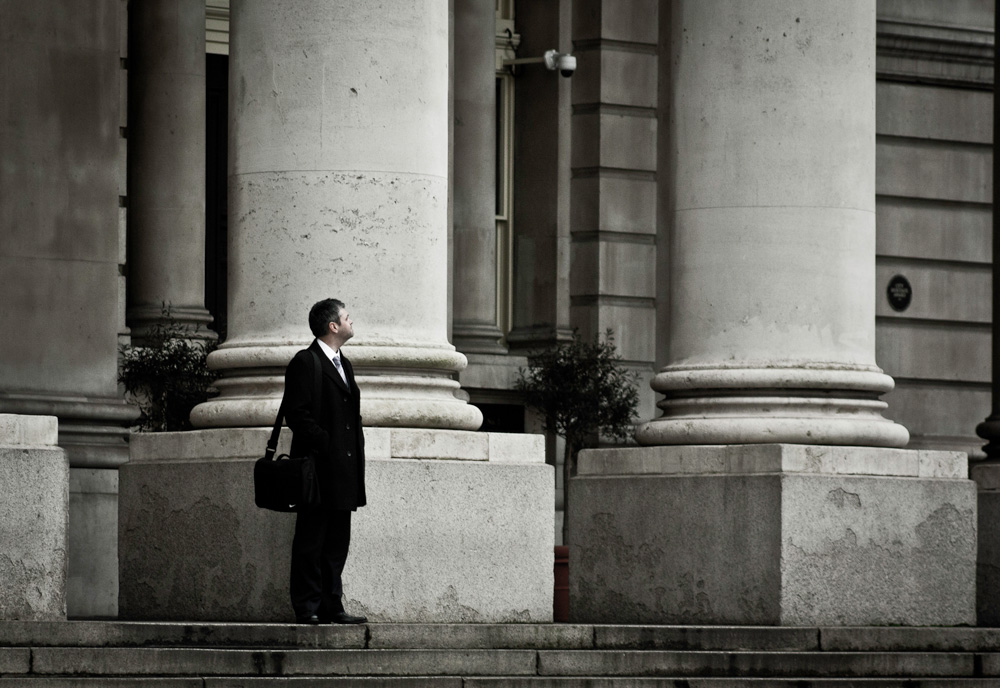
I’m quite intrigued by the arse-end of capitalism; The Man Behind The Curtain. Money is actually very, very weird if you look at it for more than a few seconds, and the concepts it relies on are quite literally surreal. This seems to me to be at significant odds with our nature as animals, and of all the places in the world to view this, one of the world’s leading financial capitals is one – have you ever been to The City at the weekend? It’s a ghost town – the quietest place you could imagine. Then at 7am on a Monday morning it’s covered in people with globally-reaching influence.
I’m quite a fan of high contrast images, as I find them easier to understand and digest than overly busy or detailed compositions. Contrary to this, however, the romantic in me finds open landscapes wonderfully desolate, and one of the things I like about the USA is how absolutely vast it is. In America you can drive for hours and hours – quite literally – through nothing very much at all, seeing absolutely no one, and getting absolutely nowhere significant. I love to just sit on a train or coach, staring out of the window, getting lost. This discourse applies to Europe too (With the notable exception of the Berlin-Warsaw train journey, which – other than the changing signage – is singularly crap).
‘Accountant’: Photography: Mike Dodson/Vagabond Images
INTERVIEWER
In Georege Perec’s ‘La Disparation’ the question is asked ‘Why do you take photographs so constantly, so obsessively? And the reply returns ‘so that I’ll see what I’ve seen’. Why do you take photographs? What draws you to the form?
DODSON
Photographs provide the opportunity for further exploration and re-examination, presentation and composition provide the opportunity for interpretation of a subject, and looking through a viewfinder makes whatever you see into a potential picture. In terms of form – form is often a fleeting moment – with people I like to fire off a lot of candid shots when people are socialising, as micro expressions can be so fleeting and yet so very powerful – it just takes that one pause to convey the truth, that one look when they both get the joke, or the glance that betrays their true feelings.
For architecture, high contrast is often visually arresting, and thus useful for that type of shot. The great thing about architecture is that it is static, and since so much of form can be dictated by lines, architectural photography allows you to fully explore these.
INTERVIEWER
The use of mirror images is used frequently in your work; as are moments of contrast – for example between darker and lighter shades – do you believe that there is a mirror image to everything? Is this world always a ‘world of opposites’? What role does juxtaposition play in art and – indeed – life?
DODSON
A mirror is a magical item – it provides us with a view of the unseen. As animals our primary sense is vision, and a mirror simultaneously makes us more powerful, by providing us with greater visual knowledge, and potentially more vulnerable from the unknown and potentially threatening. It expands our vision; it provides us with a glimpse into another, unseeable world. The metaphors a mirror can provide are easy to relate to through knowledge of the other – good/evil, light/dark, obscure/clear, etc.
It can also be used to great effect as a cheap trick in horror films, which – to Cat’s delight – I fall for. Every. Single. Time.
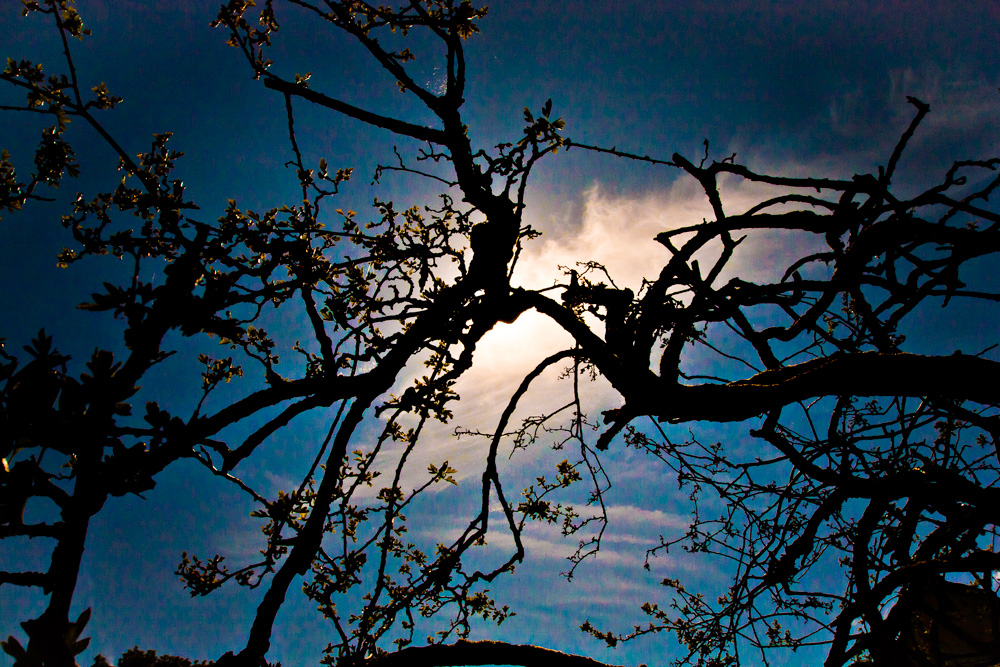
‘Glastonbury Thorn’. Photography: Mike Dodson/Vagabond Images
INTERVIEWER
Your compilation of writings, are – in the way they so often pieces of ‘micro non-fiction’ – almost photographic. They provide glimpses and snapshots into real, lived events. Do you think your writing process is photographic?
DODSON
Photography translates literally as ‘Drawing with light’. If I had any ability I would draw (my artistic talent has a significant blind-hedgehog-in-a-bag aspect to it, and thus descriptive writing and photography have been my workarounds). I’ve always been intrigued by capturing that one moment, the perfect timing, and in the climax of the story. Just as a play is constructed of ‘scenes’, ultimately everything conceived visually is a type of photograph, and writing is a way of drawing pictures in other people’s minds.
INTERVIEWER
Images and words read differently, they may not fuse, but they co-exist. Do you think there is a disjunction between word and image? What do you make of the relationship between what is written and what is seen?
DODSON
While a photograph may capture the moment wonderfully, it won’t necessarily furnish the audience with all the information – look at the recent furore over the photograph of Aylan Kurdi. In terms of history it’s often quite hard to fully detail situations, although with fiction – well – everyone knows the difficulty of making the book into a film, because everyone’s imagination is different. A significant difficulty with journalistic photography is how far it’s acceptable to stage a photograph, and one quickly enters a Schroedinger-esque situation. Writing, however, is in itself fallible as it is written from memory – Patrick Leigh Fermor’s A Time Of Gifts is wonderfully detailed for something written after the event. However, in terms of journalism, the World Wide Web and internet have changed it forever and completely – now one can experience real-life reportage instantly from the scene without it really affecting anyone involved at all.
INTERVIEWER
In much of your writing, there is the strong pervading sense of the ‘tragi-comic’ in your collection. So many of Shakespeare’s tragedies could easily become comedies and vice-versa. Your work captures the delicate balance between the two. Yet how do we tread this fine-line between tragedy and comedy?
DODSON
As a student, and as an idiot, I did the very minimum work required at university, at the very last minute, because – well – I’m an idiot. One day before a piece of work was due, I was in the library, searching frantically for a book to plagiarise, and on finding it flipped to the pages needed and read it as I hurried between the shelves, returning to my desk. At the end of the shelves was a portable step, over which I tripped and flew – absolutely flew – out from between the shelves, sailing past two very pretty (Of course they were very bloody pretty) girls. Seeing me explode out of nowhere, at a height of about three feet, and crashing head-first into a crumpled heap at the foot of a desk, one girl gasped in horror and concern, while the other instinctively pointed and laughed.
How should we tread the line? Honestly; as those two girls did.
INTERVIEWER
Looking around at current trends in photography, what are your thoughts and feelings on the industry? And how would you advise aspiring photographers to break out onto the ‘scene’?
DODSON
The great thing about technology now is that it has made everyone a photographer. The problem with technology now is that it has made everyone a photographer. As Bailey expressed his hatred of digital for bringing everyone to the same level, so that level becomes ever more refined. Digital still has a long way to go to match actual film, and because of the physical discourse, filmic photography is becoming increasingly exclusive. Journalistic photography is now pretty well entirely open to the public, and increasingly reliant on celebrity culture.
In terms of digital trends, I notice that currently over-sharpening images is currently en vogue, while thankfully the awful profligacy of HDR seems to have bitten the dust, along with the adoration for the tilt-shift filter in Photoshop. The problem and the blessing of digital is that it is so very easy now to dramatically alter a shot that it’s difficult to know when to stop, and also judge what a photograph now actually is.
If you want to get into photography you need to do a lot, a lot. The difference between a photographer and someone with a camera is the amount they shoot – if you take the shot a hundred times from a hundred different angles, to try and make sure that the right one’s in there, then you’re on the right road. Digital photography makes this all a lot easier.
If people start asking you to take photographs for them, then start asking them for money. You don’t ask a plumber to come ‘round and fix your boiler on the proviso that you’ll tell your mates about how great he is – don’t let them tell you such. And if anyone comments that that photo you took is really good, and remarks that you must have a really good camera, then legally speaking – legally speaking you can kill these people.
‘Mirror’. Photography: Mike Dodson/Vagabond Images
INTERVIEWER
How about when it comes to writing? Are there any emerging trends you’re particularly interested in?
DODSON
The great thing about technology now is that it has made everyone a writer. The problem with technology now is that it has made everyone a writer. The internet has enabled anyone with an opinion to express it and potentially be listened to – even the Katie Hopkins puppet commands a sizable audience on Twitter, and makes a sizable income for whomever the operator is. I’m quite interested in the effects that texting, Twitter and the rise of emojis have had on communication, and the fluidity of language – the concept of replacing words with numbers is as fascinating as it is irritating, and the idea of expressing sarcasm pictorially is just downright weird.
INTERVIEWER
How is the digital age impacting the writing and photography industries?
DODSON
Democratisation – there is a huge amount of noise now, the channels feeding on them are increasingly specialist, and the content increasingly diluted. The difference between professional and amateur is becoming very blurred. If you can pay your bills by doing what you do, you’re a professional. If you can’t, you’re not. The digital age thrives on vanity and narcissism, and our self-expression has been sold to us as the most important part of our id, by cynically manipulating our ego. The visceral pornography of instant gratification is encompassing in modern society now.
INTERVIEWER
When you write, what do you think is most important to keep in mind when compiling your initial drafts?
DODSON
‘Write in haste, edit at leisure.’ Michael Stipe of American rock band REM talked of ‘Vomit songs’ – where the whole lot would just come out in one hit. While successfully doing so would be incredible, it’s worth assuming that you won’t, and getting everything down as it comes – it’s awful having that excellent idea just before you go to sleep, and waking up remembering that you had to remember something. I heard that Stephen King has notebooks all over his house, which he harvests on a regular basis (This may be complete bollocks, but on a personal level I have practiced doing so ever since having read of it). Then edit, edit, edit. Rewrite and edit. Then wonder if it’s good enough for a first draft, have a huge attack of the nerves, and go back and edit it again. Do you know how long this piece of crap is taking me to write? I’ve been working on it since 1996!
INTERVIEWER
Do you have a specific ‘reader’ or audience in mind when you write?
DODSON
Generally I’m propping up a mantelpiece with a whisky, surrounded by a host of pretty young women all hanging on every word I say. Whether or not I actually am at the time I write is a matter of mere pedantry.
INTERVIEWER
What are your thoughts on some of the general trends within the writing industry at the moment? Is there anything in particular you see as being potentially future-defining, in terms of where the industry is headed?
DODSON
I think the democratisation I mentioned earlier is a significant aspect now. As the physical book becomes increasingly a fashion-statement for hipsters, so publishing and distribution is becoming easier and easier, as the internet allows you to write and publish your own work – either by website or on Kindle. I think as the collective attention span shortens, increasingly skilled editing will become prized – Strunk & White notwithstanding.
INTERVIEWER
How would you define creativity?
DODSON
Creativity is simply creating. It’s not always a good thing – there’s a lot of absolute shite out there, but by the same token there are some wonderful, uncelebrated, absolute diamonds – which so many of us are. Wordsworth said that good poetry is born of strong emotion recalled in a time of tranquillity. My writing is often such; my photography less so – my photography requires a lot more elbow grease – pounding the streets and taking time to take and retake and look at and take. Eventually – hopefully – I will find among what I’ve shot The Shot. Sometimes I won’t, and that’s tough.
INTERVIEWER
What does the term ‘writer’ mean to you?
DODSON
If you make money from strangers for writing, you’re a writer.
INTERVIEWER
In an internationalist, interconnected world, ideas and creativity are constantly being flung across community threads, internet chatrooms and forums, and social media sites (among many others). With so many different voices speaking at once, how do you cut through the incessant digital background babble? How do you make your creativity – your voice – stand out and be heard?
DODSON
I’m terribly embarrassed to say that I don’t – I write what I write. That other people like it is nice – that other people have paid me on occasion for it is nice. But it’s what I do because it’s, er – what I do. Aim to have your work speak for itself.
INTERVIEWER
For all writing, the importance of finding the right ‘voice’ is of course crucial. Often, writers’ speak of developing an ‘other’ – who provides that voice when they write. How have you created and refined your voice and tone for your writing – and do you have a separate, ‘other’ persona who helps you write?
DODSON
Much of my writing is at the very least semi- if not entirely autobiographical. I will take artistic license here and there if necessary, but I’m not imaginative enough to come up with actual, real fiction – there’s always some basis of me in it. Even in my appalling and dark stuff – we all have dark thoughts, and that we are unwilling to face them or talk of them interests me – the disconnect between the social requirement for honesty and politeness is wonderfully flawed – as detailed by Swift in Gulliver’s Travels.
‘On The Road II’. Photography: Mike Dodson/Vagabond Images
INTERVIEWER
Could you tell us a little about some of the future projects you’re working on?
DODSON
I’ve just started working as a cameraman for a fledgling production company. It’s in its infancy yet, and the work is an entirely new discipline to that of stills, but the mechanisms and structures are there – hopefully we’ll have a productive year, produce some award-winning stuff, quickly become rich and the most famous outfit in Britain, and Winona Ryder will finally stop playing hard-to-get and start returning my bloody calls.
INTERVIEWER
Could you write us a story in 6 words?
DODSON
She shouted at him – he flinched.
INTERVIEWER
Could you give your top 5 – 10 tips for writers?
DODSON
You can only break the rules when you know the rules and you’ve followed the rules and you’ve lived the rules, so write, write, write, and edit, edit, edit. Remember that you are a font of absolute crap, but don’t ever forget that you also have such absolutely wonderful beauty.
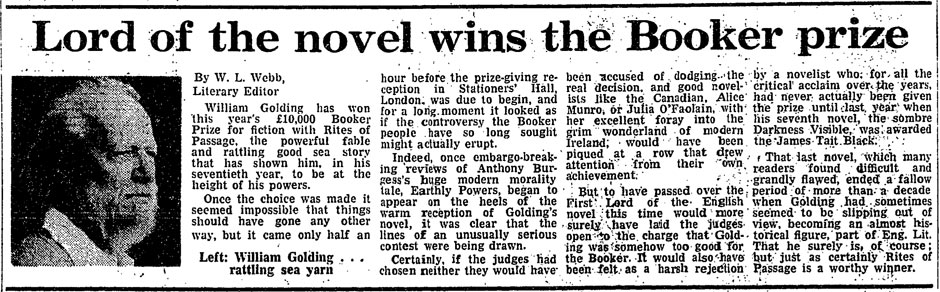
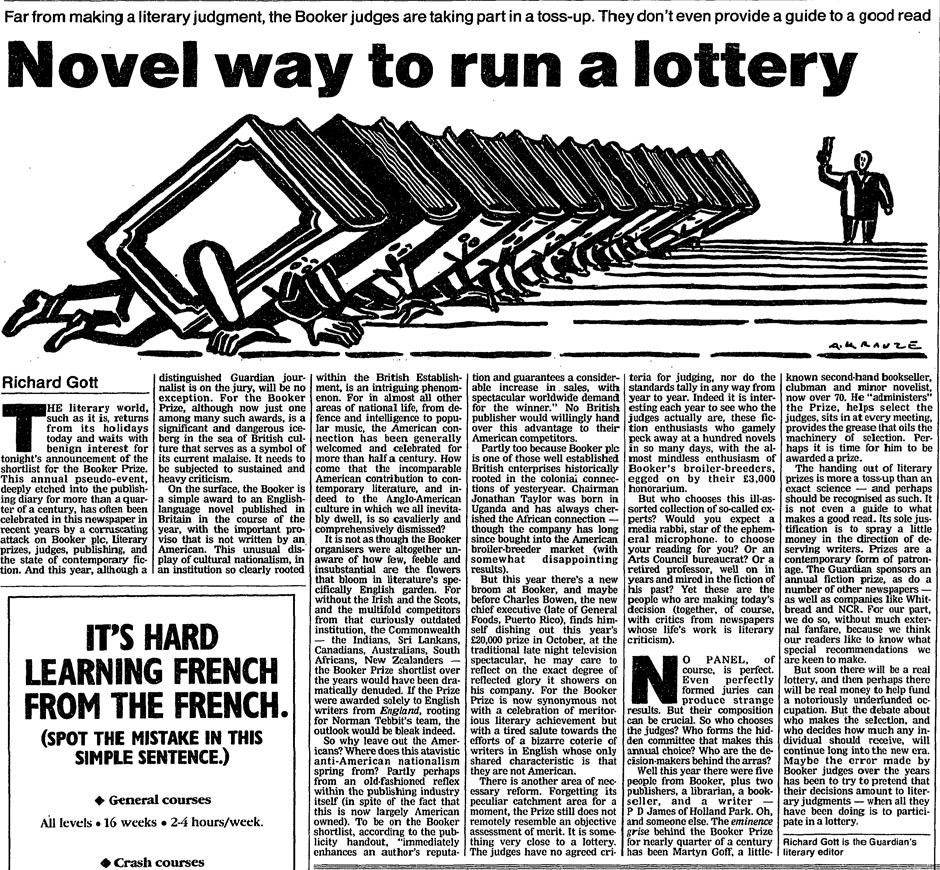
Mired in controversy since it began, the Man Booker Prize has long held the attention of the literary world. In its time, the Prize has witnessed what is as close to an authorial punch up as can be – when William Golding squared off against Anthony Burgess. It was once described by Richard Gott as “a significant and dangerous iceberg in the sea of British culture that serves as a symbol of its current malaise.” And has faced accusations of its listed books being both “too high brow” and “too readable.”
Yet irrespective of the claims against it, the prize has endured. And, as the shortlist has now been announced, we here at Nothing in the Rulebook thought it would not be out of place to suggest an alternative literary list for our fine readers to contemplate.
Supposedly, the Booker Prize aims to recognise the best British or Commonwealth authors. Yet here there undeniably seems to have been some bias toward the English. Despite a population of just 2.5% of the commonwealth, over half the winners of the prize have hailed from England’s shores. And, while there have been notable winners from former colonies, including the South African novelist J M Coetzee, it should not escape our attention that an overwhelming number of Booker judges are middle class English people, who are perhaps likely to prefer their own nation’s literature.
With this in mind, we will therefore endeavour to correct this imbalance in our own shortlist. While we have no funds to actually offer the authors on this list any prize money, we can offer a potent cocktail of hopes, dreams and admiration – and that’s probably just as good.
The list in full:
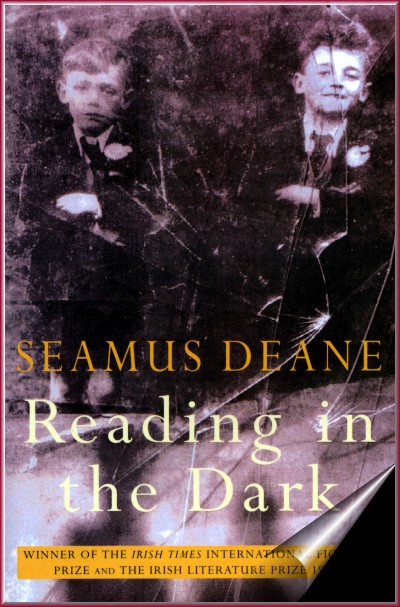
Reading in the Dark – Seamus Deane
In strikingly lucid language and scenes fired by a spare, aching passion, Reading in the Dark combines the intimacy of a memoir with the suspense of a detective story. Seamus Deane’s poetic inclinations shine through in his debut novel, perfectly illuminating a coming-of-age story of an unnamed narrator in Northern Ireland. Deane captures the underlying, subconscious fears present throughout the course of the ‘troubles’ – where people live as “if they might explode any minute” and can be “disappeared”. Yet this is a pervading background to an essentially familial story, which contemplates love, religion, innocence, love and truth. And while answers to the novels questions come in bits and pieces, by the turn of the last page readers lives have been illuminated, washed in an elegant, graceful and forgiving prose.
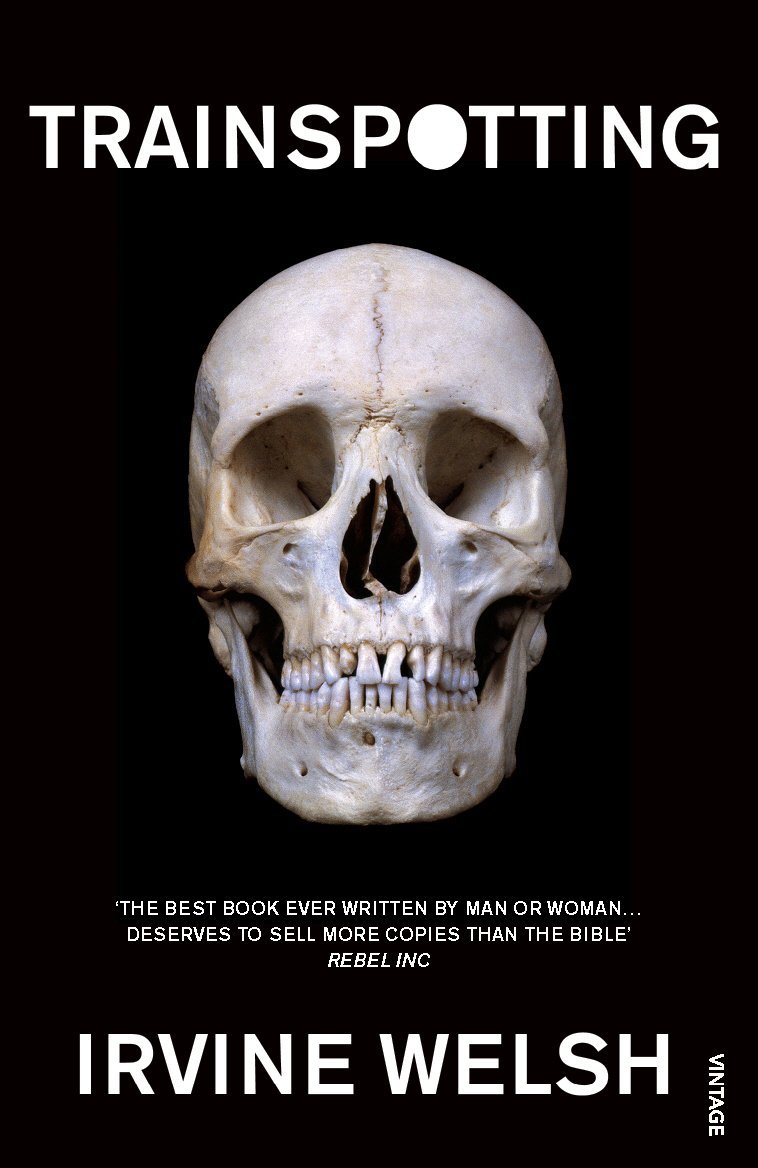
Trainspotting – Irvine Welsh
Considering two Man Booker Prize judges successfully pulled Welsh’s Trainspotting from the 1993 prize shortlist by threatening to walk out, it seemed especially apt that we list the novel here. For readers who do not come from lowland Scotland, one of the particular pleasures of this book is becoming totally immersed in the language and dialect of the novel’s characters. Ostensibly the plot follows a group of Edinburgh heroin addicts, and through its rawness, Welsh draws the reader into a world of urban depravity, Aids, drugs, and individualism – the latter an ironic homage to Thatcher’s neoliberalism, where we see in action what it’s like to live in a world where “there’s no such thing as society”.
The Handmaid’s Tale – Margaret Atwood
Canadian author Margaret Atwood’s dystopian classic tells the chilling tale of a concubine in an oppressive future America. Almost 30 years since it was first published, the book is perhaps more vital than ever. Atwood’s lyrical prose is the vehicle used to transport readers to a world where facts appear to merge into one another, and history appears immaterial. This is a fiercely political novel and, while bleak, remains both witty and wise. Arguments continue as to whether this can be classified as a work of science fiction, yet to get caught up in such debates ignores the unarguable fact that this is a truly brilliant novel by an excellent author.
Blindsight – Maurice Gee
Widely acclaimed when first published, New Zealand author Maurice Gee’s Blindsight offers readers a complex but knowing portrait of siblings who were once close but are now completely estranged as adults. As the novel evolves, Gee brilliantly draws readers into the past histories of his main protagonists slowly revealing the hidden reasons Allice Ferry and her brother Gordon now live such divergent lives. Deserves to be regarded as one of the best novels published in New Zealand in the past couple of decades.
Things Fall Apart – Chinua Achebe
Published first in 1958 – the time Britain, France and Belgium finally began to recognise the failure of colonialism and begin their unseemly withdrawal – Chinua Achebe’s debut novel concerns itself with the events surrounding the start of this disastrous chapter in African history. Setting the book in the late 19th Century – at the height of the “Scramble” for African territories by European powers – Achebe tells the story of Okonkwo, a proud and highly respected member of the Igbo clan. Through his eyes, we witness a village that has not changed substantially in generations become utterly transformed upon the arrival of the English. Yet it is the Bible – not the gun – that becomes the most violent weapon of choice by these “clever” white men. Set to remain on of the great novels of the colonial era, and the book that announced Achebe to the world as a most brilliant writer, it would be a disservice not to include this masterpiece on our humble list.
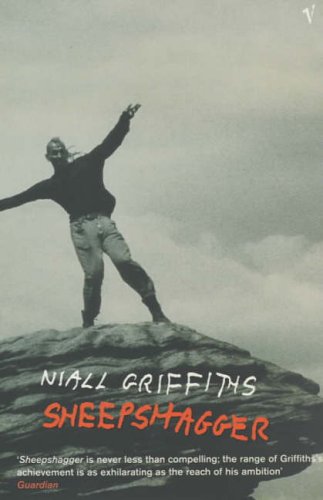
Sheepshagger – Niall Griffiths
Despite being born in Liverpool, Niall Griffiths’ strong familial ties to Wales earned the dubious honorific “the Welsh Irvine Welsh” for the stunning vernacular monologues in his books ‘Grits’ and ‘Sheepshagger’. Though there are linguistic and political similarities, it’s a disservice to think of Griffiths’ book as an imitation of ‘Trainspotting’. Here we follow anti-hero Ianto – a near mute “inbred” savant with a mystical connection to nature, who divides his time between roaming the mountains of his childhood and accepting whatever drug or drink is offered by his circle of friends. As the novel progresses, we witness near Bacchanalian horrors, a distorted but nonetheless sublime depiction of the natural world, and Ianto’s ultimate downfall. It’s vivid and compelling, a modern sensibility informed by Greek tragedy and the Blakean sublime.
Not just an ordinary reading list
So, there we have it. A finer shortlist of novels than you’re otherwise likely to find today. We may not have the excitement of guessing which of these great books will emerge the ultimate, victorious winner, but perhaps that doesn’t matter. After all, in a way, we’re all winners here. Because we’re the ones who get to go out and read these books and enjoy doing so, without ever having to carry out the agonising process of actually writing the damn things. Some might say such thinking is a bit of a luvvie-duvvie cop out; but nobody wants to treat writing like a competition, right?
In a series of posts, we here at Nothing in the Rulebookhave been asking writers to share their top tips and advice on writing. Today, it is our pleasure to bring you the top writing tips from journalist, copywriter and poet, Rishi Dastidar.
Whether you enjoy writing simply for the pleasure it gives you, or if you are looking to develop and improve, these great little pieces of advice will set you on your way!
Rishi Dastidar’s top five writing tips:
Always carry a notebook and a writing implement: I mean a phone is OK, but there’s nothing quite like dashing something off in a cursive script that only you can decipher.
Read more, and then read more than that again: Other people’s words are your fuel. What you do is compress, re-interpret, play, dance with them to make your new things. If you don’t read, you won’t write.
Find your place and time to write: and the trick is that it doesn’t have to be a long time. 15, 20 minutes every day starts to mount up very quickly. The habit of doing so soon becomes addictive, and you’ll find that the time constraint gets good stuff out of you – fast.
The blank page is scary. So don’t leave it blank before you start. Make some form of mark. Try writing 1 to 10 down the side – then you only have ten lines to write. And you’ll find you blow past that fast enough. Or pick a word from the nearest newspaper or magazine, and write that at the top of the page, then start scribbling.
Because ultimately you’re writing for you, it doesn’t really matter if another souls reads what you write. So be bold and brave when you start – there’s no one else you need to please.
About the author
Rishi Dastidar has worked as a journalist, copywriter and poet. He has written for a wide variety of brands in different sectors during his career, while his poetry has been published by the Financial Times, Tate Modern and the Southbank Centre amongst many others. His work was most recently in Ten: The New Wave (Bloodaxe, 2014). A winner of And Other Stories short story prize in 2012, he has also had reviews published in the Times Literary Supplement. He was part of the 2014-15 Rialto / Poetry School editorial development programme, and also serves as a trustee of Spread The Word. Rishi was recently featured in our Creatives in profile interview series.
When I’d just begun stand up, the excellent Scottish comedian, Matt Winning, told me something along the lines of “You should wait till you’re at fifty gigs before you decide whether you’re funny or not, because by then you will have found your voice a bit more.”
I’ve reached my fiftieth gig, through a mixture of open mics and a few ‘proper’ booked gigs. It’s probably natural then, that I’m returning to Matt’s advice. I’m usually pretty funny. Well, last night I told an extremely unfunny joke about the experimental noise artist Prurient that nobody understood and insulted an Albanian man, but I’m usually pretty funny. I make people laugh on a regular basis. I’m hardly the funniest new comedian around; but I’m not bad.
I’m concerned, though, that I’ve yet to find what my voice actually is. I don’t mean this literally of course, I’m well aware of the fact I have a prominent London middle class accent. I’m not proposing that I begin performing in course Glaswegian tones or the husky growl of Tom Waits, although both of those sound quite funny so I might give them a go.
Most successful stand-up comedians have a distinctive flavour to their comedy. You could identify a Stewart Lee routine by reading it off the page, let alone hearing it spoken. Simon Munnery; Josie Long; Bridget Christie; Tony Law; each one a top stand up and each one totally unique. Even outside of the arty alternative, comedians like Michael McIntyre or Kevin Bridges can arrive on stage to an audience who already know what to expect.
The voice of a comedian is not just the content of their jokes; but their phrasings, rhythms, timings and looks. Different comedians can give the same material have drastically different meanings. Tim Vine and Simon Munnery both often tell neat, clever puns. Tim Vine just tells them like a father who continues to joke at a daughter who is publicly embarrassed by him because he knows she’s secretly enjoying it. Simon Munnery, meanwhile, can make a simple bit of wordplay seem like the arcane wisdom of a wizard whose brain has been fried by powerful magic. Same jokes, vastly different outcomes.
Even the better comedians a newbie like me is able to get on bills with have their own distinct voices. The audience – that’s to say the real, non-comedian audience – will probably have no idea who they are; but, within a minute of their performance, little that follows will be a real tonal shift. The audience will remember their presence, if not necessarily their jokes. Ashley Haden’s air of having uncomfortably trapped you in the corner of a pub to let you know, hilariously, exactly what’s been bothering him. Joseph Murphy’s weary commitment to the telling of his wonderful jokes, as if he’s being forced to continue by a mad king who really loves spooky puns.
I could continue list the styles of my favorites of the comedians I’ve gigged with, but it would be little more than an open-mic masturbatory exercise so I’ll refrain from doing it. They’re all very good though and I love each one of them. Especially you (if you’re a comedian or a loved one).
I’m still not sure where I fit in. Over the past couple of weeks, I’ve veered between the personas of a man who hates both his own jokes and the audience, an energetic fun loving hawker of bee puns, and a passionate, smart, political satirist. At present I’m not sure exactly what my persona will be until I actually step onto the stage and begin my first joke. I’m not at the stage where I’m a confident enough performer to be able to deliver my jokes in a certain fashion irrespective of my mood.
Perhaps though, those who have seen me multiple times would have a different opinion. When I saw Daniel Kitson (who is probably the greatest working stand-up and performs like a child who’s just discovered a particularly rude word and is delighted to tell everybody about it) he did an hour long show about how our impressions of our own character are less true than how other people define us. Perhaps stand up is like that. Perhaps I’ll never really understand exactly what my own voice, or style, actually is.
I think it’s probably more important for me, at this early stage, to understand my own weaknesses, limitations and strengths. I know I struggle with crowd interaction, I’m not yet very good at saying something amusing about somebody’s job or telling men that they are less attractive than their girlfriends. My attempts to do looser, stream of consciousness style bits have also all resulted in dismal failure.
I can’t be great at every style of stand-up and, while I probably need to improve the areas in which I’m weakest, it makes sense to focus on honing and exploiting my strengths. The two gigs in which I’ve arguably been at my best, last week, I used an angry, shouting style, hurling words at my audience and barely pausing to allow for laughter. I enjoyed performing like this and I know the audience enjoyed it too (one of the great things about stand up is that you get immediate feedback on your work); but in subsequent gigs I’ve had difficulty maintaining the level of energy required.
As my on stage-character is an ironic figure – a male feminist who doesn’t understand feminism , the worst of middle-class liberalism – I also need to overcome my worry that the audience will genuinely think I’m a dickhead. A friend recently saw me perform and said “if I didn’t know you were genuinely a proper feminist, I’m not sure what I’d conclude about you as a person from what I just saw”. I think it’s something that, as long as I’m being funny, I shouldn’t worry about. Anybody worth talking to will be able to appreciate the satire.
I’m going to perform the same, shouty, set at least eight times over the next 2 weeks. If I can pull it off as I’ve envisaged it I hope I will have found my voice for the time being. Stand up is an evolving medium, and I’m sure I’ll continue to grow and evolve over my ‘career’ but for the time being it’s heartening to be finding myself on the stage.
About the author of this post
Daniel Offen is an aspiring comedian and writer. He has written four jokes and half a book. He assures us he is capable of all of the usual thoughts and emotions of an unusual twenty four year old man and will talk about them at length. He deals primarily in irony and whimsy. He tweets as @danieloffen.
In a series of posts, we here at Nothing in the Rulebook have been asking writers to share their top tips and advice on writing. Today, it is our pleasure to bring you the top writing tips from YA Author, Lola Blake.
Every writer is different
Every writer is different and every book is written in a way that is unique to the author, as well as to the book itself. Some authors use formulas, other’s creative license. Some writers are night owls and work best at 3am, others get up early and write by the dawn light. As I said, every writer is different so some of these tips may not work for everyone, so take what you need from what I’m about to say. These are my top ten tips for settling into completing that pesky manuscript that’s been playing on your mind for a while. This is what works best for me, hopefully there’ll be a tip or two on the list that will work for you also. Enjoy!
– Lola
Lola Blake’s Top Ten Writing Tips:
Know your characters
Character motivation is what drives a narrative. If you understand your character’s reasons and motivations, the story will almost write itself. Think about your story’s main issue or point of contention, then consider; what does it mean to each and every character? How is your character(s) going to react to this news? Consider the voice and temperament of your characters. Before I start my manuscript, I like to write out a brief character summary of each and every player. I decide whether or not that person is headstrong or easy-going, manipulative or level-headed. I refer to my notes before I put any dialogue on paper.
Find a method to your madness
When Stephen King puts pen to paper, his ideas are driven by his imagination. He has no plan or rough storyline drawn out, he just goes with it and ends up where his clever mind takes him and this method has proven successful for him. For me, personally, I’d get tangled up in a web of my own convoluted ideas, if I went with that method. I write my ideas out on paper and then try to come up with a timeline of cause-and-effect events to that there’s no gaps in my narrative. This works best for me. Some writers take this a step further and write out blow-by-blow synopsis for each and every chapter. This also wouldn’t work for me. To each, their own, but find something that works for you.
Don’t procrastinate
I lost months, maybe even years, of potential writing time by waiting to feel ‘inspired’ to write something. Over the past couple of years, since I became a published author, I’ve learned that free time is the best time to write. Even if your mind is blank, you’re feeling tired or particularly unmotivated, once your fingers start scrambling across the keyboard, the words will come to you. I’ve written some of my best pieces during times of apparent lethargy. I disconnected my pay TV and now I keep my laptop in the living room, in plain sight. It helps!
Know how to overcome writer’s block
Nothing on your mind? No words coming out? Can’t think of an interesting predicament, scenario or character to get your thoughts on paper? Take an ipod, listen to some cool tunes and go for a walk in the fresh air. A long walk! I don’t know if this will work for everyone, but it certainly works for me. Lots of ideas will come to you when you’ve got nothing to think about except the scenery and the music will stir up different emotions to get your synapsis firing.
Get some sleep
No-one ever won a literary prize for something they wrote when they were sleep deprived. Sleeplessness has the same effect on the mind as intoxication. I should know, I tried to write the first chapter of my second book while looking after a newborn. When I read it back a few weeks later, I couldn’t believe the garbled crap I had been prepared to put on the shelf! When my little one started sleeping through the night, I rewrote the chapter and felt much better.
Keep reading!
Whenever I hear someone say ‘oh, I’d really like to be a writer, but I hate reading’ I wonder why on earth they’d choose writing as a profession in the first place. Read a range of books, have at least one book on your bedside table, read when you’re on the train, even if it’s only for twenty minutes or so every day, but keep reading! It’s good for the soul, it opens you to new ideas and reading is great for keeping you up to date with grammatical structures and literary language.
Think about your audience, but not too much
Granted, if you’re writing a Young Adult novel it’s probably not a good idea to fill it full of F-Bombs, however, many writer’s get bogged down in the idea that they have to produce a book within the guidelines of a particular formula, to appeal to a certain market. Whether or not there’s truth in the idea, I couldn’t tell you, but I can tell you this; so many authors burn out creatively trying to write a book that’s interesting to others but not to themselves. If there’s an idea that’s interesting to you, explore it. Write the book you’d want to read yourself and chances are, someone else will like it too.
Manage your time
Decide when you’d like to complete your manuscript, set a date and then work out a schedule to achieve it. Most people that know me, can vouch that I’m an organisational Nazi, but I’ve also never missed a deadline in my life.
Ignore self-doubt
You’re your own worst critic. No-one else will ever judge your work as harshly as you. Don’t be scared of rejection, it happens to everyone and no-one experiences rejection as often as a writer, so don’t be scared to send that manuscript. Send it to as many publishers as you can. Send it until you get that ‘yes’ response, or exhaust every avenue trying.
Be proactive on social media
Lots of writers find social media exhausting (and it is!). Getting your name out there, updating your website constantly, connecting with your fan base, all of these things can be just as exhausting as the writing process itself, but it’s worth it! Even established writers use social media to connect with their readers, so don’t ever underestimate the power of social media. Even when it feels like you’ve been treading water for ages, you never know when someone’s going to click on a link to your website or Amazon author’s page. Persistence is the key!
About the author
Lola Blake writes both adult and young adult fiction. She grew up in Australia’s Surf Coast Shire, before moving to Melbourne to study creative writing. After completing her Bachelor’s degree, she spent the next ten years trying out various careers and travelling, before finally deciding on teaching. Her first novel, Coming Home was written in eight weeks, during a visit to the seaside. She now lives in Melbourne with her husband and daughter and still retains her love for the beach. She tweets as @LolaBlakes
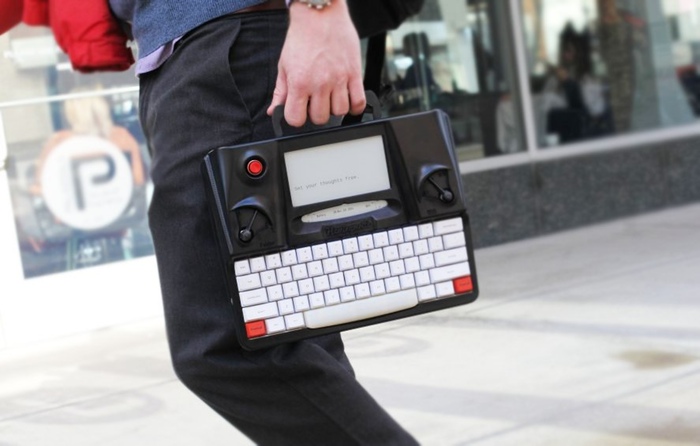
The ‘Hemingwrite’ – a minimalist typewriter for distracted writers
Aspiring writers the world over know the perils of the digital age better than most. You’ve spent the morning vacuuming, organising your junk email folder, sorting all the fast-food leaflets stuffed through your door into alphabetical order and watered your geraniums – and you’ve finally sat down in front of your shiny new laptop to write that novel you’ve been working on. But, oh no! Disaster. Somehow you’ve found your way to a website for creatives who believe in giraffe sporting equality and are reading an article about some new-fangled typewriter. You check your watch and suddenly it’s 8pm and you’ve lost the day to youtube videos of cats riding tortoises and obscure articles about chaffinches. You’ve been distracted by the ravaging digital background babble. But don’t worry – there’s always tomorrow.
Of course, there are a whole host of ideas for how to get around this (apart from the obvious action of actually just writing your novel). You can press a button to turn off the internet. Or you can go cold turkey from social media. You could even pay a friend to tie you to a chair, sit you in front of your computer and unplug the Wi-Fi – promising not to return until you’ve produced this generation’s version of On The Road. But it’s another idea that’s got us talking here at Nothing in the Rulebook – the ‘Hemingwrite’: a minimalist digital typewriter.
Modelled as a distraction-free ‘smart’ typewriter, which stops you surfing the web but still lets you save files to the cloud, this is a Kickstarter-funded tool for procrastinators of all creeds.
A pair of designers have added a modern twist to the traditional typewriter, the inventors – Adam Leeb and Patrick Paul – insist “it combines the simplicity of a typewriter with modern technology like an electronic paper screen and cloud backups to create the best possible writing experience”.
And, because it doesn’t allow access to the web, it is claimed the Hemigwrite will help writers work more efficiently.
The device includes a mechanical keyboard, and e-ink display that can be read in daylight, and access to cloud storage, such as Dropbox and Google Drive.
The portable word-processor’s battery is also reported to last 4 weeks. Which, while longer than your average laptop, still falls someway short of the traditional – ahem – typewriter, which has a battery life of well, for ever, since it doesn’t actually need any batteries.
Retailing at around £300, the device may appear less for poor, broke writers and more for people who quite like the idea of popping up in Starbucks with a new hipster-typewriter to order a mochalattecino while they brood in a leather chair and loudly laugh at quotes from Machievelli, as if it were an olden-days version of Seinfeld.
Now that the prototype has been developed, its creators have lined up a leading manufacturing group to begin making these writing tools en masse. Mr Paul said: “The 2015 Hemingwrite will ship with a minimalist interface but we will also support a development kit (SDK) to fulfill the needs of more specialized professionals like screenwriters.”
Professor Wu’s verdict:
“Obviously, in theory any new device that helps writers concentrate on putting words to paper seems like a good idea. But for much less than half the price of one of these new-fangled gadgetizmos, you could just buy an actual typewriter. And if you want to access the internet and the opportunity to save your files, just stick with your laptop or desktop, and get on with the task at hand. The only way you’ll ever find out if you “have it in you” to write a novel, or a collection of poems, or a screenplay, is to get to work and see if you do. It’s hard to write, of course; but it can be harder not to. Maya Angelou said there was no greater agony than bearing an untold story inside you. It’s true. The only way to override your distractions is to focus on that agony and to produce. So stop reading this article, get to your desk and ask yourself ‘what would Hemingway do?’” Professor Wu says.
“In fact, the man himself told us exactly what we needed to write, and it’s pretty simple. All you need, he said, is “The blue-backed notebooks, the two pencils and the pencil sharpener (a pocket knife was too wasteful), the marble topped tables, the smell of early morning, sweeping out and mopping, and luck.””
After embarking on an MA in Writing (/misguided attempt to avoid work), I wrote a story about a girl who is sent to live on an island surrounded by sea monsters. I had over-elaborate visions of mystery and madness and double- and triple-twists. It was the story I’d been trying to write and had wanted to read for years but had never managed to pull off.
Like all dedicated bookworms, I’ve wanted to be a published author for years. When I finished my sea creature story for the millionth time, and I didn’t know what else I could do with it, the only next step was look for an agent, those terrifying guardians of the gates of publishing. They’re like ghosts. Everyone thinks they might have seen one once, or knows someone who swears they exist, but they’re pretty hard to actually get hold of.
I’d sent stuff out before, really bad stuff, and felt immediately embarrassed by every rejection, but madness/fear of oblivion made me try again anyway. Three manuscript requests, a lot of rejections, and even more silences later, I was offered representation by DGA. I haven’t grown any wiser in the meantime, but if there’s anything I can say to other writers looking for an agent, it’s this:
Going sideways won’t necessarily work
Before submitting to agents in the traditional way, I threw myself at every conceivable opportunity to get my writing seen by someone. I wondered if I could sidle, like a literary crab, into the unsuspecting pocket of an agent relaxing at the metaphorical beach. I signed up for meet-an-agent events (there’s one at the Big Green Bookshop in Wood Green, and it demonstrates the soul and potential of independent sellers over online behemoths – you should go!). I went to snobby literary festivals and turned up whenever an agent came to campus. I entered competitions and threw stuff at magazines and read at launches in case there was an interested party in the audience.
Each opportunity gave me optimism, sometimes in the form of an actual business card, followed by the gradually dawning realisation that mostly people were just being polite.
But it’s worthwhile anyway. The more chances you get to meet other writers, the better. You’re doing something, practising for disillusionment, and collecting anecdotes (hard currency for when you’re swapping stories with other writers). And in any case, the approach might just work.
In my case, I clenched my teeth together and redrafted. Again.
It pays to be a lean, mean submitting machine
Later, when I couldn’t work on my manuscript any more without wanting to bang my head against the wall, I started a real campaign of submitting through agents’ slush piles.
Most advice about submitting to agents, written or verbal, is a variation on: choose who you submit to carefully. Research every agent and think hard about if they’re the right person for you.
Like a wayward teenager in angst mode, I immediately did the opposite. I callously worked A-Z through The Writers’ & Artists’ Yearbook. I made a spreadsheet of agents and submission deadlines. I had full-on affairs with colour coding and date ranges.
It’s undoubtedly true that you should only sign up with an agent if it feels right, but I figured the chances of finding one were so astronomically slim I might as well ask everyone. In the end I found someone brilliant, so I’m glad I gave myself the best chance of that meeting. It’s not pretty, but I wouldn’t have dragged myself through the process without the bright lights of Excel and a fear-driven, one-a-day regime of submitting stuff.
Small aside: a creative writing course doesn’t help anyone get an agent
I loved my degree and MA. I met some fantastic people, took some great classes, and got to write, drink, and eat nothing but tinned soup for years. I learned plenty about self-improvement, but at no point did anyone other than my tutors seek out anything I’d written, and there were no connections to the world of representation or publishing (something that originally sold it to me when I was in sixth form, to be honest).
Creative writing students have more opportunities than most to get face-to-face with authors, agents and publishers, but my agent found me in the slush pile, and I don’t know anyone who has benefitted otherwise. Take a course if you want to be workshopped and spend years pinning poems to trees, but if not, save your money for booze and strip clubs.
A hodgepodge of tips
That thing they say about being careful with copy and paste in your cover letter is true. (Despite what I assumed was my unimpeachable professionalism, I went to that dark place.)
Rejections can be photo frame-worthy. If it looks like an agent has read past the first page, something’s gone a bit right. I was seriously proud when I was turned down for being ‘too dark for children’. (And you start being able to tell the difference between personal and form rejections very quickly, a great trick to get out at parties.)
Replies to unsolicited letters/extracts usually take months, except for when they only take hours, sending you into a sweaty panic because your full MS isn’t actually ready. Be prepared.
Consequently, it will become shield-your-eyes painful to open your email inbox. Professionals recommend that for the next year, a friend/pet should do it for you.
If an agent wants to meet/speak to you, there’s very little you can do to prepare. Try not to appear mad and you’ll be fine. It doesn’t actually matter what you wear, so it’s fine to put away those intellectual non-prescription specs.
Luck plays a huge part in the whole process, but if you open yourself up to as many opportunities as possible, you’ll get luckier. Go forth!
This isn’t it
I thought that once I’d signed on the agent’s dotted line I’d feel like a ‘real writer’. I thought I’d know what I was doing, and I would suddenly have the bravery to strike out on my own, sit down, and write. But if someone asks me what I do, despite the fact that I’m up at 6 AM to edit a new chapter in time for publication day, I say I’m a digital copywriter with a specialism in cat food. I still don’t feel like I have official permission to write (I suspect it’s a clandestine operation for everyone) and it hasn’t become any easier.
But if you can’t stop writing and you’re stubborn enough to keep trying, it’s the best sort-of job in the world. And on the whole, it’s great to know that someone else likes your demons (/sea monsters).
About the author of this post
Charlotte Salter is a digital copywriter by day, YA author by night. Her first middle-grade novel, Catacomb Hill, is due to be published in the US by Dial Books in Spring 2017. She likes sea monsters, mushroom identification, and sword fighting (but not all at once).









 nothing in the rulebook