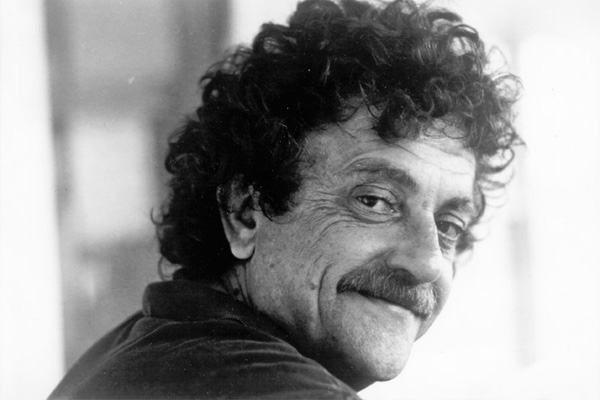
Fourteen novels, three short story collections, five plays and five works of non-fiction stand as a towering testament of Kurt Vonnegut’s ability to show us the fantastic in literature, and the extent to which books and writing can make us feel sublime. He is rightly admired by writers, readers – and most people who have had the fortune of stumbling across some of his work. Countless resources exist within the babbling expanse of the internet, based on his writing, and what he can teach us about writing – from the perspective of the writer, the reader, and the human being.
In this article, we attempt to bring some of these resources together – a mini-compendium featuring some of Vonnegut’s timeless wisdom on writing.
A first rule: no semicolons
By way of introduction, we believe it is of paramount importance to highlight Vonnegut’s self-defined “first rule” of writing. Lovers of the semi-colon should look away now.
In a delightfully dogmatic writing rule of thumb, Vonnegut offers the following advice for aspiring writers: “A First Rule: Do not use semicolons. They are transvestite hermaphrodites representing absolutely nothing. All the do is show you’ve been to college.”
Leave those semicolons by the wayside, then. Now, onwards and upwards!
An old favourite: the shape of stories
A much viewed clip available on YouTube is an old favourite of the team here at Nothing in the Rulebook. In it, Kurt Vonnegut maps out the shapes of stories, with equal parts irreverence and perceptive insight, along the “G-I” axis (Good Fortune and Ill Fortune), and the “B-E axis” (Beginning and Entropy). The footage, an excerpt from a much longer talk, is best accompanied by the transcript of the full talk – in ‘A man without a country’, an almost-memoir Vonnegut published in 2007.
The fundamental thesis behind the delightful graphs Vonnegut uses to depict everything from Cinderella to Kafka to Hamlet, is that, in his own words “stories have shapes which can be drawn on graph paper”.
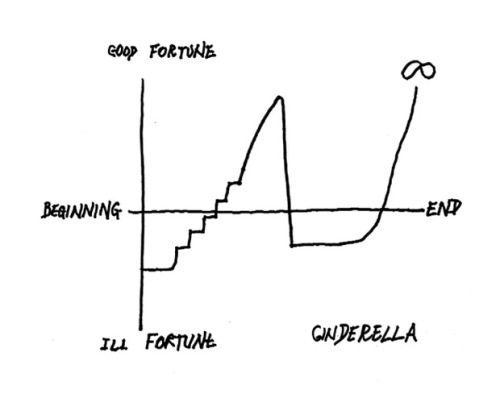
Yet this thesis, which he submitted in pursuit of a master’s degree, was rejected – according to the man himself – because “it was so simple, and looked like too much fun”.
We’ll let you decide for yourself what you make of it:
Interestingly, these plottable graphs have been creatively reimagined by graphic designer Maya Eilam, in new infographic format.
The importance of style
Vonnegut’s 1985 essay, “How to Write with Style”, published in the anthology How to Use the Power of the Printed Word, begins by reprimanding what he perceives as the impersonal sterility of journalistic reporting. This fuelled by Vonnegut’s musings on the single most important element of style, which writers of all creeds must possess – a revelation of self.
“Newspaper reporters and technical writers are trained to reveal almost nothing about themselves in their writing. This makes them freaks in the world of writers, since almost all of the other ink-stained wretches in that world reveal a lot about themselves to readers. We call these revelations, accidental and intentional, elements of style.
These revelations tell us as readers what sort of person it is with whom we are spending time […] Why should you examine your writing style with the idea of improving it? Do so as a mark of respect for your readers, whatever you’re writing. If you scribble your thoughts any which way, your reader will surely feel that you care nothing about them. They will mark you down as an ego maniac or a chowderhead — or, worse, they will stop reading you.”
Choose to ignore such a warning at your peril!
Find your routine
The idea of finding your ‘routine’ as a writer is often bandied about and discussed at great lengths on various writing forums, threads, advice boards, literature festivals, creative writing seminars and classes, and so on. Writing is, after all, a discipline; and is perhaps more about working terribly hard at something and focusing intently on that, rather than simply spending your days living life as a “creative”.
Yet recognising the importance of a writing routine and actually developing one is a trick not learned easily – and made more difficult by our increasingly 24-7 lifestyles (both working and social). For inspiration, Vonnegut serves as an icon to aspire to, with his gruelling daily routine, often noted in a marvellous collection of his letters.
In one letter to his wife, Jane, dated 28 September, 1965, for example, Vonnegut describes how he would work for 90 minutes before a short break for breakfast at 8am, then continue working until 10 am. Here, he then walks into town, runs errands, swims at the local pool, returns to his house for lunch at noon, then spends the afternoon preparing for his classes (he was working at the prestigious Iowa Writers’ Workshop at the University of Iowa), then an evening spent reading and listening to jazz music. Throughout the day he does “pushups and sit-ups” and occasionally visits the cinema, where he has his heart broken.
Perhaps it’s time we all brought a little more discipline and heartbreak to our writing routines!
8 Simple tips for writing a great story
There are plenty of such #WritingTips lists floating about. But Vonnegut’s simple list on how to write a good short story deserves repeating in full:
- Use the time of a total stranger in such a way that he or she will not feel the time was wasted.
- Give the reader at least one character he or she can root for.
- Every character should want something, even if it is only a glass of water.
- Every sentence must do one of two things — reveal character or advance the action.
- Start as close to the end as possible.
- Be a Sadist. No matter how sweet and innocent your leading characters, make awful things happen to them-in order that the reader may see what they are made of.
- Write to please just one person. If you open a window and make love to the world, so to speak, your story will get pneumonia.
- Give your readers as much information as possible as soon as possible. To hell with suspense. Readers should have such complete understanding of what is going on, where and why, that they could finish the story themselves, should cockroaches eat the last few pages.
Make your soul grow
Finally, one last, and perhaps most important piece of advice from Kurt Vonnegut. One year before the author’s death, he wrote a letter in reply to a group of New York City school children who prevailed upon him to come and visit their school. His thoughtful reply provides advice that goes beyond tips for writing or reading; and instead simply teaches how to lead a good life.
A transcript of the letter here follows:
November 5, 2006
Dear Xavier High School, and Ms. Lockwood, and Messrs Perin, McFeely, Batten, Maurer and Congiusta:
I thank you for your friendly letters. You sure know how to cheer up a really old geezer (84) in his sunset years. I don’t make public appearances any more because I now resemble nothing so much as an iguana.
What I had to say to you, moreover, would not take long, to wit: Practice any art, music, singing, dancing, acting, drawing, painting, sculpting, poetry, fiction, essays, reportage, no matter how well or badly, not to get money and fame, but to experience becoming, to find out what’s inside you, to make your soul grow.
Seriously! I mean starting right now, do art and do it for the rest of your lives. Draw a funny or nice picture of Ms. Lockwood, and give it to her. Dance home after school, and sing in the shower and on and on. Make a face in your mashed potatoes. Pretend you’re Count Dracula.
Here’s an assignment for tonight, and I hope Ms. Lockwood will flunk you if you don’t do it: Write a six line poem, about anything, butrhymed. No fair tennis without a net. Make it as good as you possibly can. But don’t tell anybody what you’re doing. Don’t show it or recite it to anybody, not even your girlfriend or parents or whatever, or Ms. Lockwood. OK?
Tear it up into teeny-weeny pieces, and discard them into widely separated trash recepticals. You will find that you have already been gloriously rewarded for your poem. You have experienced becoming, learned a lot more about what’s inside you, and you have made your soul grow.
God bless you all!
Kurt Vonnegut


Leave a comment