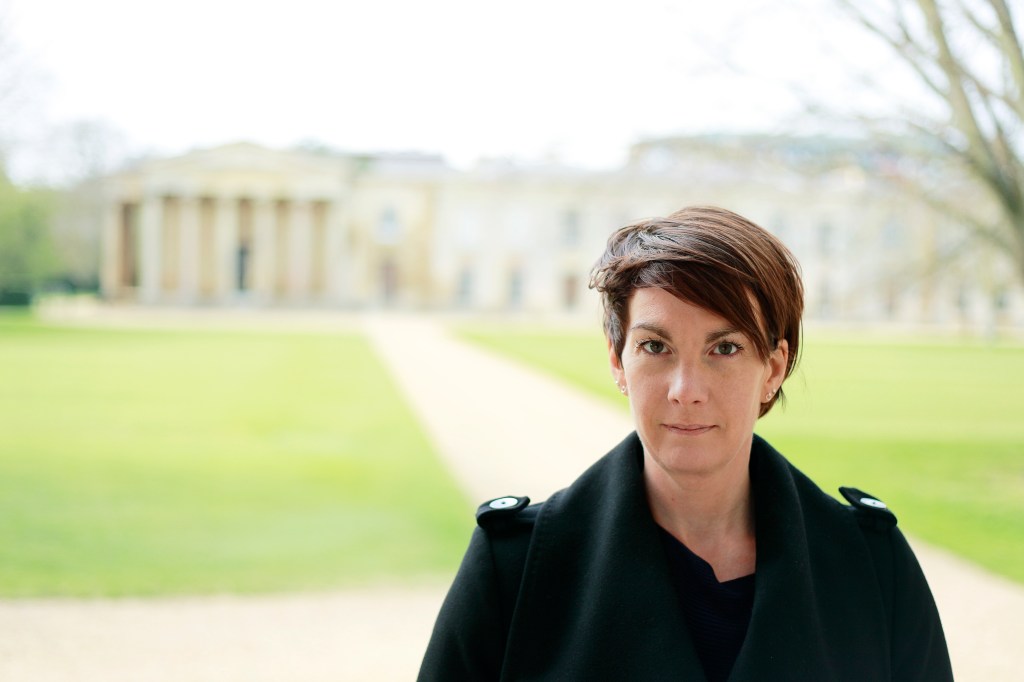
Ruby Cowling, author of This Paradise(published by Boiler House Press)
Short stories have always had the power to linger far longer in the mind than the time it takes to read them. Yet in today’s fast-paced world, so focused on the sharing of information and ideas, the short story has grown in popularity. Quick and easy to read, and even quicker and easier to share with others, Twitter is awash with new, original writing. Yet mastery of this form is no easy feat. Creating a compelling narrative that captures and holds the reader’s attention in just a few hundred or thousand words takes considerable skill, expertise and talent.
It was a genuine pleasure, therefore, to catch up with one writer who possesses each of these three qualities (and more besides).
Ruby Cowling’s short stories have won various awards, including The White Review short story prize, the Prolitzer Prize from PROLE magazine, the Bridport Prize and the London Short Story Prize. Born in Bradford and now living in London, her short story collection This Paradise (by excellent indie publishers Boiler House Press) came out in 2019. The editor of Short Fiction Journal, Cowling’s rich, wry voice shines through in her answers to these questions, just as it does in her writing.
Is writing your first love, or do you have another passion?
The “first” love in my life was music, before writing. But I decided writing would be an easier career. Yes, I know how that sounds now.
What draws you to the short story as an artistic medium?
You can do anything with the short story (as I discovered once I’d read enough of them). It almost requires you to play with it. It’s agile, it’s efficient, and it’s got a kind of self-possession – the novel somehow always seems to want you to like it whereas the short story doesn’t care… That said, I am a dog person, so I’m not sure how that fits together.
You’ve written for some of the most competitive literary magazines around. How long had you been writing before you had one accepted?
I committed to taking writing seriously in around 2005, wrote a (bad) novel gradually over the next six years, and had my first short story accepted – in a tiny but brilliant online magazine – in 2012. But, I mean, my learning process has been very fragmented; that wasn’t seven years of full-time writing. It was the usual trial, error, and long periods of sulking.
That first publication paid me £3, which, though a token, really mattered. This is why I’m so insistent that Short Fiction pays its contributors.
There’s an understandable focus in the writing community around rejection and acceptance in the literary sector. How have you personally dealt with this when first starting out in the industry, and how would you advise other writers to keep going?
I think it’s important to frame the sting of rejection as the natural disappointment that comes when something doesn’t go the way you hoped it would, rather than it being anything personal or special about you. It’s not about you! It’s just a sudden mouthful of salty water during a swim in the sea.
At Short Fiction we’ve had to “reject” many extremely good writers with really great stories just because they happened to be in competition that month with another story we marginally preferred as a team. Or take this example: our notes on one really strong and striking short piece that we declined recently said, “It’s almost Chekhovian – it’s just that Chekhov would have done it better.” The poor writer got rejected for, basically, not being Chekhov. That shows you how ludicrous it is to take it personally.
As for keeping going, you have to keep going just by keeping going. If this is what you want, it’s your choice to keep going. There’s no trick, unfortunately – no way round but through. “The obstacle is the path.”
That’s the theory. I’m not saying I’ve mastered this myself.
You’ve recently published ‘This Paradise’ with Boiler House Press. Could you tell us a little about what inspired the collection?
I always find that question difficult – about “inspiration”. The book wasn’t written calculatingly, i.e. with a collection in mind; a fact that’s probably clear when you read it. One reason it took five years to find a publisher (the wonderful Boiler House Press didn’t even exist when it first went out) was that it’s not overtly themed. But as you build up a body of work, certain themes and links do tend to arise. Turns out I’m compelled by questions of where we’re going with the environment, technology, and accelerated societal change… and big companies and governments and how we as individuals form and are formed by them. Oh, and there’s loads of rain in the book? And sisters? That kind of thing.
Are there any specific collections or individual short stories you’d recommend others read, and why?
This is a huge question! Read everything you can: quickly, hungrily, with total disregard for any book-buying budget or other life commitments. Make sure you read outside your own gender, ethnicity, nationality, class and experience, and read work in translation.
Read the classics but, critically, see what others are writing right now by reading literary magazines and contemporary collections. There is so much free, quality stuff online.
Discovering George Saunders changed my life (but I understand he’s not everyone’s cup of tea (but those people are mistaken)).
Kurt Vonnegut famously structured his daily routine around writing and exercise. Do you have any dedicated writing process that you strictly follow when putting your drafts together?
Nope. When I’m first finding my way into something it’s a world of sickening procrastination. When I’m really into something (the editing stage, usually), I’m at my desk and don’t move until the physical pain gets too much. Writing is really hard on the body. I used to think writing-and-yoga retreats were a sort of fluffy idea but in fact the yoga makes the writing more likely to be physically survivable.
The well-documented collapse of author’s incomes makes it increasingly challenging for writers and artists to pursue their creative goals and also afford to, well, pay the rent. What’s your take on the state of the industry at the moment, and is there anything that can be done?
Another enormous one… The sad fact is that everyone other than the highest-paid 0.5% of authors needs income from elsewhere, and all too often that means those from better-off backgrounds are much more likely to be able to commit to writing as a career. (This starts so early, too – if you grow up in a family/area/class that sees “being a writer” as a feasible option, it means your dream is already so much more within reach than if you grow up in a family/area/class for whom “being a writer” is ridiculous pie-in-the-sky, because it’s economic suicide. It’s not just about providing the occasional £5k grant to working writers – though of course these are valuable, thanks! I’ll take ten.)
The industry at the moment seems to be ever-increasingly risk-averse, at least among the publishing behemoths, and that’s reflected in their lack of willingness to take risks on genuinely new types of work, new stories, untested names and underrepresented voices.
But writing is an art form and publishing is an industry, and when those two cogs try and meet, there’s a horrible grinding sound. The smaller publishers and independents are doing brilliantly in the face of this and need all our support, including systemic support like tax breaks. Proper economic encouragement for the arts, with proper inclusion, could begin to erase the boundary between mainstream and non-, get more people interested in books, and help rebuild the value of “culture” which has been thoroughly mangled in the Machine.
Do you have any suggested literary magazines or writing competitions that you’d recommend aspiring writers submit their work to, to help them get noticed?
Obviously at the moment I’d recommend the Short Fiction/University of Essex Prize as a competition that will be a prestigious CV line for whoever wins, is runner-up and/or on the shortlist. Jon McGregor is our shortlist judge, and Short Fiction has a long history of publishing really excellent work.
Otherwise, aspiring writers will have their own sense of what’s good to enter, because they will be reading widely and aware of the contemporary “scene”… right? If they’re not, then there’s likely to be something missing in their writing. But anyone reading this is already looking in the right places.
What’s next for you and your work? Any exciting projects in the pipeline?
Always! It just depends how long and how dark that pipeline is – the eternal unknown.
Your sensible answer is: I have a novel manuscript ready to go out and I’m in the early stages of another short fiction collection.
Let’s not pussyfoot around here. This is a book in which there is a remarkable focus on cat penises. And, perhaps surprisingly, it’s all the better for it.
Ross Jeffery’s debut novel Juniper is a post-apocalyptic horror in which the starving residents of the titular forgotten Midwestern town, Juniper, are forced to rely on monstrous interbred cats for food.
This provides the backdrop for what is an utterly odd and totally dark story in which one of our protagonists, Betty, discovers one of these grizzly feral felines battered and dying on the side of the road.
It is a fascinating decision for Jeffery to focus so heavily on Betty – a character on the very edge of a society that itself is largely forgotten and unwanted by the rest of the world. It heightens the sense of isolation we feel, and helps us understand why this person living as she does on the edge of reality might wish for some company – feline or otherwise. And so, when Betty decides to nurse this dying cat back to health, the die is cast.
Now, while there is not quite any feline fellatio, there is undoubtedly an uncomfortable sexual undertone to many of the scenes in which Betty interacts with this giant ginger Tom. But this is nothing compared to the searing horror Jeffery evokes in perhaps the most arresting scene in the book; in which Betty castrates Tom the cat – and we, as the reader, are treated to the most intimate dissecting detail of this surgery, stomachs turning as she pops out testes “like a skinned lychee” and separates them from the sinewy chord that attached them to the cat’s body.
There is considerable writing skill on display in such scenes – and we can attest that this is one of those rare descriptions that will live in the mind and memory long after reading. The surgical precision of the writing, the clean descriptions, contrasted with the horror of what is being described, creates a genuine physical reaction during reading that very few writers are able to evoke from their readers. This alone should mark Jeffery out as a writer to watch, and he deserves the praise he has received from other authors and literary professionals.
It must be said that there are moments in the book where it feels as though it could have done with a second line edit. There are inconsistent changes in tense – every now and then, and seemingly apropos of nothing, shifting sentence by sentence from past to present. And occasional typos appear, so we see a cat’s balls “saved clean” rather than “shaved”. But these should not detract from the real strength of this book, which is the story itself.
The characters are peculiar, stark raving mad in some cases; and within them we see many of the worst parts of humanity starkly reflected back at us. There is greed, aggression and anger and fear. In the character of Klein, we are presented with a truly evil domestic abuser – and the feline fate that he meets is absolutely befitting. But there is also something more innately human, which we see clearly in the characters of Betty and Janet; a yearning for companionship.
So, yes, this is a book that has a lot of cats and cat penises in it. But it’s also a book about human beings. The relationships we have; flawed as they may be. And the way we try to cope with the reality in which we are confronted with. In this way, more than anything, this is a book about human existence. It’s peculiar; sure. But then, so are we.
If you pass the Kreuzkirche on the old market square in the German city of Dresden and linger for a second, waiting, you might hear the voices of the Kreuzchor, the old choir, rehearsing inside. Members of the Kreuzchor have sung since the 13th century; through the city’s cultural revolution, through scientific enlightenment, through the waves of Nazisim. Through the night of Tuesday 13th February 1945 when British bomber planes dropped over 900 tonnes of high explosives on the city, killing 25,000 people in one night.
‘The voices are piercing,’ says historian Sinclair McKay. ‘For a moment you become sort of out of time. It’s such a dislocating and wonderful thing. The night of absolute horror is one thing but, on either side of that is a city crackling with all kinds of energy and vitality.’
McKay’s new book, Dresden, retells the story of the city, recounting that terrible night minute-by-minute from the perspective of the people that were there. He dips into the points of view of doctors, operating while their own homes were in ruins, air-raid wardens trying to regain order, the prisoners of war that were safer than their Nazi counterparts, billeted in slaughterhouses with concrete foundations.
‘The people whose diaries I read were not infused with Nazism,’ McKay tells me. ‘There was a fifteen-year-old boy who had been conscripted into the Hitler Youth but he was very bookish and he was just obsessed with stamp-collecting. He sounds, actually, a bit like Adrian Mole. There’s this incredibly sweet voice that comes through. He talks about the uniform – the aggression of the uniform. He was helping refugees that night, rural refugees, guiding them to billets in the city. He wasn’t being aggressive, he wasn’t menacing anyone. There’s always that glint of humanity.’
McKay has come to Lincoln to talk about his book to a crammed auditorium. It escapes no one that it was from Lincoln, from the bases scattered about the county, that the bombers flew.
‘I think it’s very, very important to balance the story of what the people of Dresden went through with what the young bomber crews went through,’ says McKay. ‘These young men who had all volunteered, who flew out on all these missions, deep into the darkness of enemy territory again and again, knowing there was every chance they wouldn’t be coming back, knowing there was every chance they would be consumed in molten explosions, having seen so many of their friends killed, having returned to air bases with empty beds… they were doing it because they believed it was the way to stop the Nazis, the way to stop Hitler. The sacrifices they made were beyond calculation. Plus: the courage. I cannot imagine what it must have taken to climb into a Lancaster bomber, to know you’re making a four-hour flight into the heart of enemy territory, being fired upon the whole time, and then the flight back. Quite apart from all the ramifications of bombing, seeing it from above… people may have come back safe but they didn’t come back happy. The legacy of it runs deep.’
McKay is considered and charismatic: erudite to the extreme. His answers arrive in exquisitely-formed sentences; you can almost see the semi-colons. He cuts straight to the heart of the matter, finds the pulse behind the facts. There can be no condemnation, he seems to suggest, until you climb into the cockpit with these young men, until you fly with them into certain death, the inferno. The people on the ground, looking up: even their story is complicated. Pre-war, the Jewish population in Dresden was around six-thousand. On the night of the bombing, there were only 198, rounded up and contained within ‘Jew Houses.’ Now, the houses still standing bear plaques.
This level of nuance, however, this understanding and acceptance of humanity and its complexity is perhaps a luxury we take for granted on this side of history. McKay relays telling a German journalist exactly the same story he told me, about the stamp-collecting boy, earlier in the day.
‘When I told her that, about his humanity, she went pale and said, ’You’re talking about Nazis – you’re still talking about Nazis.’ So, like I say, there are these layers and layers. At the moment, there are lots of political difficulties over there with the far-right. Extremists from outside the city want to hijack the history of bombing and say: ‘We were all victims too – this is our holocaust.’ You really, really can’t do that – you can’t go down that road.’
But most people don’t. Though the subject seems dark and unimaginably gruesome, the most moving moments of our discussion are the times when McKay mentions people doing good. It’s amazing how much of the interview we spend smiling. One of the prisoners of war held captive in Dresden was American writer Kurt Vonnegut. His novel Slaughterhouse Five is so-called because he was billeted in slaughterhouse five. During his imprisonment, he was made to work in a malt syrup factory with female civilian colleagues.
‘He was treated abominably by his Nazi captors,’ says McKay. ‘There was violence, there was brutality, practically no rations at all and they were all forbidden to touch the malt syrup. The temptation was so intense. One day, he just plunged his hand into the vat and sucked his fingers greedily. As he did so, he looked up and caught the eye of a female co-worker. He thought, ‘That’s it – I’m going to be denounced and punished terribly.’ But then, the women smiled, winked and they carried on from there. It’s tiny moments like that – the unexpected – that show the other side of the story.’
Ordinary people doing good; the source of so much pride, our own shame. At a recent memorial service to commemorate the bombing, McKay was at the cathedral in Dresden sitting in a pew next to an elderly woman, listening to the music.
‘I don’t know how she knew I was English,’ he said, ‘But she turned to me and said, ‘This is for Coventry too.”
Dresden is twinned with Coventry, which fell victim to German bombing raids in 1940.
‘In the 1950s, young people were going over from Dresden to Coventry with artworks,’ says McKay. ‘People were going from Coventry to Dresden to help clear rubble. This was even when it was behind the Iron Curtain, so there was an extra dimension.’
McKay has written a book about death – about 25,000 deaths – but also a book about life. Dresden: a place of art, culture, music and science. The place where mouthwash was invented in 1895 by Karl Ligner, who was disgusted by the local habit of swilling out mouths with brandy first thing in the morning. A place that can thrive, be torn apart and re-stitch its seams. A place that can recover its old cosmopolitan soul, even in the face of far-right extremists. A place where you can walk, remember the past, be thankful for your present.
Where you can even hear the singing.
Nothing in the Rulebook editor, Ellen Lavelle, is a graduate of the University of Warwick’s prestigious Writing Programme. An aspiring novelist and screenwriter, she has worked with The Young Journalist Academy since the age of fourteen, writing articles and making short films for their website. She’s working on a novel and interviews authors for her blog – you can follow her @ellenrlavelle on Twitter. She is currently commissioning features for Nothing in the Rulebook and can be reached via the nitrbeditor@gmail.com email address.
With thanks to Gill and Sasha at Lindum books and Olivia at Penguin Random House
When it comes to writing competitions, there are hundreds of contests held every year, often with tempting prizes, but many writers don’t enter. If you’re one such writer – always thinking of submitting your work but never quite getting round to it – we’ve got a real treat for you. One that could give you the insight you need to craft the perfect, prize-winning short story.
Helen Yendall is a writer and tutor and member of the Evesham Festival of Words literary festival, as well as one of the initial readers for the festival’s short story competition. In this article, Yendall shares with us her top tips for writers thinking of submitting their work to writing competitions. We hope this fantastic advice will set you on your way to literary success!
Short story competitions: Helen Yendall’s top tips
Don’t leave it to the last minute to submit your story. Most entries arrive in the final few days of a competition and the judges are under time pressure to read them. Send your story in early and you’re effectively buying more time; more time for your story to be read, considered and, hopefully, placed on the ‘shortlist’ pile.
If the competition has a theme, don’t go with your first idea. It’s likely to be the same as many other people’s and you want your story to stand out.
Make sure what you’re submitting really is a short story. I’ve seen ‘short stories’ that were actually monologues, a short play, character studies, autobiographical pieces and novel extracts. No matter how well it’s written, if the judges don’t consider your entry to be a short story, it won’t win.
In a short story, something has to happen. Even if the ‘something happening’ is simply a change of mind or point of view. The hero must be altered in some way and shouldn’t be the same at the end of the story as at the beginning.
Short stories are essentially about character. There’s not room for a huge cast of people. Ask yourself ‘whose story is this?’ and focus on that character.
A good title should lift your story and entice a reader. It’s also the first impression a judge has of your story and your writing, so it’s important.
A strong start is important: you want to ‘hook’ your reader as quickly as possible. But think ‘intriguing’ rather than ‘shocking’. A shocking first line can be a hard act to follow, as well as seeming gimmicky and contrived.
Read the rules carefully. If your entry is disqualified (say, because you included your name on each page, when your entry was supposed to be anonymous), you’ll never know. And you’ll wonder why that brilliant story you wrote – and it may well have been brilliant – wasn’t even longlisted.
The maximum word count is a guide, not a target. Your story might naturally finish much sooner and that’s fine (don’t pad it out unnecessarily). But we sometimes see entries that are a fraction of the permitted word count. It’s not impossible, of course, for a story of only 300 words or so to win a competition but it would need to be exceptional. Far better to develop your themes and character(s) and write something longer.
Watch for typos and grammatical mistakes. A spelling mistake on the second line of a story (this happens) is off-putting and will make a judge wonder just how much care has gone into crafting and polishing that story.
Our 2019 judge, esteemed short story writer, Vanessa Gebbie, urged entrants to be brave and take risks with their writing. A particular judge may not like it, of course but I think it’s true to say that no judge will choose a bland (or ‘safe’) story as a winner.
When it comes to a competition entry, I believe your ending is actually more important than your beginning. A good ending can enhance and lift an unremarkable story but a poor ending can ruin an otherwise fabulous story.
When I judged last year’s competition, so many entries fizzled out at the end, as though the writer had run out of steam, or word count, or ideas. So many endings were a cop-out, or confusing or just plain dull. There were 5 or 6 stories that were in contention for the longlist but their disappointing endings let them down.
You don’t have to tie everything up – there doesn’t have to be a happy ending. But the ending must be fitting and satisfy the reader. It’s part of your challenge as a writer to work out what that might be.
I’m sometimes asked what kind of story I’m looking for when I judge a competition and the honest answer is I don’t know until I read it. For me, a good story is one that makes me forget I’m reading but that I remember for a long time after I’ve put it aside.
Good luck!
About the author of this post
Helen Yendall is a writer and tutor. She blogs at www.blogaboutwriting.wordpress.com. She’s a member of the steering group for Evesham Festival of Words and acts as one of two initial readers for the Festival Short Story Competition, which is open for entries until midnight on 20th March 2020. More details about both the festival and the competition in the hyperlinks above.
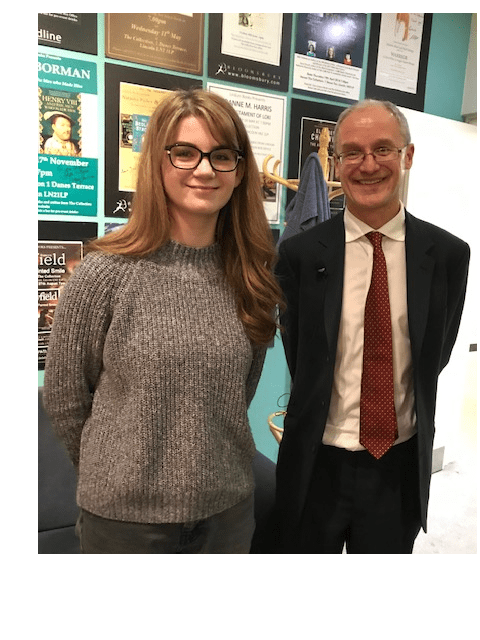
Author Jane Robinson writes books wearingan apron.
‘There’s some weird, horrible domestic subtext to this – I don’t like to think about it too much!’ she says. ‘But when I’ve got my apron on, I know it’s time to write. Then I take it off to have tea.’
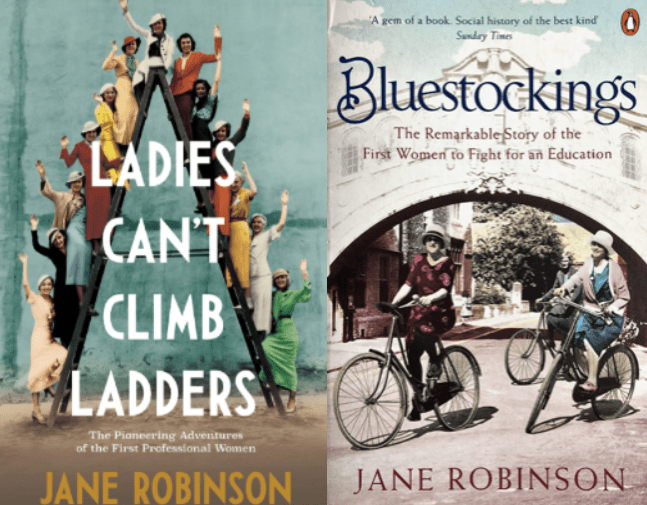
Robinson is a social historian, writing about women pioneers, the women that changed the world, so perhaps the apron balances it out. Regardless, her latest book, Ladies Can’t Climb Ladders: The Pioneering Adventures of the First Professional Women, is her eleventh – if it ain’t broke don’t fix it. Now, on this cold, January night, she’s at The Collection Museum in Lincoln, to talk about the book to a packed auditorium. I’ve managed to grab her for ten minutes before she goes on, put together the pieces of her own past. Robinson’s writing career started when she was working in an antiquarian bookshop, straight out of university.
‘One day, a guy came in and said he wanted to start collecting every book that had ever been written by a woman traveller,’ she says. ‘At that stage, I thought that would probably be about thirty or forty books. I was telling another friend this and they said ‘Why don’t you do a list?’ I thought that was a good idea – a way of making my name in the antiquarian world. And then I started reading the books I was only supposed to be listing. There were names like To Lake Tanganyika in a Bath Chair and To Outcast Siberian Lepers and I just thought, who were these people writing these books and doing this extraordinary travelling?’
The list of books turned into a book written by Robinson. She chose to focus specifically on the women that had written about their adventures, that told their own stories. She featured 450 women and left as many out. So much for thirty or forty.
Since then, she’s written books about suffragettes and illegitimacy, the first women to get university degrees and the WI. She’s written a biography of Mary Seacole ‘the charismatic black nurse who became a heroine of the Crimea’ and the English women of the 1857 Indian Mutiny, the ones that sided with the Indians in the conflict.
‘Usually, there’s one standout story in each book,’ says Robinson. ‘That story leads to the next book and then the next book and then the next book.’
Her latest, Ladies Can’t Climb Ladders, is about women a hundred years ago, trying to break into professions. It must be difficult, I think, immersing yourself completely in stories about oppression and suppression, seeing talent, passion and lives go to waste.
‘In some ways it makes me feel optimistic,’ she says. ‘These were ordinary women – our great-grandmothers, our batty great-aunts – doing amazing things and that’s really uplifting. But then I realised the battles they were fighting, we’re still fighting, and the prejudice they were coming up against… it’s not quite the same but there’s still prejudice there. I don’t think they would be particularly proud of us for the pace of change that’s followed their pioneering. I’m uplifted because they’re inspiring people but it’s a little bit depressing sometimes to realise things haven’t changed as much as we would hope.’
This is the thing that makes the evening magic – this feeling that the stories Robinson tells are not really over. The women in the book, the women she talks about in her lecture, might as well be sitting in the audience – their cloche hats and brollies filling up the back row – for how relevant, how resonant, their stories feel to the women that have bought tickets, found something cultural to do with their Friday night.
The way this is revealed is simple: after the talk, Robinson opens the floor for a Q&A. Gradually, slowly at first and then with increased urgency, people start putting up their hands, telling their own stories. We hear about women not given jobs in the armed forces because they weren’t wearing makeup, women not offered jobs because they were. Women in their sixties forced to do needlework instead of woodwork, teenage daughters now that are guided towards ‘more suitable’ A-levels. We hear from women that needed male relatives to accompany them to banks and sign paperwork before they could make any kind of financial decision, line managers telling women not to bother with aspects of training because ‘you won’t be interested in this.’ A woman in the row in front of me talks about her time at university, about applying for a philosophy course with a less-academic male friend. The friend got on the course. She was told that, if she wanted to do philosophy, she would also have to take an extra course in mathematics to prove herself because ‘the female brain isn’t logical.’
The women in Robinson’s book helped us get where we are but we’re not there yet. Over my short time on Earth so far, I’ve realised that being a woman means being angry quite a lot of the time. Robinson says she channels that anger – she finds another woman, sometimes in another time, that was angry about the same thing, finds out what she did.
‘It can be quite creative,’ she says.
It’s an exciting time for Robinson. Aside from travelling, doing talks, writing books, she’s currently in talks about adapting her book Bluestockings: The Remarkable Story of the First Women to Fight for an Education into a TV series. It’s a long process, she says, but extremely exciting.
‘If it comes off,’ she says, ‘I demand a cameo role as a crusty old woman don.’
It must feel like quite a responsibility, I think, to represent these characters, their stories, in a way that does their achievements justice.
‘I feel a sense of gratitude to almost all the women I write about,’ says Robinson. ‘I think this is the least I can do with my particular talents and personality to pay them back for what they did. It sounds a bit soppy but I feel that quite strongly. I’m not going out, breaking down barriers or crossing Antarctica with a baby in my rucksack, but I can give them back their voices.’
The rest of us can listen.
Nothing in the Rulebook editor, Ellen Lavelle, is a graduate of the University of Warwick’s prestigious Writing Programme. An aspiring novelist and screenwriter, she has worked with The Young Journalist Academy since the age of fourteen, writing articles and making short films for their website. She’s working on a novel and interviews authors for her blog – you can follow her @ellenrlavelle on Twitter. She is currently commissioning features for Nothing in the Rulebook and can be reached via the nitrbeditor@gmail.com email address.
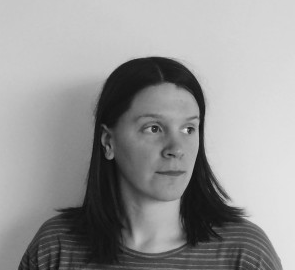
A few years ago, Helen Hancocks was on the London Underground with her father and brother. It was a busy carriage and Helen and her brother were on one side, her father on the other. Suddenly, her father started flapping his arms and mouthing at them. It was only when they got off that Helen saw the little boy in the pram reading one of her picture books.
Helen Hancocks
‘If I’d had the conviction, I would have said ‘I wrote that!’ Hancocks tells me, ‘but I just went ‘oh that’s nice,’ and jumped off the train!’
We’re sitting in the Bailgate Deli in Lincoln, where we both live, drinking hot chocolate and catching up. I first met Hancocks when we worked together in a bookshop in the city centre. She’s now left the shop to pursue her freelance career as an artist full-time. Still, you can always tell which review cards were written by Helen – her handwriting is quirky and cool, clear but with character. She knows how to wield a Sharpie.
Art is in her blood. Her grandparents were printmakers at Grimsby college, specialising in lino print, and, while her parents earned money as teachers, they were both practising artists in their spare time.
Helen always loved drawing, loved the work of Maurice Sendak, Judith Kerr and Shirley Hughes as a small child. However, though she always wanted to work in the arts, it was the discovery of Oliver Jeffers as a teenager that made her consider writing and illustrating picture books as a career. She graduated from Manchester School of Art with a first-class degree in illustration and animation in 2011, started putting together her first picture book.
‘I sent some work off to publishers and they said wanted to meet me,’ she says. ‘I expected to just get work experience but they said ‘Oh no, we’d actually like to contract this book up and publish it.’ That was the moment when I was like, oh, this can actually be a thing. And then there’s the moment you actually see it in a shop. I still haven’t lost that excitement yet.’
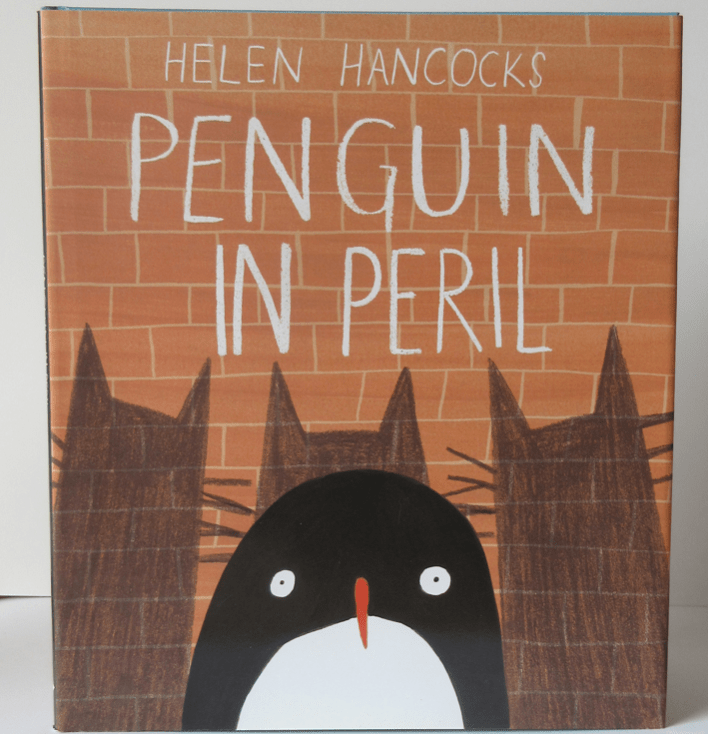
Her first book, Penguin in Peril, was published in 2013 by Templar Publishing and follows three cats who steal a penguin so he can catch fish for them to eat.
‘I read a news article about a boy stealing a penguin from a zoo,’ says Hancocks. ‘I couldn’t draw people so I drew cats instead.’
Penguin in Peril has now been translated into French, Polish, German, Danish & Chinese. It was nominated for the Kate Greenaway Medal 2014, as well as Shortlisted for Waterstones Children’s Book Prize 2014, Peters Book Award 2014 & The Cambridge Read It Again Award 2014.
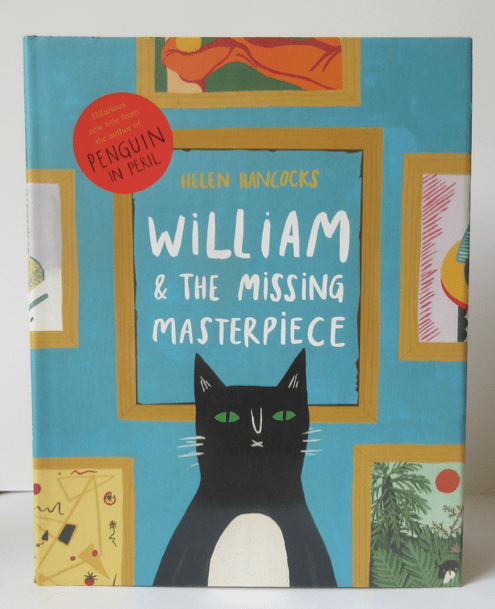
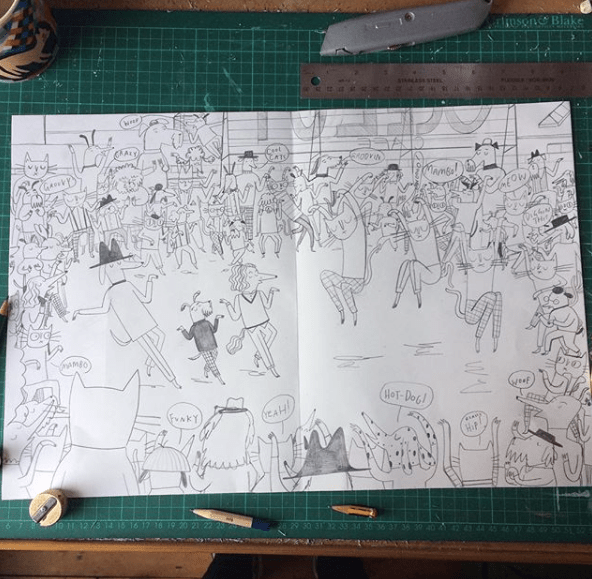
Hancocks really is very good at drawing cats. Her William series is based on her cousin’s cat, William.
‘He’s such a lovely, handsome cat,’ she says. ‘I imagined what he might do – go on adventures, you know. And then I pitched this to my editor and they were like, why? What’s his motivation? So then it became more of a crime caper. It didn’t start out like that – he was just going to be a travelling cat that went to a different city in each book but, yeah, then it became a crime story.’
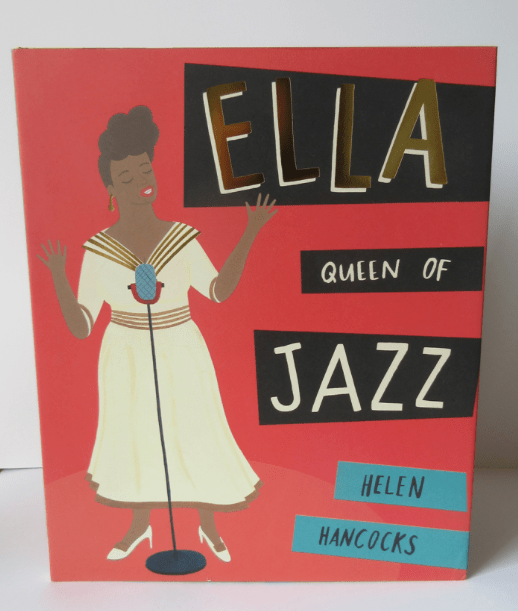
She’s good at cats but Hancocks can now also definitely draw people. Her book, Ella Queen of Jazz, is based on the life of Ella Fitzgerald. In 2017, Helen hosted an event at Cheltenham Jazz Festival.
‘People were buying tickets for the launch event so there was a lot of pressure,’ she says. ‘I had two lovely performers singing and doing some jazz which helped a bit but I’m not very confident with reading aloud. I have learned that I should read it aloud as I write though because that’s how it will be read or listened to later.’
Performance is quite a large part of an illustrator’s career, strange though it may seem, as art is usually a fairly solitary activity. Hancocks spends a lot of time running workshops in galleries and visiting schools.
‘The kids always see so much more in your books than you ever thought possible,’ she says. ‘I went to a school once and they’d done the first William book as their book for the term. They didn’t just read the book; they learned about Paris. They had a fake trip to Paris by setting out the chairs as if they were on a plane, ate croissants and learned about different monuments and art movements. The first William book is set in a gallery so they learned about Matisse and surrealism which wasn’t bad, seeing as it all started with my silly idea about a cat solving a crime in Paris.’
Helen’s art is delightful, draws on her love of animals, travelling, people, cake, culture and film. She’s designed logos for businesses, prints for walls. You can get her illustrations on tote bags, hang her paintings in your house. It’s a brighter world, the one in which Helen’s characters live, and must be a fabulous place for children to start savouring stories.
‘Working in the bookshop was an eye-opener,’ Helen says. ‘You think you’d just be reading books all day and maybe making pretty displays, but there’s actually a lot more to it. That said, it is my pipe-dream that one day, perhaps when I’m in my sixties, I’ll have a bookshop just for picture books. There’s a really beautiful place in Bologna, for the Bologna Book Fair, which is just a children’s bookshop. It’s wonderful – that’s my dream.’
The bookshop was also a great place to get inspiration, to pick up on other writers and illustrators creating interesting books. Helen is a great person for book recommendations.
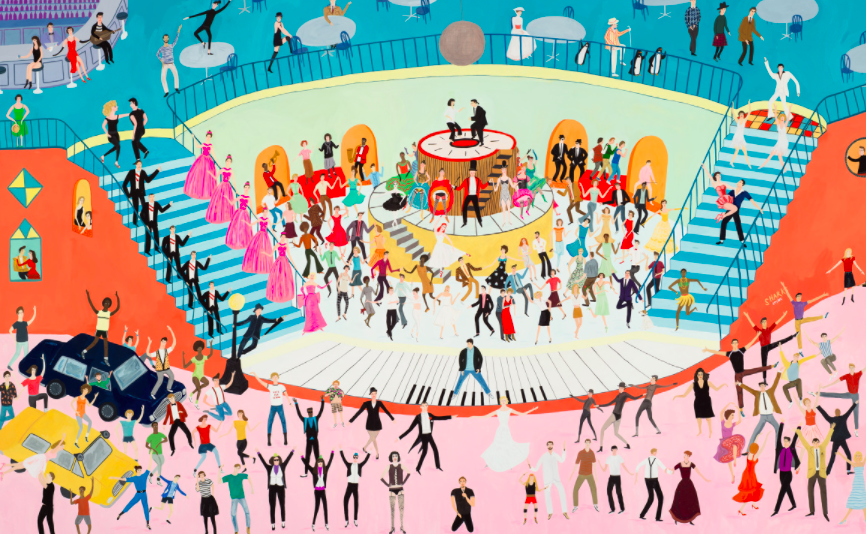
Gotta Dance, Gotta Dance, 2014 (copyright Helen Hancocks)
‘My favourite book that I read while I was at the shop was The Murderer’s Ape by Jakob Wegelius,’ she says. ‘It’s a 9-12 book and it’s set in Portugal. Quite a hefty book for 9-12-year-old but really brilliant adventure read. I really like Katherine Woodfine’s series, which is a detective series, set at the turn of the century. In terms of picture books, I love anything by Carson Ellis, John Klassons, Oliver Jeffers, David Roberts and Isabella Arsenault. They’re all really amazing.’
If you want to know more about Helen and her art you can visit her website here. To find out the details of her workshops follow her on Twitter and Instagram. She has a shop where you can buy prints and merchandise. That’s if I don’t buy it all first.
Nothing in the Rulebook editor, Ellen Lavelle, is a graduate of the University of Warwick’s prestigious Writing Programme. An aspiring novelist and screenwriter, she has worked with The Young Journalist Academy since the age of fourteen, writing articles and making short films for their website. She’s working on a novel and interviews authors for her blog – you can follow her @ellenrlavelle on Twitter. She is currently commissioning features for Nothing in the Rulebook and can be reached via the nitrbeditor@gmail.com email address.
What’s the greatest love story ever told? Romeo & Juliet? Doctor Zhivago? Casablanca? Or perhaps it’s one you’ve not yet heard of.
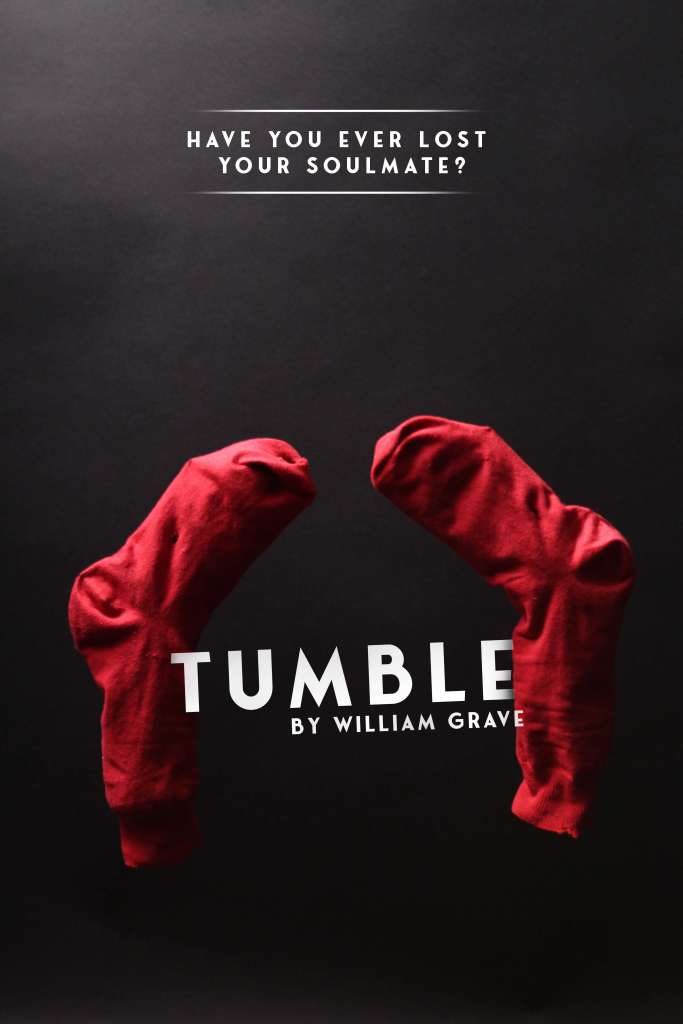
Tumble is the new short film created by London-based film maker, William Grave. Released on Valentine’s Day, the film follows the relationship of two star-crossed lovers socks.
As couples around the world celebrate another Hallmark festival, Tumble promises to be the perfect antidote to the consumerism of Valentine’s Day – allowing couples and singles alike to enjoy a charming tale of love and loss (and lost socks).
Nothing in the Rulebook caught up with Grave to talk about movies, screenwriting, as well as Tumble, and just how one goes about auditioning candidates for the crucial role of ‘lead sock’.
INTERVIEWER
Tell me about yourself, where you live and your background/lifestyle
GRAVE
I live in Kingsbury, north London. Born to an Italian Mother and an English father, I was very fortunate to grow up with the world’s greatest roasts and Italy’s finest tiramisus. I couldn’t sing or play an instrument, but writing was something that gave me that buzz you see from musicians on a stage. I studied Creative Writing at Warwick, where in my final year I did a screenwriting module. That opened a door for me in my brain. Screenwriting is all about the story, and that’s what I love about it.
And from screenwriting I’ve moved onto directing. I feel like you haven’t truly written the film until you direct it, as so much evolves from just a line on a page and so many new ideas come up in the film-making process that makes the story and individual scenes better.
INTERVIEWER
Is film making your first love, or do you have another passion?
GRAVE
I wrote poetry, prose and still do a lot of screenwriting. The amazing thing about writing is that it’s just you and the page. You are in control of that whether you like it or not. No excuses. Film-making often involves dozens of people and every jigsaw piece has to fall into place just to have a film made.
INTERVIEWER
Who inspires you?
GRAVE
Charlie Kauffman is a screenwriter who often breaks the rules, and has so few films made despite the critical success of Being John Malkovich, Adaptation and Eternal Sunshine because he challenges the studios’ norms so much. I was lucky to see him in a Q&A a few years back in London.
INTERVIEWER
Your short film, ‘Tumble’ centres around essentially a love story between two socks. Why did you feel it was important to tell this story?
GRAVE
I’m interested in the power of inanimate objects to move people, simply through music and point of view shots. In some ways it was an experiment. But, beyond that, I think everyone has suffered from a form of loss or heartbreak in their life. I hope this film could mean something to them.
Watch the trailer for Grave’s film ‘Tumble’ here
INTERVIEWER
How do you make a story about two inanimate objects feel ‘real’?
GRAVE
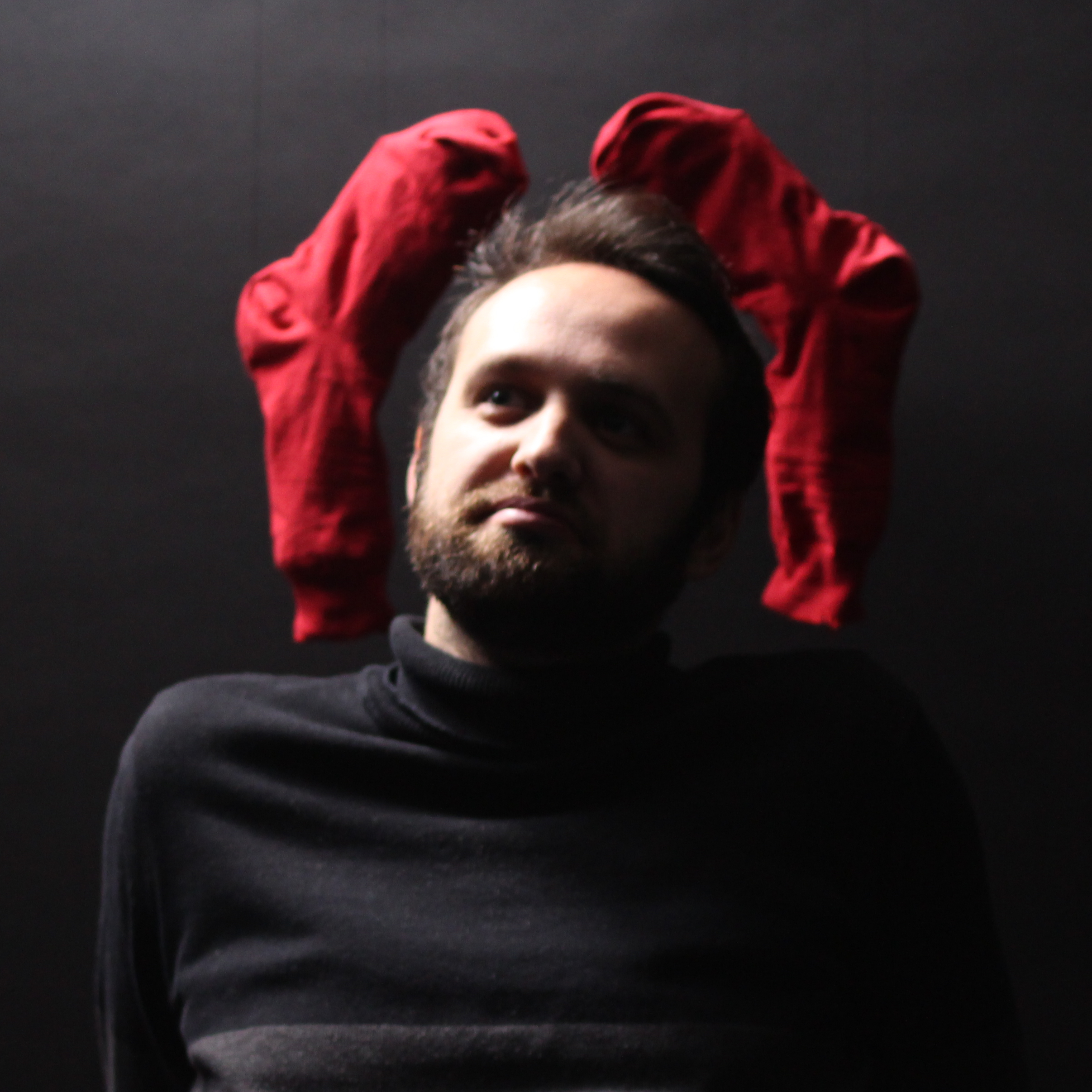
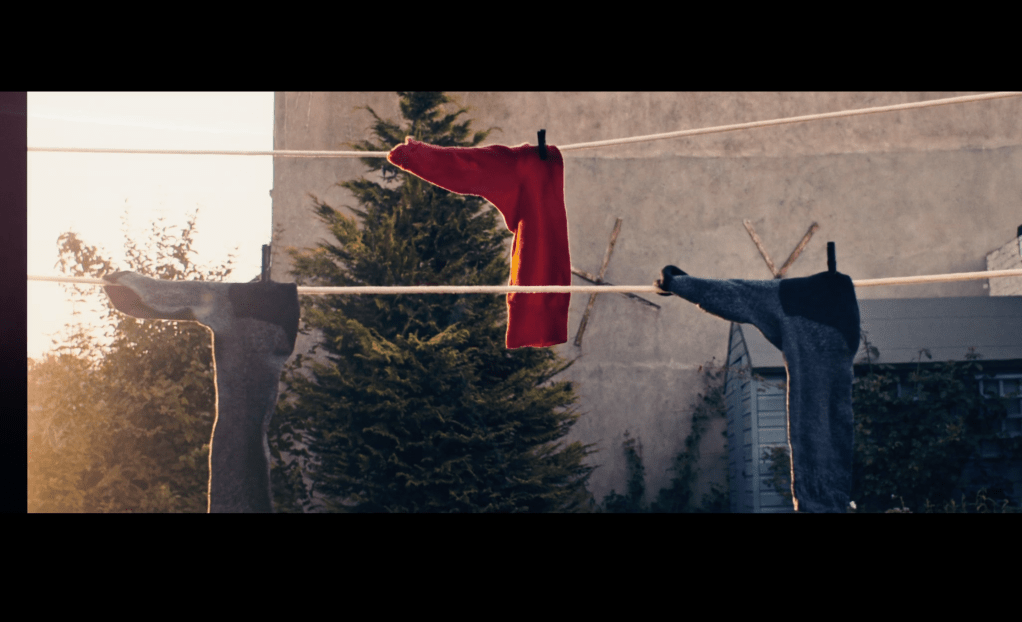
Before starting out, I had to think about how to anthropomorphise a sock. What is the mouth? Where’s its head? I did a series of testing. I had a ‘casting’ problem when it came to the socks too. As mad as it sounds, I spent about 200 pounds on different socks. Some had hearts on them, but it felt a bit on the nose. The day before shooting I saw these two red socks, and made a little hole where the big toe would be and a hole on the base, and suddenly it gave the old sock almost an ‘eye’ and a ‘mouth’. Now you have a character to identify with. And when you have two of them, you have a couple to root for.
A ‘casting problem’ with socks? A still from Grave’s short film, ‘Tumble’
I didn’t want to animate the socks or have dialogue. I wanted their journey to be ‘real’ but emotionally involve the audience by showing them what they’re seeing. What they’re going through. The ups and downs in life that are out of their control.
Music was always going to be crucial to bring to life this ‘Casablanca for socks’. Recording live, the pure emotion in the singer songwriter’s Jean Claude Madhero’s voice… it was breathtaking. His music is about love and loss, so was a natural fit for this film. Being from Martinique, he sings in French Creole. Even without knowing the dialect, the words emotionally translate so well. Especially the final song.
INTERVIEWER
In the film, you use some interesting cinematography – including a shot from inside a washing machine. Can you talk us through the process of creating these shots, and were they always in your mind when you were writing your initial script?
GRAVE
It was initially a very short script, so a lot had evolved from what was on the page. Like, yes the sock is hung up on the line, but is it a traditional washing line or one that spins? And how do we make it feel like suffering? A crucifixion?
We had a plumber cut a washing machine in half so we could shoot from the inside of it. My cinematographer James had the great idea to put the socks in a fish tank and place the lens against the tank. In the film you don’t see the tank at all, you just get the effect of the water rising above you inside the washing machine amongst the socks.
Later on the shoot day, the cinematographer was putting the lens cap over the lens after a shot and I noticed these shards of light broke through the darkness when that occurred. I asked him to do it again, and that moment features in the film during the ‘shipwreck moment’ when the lonely sock comes to on the washing line.
INTERVIEWER
As both a writer and director, could you tell us a little about how you view the relationship between these two roles? Is a script sacrosanct? Or does the director have ultimate creative control over any film?
GRAVE
I came into directing because I think in the end, you could have a feature film made as a screenwriter but deep down you will be very frustrated by some of the choices made by the director. Unless you are Aaron Sorkin, the screenwriter has very little influence on the film once it goes into production. If you are directing something you have written, it’s like you’re writing a new draft. You are improving it. You are thinking about it on so many levels that you did not when you were writing it and that’s the exciting part. The same goes with dialogue I have written in the past, when an actor makes an improvement on a line – good! They’re making the film better, which is what you want. You can’t be too precious about it and get in the way of yourself.
INTERVIEWER
One of the reasons ‘Tumble’ works so well is that it is ultimately about one of the most timeless stories of humankind: it’s about love, loss, and the way we view and deal with relationships both past and present. How do you go about creating a story that feels new and unique when it’s about something as ageless as these themes?
GRAVE
I’m drawn to stories and ideas that feel fresh and original, but you still need to find something universal within it. Everyone’s got an odd sock in their sock drawer, but everyone also has had a moment of loss or heart-break in their life. I think it’s the reason why, when people ask about the story, they are so desperate for the socks to get back together again.
INTERVIEWER
Why do you think it’s important to tell this story today, in the context of the current world we live in?
GRAVE
Let’s be honest. This is a film about socks. It’s not going to take down Trump and or the rise of Nationalism, but if it makes one person smile around Valentine’s Day, I would be happy with that.
INTERVIEWER
Can film making – or good stories – change the world?
GRAVE
If you go back to The Birth of a Nation, which boosted the status of the KKK in 1915, it can change the world and sometimes not for the better. But, if film has that power to bring about negative prejudices, surely it can do the opposite too.
There are some worthy films being made and about important issues, but film-makers and all storytellers need to find a way to get that message out to everyone and not just narrow echo chambers or film festivals.
In Blackkklansman, Spike Lee chose (with permission from her mother) to show the murder of Heather Heyer at the Charlottesville far right rally at the end of the film. It was incredibly powerful and it was watched by millions in cinemas across the world. Even though the film was set in the 70s, it shows the danger of the far right today and how it’s not just something from our distant past.
INTERVIEWER
Looking around at current trends in film-making, what are your thoughts and feelings on the industry? And how would you advise aspiring film makers or script writers to break out onto the ‘scene’?
GRAVE
I would say it’s a time to be optimistic. Whatever people feel about Netflix, they are making films that other studios would have passed up on. For example, films with a vegan message like Okja would have been passed up by the traditional studios; but not Netflix. More stories than ever are going into production – and less cliché ones too.
I’m still trying to break onto the scene myself, but you can learn with every BFI networking event you go to. Once you have a couple of good shorts written under your belt, put the synopsis up on shootpeople.org and see if you can get a good cinematographer on board. From there you can probably get a producer on board and actually direct the film yourself. It’s very common for shorts to have a ‘writer director’ credit, and it’s the most likely way you will get something made. If it’s good, you can enter your short into festivals, and that’s how people tend to get noticed.
From reading about the Sundance Screenwriting Lab, I’ve seen that people have got in after having a few short films made. Actually getting something made seems to have a value over a good script on a page because it has engaged enough people to actually make the damn thing. Even on a short, there is often a small army needed to make a film. So, even if you just want to be a screenwriter, have a go at directing. You might love it. You might hate it. But, if you don’t try it, you won’t know.
INTERVIEWER
In terms of writing screenplays, what do you think is most important to keep in mind when writing your initial drafts?
GRAVE
Short films can be written in a day. But features are another beast. I spend about 4 weeks just planning and writing scenes on cue cards, and then you get down to writing the thing. The exciting moment is when a character does something you didn’t plan for. They’ve come alive beyond your notes and initial thoughts.
It’s a bit of a cliché but learning from experience, it’s better to master the form before breaking it. 3 Act structures have been around since Aristotle’s Poetics, and it is certainly your best starting point. What you choose to tell within that principle can be the most original, strangest story on the face of this planet. Giving your story a form, does not take away from its creativity. As people who write poetry know, having a rhyme scheme and restrictions can actually make for better poetry. Sometimes!
Finishing your feature film first draft is a great moment. Buy yourself a drink. But, then you go through the process of sending it onto trusted readers, and the next draft is actually harder I find. Because, so much thought went into your first draft and once you change one scene or character, the whole film sometimes needs to be rewritten. A painful process that sometimes has to happen.
INTERVIEWER
Do you feel any ethical responsibility as a writer or director?
GRAVE
I think you have a responsibility to yourself to tell your story, a story no-one else will tell. If you think too much about outside influences your work will be tempered by that. Equally, you can be motivated by a social issue you want to tackle, but if it becomes too didactic your story or film risks being turned into a charity advert.
Then there’s the day to day of film-making. When you’re working with people there are always ethics involved. I’ve worked with actors in an audition, where there is a kiss scene. In everything you do in film, you want authenticity above everything. If it feels real to you, directing it in the room, there’s a likelihood that will transfer to an audience too. But, of course you have to also make sure the people you are working with are comfortable and happy.
In my next film, there is a dinner scene with a roast goose being served; it’s supposed to be set in the traditional countryside and you work with a food artist. They go about getting a roast goose, but even though I’m not a vegetarian, you question whether that goose needs to die for your film. These are day to day ethical questions, you ask yourself in film-making.
INTERVIEWER
Many directors talk about the idea of dealing with ‘disaster’ – the unexpected dilemmas or catastrophes that appear when you least expect them over the course of making a film. Did any of these occur during the making of your film, and how would you advise other aspiring directors to deal with such events?
GRAVE
Making films is how you cope with ‘disasters’ and still get the thing made. I’ve had my fair share with another film project with a 20k budget, and the whole thing fell through 4 days before shooting. But, sometimes a disaster can lead to something better.
With Tumble we lost a multi award winning composer from the project, which sucks as the film is so reliant on music. One day I was on the tube and walked 100 metres past this amazing voice complimented by a guitar. It was the voice of Jean Claude Madhero busking in Oxford Circus. I wanted a Latin sound for my film, something passionate and melodramatic, and his voice stood out. We teamed up together for this film, and I feel very fortunate to have worked with him. I’m releasing this film, because I’m inspired by him. I want the whole world to know about him and his talent. At the age of 70, he himself has had some knocks backs, having been homeless in Paris many years ago, but he never gave up on his art.
Listen to the dulcet tones and beautiful guitar of singer songwriter John Claude Madhero – who provides the music to ‘Tumble’
INTERVIEWER
How would you define creativity?
GRAVE
Giving the jumbled up toys in the toybox a new playground.
INTERVIEWER
What does the term ‘writer’ mean to you?
GRAVE
Someone who hasn’t given up on their dream.
INTERVIEWER
Could you tell us a little about some of the future projects you’re working on?
GRAVE
In My Day is a black and white short about a white girl from Bradford who is deeply in love with her British Asian boyfriend, Asif. But, the local skinheads in the city and her parents from the countryside aren’t accepting of their relationship. The true reason for their hostility is only revealed at the end: Asif is a robot. It’s a film that questions what will we be conservative about in the future. I’ve been very fortunate to get a Bafta winning composer on board, a feature film cinematographer, costume designer from Netflix’s Sex Education and the sound recordist from Peaky Blinders. The great thing about being based in London, is that there are a lot of passionate film-makers out there, and a good script can help you bring onboard top people as a passion project. We’re currently looking for a new producer, if anyone is out there?
INTERVIEWER
Could you write us a story in 6 words?
GRAVE
The houseplant stopped being thirsty yesterday
INTERVIEWER
Could you give your top 5 – 10 tips for writers and film makers?
GRAVE
1)Find yourself a producer, who is committed to you and your storytelling. They are priceless, and you will make a few shorts together and then the next step is a feature. The directors who are making their debut feature films often have a producer on board who has been with them from their earlier shorts.
2) Don’t Give Up. What draws me to film, beyond the storytelling and opportunity to work with many talented people, is that you can still be doing this into your 70s and 80s. You never retire from something you love. And however old you are, you can start now.
3) Stick with your instincts. Whether it’s a story premise or how you want to shoot a scene, your instincts are your best and quickest guide.
4) Don’t follow a trend. They don’t last very long. By the time you have written your screenplay and got it made, it won’t be ‘on trend’ anymore.
5) Welcome back. You’re going to university again. With every film you make, you’ll be learning so much. Embrace that.
6) An imperfect film is better than an unreleased or no film, and I include mine in that bracket. Vimeo has thousands of password protected films that are never put out to the public because it was never quite as good as the director had hoped.
Quick fire round!
INTERVIEWER
Favourite writer/director?
GRAVE
After Charlie Kaufman, it would be Taika Waiti. Love his style of storytelling, where light meets dark, and his new film Jojo Rabbit has that in abundance.
INTERVIEWER
Critically acclaimed or cult classic?
GRAVE
Cult Classic – it’s actually loved by people and for decades.
INTERVIEWER
One film everyone should watch?
GRAVE
La Vita e Bella – Life is Beautiful
INTERVIEWER
Most underrated artist?
GRAVE
Talib Kweli
INTERVIEWER
Most overrated artist?
GRAVE
Stormzy
INTERVIEWER
Who is someone you think more people should know about?
GRAVE
Jean Claude Madhero
INTERVIEWER
If not film-making – what would you do?
GRAVE
Write novels.
INTERVIEWER
Do you have any hidden talents?
GRAVE
Undefeated at Limbo… going on 10 years.
INTERVIEWER
Most embarrassing moment?
GRAVE
Too many to tell.
INTERVIEWER
What’s something you’re particularly proud of?
GRAVE
Being an uncle… although I can’t take any credit for that.
INTERVIEWER
One piece of advice for your younger self?
GRAVE
If not now, when?
Watch the full version of Grave’s film, ‘Tumble’ right here
John Claude Madherowill be performing his incredible music live at the Whirled Cinema in London during a special screening of ‘Tumble’ on Sunday 16th February at 8.30pm . Email William Grave at willgrave@gmail.com for a free ticket.
‘Flash’ fiction is many things; short, difficult to categorise, easy to read but so much harder to write. These mini narratives, stories that fit neatly in your pocket and can be read in the same amount of time it takes to smoke a cigarette, offer writers the chance to hone their ability to write precisely and concisely – condensing whole plots into the space of a few hundred words. When done well, these miniature stories can transport readers to far off realms and pack emotional sucker punches that leave you reeling.
If you’re new to the world of flash or desperate to learn more about this exciting writing form, you’re in for a treat. That’s because we’ve caught up with a flash fiction legend in Christopher Allen – editor-in-chief of SmokeLong Quarterly, one of the longest running (and perhaps most well-known) online journal dedicated to flash fiction.
Alongside his work with SmokeLong, Allen is the author of the flash fiction collection Other Household Toxins (Matter Press, 2018). His work has appeared in The Best Small Fictions 2019, Booth, PANK, Indiana Review, Split Lip Magazine and lots more. Allen is also a self-described nomad – and it was an absolute pleasure to catch up with him in a conversation where we discuss the craft of flash fiction, the publishing scene in general, as well as someexcellent writing advice to anyone looking to launch their own literary careers and get their writing published.
Is writing your first love, or do you have another passion?
Thank you so much for these interesting questions. Writing is a tie with singing. That’s the easy answer. I was always going to be both.
What draws you to flash fiction?
Fate? When I was songwriting, people kept telling me my songs sounded like stories. At graduate school, my professors told me my essays sounded like stories. I tried cramming these stories into novels and screenplays for a while before I found the perfect fit of flash fiction.
Distilling a narrative into a few hundred words is an incredibly challenging task – how do the best flash fiction writers manage this?
Great question. I think you have to find a situation that moves you, the right moment and something profound about that moment—and then of course you need to have a feeling for compression and urgency. But for some flash writers it’s also a challenge to write longer flash-length stories. I’m actually teaching a workshop at the UK Flash Fiction Festival in June on expansion in flash with my fellow editor Helen Rye.
You’re the editor of Smokelong Quarterly, one of the most well-known and longest running literary journals dedicated to flash fiction. When reading pieces that have been submitted to your magazine, what are you looking out for?
Thank you. I’m very proud of SmokeLong’s history and honored to be at the helm. We—the 12 editors who read submissions—are looking for stories so engaging and so emotionally affecting that we can’t stop reading. We are looking for solid narratives that show what flash fiction can do.
Quick question: there was some historic debate about what to call what has become known as ‘flash fiction’. There was ‘micro-fiction’, ‘smokelong fiction’, and ‘flash’, among others. Has ‘flash’ definitively ‘won’ this battle? Why?
Yes. Flash has won. There were lots of others too. Palm fiction, little fiction, sudden fiction, short short stories. For years, “flash” seemed a bit flimsy to describe the form, but we have embraced it. I hope we have also helped to make it something bold, honest, and literary.
Not necessarily a question; but just for clarity, ‘smokelong’ sounds cooler than ‘flash’.
Doesn’t it? Last year I was in Hong Kong, visiting a fellow editor. She helped me find a reference to the idea of “the length of time it would take to smoke a cigarette” in Chinese (since the name SmokeLong is supposed to come from the Chinese for this length of time). We could have smoked six or seven cigarettes in the time it took us to find a reference in a ‘90s Chinese pop song. Over the years, we’ve dealt with a fair amount of criticism for apparently encouraging smoking. But we don’t! We encourage reading flash fiction instead. Could you imagine? We’d go on our flash breaks. We’d have special areas at airports. We’d have flasher’s cough.
Do you feel that there are specific challenges in marketing and promoting flash fiction compared to novels? How do you promote the stories you publish?
The flash fiction community is a cult. If we love a writer, we start chanting until an indie publisher picks them up. But seriously. There are a few superstars who have no problem selling very short prose to big publishers: snippets of this and that, paragraphs of random thoughts, thinly cut slices of life, philosophizing (and calling it flash fiction); but the overwhelming majority of flash fiction writers—who actually write flash fiction—rely on social media and the “loyal community” to get the word out.
The challenge is to get beyond this cult to get our work to the pretty novel readers who cringe and say “Flash fiction?” at a party. “What’s that? I’ve never heard of it. Have you thought about writing a novel?”
You look at some of the novels being published these days and, compared to the world of short & flash fiction, there are so many more sequels, prequels, and franchises. Do you think flash fiction allows writers to become more adventurous?
I’m not sure if flash fiction allows writers to be more adventurous, but the form does allow us to explore more situations, more various literary devices, more characters, more everything (except I suppose words) than the average novelist.
But flash fiction writers do write sequels and prequels and linked stories. Bath Flash Fiction has a regular novella-in-flash competition, and there are lots of chapbook competitions that welcome flash-length stories.
There’s an understandable focus in the writing community around rejection and acceptance in the literary sector. As one of the people in the industry who has the power to choose which stories get published, how would you advise writers to keep going?
Recently there was a discussion on Twitter about rejection. The question was “Why would you keep submitting to a journal who repeatedly rejects your work?” The question was in response to a tweet encouraging people to choose a GIF that represented the face a journal editor makes when they see the writer’s story in the queue. A few months ago SmokeLong accepted a story from a writer who had submitted to us 43 times. Never stop. But also be honest and ask yourself why your work is being rejected.
As an editor I have to think of the writer. Is this writer going to be happy 10 years from now having this story out in the world? I wish a couple of editors had rejected stories of mine 10 years ago.
What are three things a writer can do to write publishable short stories?
Write something you’re burning to tell the world.
Fully imagine the situation.
Read other stories and learn from what you read.
Who inspires you?
Anyone who works hard and is kind.
Are there any specific collections or individual flash fiction pieces you’d recommend others read, and why?
The well-documented collapse of authors’ incomes makes it increasingly challenging for writers and artists to pursue their creative goals and also afford to, well, pay the rent. What’s your take on the state of the industry at the moment, and is there anything that can be done?
Some indie publishers of flash fiction are making a little money I think. It’s definitely a niche market. No one is getting rich, but there will always be innovators who manage to make money through publishing. As a writer and a publisher, I have to see this from both sides.
In May 2018, SmokeLong became a paying market. We’re doing our tiny part. All we can do as a journal is try to pay writers as much as we can while looking for ways to pay more. And we do that. This is always on my mind.
Do you have any suggested literary magazines or writing competitions that you’d recommend aspiring writers submit their work to, to help them get noticed?
Yes. And I think it’s so important to send work to competitions. In the flash fiction world there are so many respected contests with big prize money. Here are the biggest (but you can easily Google “Flash Fiction competitions 2020” for more):
What’s next for you and Smokelong? Any exciting projects in the pipeline?
There are, but I can’t talk about them yet. Right now we are reading entries for the SmokeLong Quarterly Award for Flash Fiction. All the finalists will be compensated and published in the June 17th-anniversary competition issue. And some talented writer will win $2000.
At the end of April we’re also running another 7-week SmokeLong Quarterly Flash Fiction Workshop online with workshop leaders Sherrie Flick, Tara Laskowski, and Christopher Allen (me).
For your readers attending AWP in San Antonio, we are running a micro-fiction competition. Bring a story on paper (400 words or fewer) to the SmokeLong Quarterly table at the bookfair by 4:45 pm on Friday March 6. We’ll announce the winner on Saturday morning and hopefully hand over $200 right there at the fair.
Who doesn’t read books? If it’s a question that seems loaded with incredulity, that’s because it is. Literature – and books – are, after all, tools to help us live and die with a little bit more wisdom, goodness, and sanity. Yet it is also a question prompted by research that suggests adults in the UK are increasingly turning away from books and leaving them unread on bookshelves.
TGI consumer research from Kantar Media released in 2019 suggests just 51% of adults in the UK read at least one book in the previous year. Not only is this a decrease from 56% in the prior year, it also means 49% – essentially half – of adults in the UK didn’t read a single book in a full 12 months.
Looking across the pond to America, meanwhile, data from Pew Research Centre suggests US citizens are reading substantially more books than their British cousins; with just 27% of Americans saying they did not read a book in 2019.
Why the disparity? Well, a clue lies in what both sets of research revealed about the demographics of readers and non-readers.
In both the US and the UK, those adults who were classed as ‘non-readers’ were more likely to be non-graduates, more likely not to have finished high school, and more likely to be from poorer backgrounds.
Kantar’s TGI research also suggested that there is a growing age divide among UK readers; with 15-24 year olds 32% less likely than the average citizen to be heavy readers, and more likely not to read books at all.
While we need more qualitative data to discover for certain what is putting people off books, from this existing research we might extrapolate that there is a clear correlation between the decline in reading among young people and their increasing obsession with smartphones and social media. We know, after all, that global attention spans are decreasing – particularly quickly among young people – and that books, after all, require so much more attention than a 5 second video on Tik-Tok.
We can also point to an obvious cause of non-readership: poverty.
In the UK, where 10 years of Conservative mis-rule of the economy has seen wages deteriorate, and poverty levels increase to their highest rates in decades, while draconian changes to welfare systems leave children and their parents starving amid increasing job insecurity, it seems a little to obvious that one of the reasons UK adults from poorer backgrounds may not be reading as much as they once did is because they can’t afford to buy books. After all, the cost of a new paperback – around £10 – can in some cases be the difference between keeping the heating on.
The price of books of course shouldn’t be a barrier to people’s ability to read – and find enjoyment and satisfaction from – literature. Yet under the Conservatives, the UK has also seen drastic cuts to library and library services, with the closure of hundreds of libraries across the country since the Tories came to power.
As if to underline the important role libraries play in enabling people to read, Pew research points out that a 2015 survey found that the demographic groups they surveyed acknowledged the importance of libraries in their communities and for their families: Black and Hispanic adults, those in lower-income households and adults ages 30 and older were more likely to say that their local libraries serve them and their families “very well.”











 nothing in the rulebook