• Art Review: Five Hides
    Christopher Stead’s ‘Things Fall Apart’ seen through a ‘window’ of Ellie Hayward’s ‘The Wrong Trousers’ at the Five Hides art exhibition curated by Thorp Stavri.

    The Domesday Book listed the Manor of Walworth as being “five hides” in area (enough to support five families or to produce £5 in taxes). Some 950 years later, the grounds of this manor are lost somewhere here between Elephant and Castle and Kennington; just off the Walworth Road. But we are not looking for a manor or families to work its land. Amid the contrasting architecture of modern new developments and ‘gentrification’ and older Victorian buildings competing with post-war, brutalist architecture, we find ourselves crossing a flower bed in a non-descript well-manicured square, surrounded on three sides by newly built flats. We are hunting for something elusive; independently curated modern art.

    Gasping for culture, having spent months in Coronavirus-related lockdown, the thought of uncovering new artistic gems and talent has proven too good to resist. As you arrive, you practically run through the small entrance door, ducking under the netting hung there. Your partner questions whether this is the right place, but as you step in, it is clear you have entered Narnia.

    Haunting music fills the cavernous old swimming pool building, a monument to a long abandoned municipal dream – it’s a befitting venue to host one of the few remaining exhibitions from the struggling arts sector.

    The building itself is magnificent in its faded grandeur, and although time has robbed it of its plaster and tiles, nothing could dimmish the majesty of its scale. Colourful exhibits dot around the room – playing with the buildings’ size and you feel like you are in a post-apocalyptic toy chest.

    The artworks lack signs; yet there is an accessibility to the them that allows even an art-novice to enjoy and ponder. At the front there are QR codes, which will guide you around the exhibit, but it’s honestly refreshing to look at the art as it is – without justification or rationale – and understand what it says just to you.

    There are individual gems in the artworks coming from a collection of 19 artists, early in their careers, although a couple have certain amateur scent. However, part of the magic also comes from the way they have expertly been curated by Thorp Stavri, a London based curatorial platform dedicated to supporting early career artists. As we entered the show Eric Thorp himself sits tilted on a chair behind the entrance desk, wearing a beard-beanie hipster uniform, greeting guests with a genuine smile.

    It’s difficult to pick favourites in a show displaying so much diverse talent from 19 different emerging artists, but personal highlights for me were the work of Anna Perach, Jack Evans and Christopher Stead.

    Stead’s “Things Fall Apart” dominates the room with its size, matching the buildings industrial scale. It’s a net which looks like it has been dragged from the bottom of the ocean, with fraying canvas and wires playing the part of fishing debris. It’s pretty – on a smaller scale, it could almost quaint – something you may see in a upmarket gift shop in a seaside town. However, the scale and the situation combined lends it a different, more sombre air. Looking at the tangle of netting in ocean hues, I couldn’t help but think of ocean pollution, climate change and a million David Attenborough documentaries – which, no doubt the intensely political Stead was eluding to with his title “Things Fall Apart”.

    “Mother of Egg” by Perach is one of the most eye-catching pieces in the collection. Both powerful and vulnerable at the same time it shows a humming bird shielding an egg – representative of the duality of female archetypes. The sculpture’s bright colours and organic textures contrast gloriously to the industrial surroundings. It’s made with Perach’s signature “tufting” technique; the material at once the material looks moulded, sewn and fluffed. Looking at it, it’s hard not to want to run your fingers along the surface. In a pre-Covid time, the sculpture was meant to be worn, and there is something very satisfying about that – the piece is made to be touched.

    Jack Evan’s work meanwhile is tucked unassumingly at the side of the room, which seems an appropriate place for the piece entitled “Land that Time forgot”.  The humorous piece, which harks on consumerism and nostalgia, seems as if Evans has pulled it off from a wall in an Old Blockbuster’s. Stocked on the shelves are neat rows of semi fossiled VHS copies of “Jurassic Park” (purchasable after the show for £50), it’s initially witty, but also pleasing in the level of subtle detail. Each time I think I am done looking, my eye is drawn to something new – another little joke, an embedded fossil here, a splash of colour there. The work does not shout, but none the less it commands attention.

    The Five Hides was my first proper art show post-lockdown, and it did not disappoint. The gigantic venue is beautiful in its own right, but every aspect was enhanced and challenged by work of so many young artists. My main critique is that the 30 minute slot you book is not nearly enough to explore each of 37 exhibits in the level they deserved. If you are lucky, you may be able to stay a bit longer if the next slots are booked, but I would recommend booking two if possible, especially since tickets are free, thanks to Arts Council England and through the continued support of Projekt and FAD Magazine.

    The Five Hides ran from 3rd – 16th October in Manor Place.

    It is curated by Thorpe Stavri. It features work of: Josephine Chime, Charlotte Dawson, Jack Evans, Katharina Fitz, Enam Gbewonyo, Ellie Hayward, Kate Howard, Alice Irwin, Thomas Langley, Shepherd Manyika, Anousha Payne, Anna Perach, Sean Rennison Phillips, Anna Reading, Ally Rosenberg, Corbin Shaw, Christopher Stead, Tess Williams and Hannah Wilson

    About the reviewer

    Jennifer Taylor is a twenty-something reader and art-lover based in London. She knows a thing or two about Kombucha and how to grow avocados. When not forgetting to water her (other) houseplants, she can usually be found with a book in-hand or else generally wishing she had a dog. She (occasionally) tweets at @JenTaylor300 and can be found on Instagram @jennifertaylor12
  • Other voices, Other rooms, Other books
    “We find new ways of looking at the world through stories,” writes Geoffrey Heponstall.

    We all have our likes and dislikes in reading. We naturally gravitate towards some books, while others can feel like exploring alien territory. Of course, venturing into the unknown and discovering the unfamiliar is an essential part of a reading life. If you always read the same sort of thing, it can be like hearing the same old gossip, the same old grumbles at the bus stop. There may be a comfort in the routine, but it has the air of the mausoleum about it.

    There is always a risk in reaching out to the new. That author whose work you don’t know may not be worth knowing. Why all that praise quoted on the cover? On the other hand, and perhaps more likely, you may find something that fills a space on the bookshelf that is actually a space inside your head.

    When this happens, what you have found is a fresh way of looking at things. This, surely, is one of the great benefits of literature: we find new ways of looking at the world through stories. Indeed, if further proof were needed that as human beings, our perceptions of the world vary so much; you need look no further than a new book. Seeing something from a different angle can be refreshing or challenging or disconcerting. It can help us change our minds a little. Or it gives an opportunity to focus more clearly on what we feel. However we react, we find our thoughts energised.

    Literature’s central purpose, surely, is to enrich our imagination. It may develop our sympathies, also our knowledge and understanding. But these qualities are secondary to literature’s ability to widen our awareness beyond ourselves. Do we value a piece of writing because it directly relates to our lives? Or do we value it for the opportunity to see how others see the world, and how there are other worlds? In Other Voices, Other Rooms. Truman Capote coined the perfect title. A good book opens a door that you never really noticed before. Who wants to read about what they already know?

    This is perhaps a problem with generic, ‘pop’ literature. As Julian Barnes once wryly noted, publishers these days are only interested in printing “copies of novels that are copies of already successful novels.” So often, these books only reflect the lives of their readers (or perhaps their authors; there could be a reason so many novels in the last 100 years tend to follow the routines of middle-to upper class white men). Yet this homogenises viewpoints and restricts the realities we can uncover through a good book.

    A similar, but slightly different concern, comes from the well-meaning educators who believe that children should be given only the books they find directly relevant. Don’t give them Tom Sawyer or Treasure Island or Just William. Don’t show them about the world beyond what they can see. This is an attitude that misses out on the potential growth of awareness that a wide culture has to offer. The world was not created yesterday, and the world created contains so much. So much that we need to feed our minds on.

    I am not certain that we immediately recognize our lives even when they are depicted in literature. Reading lends distance as well as immediacy to the subject matter of a novel. There may be some direct relevance to our lives, but the narrative is told from an unfamiliar angle. ‘This is about me’ may be a response not to how we really are but how we think we are.

    What this often comes down to is a question of narrative. If the narrative voice is honest, then the story will be interesting to anyone with sufficient intellect and empathy to place themselves there within the pages of the book. People who are surprised that a white man can appreciate Toni Morrison or that a gentile can appreciate Isaac Bashevis Singer know nothing about literature’s power and purpose. Its purpose is to enrich; its power is the enchantment it contains to achieve that purpose.

    We seem to be – rightly – at a point when people are finally waking up to the dawning realisation that, as with so many aspects of society, we do a disservice to children if we classify books (or anything, for that matter) as being “for boys” or “for girls”. Books are for everyone.

    Yet in many ways we are still fighting the same battles. With genres like ‘chick lit’ and ‘lad lit’, we seem to be dividing experience at a moment when we need more harmony and universalism.

    Surely, it is important for us all to push back against being boxed into stereotypes and force fed culture “made for us” (as if that were possible). If books teach us anything, it’s that things can change, and there are a million new worlds to be found. So, let’s make our own world one we’d like to read about.

    About the author of this article

    Geoffrey Heptonstall is a widely published poet, contributing to anthologies and magazines throughout the world. He lives in Cambridge where he has taught Writing at Anglia Ruskin University and at various locations for the Open College. He has been a writer with The London Magazine, especially as a poetry reviewer. His publications include a novel, Heaven’s Invention [Black Wolf 2017], a full collection of poetry, The Rites of Passage [Cyberwit 2020], and a number of short stories, and essays for a wide variety of publications. He is also a playwright with many plays and monologues broadcast, performed and/or published. He was an associate writer with Duck Down Theatre Co 2013-15. @geoffreywrites

  • Book review: Uncanny Bodies
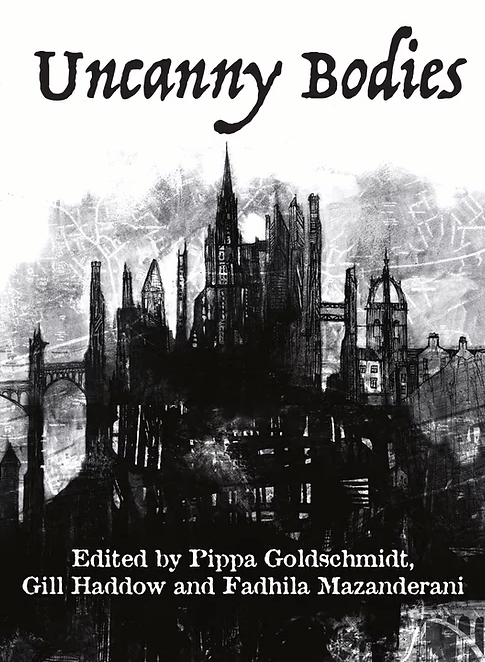
    The ‘Uncanny Bodies’ anthology, edited by Pippa Goldschmidt, Gill Haddow and Fadhila Mazanderani, is available from Luna Press Publishing.

    “What is the uncanny?”

    This is the question that greets us as we begin to read Uncanny Bodies – the anthology edited by Pippa Goldschmidt, Gill Haddow, and Fadhila Mazanderani. It is also what we may perhaps term “the” question; the question to which the entire anthology is dedicated to exploring (if not quite answering).

    Of course, we are given – in an excellent introductory essay from the three editors – an overview of how the term ‘Uncanny’ (or “unheimlich”) has been used by Freud and others. Yet even here, the editors note a difficulty in providing the uncanny with “any straightforward genealogy or definition”. While Freud may have popularised the term in his seminal 1919 essay; it was used by another psychologist, Ernst Jentsch, some 13 years previously; but of course the word itself originates in 16th Century Scots dialect. This difficulty in defining the true meaning of the word at the core of this anthology feels – perhaps – uncanny in itself. As readers, we are placed in a position of unfamiliarity and uncertainty, as though we are always at the edge of true understanding.

    Few tools, of course, are better at helping us explore the meaning of the world, of reality, and our own understanding of it, than writing. And so a written anthology dedicated to the uncanny feels well warranted. What is perhaps most interesting about the anthology is that it brings together creative writers with academics and social scientists – and thus the writing within the anthology draws from a variety of writing mediums. Within these pages, we have classic short fiction and poetry, but also experimental, modernist and surrealist creative writing, placed alongside long-form journalism and academic essay. It is a veritable menagerie of creative writing, brought together in a unique – though of course, uncanny – literary zoo that explores the central question (“what is the uncanny?”) from every conceivable angle.

    It makes for quite the surprising and engaging literary ride. Occasionally it can get exceedingly meta, as lines from Freud’s essay are turned into poems, which are in turn remixed and subject to intense academic reflection and study. Sometimes, the shift in styles and tones from short fiction to minimalist poetry via academic essay can jolt the reader and prevent them from settling into the book or getting too comfortable. But perhaps this is the point; a collection of only short stories or poetry or essays may lull readers into that dreaded sense of familiarity which is so lost in encounters with the uncanny. Indeed, Freud’s own definition of the uncanny, as the moment when “the familiar become strange” feels pertinent here: we pick up a book expecting some familiar course charted through familiar styles, only to encounter such vibrant originality springing from each page.

    Because – and this is key – the stories, poems, and essays in this collection are precisely that: original. The writing is unique and each writer brings their own voice, their own interpretation, to the core subject/question at hand. We explore the uncanny from the point of view of human biology; of physical pain, tumours, body dysmorphia (two pieces, ‘Bunting’ by Neil Williamson, and ‘Skin Sisters’ by Bridget Bradley follow characters diagnosed with dermatillomania: the urge to pick and pull at your own skin). But we also explore the uncanny from the perspective of our own world in which we live. In Alice Tarbuck’s excellent poem, ‘Alexa’, for example, we explore the relationship between human and virtual ‘Assistant’, which leaves us with the sinister final stanza:

    She plays my favourite songs, suggests

    My favourite recipes, and I sing back,

    Unbutton my dress, turn on the taps, still

    Unaware that her price is perched

    On the periphery, like a single black bird on a wire

    Like a single eye at the keyhole

    Where no eye was before.

    These are the moments that truly bring into sharp focus the reason why we need further awareness and consideration of ‘The Uncanny’. We live in a world in which so many things that seemed strange (robots in our homes, in our pockets) are now familiar – strangely so. And we simultaneously live in a world where things that seemed familiar (human contact, for instance) now feel strange.

    This is not to say that every written piece in Uncanny Bodies will be to each reader’s personal tastes; but rather that there is something in this collection for everybody. People often speak about the way books seem able to reach out a familiar hand to grasp your own; an acknowledgement that what you felt inside yourself your entire life is not strange. With this collection, dozens of hands reach out towards us; but in this instance offer both strangeness and peculiar familiarity.


    ‘Uncanny Bodies’, edited by Pippa Goldschmidt, Gill Haddow, and Fadhila Mazanderani, is published by Luna Press Publishing – https://www.lunapresspublishing.com/product-page/uncanny-bodies

  • Review: The Devil and the Dark Water by Stuart Turton

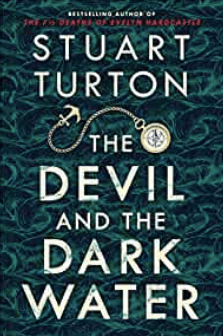
    Stuart Turton’s second novel, The Devil and the Dark Water, sails into bookshops in October this year, in the wake of his triumphant debut The Seven Deaths of Evelyn Hardcastle. Seven Deaths won the Costa First Novel of the Year Award in 2018, was shortlisted for the Theakston Old Peculier Crime Novel of the Year 2019 and was Waterstones’ Thriller of the Month for October 2018 – it was a big deal. Ambiguous and sprawling, Turton’s first novel mixed Agatha Christie and Christopher Nolan. It was golden age crime within a mind-bending plot; its complexity and playfulness delighted readers across the world.

    It’s a tough act to follow. But it’s time to follow it. 

    The origin of Turton’s second novel, The Devil and the Dark Water, goes back to the early 2000s, when he missed a flight to Singapore and ended up stranded in Australia. While he was there, he visited the Maritime Museum on the west coast and discovered the wreckage of The Batavia, a merchant vessel wrecked on a coral island in the 1600s. Not only did the survivors have to deal with the physical challenge of being wrecked on a tiny island, but they also had to deal with a tyrannical officer that assumed control and committed a number of violent atrocities before they were all eventually rescued.  

    ‘It’s a horrific story, but within it are all these other amazing stories,’ Turton says, in the essay printed in the advanced reading copy of The Devil and the Dark Water. ‘One of the soldiers on board led this heroic resistance. The captain navigated a rescue boat across thousands of leagues of unmapped ocean to bring back help.’ 

    Turton wanted to tell these stories but he also wanted more. With the same appetite that drove him to write the genre-defying The Seven Deaths of Evelyn Hardcastle, Turton took the story of the shipwreck and added a mystery, a hero, the sense of the occult. 

    ‘Like Seven Deaths, I wanted a lot,’ he says. ‘And like Seven Deaths, I drove myself a little mad delivering it.’ 

    Turton has poured his enthusiasm for the period, for his characters and literature in general, into every page. From the moment The Devil and the Dark Water lowers the gangplank, it draws the reader into an exciting, fast-paced plot. In the way Seven Deaths drew on the style of Agatha Christie, The Devil and the Dark Water tips its tricorn to Sherlock Holmes’ deerstalker. The main protagonist, Arent Hayes, is the Watson of the central pair, left to solve the mystery alone while Sammy Pipps, his Sherlock, is imprisoned below deck. Huge, gruff, with a heart of gold, Hayes is almost a hybrid of John Watson and Cormoran Strike – convinced his partner would do a better job but able to use his size and military experience to advantage. He’s an effective investigator and the story, when told through his eyes, is propulsive and efficient. The most frightening sequences are the ones we see through Arent Hayes. 

    Turton invests a great deal in Hayes, delving into his background with a story that harks back to Conan Doyle’s A Study in Scarlet – there’s a faraway land, dark secrets, mysticism. He gives him a love storyline that unspools quickly (possibly too quickly), a sharp tongue and a fierce sense of loyalty to his friend. For many readers and, indeed, many Sherlock fans, Hayes will be an immediate favourite. At times, however, the book feels more like the second in a series than a stand-alone novel. Turton relies on us buying Pipps and Hayes’ relationship, even though they share very little time together on the page. We all know what an eccentric genius looks like, as they’re often slinking across our TV screens, and Turton’s instinct, keeping Pipps in the dark and shining the light on Hayes, is a smart move. It does, however, rely on us taking their relationship, their past triumphs and published cases, at face value. Other characters mention reading Hayes’ accounts of their adventures – we hear passing references to previous mysteries – but the pace of the plot gives little opportunity to explore these in detail. It is an adventure story, however – the order of the day is excitement and Turton does deliver this, sloshing intrigue across the deck. 

    The cast is colourful and Turton delights in their deviousness and dishonesty, as well as their ability to do good. There are ghostly lepers that haunt the decks, suspicious priests and beautiful courtesans. We hear from most of them, see a scene through their eyes, and then we very quickly hear from another. There are moments where this is slightly jarring, where Turton seems to be yearning for the narrative power of Seven Deaths, where the protagonist spent each chapter in the body of another character. Here, there is no such decisive barrier between perspectives and they sometimes bleed together – within the space of a couple of paragraphs, you’ve visited several different heads. It’s an agile way to tell a story but it does demand a certain level of focus from the reader. Some sections need to be re-read, some footsteps re-traced. But it is a mystery book – clues ask to be inspected. And then inspected again. 

    At face value, The Devil and the Dark Water seems like a very different book to The Seven Deaths of Evelyn Hardcastle. The setting and the structure are certainly a change but the style and the scope – the things that matter to Turton fans – are both familiar. The pace increases towards the end and gives way to some real moments of horror. Though some details may temporarily snatch 17th-century historians out of the story – noblewomen carrying a handy set of peasant clothes for when they want to escape the trapping of their station, one or two too many ‘okays’ for 1634 – for readers on the lookout for mystery and murder, Turton’s latest is a must-read. 

    The Devil and the Dark Water sets sail in October 2020.  You can pre-order it from Waterstones here.

    Thanks to Zoltan Tase on Unsplash for the featured image.


    About the Reviewer

    Ellen Lavelle is a post-graduate alumni of The University of Warwick’s Writing Programme. An aspiring novelist and screenwriter, she has worked with The Young Journalist Academy since the age of fourteen, writing articles and making short films for their website. She’s currently working on a novel. She interviews authors for her blog and you can follow her @ellenrlavelle on Twitter. 

  • Creatives in profile: interview with Matthew Sperling
    Matthew Sperling’s latest book, Viral, was published in September 2020

    Matthew Sperling’s first novel, Astroturf, was published in 2018 and longlisted for the Wellcome Book Prize. His work has featured in Apollo, the Guardian, the New StatesmanProspect, The White Review, and Best British Short Stories 2015. 

    Born in 1982, Sperling is a lecturer in English Literature at UCL. Here, he has continued writing – with his second novel, Viral, published in September 2020.

    Following the lives of “internet entrepreneurs” Ned and Alice, Sperlin’s latest book has been variously described by critics as “outrageous, sexy and funny”, and “a brawn cocktail that nails the zeitgeist”.

    On the eve of the publication of Viral, Nothing in the Rulebook’s own Christopher Barkley caught up with Sperling to talk writing, literature, and football…

    INTERVIEWER

    Tell me a bit about yourself, where you live, and your background / lifestyle?

    SPERLING

    I was born in Kent in 1982. My mum’s American, and she worked as a children’s librarian, while my dad worked as a primary school headteacher, and I grew up in a village outside Gravesend, where I went to school. A Thames Estuary upbringing. I went to the grammar school in Gravesend – and my dad had been a grammar school boy before me, the first person in his family to go to university and so to move between social classes – then I went to Oxford for university. I was in that fortunate last generation who didn’t have to pay fees for university, and then, after short periods post-university working on dictionaries at an academic publisher, and messing around making devised theatre with some friends, I got funding to come back and do graduate studies, which set me on the path to becoming an English Literature academic. Alongside this though, I started trying to write fiction with some dedication in around 2006. Ten years later, I finished the first draft of Astroturf during a year of unemployment when I lived in Berlin. During that year I got married as well, and then in a fairly short space of time, I got a job at UCL that brought me back to London, and Astroturf found a publisher at riverrun. By the time it came out in August 2018, I was almost a year into writing Viral. I now live in Highbury.

    INTERVIEWER

    And would you say writing is your first love, or do you have another passion?

    SPERLING

    Writing probably runs in parallel to football, as my first love. Sometimes in dreams they seem to merge into each other. My earliest literary work combined them: it was a graphic novel I wrote aged 8 called Ghostly Rovers, the story of a football team made up of ghosts and ghouls. The players were mainly named after players from World Cup 90, with a Gothic twist on them. Peter Shilton became Peter Skeleton, Mark Wright became Mark Fright. Ian Wright also became Ian Fright. And so on.

    INTERVIEWER

    Ghostly Rovers! Perhaps a project for the future? I’d read it. Yes, from Astroturf, I can sense your knowledge of the physical / sporty realm. It gives a solidity to your work, and as a sporty person myself, it’s refreshing to read someone who knows about that side of life. Are there any other writers or artists whose work inspires you?

    SPERLING

    In my late teens I became a modernist, in a way that’s very predictable for an intellectually ambitious, provincial teenager, but seemed to me at the time very unique and powerful: so I was reading Joyce, Woolf, Eliot and Pound, and making what felt like a discovery in their work about the estranging power of language and its capacity to seem charged with energy on the level of word and phrase. That fed through into what would become my academic interests, and for a while I was trying to write poems somewhat in the vein of late-modernist writers like Geoffrey Hill. But more important, or more useful discoveries for my own writing came a bit later: reading Patricia Highsmith for the first time in my mid-twenties was a sort of breakthrough, and I have her books continually at my side while I write my own. Among contemporary writers, there are lots of people whose new work I will immediately acquire and read, and whose example I find useful and useable and challenging for my own work: writers like James Lasdun, David Szalay, Ottessa Moshfegh, Frances Leviston, or Will Harris.

    INTERVIEWER

    Your first book, Astroturf, has been described as ‘a snapshot of contemporary masculinity.’ What does contemporary masculinity mean to you? And what would you say to the young man, perhaps reluctant to venture into a bookshop?

    SPERLING

    I’d prefer to swerve that question: if I was able to say what it meant to me, I wouldn’t have needed to write the novel. Actually as I wrote the book I wasn’t really aware of writing about masculinity as such: I was interested in success and confidence, and how they flow into and out of bodily and social life; and in what the political extensions of them are, how they interact with ideas of self-improvement and optimization, and with relationships and working life. Then I sent the book off into the world and everyone came back and said it was about masculinity, so I guess it must be true. I don’t know what to say to encourage young men to read more. Literary publicists have been trying to crack that one for years, without much success, I think.

    INTERVIEWER

    In Astroturf, and the upcoming book, Viral, Ned and Alice become embroiled in some shady schemes and legal grey areas. In Astroturf it’s steroids; in Viral, the unhinged amorality of startup culture. What interested you in those worlds?

    SPERLING

    Good question. It must be that I like these shady areas because I feel a bit shady myself. It makes me think of the lines from Browning that Graham Greene liked to quote as the epigraph to his novels: ‘Our interest’s on the dangerous edge of things: / The honest thief, the tender murderer, / The superstitious atheist…’ But with those specific worlds, it’s also the allure of finding subcultures that have their own detailed structures and vocabularies and ways for people to relate to each other. And finding phenomena that seem to me to speak very directly to new formations and pressures and impulses in contemporary life.

    INTERVIEWER

    What are some of those pressures and impulses? Do you find they affect your creative process?

    SPERLING

    One thing that runs through both Astroturf and Viral, I think, is the sense of people being caught in this moment – the neoliberal moment, we might say – in which all aspects of private experience, selfhood, and bodily life, are becoming quantified and technologized and marketised, and there’s hardly any remnant in personal life that can’t be recruited as a kind of work. Lifting weights is interesting in that sense, because on the one hand it’s a purely pointless, self-delighting or self-punishing practice, and on the other hand it immediately becomes a regime and a form of self-regulation. Making yourself into a subject quantified into goals and reps and volumes. And maybe that’s why, in those two books, when people take drugs, they take anabolic steroids or modafinil: drugs that enhance your performance, that optimise your capabilities, but not party drugs. As to whether this affects my creative process, it does: I very much work through measuring out short-term and medium-term goals, getting into the habit of repetitive exercise, trying to keep track of my gains from week to week. I don’t know how I would write books otherwise. It’s that structure, for me, that allows the moments of total absorption and joy that happen during the writing.

    INTERVIEWER

    Yes, I’d venture to say it’s about finding balance. Acknowledging the use of regimented work and how it can be fulfilling in the long term, but also recognizing that not everything is an optimization game. Viral, I think it’s safe to say, has a few unbalanced characters, who find themselves in quite a bit of trouble. At times it feels like a thriller — what are your thoughts on genre?

    SPERLING

    I’d be very happy if an audience of thriller readers enjoyed Viral, and certainly I wanted it to create suspense in its patterning, and to hit its mark, in a Highsmithian way, at building and accelerating momentum from a slowish start. In truth I’m not an experienced reader of genre novels but I think the division between them and literary fiction has pretty much vanished, or at least it doesn’t seem important to me. I read Mick Herron with as much enjoyment as some of the writers I named above as influences.

    INTERVIEWER

    Your new book, Viral, comes out on the 17th September; what’s next for you and your work? Are there any other exciting projects in the pipeline?

    SPERLING

    I have a few ideas for the next book, but I haven’t properly started it yet. I substantially finished Viral in the middle of 2019. This year’s events have got in the way of starting on another book, but I might be readying up now. I won’t give anything away except to say that the internet will play no role in it.

    INTERVIEWER

    Grand! So, game for a few quickfire questions?

    SPERLING

    Yeah!

    INTERVIEWER

    Favourite book?

    SPERLING

    The Talented Mr Ripley.

    INTERVIEWER

    Critically acclaimed or cult classic?

    SPERLING

    I’m happy to be both.

    INTERVIEWER

    Underrated writer?

    SPERLING

    I think James Lasdun is very underrated in this country.

    INTERVIEWER

    Overrated writer?

    SPERLING

    This is an unhealthy topic for me to think about because the literary world and prize culture and social media are so set up to induce crazy envy and paranoia about other writers. I wish them all well.

    INTERVIEWER

    A lovely answer! Spirit animal?

    SPERLING

    My favourite animals are dogs. They have a real way about them.

    INTERVIEWER

    Any hidden talents?

    SPERLING

    I don’t have enough to keep any of them hidden.

    INTERVIEWER

    Something of which you’re particularly proud?

    SPERLING

    I’m especially proud, having just got the finished copies of Viral, at how thick the spine is.

    INTERVIEWER

    And lastly, what would be your advice to an aspiring writer?

    SPERLING

    ‘In the destructive element immerse.’


    Matthew Sperling’s latest novel, Viral, is published by Hatchette Books

  • Heard it on the ‘Grapevine’: an interview with California-based band, ‘Honeyboys’
    California-based band, Honeyboys are making music that pushes boundaries, blends genres and maintains an inherent sense of rawness.

    It’s been a pretty intense 12-months for California-based band, Honeyboys. Perhaps this is unsurprising, given the world has been struck by a devastating global pandemic. But for the band, they’ve not only released four genre-blending tracks, they’ve also written an “album worth” of other songs in amongst all the madness.

    For lead guitarist, Reese Gardner, the key to this prolific creative streak has been the natural synergy between each band member. “When you’re a musician, you just have this instant connection with other musicians,” Reese says, recalling the moment during the fall of 2019 when he met vocalist and Napa-resident Ari Eisenberg at California Polytechnic State University. “You can just chat so easily for hours about music and the bands you love, and you have this shared passion for wanting to create really amazing sounds.”

    Drummer, Matt Sato, agrees, “you just click with other musicians,” he says. “I’d loved drums since I was a little kid, but I’d never been in a band or anything like that. Then when I first came to Cal Poly, I got chatting to Reese at a social and we ended up talking for two or three hours – just purely about music. Then at the end he was like ‘we should start a band’, and I was like, ‘yeah I’m down for that – but I didn’t know how serious he was!”

    Gardner is the one who pulled the band together, according to Eisenberg. “Reese just pulled us all together really in that first quarter at Cal Poly,” he says. “He was the one who found everybody; he even found Grady (Gallagher – Keyboard) on Instagram and was just like ‘I need this guy in our band’”

    Apart from their instruments, each member of the band brings their own flavour to the group. It makes for an enjoyably eclectic sound: as their blend of music is fresh and exciting (you can check out their latest tune, Grapevine here). But it’s not easy to define into a single genre or category. But then – that’s kind of the point of this young new band, who are keen to experiment and try new things. This means that their shared love of jazz, pop, hip-hop and classic rock is allowed to spread, uncontrolled, working its way into new and – ultimately – incredibly groovy new sounds. By the time of our interview, this can be seen in how unique each of their four released songs are.

    But while Honeyboys’ music might sound exactly like you’d imagine California should sound like (fun, sun-soaked and energetic), there’s an elephant in the room that is part of the reason this year has been all the more surreal for a debut band.

    When Nothing in the Rulebook sat down with Honeyboys, we do so over Zoom (which seems to be one of the most common phrases of 2020) – and each of the band members dial-in from a different state; a different city. The impact of Coronavirus is therefore unspoken before the interview even begins; but lead vocalist, Eisenberg, it’s not just Covid-19 that’s on his mind.

    “It’s all pretty apocalyptic” he says. “The lockdown has been so bad, especially in California. But right now we also have these massive wildfires coming in, too. So it’s quite insane, honestly; but we’re getting through it. We’re making music.”

    But how exactly does one go about making music in a time of Coronavirus, especially with the band spread out across the US?

    “It’s a totally different feel making a song virtually compared with being able to write a song with everyone in person at the same time,” Gallagher says.

    “Absolutely,” Gardner agrees. “The one thing I really miss is just jamming. The thing I took for granted was just the beauty of improvisation – where you can have a go at everything, feel the energy from other musicians and work together to create something unique.”

    “You end up having to work on little bits and then you share that with the group and collaborate and share ideas and feedback – but you can’t do anything ‘live’ – not that it’s necessarily a bad thing,” Gallagher adds.  “Since we’ve been writing new songs virtually and recording, we’re definitely a little bit more experimental.”

    In some ways, then, lockdown has been liberating for the band. Eisenberg notes that, having been a base singer as a teen, recording Grapevine during lockdown allowed him to experiment with a falsetto: “the song is so fun and energetic and happy and catchy,” he says. “the song allowed me to do a lot more falsetto and I think before lockdown I’d have been nervous singing falsetto live; but working on it as hard as we did during quarantine has given me the confidence to it more and weave it into more of our songs.”

    But while the band have been churning out new songs at a rate of knots (an entire album-worth of material in a school year is no mean feat); they’re also alive other seismic events that have been taking place across the USA, especially when it comes to the Black Lives Matter movement in what has often been a polarising election year.

    “As of now, our politics are really polarised,” Sato notes. “We’re having an election this year which is arguably the most important election we’ve ever had, so it’s really important for us to use our platform to support these really powerful movements like Black Lives Matter.”

    “I think it’s important for people who have platforms to promote positive messages,” Eisenberg agrees. “It wouldn’t be right if we didn’t acknowledge the BLM movement and so we set up a fundraiser and donated all the money from our merchandise sales to BLM.”

    “Of course, things are so polarised right now that I do think it’s important that music isn’t just about politics,” Gardner says. “There are some punk bands that I love that are really political and I love that – but our vibe with Honeyboys is quite a lot more chilled and blissful, and it would be a little odd if we loaded these fun groovy songs with loads of heavy political messaging. So I think one thing music can do is actually help to bridge the gap between all the polarised views and actually remind people that you can lose yourself in music and forget about all the anger and stuff from time to time.”

    A great example of how Honeyboys’ music is bringing people together is their latest music video for Grapevine. Recorded under lockdown, the band couldn’t shoot a video as you normally would, so ended up going out to their community of fans, asking folks to send in clips of them singing and dancing to the beat. It brought in videos from around the world – at a time when everyone was locked in their houses unable to see each other personally, was this a way of connecting people and bringing them together?

    “Absolutely,” Eisenberg says. “It was genuinely collaborative and so great to connect with people from around the world. We’re not the first band to create a video like this but it’s always such a positive thing when people do make videos like this – it was such a positive experience. And you need that; you need that positivity.”

    And on that note; we move onto the quickfire round!

    INTERVIEWER

    Describe your music in a single word or phrase?

    HONEYBOYS

    Honey

    INTERVIEWER

    Favourite musician or band? (one each)

    HONEYBOYS

    Jacob Collier; Pink Floyd; Dominic Fyke; and Realestate

    INTERVIEWER

    A song you love and/or a song you hate?

    HONEYBOYS

    Grady Gallagher: Love the song “Running Out of Love”

    Matt Sato: Love Dangerous by Big Data

    Ari Eisenberg: Take a Walk by Passion Pit. Is a great tune; but personally I don’t like “Walk” by Carnegie.

    Reese Gardner: Love ‘The Dream’ by the OC’s. A song I hate is All the Small Things by Blink 182. It was hella vibe in 6th grade, but now it’s just kind of noise

    INTERVIEWER

    Any under rated artists that you know that we should all be listening to?

    HONEYBOYS

    AG Cook; Chiiild; Moses Sumny; Ian Dior – he literally just blew up a month ago and you should all check him out.

    INTERVIEWER

    If music didn’t exist, what would you do?

    HONEYBOYS

    Surf, probably!

    INTERVIEWER

    Any hidden talents?

    HONEYBOYS

    Grady Gallagher: I can do a rubix cube

    Matt Sato: I can wiggle my ears

    All: It’s always you Matt!

    Ari Eisenberg: I’m very good at massaging people. You guys don’t know this about me but I was very well known about this in high school…maybe that sounds like I’m trying too hard.

    Reese Gardner: Rap battling. In high school, I’d just rap battle people. I’d go round hyping people then drop two bars and then be out

    INTERVIEWER

    What’s the weirdest thing to ever happen to you on stage or when recording?

    HONEYBOYS

    We were doing a show once and there was a massive mosh pit. We were playing Yo Yo, and folks were just going wild, jumping all over the place. Then one girl jumped into Ari and sort of span around and fell into our drum kit. That was pretty crazy.

    INTERVIEWER

    What is something you’re particularly proud of?

    Honeyboys

    Matt Sato: The thing I’m most proud about is the community we have; you know it’s the people who come to our shows, the people who make our art work, like Olivia – she’s so talented. Then we have someone who helps with our social media and there are so many people who have reached out and helped us to get to where we are today. I can’t really say thanks enough – our community and our fans, it just is so awesome. I still can’t get over the fact that people are out there listening to our stuff!

    Ari Eisenbgerg: yeah absolutely the fans are so amazing – love our fans and love our community as Matt says. I think I’m also proud of Grapevine – we put in so much work on that, going through I dunno how many edits and re-recordings to get it to how it is – and for people to really like it and listen to it is just ace.

    Grady Gallagher: For me personally what I’m most proud of since joining this band, is before this I’d never really written any songs. I was always too scared to write stuff. But when I first started jamming with these guys, I broke out of my shell and started writing songs. I’m proud of myself for that.

    Reese Gardner: I was going to say the song writing, but also, we just cranked out enough songs for a whole-ass album, in not even a full school year. The work ethic from these boys is just through the roof – we’re always writing; we’re always working on something new. For me, it’s all about the music, and it’s so great to be involved in a project where we’re so focused on making stuff that sounds good. That’s what music is all about, right?

    Find out more about Honeyboys via their website – and follow them on all the usual channels (Spotify, Instagram, Twitter, Youtube).

  • Macbeth: rebooted

    Tradition requires that a ‘ghost-light’ be left on while the theatre is dark, to ward off restless ghosts and protect its magic from harm.

    The lights are off, but the magic is not gone.

    A closed theatre is a perfect playground for mischievous spirits intent on wreaking havoc.

    Three witches usher, stage manage and execute the tragedy of Macbeth and Lady Macbeth, two innocents trapped in a Truman-esque reality which is both virtual and brutal.

    This October, Big Telly Theatre Companyinvites audiences to draw their curtains tight, turn off the lights and enter the realm of the witching hour for an up close and personal theatrical reboot of one of Shakespeare’s most well-known plays.

    Directed by the theatre company’s founder Zoe Seaton, this atmospheric Macbeth is a timeless blood-soaked tale of murder, lust and power, in a world where reality and illusion are hard to tell apart; a hinterland of hype where fate is twisted, control is remote, and comfort is in entirely another zone.

    The world premiere of this fully immersive digital theatrical production will open at the 58th edition of the Belfast International Arts Festival (BIAF), Ireland’s leading contemporary international arts festival and the highlight of this year’s virtual programme. The show, which has been specifically produced for this socially distanced world, will be performed live on screen for four nights before transferring to Creation Theatre’s platform as a co-production until 31st October.  A special midnight show will be performed on the 30th October, the night before All Hallow’s Eve.

    Zoe Seaton, who has directed four successful lockdown productions since April 2020, including the critically acclaimed The Tempest – Live, plans to create a heightened sense of suspense and tension for this special production.

    She says: “Think of the witches like spyware – a form of malicious behaviour gathering information and infiltrating the system. The show is going to be loaded with technology aimed at playing tricks on the mind, eyes and ears of the spectator. I want them to feel privy to every dilemma and dark corner of this classic text but we also want to be playful and have fun with the characteristics of digital theatre –  garbled audio, inexplicable dropouts, fake locations, special effects – the unpredictability of the internet – exactly what is live and what is not – like in horror films when there seems to be a power cut – what if your connection hasn’t been lost – what if it’s been taken? Constantly shifting between the dark and the light, between horror and comedy.”

    The atmospheric Celtic inspired soundtrack has been composed byGarth McConaghie (THE LYRIC THEATRE, BELFAST, NEW VICTORY THEATRE, BROADWAY, NEW YORK, with set and costume design by Ryan Dawson Laight (CHICHESTER THEATRE FESTIVAL, GARY CLARKE COMPANY, DENADA DANCE THEATRE, V&A). Martin Collett, Senior Programme Director at Channel 4 News, is collaborating on the production with Big Telly Theatre as creative consultant, exploring special effects and vision mixing technology to enhance the visual impact of the show. 

    Macbeth features a five strong cast which includes Nicky Harley (GAME OF THRONES, HBO),  Lucia McAnespie (THE NATIONAL, TRAFALGAR STUDIOS, LYRIC THEATRE, FINBOROUGH THEATRE, SOHO THEATRE), Dennis Herdman (AROUND THE WORLD IN 80 DAYS – TOUR, RSC, REGENT’S PARK, SHAKESPEARE’S GLOBE, RSC, NEW VIC THEATRE), Aonghus Og McAnally (PENNY DREADFUL, Showtime, John Boorman’s The TIGER’S TAIL, The BARBICAN) andDharmesh Patel (RSC, SHAKESPEARE’S GLOBE).

  • Into the uncanny valley
    In Freud’s words, the uncanny is ‘not the strange, but the familiar become strange’. Photo credit: Jonas Verstuyft.

    One hundred years ago Sigmund Freud wrote an essay about the phenomenon of the uncanny, in which he said that the uncanny (‘unheimlich’ in the original German) is not the straightforwardly macabre or gruesome. Rather, it’s the sense of discomfort or unease that emerges when something that should be known to us turns hostile. In Freud’s words, the uncanny is ‘not the strange, but the familiar become  strange’.

    The uncanny might be a doppelgänger or a puppet, it might be your childhood home when you visit it as an adult, it might even be your own body alienated from you through illness. Although the uncanny has been around for a long time, it’s doing a good job of keeping up to date; when we observe real or virtual robots displaying a human-like degree of realistic behaviour we often react with revulsion, perhaps because this ‘uncanny valley’ phenomenon challenges our assumption that humans are unique.

    A few years ago, I started a project to consider the uncanny, with two social scientists based in the Science, Technology and Innovation Studies (STIS) unit at the University of Edinburgh. Dr Gill Haddow and Dr Fadhila Mazanderani are particularly interested in how medical machinery and scientific understanding impact our understanding of our own bodies and how we can become estranged from ourselves during periods of illness and medical treatment. As unofficial writer-in-residence at STIS, I’ve long been interested in how we can use fiction to examine these issues. It seems particularly appropriate because Freud’s own essay draws extensively upon fiction to illustrate the concept; he discusses the desires and emotions of the characters in E.T.A. Hoffmann’s famous (and deeply uncanny) short story ‘The Sandman’ as if they were his patients, apparently forgetting that they’re fictional.

    At the start of the project we held a workshop for writers and academics to discuss whether medical and social advances have made us uncanny creatures. How do the use of prosthetic limbs change our view of our bodies? How do gene therapies change our view of who we are? And how do advances in robotics and AI challenge our assumption that humans are unique?

    The workshop took place in Edinburgh, which felt apt in many ways. The English word ‘uncanny’ is derived from the Scots ‘canny’, c.f. the Scots phrase ‘ca canny’, meaning ‘proceed cautiously’. But ‘canny’ is a slippery term that can mean ‘shrewd’, ‘safe’, ‘prudent’ and even ‘having supernatural knowledge’ which is also a meaning of ‘uncanny’; the two words are not always antonyms.

    Edinburgh itself sometimes feels like an uncanny city. It is a city of two halves, the Old Town and New Town facing each other across the seam – or scar – of the railway lines. The lower levels in the medieval Old Town (such as St Mary’s Close) are now not always inhabited (they were abandoned after outbreaks of the plague) and can be thought of as architectural analogies of the hidden subconscious. The resulting deep city canyons, such as Cowgate and Grassmarket, have become physical renderings of ‘uncanny valleys’. The eighteenth century New Town is an urban manifestation of order and enlightenment, the elegant streets laid out according to geometrical relationships. But many of the houses in this part of the city were built with the proceeds of slave-ownership, and given that so many tourists visiting the New Town also spend money here, it’s arguable that the city itself still benefits from the long-gone slave trade.

    We spent part of the workshop discussing aspects of the uncanny, in a conventional academic manner, and part of the workshop defacing Freud’s essay using pencils and Typpex. Afterwards, the writers created pieces of literature and the academics responded to those pieces. These aren’t all conventionally written academic pieces; many of them draw upon personal experiences, particularly of illness, pain and medicine. As is fitting with this subject, some contributors cross boundaries themselves; Ruth Aylett is a professor of robotics at Heriot Watt and also a poet, drawing upon her expertise to produce a finely considered poem about the similarities and differences between humans and robots. Aoife S. McKenna is a social scientist interested in reproduction, her essay includes a poem she constructed using words found in Freud’s essay. The poet nicky melville specialises in found poems, his ‘familiars’ in this anthology takes all the phrases using the word ‘familiar’ in Freud’s essay. The fact that the poem consists of two parallel columns of text, one for each of two English language versions of the essay, only goes to highlight the mutability that translations introduce.

    I started this project interested in how adept the uncanny is at evading any sort of exhaustive definition. Freud attempts to define it, then he gives examples, then he discusses his personal experiences of the uncanny; albeit in a remarkably unconvincing manner, he claims his getting repeatedly lost in the red light district of an Italian city is just an accident over which he has no control.

    Perhaps the uncanny’s ability to evade definition is the secret to our simultaneous fascination and unease with it, it endures because it undermines simple categorisation. It shifts and changes, always recognisable, yet always altering. Something that appears to be secure starts to slip away. When boundaries can’t be trusted, what can we cling onto?

    This is why the uncanny is useful, because it can tell us more about ourselves and how our assumptions of what is fixed and coherent is in fact mutable and subject to influence, both internally and externally. It is the usefulness of the uncanny that leads us here, to this anthology.

    When you work on the uncanny it creeps out into other aspects of your life. You start to see everything as uncanny, and you become less uneasy about it, and more intrigued by it. It becomes representative of a sort of freedom, an ability to break away from rules and margins. For example, I’m English and yet I’ve lived in Scotland for most of my adult life, which means that sometimes I’m classified as a Scottish writer, other times not. I’m currently living in Frankfurt and I recently acquired German citizenship because of my family background. I’m legally German, but do I feel German? Do other people here consider me to be German? I have to stay with the awkwardness, learn to live with it to really understand where it comes from and what it tells me about my understanding of boundaries and identity.

    Uncanny Bodies, edited by Pippa Goldschmidt, Gill Haddow and Fadhila Mazanderani, is published by Luna Press

    About the author of this post

    Pippa Goldschmidt lives in Frankfurt and Edinburgh. She used to be an astronomer, and she’s the author of the novel The Falling Sky, the short story collection The Need for Better Regulation of Outer Space, and co-editor (with Tania Hershman) of the anthology of literature inspired by Einstein’s theory of relativity I Am Because You Are. Her work has been broadcast on BBC Radio 4 and published in a variety of places including most recently Mslexia, Litro and the Times Literary Supplement. Pippa enjoys collaborating with scientists on inter-disciplinary projects, the current one involves sheep. Please come visit at www.pippagoldschmidt.co.uk and @goldipipschmidt

  • Review: Hamnet by Maggie O’Farrell

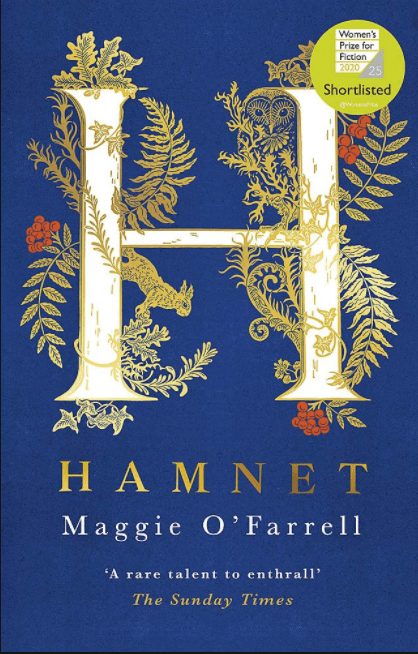
    Shortlisted for the 2020 Women’s Prize for Fiction, Hamnet by Maggie O’Farrell is about an eleven-year-old boy that loves his sister. It’s about the boy’s mother, who can tell who people are and what they will become, just by holding their hand. It’s about the boy’s father, William Shakespeare, who has gone to London when he should be at home. 

    It’s also about a flea, a sickness and a worldwide pandemic. 

    Maggie O’Farrell had no way of knowing what was going to happen in the year Hamnet was published and yet disease and paranoia echo across every page. Some books were destroyed by this pandemic, lost through lack of publicity and events, readers with minds more concerned with fact than fiction. Other books were made. Of course, Maggie O’Farrell needs no help getting noticed – her previous work contains bestsellers and prize-winners, well-reviewed and well-liked. And yet, the context of the coronavirus pandemic lifts Hamnet up and drops it centre-stage. It captures the urgency and panic of life right now, in spite of the fact it takes place in 1596, almost five-hundred years ago. 

    ‘I first discovered Shakespeare had a son called Hamnet, who had died at the age of eleven, when I was studying for my Scottish Highers, aged sixteen,’ says O’Farrell in a video filmed from lockdown for Forbidden Planet. ‘Even though I was only a teenager and some way off being a parent myself, the symmetry of these names [Hamnet and Hamlet, Shakespeare’s famous tragedy] struck me. For a man who is so mysterious to us – so little is known about him, his actual life – to call a play and probably his most tragic antihero after his dead son, to me seemed to speak volumes. It seems like an enormous sign somehow. I’m not quite sure what it is, but then there’s so much about Shakespeare that is uncertain.’ 

    The character of William Shakespeare casts a long shadow over the book. He’s never explicitly named by O’Farrell and he flits from page to page, escaping serious scrutiny. This is a stage he’s never on for long. Near the beginning, on a sunny morning in 1596, we get a glimpse of him ‘striding through Bishopgate towards the river, where he aims to buy one of the flat, unleavened griddle cakes that sell on stalls there.’ O’Farrell paints this moving portrait with adoring strokes – ‘People say of him that he has gold stored in bags under the boards of his lodging: he has heard this and smiled.’ But we only get this scene with Shakespeare in London because we need to know he’s the father of the sick little girl sick in Stratford. We need to know he’s two days’ ride away. 

    The drama here is the family tree, branching out and around Shakespeare; how it came to grow, survive and the strangling vines of sickness winding up around the trunk. With Shakespeare himself regulated to a supporting role, it’s his wife, Agnes, who bears the weight of the tragic hero. Her tragic flaw is never explicitly stated but, early, as Hamnet runs from cookhouse to brewhouse to washhouse, trying to find an adult that will magically restore health to his sick sister, O’Farrell draws us to one side. In a separate section of text, almost like an aside in a play, she tells us all lives have ‘an epicentre from which everything flows out, to which everything returns. This moment is the absent mother’s: the boy, the empty house, the deserted yard, the unheard cry… It will lie at her very core, for the rest of her life.’ 

    Most people know Shakespeare’s wife as Anne Hathaway, the recipient of the second-best bed in his will. But, during her research, Maggie O’Farrell discovered that Shakespeare’s wife’s own father referred to her in his will as Agnes. 

    ‘I thought if anyone’s going to know her name, it’s going to be her dad,’ O’Farrell tells Damian Barr in a video recorded at his Literary Salon, just before lockdown. ‘Why are we all calling her Anne Hathaway when we should all be calling her Agnes Shakespeare, which I think is probably her name?’ 

    Agnes is an outsider, an almost Cinderella-like figure, before she meets and marries her husband. O’Farrell is interested in Agnes’ mother, rumoured to be ‘a gypsy or a sorceress or a forest sprite.’  But then, after her mother’s death and father’s re-marriage, Agnes is shunned and scorned, loathed by her new stepmother. There’s a wildness about her, an ability to see people for what they really are and what they will become, that captivates the young Latin tutor hired to educate the young men of the household.

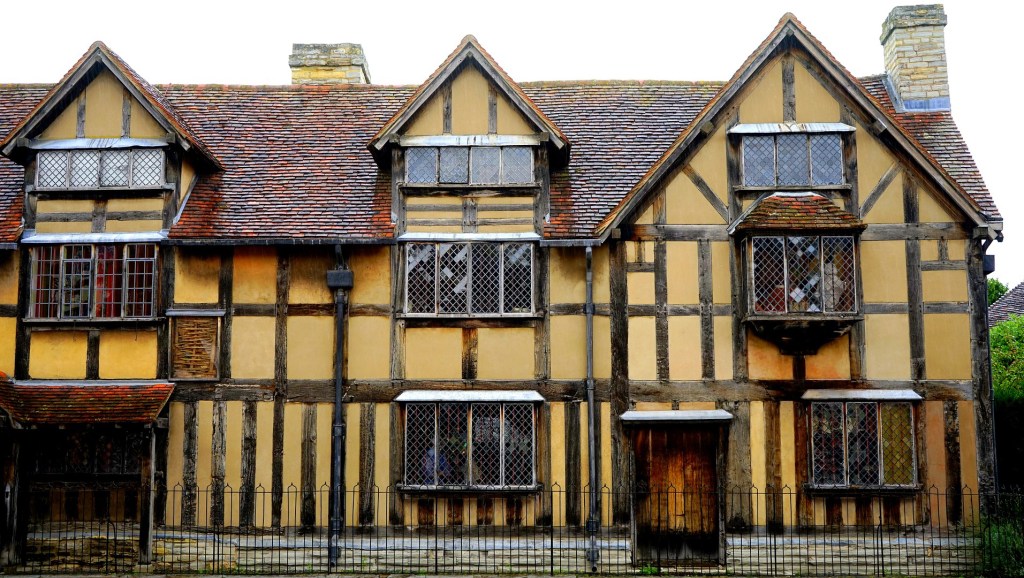
    Shakespeare’s House in Stratford

    This is the way the novel works. There’s no rolling plot here. We know what happens, who lives and who dies, what the tutor becomes. But that’s not the point. The point is the epicentre, ‘from which everything flows, to which everything returns.’ The glimpses of life we get before and after Hamnet’s death, of Agnes’ childhood, of Shakespeare onstage, the lives of Hamnet’s sisters, grandparents, aunts and uncles, are all ties together by the death of the boy, of this echoing tragedy lying at his mother’s ‘very core for the rest of her life’. It’s an effective technique, allows O’Farrell to stitch rich scenes of anguish to absences, flicking forwards and backwards in time to make pairings and draw comparisons. Readers already interested in Shakespeare, familiar with the threadbare patchwork scholars have crafted of his life events, will find O’Farrell’s novel refreshing, an opportunity to re-examine with the looming legend of the central figure pushed to one side. For those that want cold, hard facts – a straightforward biography of Hamnet Shakespeare – O’Farrell’s novel, with its light and shade, its unravelling timeline, may linger a little too long in the shadows and depend too much on the imaginative power of its readers. Those that like a ponder, however, those that think about the living, breathing bodies of geniuses and the bodies around them, will be enthralled by Hamnet, and may need some time to get over its most moving passages.

    But, on the subject of epicentres, it’s impossible to ignore the current running through the novel, the current dictating the direction of our lives right now, whether you know anything about Shakespeare or not. For any reader, there’s a description that falls in the middle of the book that will make you stop, blink, take note. A cabin boy in the Mediterranean goes ashore to find food, pets a monkey, carries three fleas from the monkey back to the ship, sets sail. Three days later, past Damascus and heading for Aleppo, the midshipman is unwell. By the time they reach Aleppo, he’s dead. 

    O’Farrell charts the progression of the disease, from the ports of the Mediterranean to a cart heading to Stratford-upon-Avon. It’s a journey we’ve spent the last six months thinking about, watching on animated slides in press conferences, seen dissected in documentaries. It’s why we wipe down our shopping, can’t see some friends or members of our own family. And as we wipe, adjust masks, we see ourselves as the source, capable to making the one terrible mistake that sets the stage for tragedy.  

    O’Farrell’s been trying to write this book for thirty years. Intimidated by the scale of the story she wanted to tell, by Shakespeare, by the 16th century, she managed to write two novels (Instructions for a Heatwave, This Must Be the Place) and one memoir (I Am, I Am, I Am) instead of writing Hamnet. She wrote 15,000 words and stopped. Went to Stratford. Started again. It’s taken thirty years to write but the timing seems right. It knew what it was, what it would become, what it would mean, and it was waiting.  


    About the Reviewer

    Ellen Lavelle is a post-graduate alumni of The University of Warwick’s Writing Programme. An aspiring novelist and screenwriter, she has worked with The Young Journalist Academy since the age of fourteen, writing articles and making short films for their website. She’s currently working on a novel. She interviews authors for her blog and you can follow her @ellenrlavelle on Twitter.

  • On being bold

    When I was in the sixth grade, one of the girls in our class, Rachel, brought in a copy of Judy Blume’s Forever and passed it around to the rest of us. Forever contains a scene where a girl loses her virginity. That’s pretty much the controversial bit of it. Rachel of course got caught and harshly punished – too harshly in my opinion, because, as far as I was concerned, the book was laughably tame compared to my reading history.

    When I talk with friends or other writers or readers about the books they read in their childhood, what I usually hear are the classics: Roald Dahl, Anne of Green Gables, Beverly Cleary, The Secret Garden, A Wrinkle in Time. While I did read a few Beverly Cleary books, I rarely read any of the other classics.

    My sister is nine years older than me. The two of us have always been avid readers. Her taste in books has shifted, but for a long time, if you asked her what her favourite book was, she’d say A Woman of Substance by Barbara Taylor Bradford. She also read a lot of Maeve Binchy and Danielle Steel. Her bookshelf was never forbidden to me. I could read what I wanted, even at nine years old, so – Danielle Steel it was. I tore through every book on her shelf. Maybe it was because I felt like I was doing something forbidden, like the books were my secret and I had to read as fast as I could before I was caught. But, to give the writers credit, they knew how to hook a reader and keep the story moving. And, without realising it, I can say it’s something that has influenced my own writing, how to keep a reader intrigued, or just interested enough, coaxing her one bit at a time, to keep reading.

    My book, A Place Remote, is not a romance novel. It’s a short story collection. And while the first story in the collection, “Winnie,” could be classified as a love/lust story, women’s sexuality is not the focus of the collection. When I think about why, I realise my interests shifted in college from stories about women’s sexuality to the struggles of women writers themselves. How so many had to write under male pen names to get their stories out. George Eliot, Isak Dinesen, George Sand, E. Annie Proulx, who started writing as E.A. Proulx.

    For a long time, I considered sending out my stories under an androgynous pen name – I even created a fake e mail account, but I just couldn’t pull the trigger. Because I knew. The stories would be accepted, I’d be treated with more respect, and it bothered me. I was going to publish as a woman, however long it took. Here’s an article written by a woman about the differences querying agents as a woman vs a man. Check out another woman’s experience, this time submitting poetry as a man vs a woman (be sure to read the entire thread). Even in poetry, it seems, women’s sex sells.

    Whether we’re writing about women’s sexuality or not, whether our books are secrets, either because of the subject matter or our hidden identities as writers, all of us, every single woman writer who publishes a book must embrace the boldness of the act. Because we have all been told, at some point or other, to stay in our lanes. Or even, to quit writing. To go gentle into that good night.

    Even when we do stay in our lanes, our work is pigeonholed, dismissed, made to be a secret. And the lanes? The lanes are narrow and restrictive. What are men’s lanes? All of them. And women’s? Motherhood, domesticity, women’s sexuality, women’s work. To that I say no. Claim your space, women. Never let our books or our identities be hidden. Show yourselves. Be proud of your work. Be bold with your words.

    About the author of this post

    Gwen Goodkin writes fiction, non-fiction, screenplays, teleplays and stage plays. Her short story collection, “A Place Remote,” will be published by West Virginia University Press in 2020. Her essay collection “Mass for the Shut Ins” was named a finalist for Eyewear Publishing’s Beverly Prize. She has won the Folio Editor’s Prize for Fiction as well as the John Steinbeck Award for Fiction. She has twice been nominated for a Pushcart Prize. Gwen’s novel, “The Plant,” was named a finalist in the Faulkner-Wisdom Novel-in-Progress competition. Her TV pilot script, “The Plant,” based on her own novel-in-progress was named a quarterfinalist for Cinestory’s TV/Digital retreat. She won the Silver Prize (Short Script) for her screenplay “Winnie” in the Beverly Hills Screenplay Contest. She has a B.A. from Ohio Wesleyan University, an MFA in Creative Writing from the University of British Columbia and has also studied at the Universität Heidelberg. Gwen was born and raised in Ohio and now lives in Encinitas, California with her husband and daughters.