
Books are vessels of ideas — thoughts inked onto pages, bound together in fragile, and, frankly, flammable covers.
Now, you might read that sentence and think, wait, why are they talking about books being flammable? That seems like a strange description to leap to when thinking about an art form that includes works that have genuinely advanced human civilisation and understanding of the world. And you’d be right of course: except that for a portion of humanity there seems a select group who look at books as something that ought not to be read or cherished; but to be destroyed.
Historically, their fragility has made books the target of censorship. From the bonfires of the Inquisition to the ash-strewn streets of Berlin in 1933, book burnings have long been symbols of the eradication of dissenting voices. But what if a book could physically resist such destruction? What if it could defy not just metaphorical silencing, but the very flames themselves?
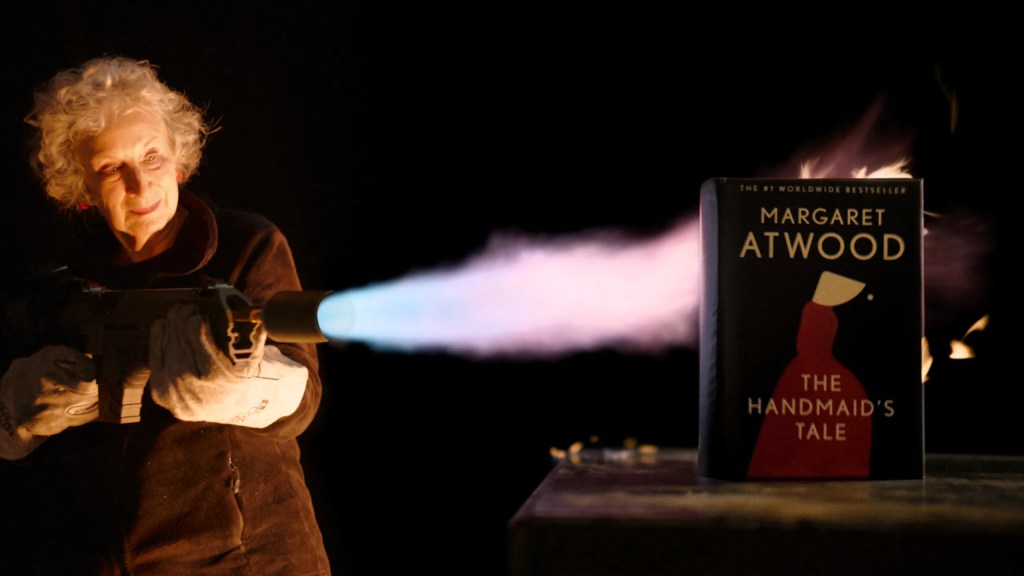
In 2022, Penguin Random House collaborated with author Margaret Atwood to create just such an object: the “unburnable” edition of The Handmaid’s Tale. Not merely a marketing stunt — though undeniably a striking one — this artefact became a defiant symbol of literature’s enduring resistance to suppression.
A flame-resistant manuscript
Crafted with precision and purpose, this unburnable edition was a feat of materials engineering. The pages were made from phenolic sheets, a substance typically used for circuit boards. Its binding featured aluminium foil, while the spine was constructed from stainless steel. Even the ink was specially chosen to withstand extreme temperatures, ensuring that every word would remain intact, regardless of how ferocious the fire.
To demonstrate its indomitable nature, none other than Margaret Atwood herself wielded a flamethrower against her own creation. In a video that quickly went viral, Atwood dons the heavy weapon and gears up like Arnie in Commando. She then aims the fiery weapon at the book, her expression equal parts mischievous and triumphant. As the flames lick at the tome, it emerges unscathed — a phoenix that never needed to burn to rise.
WATCH: Watch acclaimed author Margaret Atwood attempt to burn her own book with a flamethrower below:
Why create the unburnable?
The unburnable book’s creation was no idle exercise in excess. It was produced as a one-off collectible and auctioned by Sotheby’s to raise funds for PEN America, an organization dedicated to defending freedom of expression. The timing was significant: Atwood’s The Handmaid’s Tale had become an emblem of resistance in the face of rising authoritarianism, particularly in the United States, where debates over book bans were (and remain) increasingly polarised.
Atwood herself has often remarked on the eerie prescience of her dystopian novel, set in a society where women’s autonomy is stripped away, and their lives are dictated by a theocratic regime. The unburnable edition acts as both a warning and a testament. It’s a reminder that while ideas can be contested, suppressed, or even outlawed, their persistence often defies destruction.
The symbolism of survival
Books hold a duality: they are both fragile objects and enduring symbols. A single spark can reduce a library to ash, yet the ideas within those books often outlive their physical forms. The unburnable edition of The Handmaid’s Tale flips this dynamic. Here, the physical book itself resists obliteration, becoming a literal embodiment of literature’s tenacity.
This unburnable edition invites a meditation on what we value in books. Is it the tangible object we cherish? The tactile sensation of pages between fingers? Or is it the ideas and stories that transcend their physical medium? In an age where digital books can be deleted with the click of a button and physical copies face bans in schools and libraries, this artefact reminds us of the inherent vulnerability — and resilience — of the written word.
And to continue with this thought – the rising number of book bans (and sometimes burnings) across the USA not only invites those of us who care about these things to rise up against them. But also places ever greater emphasis on the places that guard and protect books. Most notably? Our public libraries. In a world in which State Senator and gubernatorial candidates threaten to “burn woke books”, our librarians find themselves placed as guardians of something that is sacred to many; but terrifying to a select few. If that thought strikes a chord with you – do consider ways of supporting your own local library at a time of ever-greater funding cuts.
A singular artefact, a universal message
While only one unburnable book exists, its message is universal. By enduring the flames, it calls attention to the broader, ongoing threats to free expression. It asks us to reflect on what’s truly at stake when books are burned—not just ink and paper, but the collective memory and imagination of a culture.
In creating a book that cannot burn, Atwood and Penguin Random House have given us a story within a story: one of resistance, innovation, and hope. It’s a tale that reminds us, as all great literature does, that even in the face of destruction, words have a way of surviving—and sometimes, they do so in ways we never imagined.
Enjoyed reading this post? You might also like these articles from our archives:
- Literary oddities: the Voynich manuscript https://nothingintherulebook.com/2016/12/03/literary-oddities-the-voynich-manuscript/
- Planting trees for the library of the future https://nothingintherulebook.com/2016/03/08/planting-trees-for-the-library-of-the-future/
 nothing in the rulebook
Leave a comment