
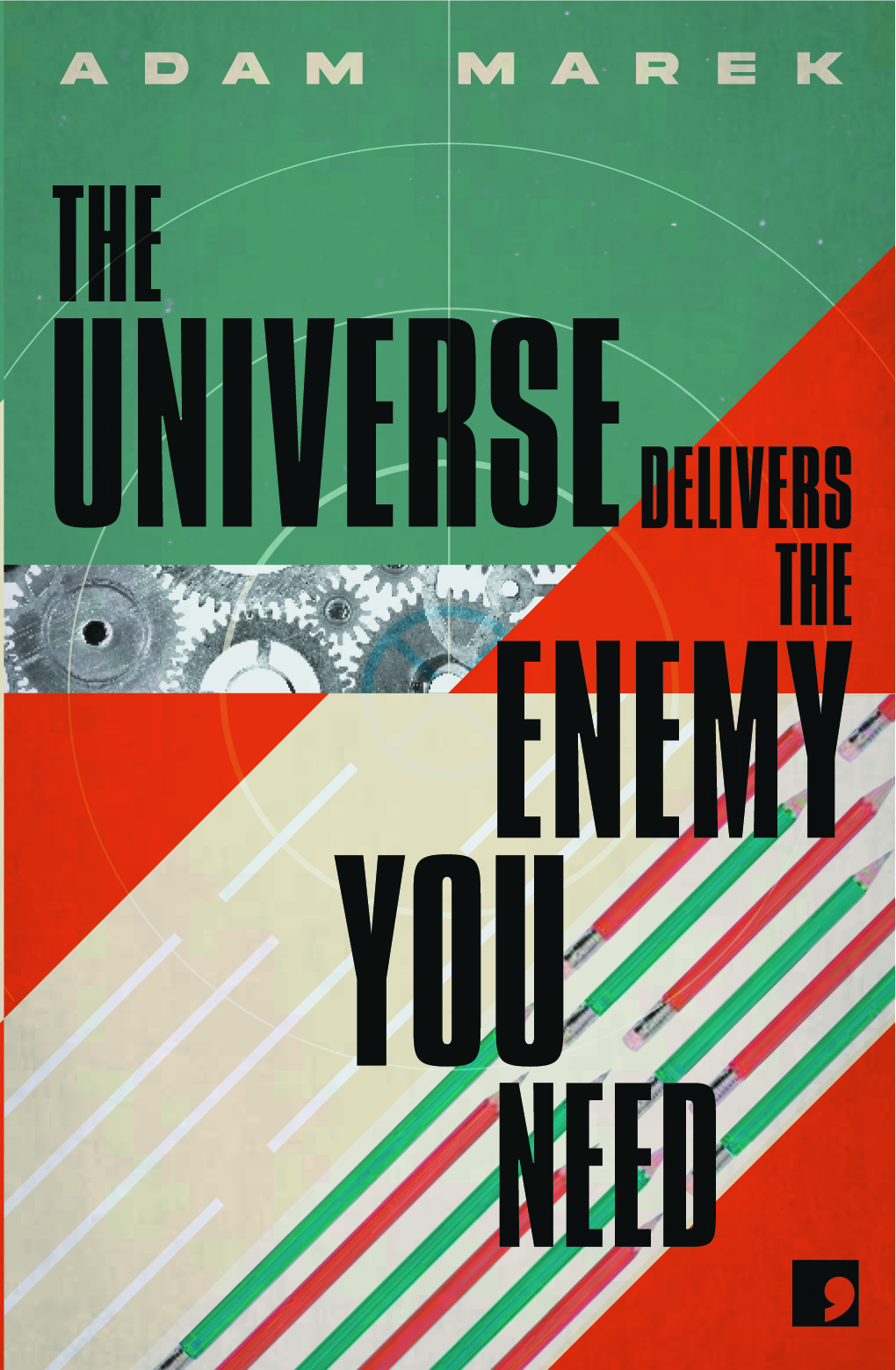
Adam Marek’s fictions have garnered a reputation for their blend of surrealism and domestic familiarity – even prompting the coinage ‘Marekian’. Eleven years have passed since his last collection The Stone Thrower. That gap puts a weight of responsibility on his latest project, The Universe Delivers the Universe You Need, given the high praise his previous books attracted.
Off the bat then, he has not abandoned his readiness to delve into different genres. Here we have several future-tech pieces, a retro-toned sci-fi tale, the surreal, the concept-driven, and a couple of straight-up realistic stories. If this were a first collection a reviewer might say he’s finding his voice. But Marek has long found his voice and his stance: one of endless fascination with how strange people can be. He follows the credo that psychological reality is best conveyed via the fantastical.
Irreal, surreal, new weird, slipstream, or fantastical fiction (Marek’s preferred term) often battles to reach the mainstream and these, being short stories, are doubly niched. Despite this, there are a healthy number of writers (UK and beyond) drawing upon elements of the fantastical: Helen Oyeyemi, Daisy Johnson, George Saunders, Kelly Link, David Mitchell, Zoe Gilbert, Etgar Keret, Sarah Hall. And if I may drop in a quotation from a writer feted for her realism: “The surreal is as integral a part of our lives as the ‘real’” – Joyce Carol Oates. Besides, realism fast loses its right-of-first-refusal on depicting the world when that world is one of people living lives untethered from place or history, communing online with artificially intelligent entities.
At their best, Marek’s stories are a conjuring trick performed right before your eyes. You believe you see every movement but don’t understand how the thing was accomplished.
Shouting at Cars for example, begins with an opening sentence that deposits the reader in a world of wonder: “Every Christmas Eve we took a hamper to the troll beneath the East Bridge.” The dad speaks to the creature in the way one might with an elderly relative who has just cursed at the nursing staff. The family soon bids farewell.
It may be a parable about how we treat the homeless, or a family’s shameful secret. “What made me angry was how everyone else in the house seemed so much more relaxed after the troll died.” But this interpretation stretches and tears when, as an epilogue almost, the young narrator reveals how he used secretly run amok with the troll, shouting at cars, spraying graffiti, rolling manhole covers down the street. ‘Everything I know that’s worth knowing I learned from the troll.’
It’s one of Marek’s ‘fantastical’ mode of stories. Another memorable one is The Bullet Racers. It’s a wonderfully absurd tale of a village festival where each year local boys try to outrun a bullet. The Ghosts We Make is another lucid tale with aberrations of weirdness. Every time the couple have sex, a small ghost will hover around the room for a few days. It’s a playful story where interpretations constantly slip away.
I could attempt an exegesis of his method, but Marek has saved me the bother. In interview he says, “whatever magical/otherworldly thing has bled through into reality, it’s often an external projection of something internal to the protagonist” His approach is distinct both from the surrealists, who believe their art can bypass the conscious censor, and the fantasy writers, who mine the archetypes that have powered myths and legends for millennia.
In the last eighteen months we have all been reading apocalyptic headlines about the impact of Artificial Intelligence. Marek approaches this topic in Poppins (likely written before ChatGPT). It’s interesting but reads as though it could have been written decades ago. Companions is an intriguing and germane exploration of our (no longer futuristic) encounter with AGI entities. There’s an ineffable feeling of dislocation about his conversations with his dead grandma (are they imaginary chats or is she also an artificial entity like the companion?) Marek’s prose is often weirdly luminous:
“She strikes one of the pink-headed matches, which I coveted so much in my youth, and draws on her cigarette with such vigour that her cheeks pull in and the shape of her skull is revealed.”
The second chief characteristic of Marek’s writing is his deft portrayal of family relationships. It’s a Dinosauromorph, Dumdum, like three or four in the collection, features parents, and children aged between six and sixteen. A couple pay a visit to old friends and soon intuit that all is not well. It’s the sensitivity to adult friendship and parenthood which elevate this story.
The best of the more realist stories is the penultimate, Roberto’s Blood Emporium. It has a woozy impressionistic atmosphere spiked with the boy’s summer crush and an angsty sense of crisis. It feels like a betrayal to say my favourite story is the realist one, but it’s definitely up there in my top three.
The book could have been streamlined with a few of the future-tech stories cut. Pale Blue Dots for example is not sufficiently distinct from Poppins which had the merit of having a sly humour. The collection finishes with an ultra-violent comic book escapade – that’s what Marek has done in his previous books (Meaty’s Boys in #1, Without a Shell in #2) so we won’t quibble.
It’s a fascinating collection, often glowing with human warmth, and in several stories flashing with real brilliance.
Pick up a copy of Marek’s ‘The Universe Delivers the Enemy You Need’ from Comma Press.
About the author of this post

Aiden O’Reilly’s short story collection Greetings Hero was published in 2014. He has worked as a translator, a building-site worker, an IT teacher, and a property magazine editor. His fiction, essays, and reviews have appeared in The Dublin Review, The Irish Times, The Stinging Fly, Litro magazine, The Missouri Review, and many other places. Follow him via BlueSky @aidenoreilly.bsky.social and via Facebook.
 nothing in the rulebook
Leave a comment