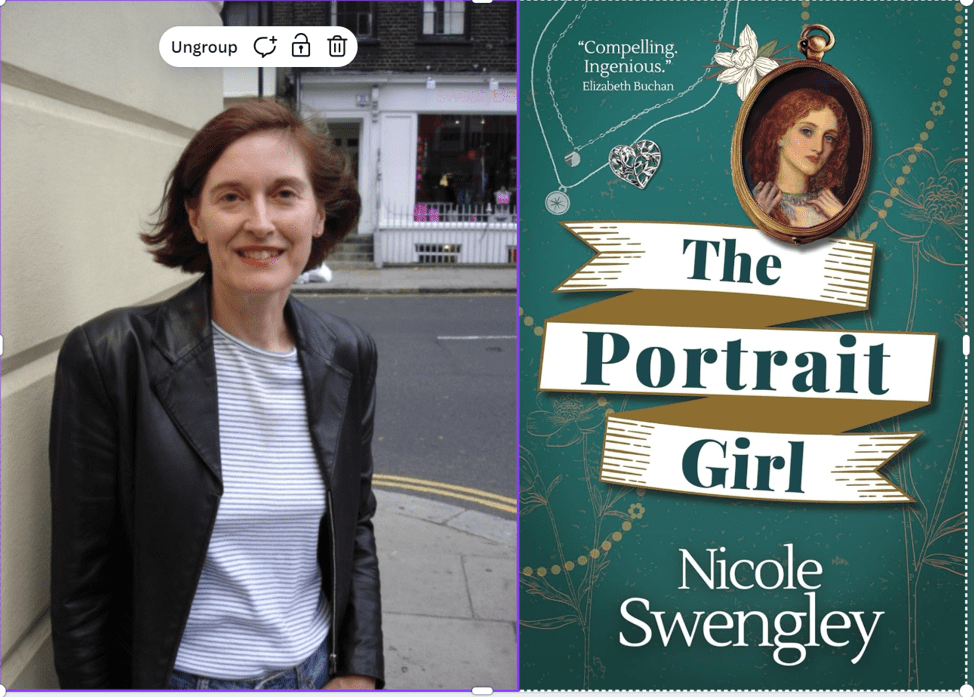
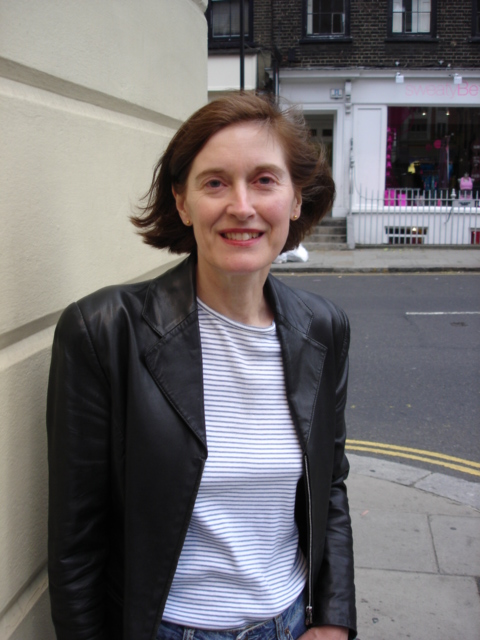
Surrounded by supporters, friends and at least one prominent designer, Nicole Swengley launched The Portrait Girl on the 10th October. This time-slip historical fiction piece was published by Breakthrough Books, an independent, author-led publishing collective based in Cornwall.
The novel follows Freya Weatherby’s journey through the world of the Victorian art world. Vivid descriptions of art and design reveal Swengley’s fascination and deep understanding of the subject whilst also showcasing the illustrative power of her writing.
A few days before the launch, Nothing in the Rulebook asked Nicole some questions. Below she highlights the differences between journalism and novel writing, some of her inspirations in both areas and reveals how she sets herself up for a successful day of writing.
You have been writing as a journalist for 30 years, why did you choose to write a novel, why now?
I’ve been drawn to creative writing since childhood and have given it a stab professionally, over the years, with a number of short stories published in women’s magazines and in a crime anthology. I was even shortlisted in a national magazine/TV short story competition many years ago. But I never really had sufficient time to devote to full-length fiction because I was constantly pitching features ideas to newspapers and magazines to sustain an income from freelance journalism. In 2017, however, I signed up for a Faber Academy fiction-writing course tutored by the author, Rowan Coleman, as I thought it would give me the impetus and techniques to start writing a novel. It was during this course that I began plotting The Portrait Girl and it all led from there.
Much of your journalism has been about home design, what is it about this subject which inspires you? How has it influenced your new book?

The world of design and interior decoration fascinates me. I admire the way designers analyse a practical problem and find ingenious ways to solve it. I’m also drawn to contemporary craftwork and feel we should support artisans in keeping traditional crafts alive. I find the aesthetic aspects of interior decoration very appealing, whether that’s pattern, colour, shape, texture or materials. I had great fun going to town on descriptions of the interiors in my novel, particularly a fictional house in Chelsea where much of the action takes place. Some of these fictional designs are directly inspired by the real-life work of contemporary designers who are mentioned in the Acknowledgments page of the book.
What is your favourite piece of art and who is your favourite artist?
It’s so hard to pick just one! I’m fortunate to have a small, pictorial piece of stained glass by the late Patrick Reyntiens (who worked with John Piper to create the stained glass in Coventry cathedral and Liverpool’s Metropolitan cathedral amongst many other commissions). It shows a figure resting or sleeping, face down, above which a landscape of fields and trees, divided by wavy lead-lines, creates an impression that the sleeper is dreaming of this place. Its deep blues and greens give the glass a jewel-like appearance and I couldn’t resist metaphorically popping it into an art collector’s vitrine in my novel. As for artists, the Pre-Raphaelites and their circle have been a particular favourite since discovering them as a teenager, so I’m delighted that the front cover of The Portrait Girl features an alluring study of a female head, painted in 1864 by Arthur Hughes.
What is your favourite book and who is your favourite author?
It’s almost impossible to single out just one author, but based on the number of books I’ve read by the same writer it would be Daphne du Maurier. Of her books my favourite is Rebecca although I would recommend The King’s General to anyone who enjoys historical adventures.
What have you found to be the biggest differences between writing fiction and journalism?
As a journalist you tend to absorb wads of information then pare it to a minimum. In contrast, writing a novel demands expansion – opening out, building up, layering in a way that feels almost architectural.
What does a day of writing look like for you?
I’ve always been a ‘morning’ person, so I’ll start writing around 8.30am to 9am and carry on until a lunchbreak around 1pm. I’ve been surprised, however, to find writing in the afternoon can work well when I’m deeply engaged in the story although I usually go for a walk at some point and rarely continue later than 6pm.
What inspired you to get into writing?
Reading stories from a young age. I was constantly borrowing books from our local library, and it felt like a natural progression to try and write my own.
Who has been your biggest journalistic inspiration?
I think it’s incredibly sad that the London Evening Standard – essential reading for Londoners since 1827 – no longer prints daily editions (it’s now weekly) as I admire Melanie McDonagh’s common-sense opinion columns, Robert Fox’s defence analysis and Jonathan Prynn’s business reporting. Over on the BBC, Ros Atkins’ ‘explainers’, with their grasp and distillation of hard facts, are a model of their kind.
Who has been your biggest novelistic inspiration?
Far, far too many authors to mention here! I feel that everything you enjoy reading is somehow filtered into the mix of inspiration. Childhood favourites included H. Rider Haggard, Conan Doyle and Robert Louis Stevenson. Teenage years were spent with Mary Stewart and Daphne du Maurier. Later I found Paul Scott, Elizabeth Taylor, Olivia Manning, William Trevor, Rosamond Lehmann, Sarah Waters, John Banville, Elizabeth Buchan, Alan Hollinghurst, Kate Morton, Margaret Atwood, Rupert Thomson…..the list of inspiring novelists just goes on.
What advice would you give to aspiring journalists and authors?
Be persistent. Just keep going until you get there.
Did you have an ideal reader in mind when writing The Portrait Girl? Do they differ from the ideal reader of your fiction?
Reading is such a subjective experience. Everyone brings their own take to it so I never had a specific reader in mind. Basically, I tried to write the kind of novel I would enjoy reading myself – part-adventure, part-mystery with plenty of atmospheric description.
Can we expect more novels from you in the future? Can you tell us anything about them?
I have a work-in-progress – another mystery – so I’d like to say, more in hope than expectation, watch this space.
What upcoming books by other authors are you most excited about?
I can’t wait to read The Sea House by Louise Douglas – she’s so good on compelling family secrets – and Paula Hawkins’ latest thriller, The Blue Hour, sounds tantalisingly chilling. Amelia Kyazze’s story about the kindness of strangers, The Café on Manor Lane, should provide a soothing contrast while Alan Hollinghurst’s first novel for seven years, Our Evenings, and William Boyd’s Gabriel’s Moon will also be on my reading-list.
 nothing in the rulebook
Leave a comment